
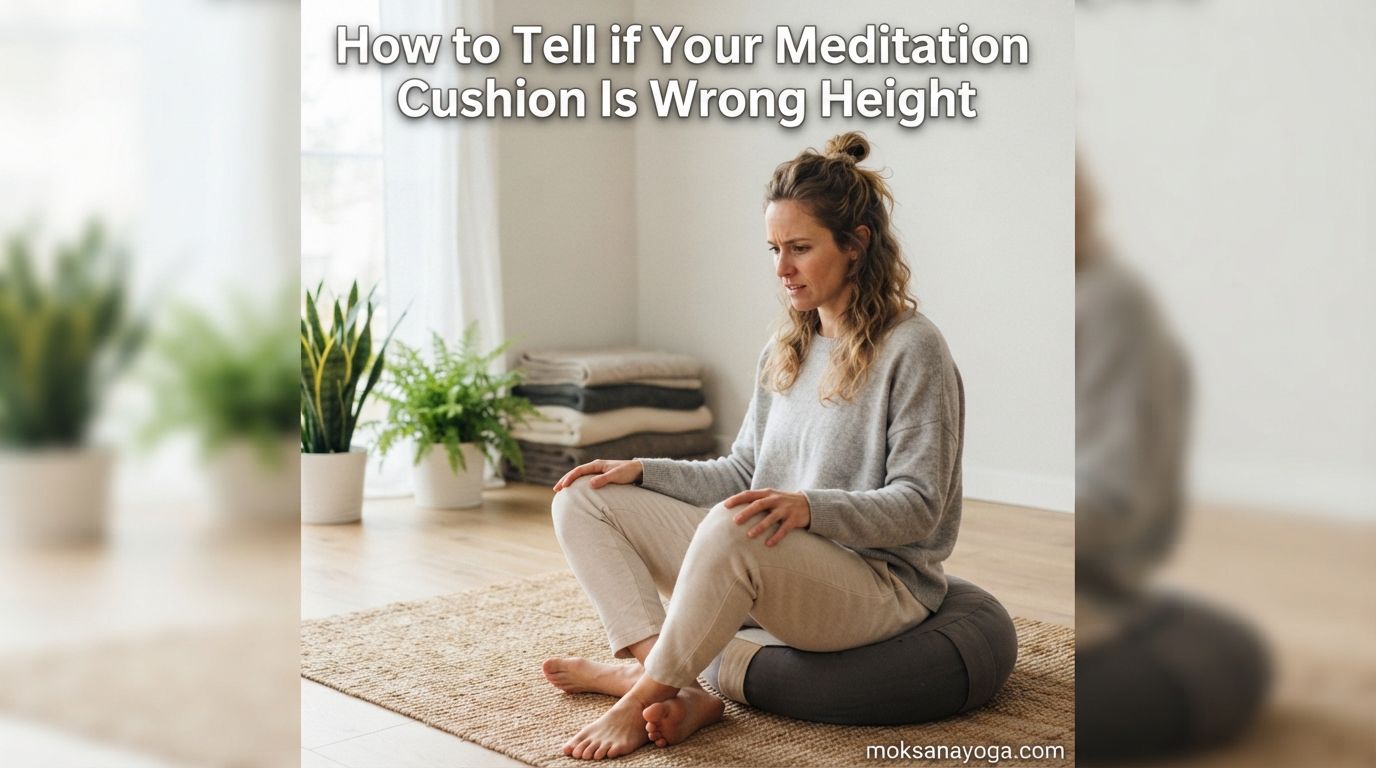
You settled onto your cushion, closed your eyes, and within ten minutes your back ached, your foot went numb, and your breath felt shallow. If that sounds familiar, there is a good chance your meditation cushion height is the problem.
The golden rule is simple: your hips should sit slightly above your knees. When they do, your pelvis tilts forward naturally, your spine stacks into its natural S-curve, and your body stops fighting gravity. When they do not, every minute on the cushion becomes a quiet battle against your own anatomy.
This guide walks through exactly how to tell if your meditation cushion is the wrong height, what the symptoms mean, and how to fix the problem without buying gear you may not need.
Table of Contents
The Golden Rule: Why Hips Above Knees Matters
Correct meditation cushion height comes down to one relationship: the height of your hip joints relative to your knee joints. When your hips rest even one or two inches above your knees, your femurs angle downward. That downward angle lets your pelvis roll forward into an anterior tilt, which is exactly what you want.
An anterior pelvic tilt creates three things at once. It stacks your vertebrae so the deep muscles along your spine do not have to hold you upright. It opens your hip flexors instead of pinching them. And it lets your diaphragm move freely so your breath stays slow and full.
Drop your hips below your knees and the whole system reverses. Your pelvis tucks under into a posterior tilt, your lower back rounds, and your psoas tightens to keep you from folding in half. That tension is what you feel as discomfort five or ten minutes into a sit.
This is why meditation teachers across traditions, from Zen zafu practice to Vipassana retreats, repeat the same instruction. Hips above knees. Get that right and most other posture problems take care of themselves.
How to Tell if Your Meditation Cushion Is the Wrong Height: Too High Signs
A cushion that is too tall is less common than one that is too low, but it happens most often with taller practitioners, people using a zafu designed for a different body type, or anyone who has over-stacked blankets and bolsters. Here are the signals.
You Feel Perched, Not Grounded
When the cushion lifts you too high, very little of your body makes contact with the floor. Your sitz bones balance on top of the cushion instead of settling into it, and you feel like you might tip in any direction at any moment.
Groundedness is not just a spiritual concept here. When your knees and inner thighs do not press into the floor or zabuton, you lose the triangular base that keeps a cross-legged posture stable. Your core has to do the stabilizing work instead, and it fatigues fast.
Your Lower Back Arches
Too much height pushes your pelvis into an extreme anterior tilt. Instead of a natural lumbar curve, you get an exaggerated arch. The deep muscles in your lower back grip to hold the position, and after a few minutes that gripping turns into a dull, constant ache right above your sacrum.
If you notice yourself repeatedly trying to tuck your tailbone or flatten your lower back during a sit, your cushion is likely too tall.
Your Hip Flexors Feel Strained
An extreme anterior tilt stretches the front of your hip capsule taut. You may feel a pulling sensation deep in the front of the hip, where the psoas and iliacus live. That pull is your hip flexors under load, and over a long sit it can leave you sore for days.
You Feel Drowsy or Disconnected
This one surprises people. A cushion that is too high can actually make you sleepy because the over-arched spine compresses the back of your ribcage and restricts full diaphragmatic breathing. Shallow breath lowers oxygen flow and triggers a drowsy meditation state that feels calm but is really just mild oxygen deprivation.
If you consistently nod off on your cushion no matter how much sleep you got, check your height before blaming your effort.
Signs Your Cushion Is Too Low
A cushion that is too short is the more common problem by far. It happens with kapok-filled zafus that have compressed over the years, with cushions designed for shorter bodies, or with beginners whose hip flexibility is still limited. The symptoms are hard to miss once you know them.
Your Spine Rounds and Slumps
This is the headline symptom. When your hips drop below your knees, gravity pulls your pelvis into a posterior tilt and your lumbar spine reverses its natural curve. You collapse backward, your chest drops, and your shoulders roll forward. No amount of willpower or core strength holds you upright for long against that geometry.
Many practitioners interpret the slump as a discipline problem and try to muscle through it. It is not a discipline problem. It is a leverage problem, and the fix is height, not effort.
Lower Back Pain Within Minutes
The rounded spine loads your intervertebral discs unevenly and forces the muscles along your lower back to work overtime. The result is a stiff, aching lower back that often lingers after you stand up. If your back always hurts during or after meditation, posterior pelvic tilt from insufficient height is the most likely culprit.
Your Legs Go Numb
When your hips sit below your knees, the angle of your hip joint compresses the tissues around the sciatic nerve and the femoral artery. Blood flow to your lower legs slows, and within ten or fifteen minutes your feet tingle, go numb, or fall asleep.
Numbness is not a normal rite of passage in meditation. It is a signal that something in your setup is pressing where it should not.
Your Breath Feels Restricted
A collapsed chest compresses your lungs from the front. Each breath becomes shallow because your ribcage literally cannot expand. If your teacher keeps reminding you to breathe deeply and you physically cannot, your posture may be the issue rather than your attention.
You Constantly Shift and Fidget
Restlessness on the cushion often gets labeled as mental agitation. Sometimes it is purely physical. When your body cannot find a sustainable equilibrium, it will keep adjusting, searching for a position that does not hurt. Frequent shifting is your body asking for a different height, not a clearer mind.
The Step-by-Step Height Test
Here is a simple diagnostic you can run in under five minutes the next time you sit. You do not need any special equipment, just a mirror, a wall, and your current cushion.
Step 1: Check the Hip-to-Knee Line
Sit on your cushion in your usual meditation posture in front of a full-length mirror turned to your side. Look at the line from your hip joint to your knee joint. If your hips are clearly below your knees, your cushion is too low. If your hips tower over your knees by more than three or four inches, it may be too high.
Step 2: Do the Wall Slide Test
Sit with your back a few inches from a wall. Slide back until your shoulder blades touch the wall but not your head. If your lower back cannot reach the wall without you arching hard or tucking violently, your cushion is the wrong height. The right height lets your spine contact the wall with a natural, comfortable curve.
Step 3: The Five-Minute Compression Check
Sit for exactly five minutes on your cushion, then stand up and assess. If the first minute felt fine but by minute four your back ached and your legs tingled, your cushion is compressing under your weight and dropping below the effective height you need. This is the time-based diagnosis most guides miss.
A cushion can feel perfect for ninety seconds and reveal its true height by minute five. Always test for at least five minutes before you decide.
Step 4: Add or Remove Height
If your hips were below your knees, fold a firm blanket in half and place it under your cushion. Sit again for five minutes. If the symptoms improve, you have confirmed the diagnosis. If your hips were above your knees by too much, remove a handful of fill if you have a buckwheat zafu, or try sitting on the cushion without the blanket you usually stack underneath.
Step 5: Confirm With the Breath Test
Once you find a height where your hips sit clearly above your knees and your spine stacks without effort, take three slow deep breaths. If your breath flows easily into your belly and lower back without strain, you have found your height. If you still have to work for each inhale, keep adjusting.
Body Type Considerations: Height, Flexibility, and Joints
There is no universal correct cushion height because there is no universal body. Your individual height, hip flexibility, knee condition, and sitting posture all change the number.
Taller Bodies Need More Height
If you are over six feet tall, a standard five-inch zafu will almost always leave you too low. Your long femurs create a steep angle that needs more elevation to clear. Most taller practitioners need seven to nine inches of effective height, often achieved by combining a zafu with a folded blanket or a second cushion.
Shorter Bodies Need Less
If you are under five feet two inches, a tall cushion can lift you too high. Shorter femurs need less elevation to get the hips above the knees. A four-inch cushion or a low crescent zafu often works better than a standard round one.
Tight Hips Need More Height
Beginners and anyone with limited external hip rotation often assume they need a lower cushion because sitting cross-legged is hard. The opposite is true. Limited hip flexibility means your knees ride higher when you sit, so you need more cushion height just to clear them. As your flexibility improves over months of practice, you may find you can lower the cushion.
Knee Issues Change the Equation
If you have knee pain, knee surgeries, or arthritis, forcing cross-legged sitting at any height can aggravate the joint. A seiza bench or kneeling bench with the cushion between your ankles bypasses the knee entirely. The same hips-above-knees principle applies, but the geometry is different because your thighs are vertical rather than crossed.
Flexibility Changes Over Time
Your correct height is not a fixed number. A cushion that worked perfectly last winter might feel too high after a summer of yoga, or too low after months of desk work tightened your hips. Recheck every few months, especially if your sitting comfort has changed.
Cushion Fill Materials and Compression
The fill inside your cushion affects both the starting height and how that height changes over the course of a single sit and over months of use. This is where many height diagnoses go wrong. People blame the cushion shape when the fill is the real variable.
Buckwheat Hulls
Buckwheat hulls conform to your body and hold their shape under load. They compress less than kapok during a sit, which means the height you measure when you sit down is close to the height you have ten minutes later. Buckwheat also lets you add or remove fill to dial in your exact height.
The downside is weight. A buckwheat zafu can feel heavy to carry, and the hulls break down slowly over years, losing a small amount of volume.
Kapok
Kapok is the traditional cotton-like fiber used in classic zafus. It starts firm and tall, but it compresses significantly under body weight and flattens permanently over months of regular use. A kapok zafu that was the perfect height when new can drop an inch or more after a year of daily sits.
If your cushion felt right six months ago and feels too low now, kapok compression is almost certainly the reason. Fluffing it in the dryer on low heat can restore some volume temporarily, but the long-term fix is either refilling or replacing.
Memory Foam and Polyfill
Memory foam molds to your body but has a slow rebound, which means it sinks gradually over the first few minutes of a sit. This is the classic time-based height drop: perfect at minute one, too low by minute five. Polyfill beads behave similarly but bounce back faster between sits.
The Takeaway
Always test your height after five minutes of sitting, not in the first thirty seconds. The fill needs time to settle into its working compression, and that settled height is the one your body actually lives with for the rest of the session.
DIY Height Adjustments You Can Try Today
Before you buy a new cushion, experiment with what you already have. Most height problems can be diagnosed and partially fixed with household items in a single sitting session.
Add a Folded Blanket Underneath
A firm wool or cotton blanket folded in half or thirds under your zafu adds one to three inches instantly. This is the single most effective DIY adjustment for a cushion that is too low. Use a blanket that does not slip, and avoid anything too plush, which will compress unpredictably.
Stack a Zabuton Under a Zafu
If you sit on a bare floor or thin mat, adding a zabuton, or even a firm futon pad, raises your entire base. This also cushions your ankles and knees, which indirectly improves your ability to relax into the correct posture.
Remove Fill From an Overstuffed Zafu
If your buckwheat zafu is too high, unzip it and scoop out a cup of hulls at a time. Test after each removal. Keep the removed hulls in a bag so you can add them back later if you overshoot.
Try a Crescent Zafu
A crescent-shaped cushion gives you the height of a round zafu but with a cutout at the front that accommodates tight inner thighs. For many practitioners, the crescent shape solves a height problem without changing the actual inches.
Switch to a Seiza Bench
If cross-legged sitting at any height causes knee or hip pain, a seiza bench changes the posture entirely. You kneel with the bench over your calves and your weight supported by the bench. The bench angle tilts your pelvis forward into the same anterior tilt you want from a zafu, without requiring hip flexibility.
Use a Wedge
A firm yoga wedge or meditation wedge placed on your cushion tilts the sitting surface forward by a few degrees. This can convert a marginally too-low cushion into one that creates enough anterior tilt to stack your spine.
FAQs
What height should my meditation cushion be?
For most people between five and six feet tall, a cushion height of five to seven inches works well. Your hips should sit slightly above your knees when you settle in. Taller practitioners or those with tight hips often need seven to nine inches, while shorter practitioners may only need four to five.
How do I know if my meditation cushion is too high?
If your lower back arches, your hip flexors feel strained, you feel perched and unstable, or you get drowsy during sits, your cushion is likely too high. Your hips should be above your knees but not towering over them by more than three or four inches.
How high should a zafu be?
A standard round zafu is about five inches tall when new. That works for average-height practitioners with moderate hip flexibility. If you are taller, have tight hips, or sit in full lotus, look for a taller zafu or add height with a folded blanket underneath.
Should my knees touch the floor when meditating?
In a cross-legged posture your knees ideally rest on the floor or on a zabuton for stability. If your knees float well above the floor, your cushion may be too high or your hips too tight. Raising the cushion height lets tight hips relax and helps the knees drop.
Can a meditation cushion be too firm?
Yes. A cushion that is too firm can dig into your sitting bones and cut off circulation, while one that is too soft compresses past the height you need. Buckwheat hulls offer a middle ground because they conform without bottoming out.
Why do my legs go numb during meditation?
Numbness usually means your hips are below your knees, which compresses the sciatic nerve and restricts blood flow. Raise your cushion height until your hips sit clearly above your knees and the numbness should improve or disappear.
Final Thoughts on Finding Your Height
Learning how to tell if your meditation cushion is the wrong height comes down to listening to your body and running a few simple tests. Check whether your hips sit above your knees. Notice whether the discomfort shows up in the first minute or only after five. Pay attention to whether your breath flows freely or feels trapped.
The right height removes effort from your posture so your attention can go where it actually belongs. Start with the blanket trick under your current cushion, test for five minutes, and trust what your body tells you. Small adjustments often make the difference between dreading the cushion and settling in deeply.