
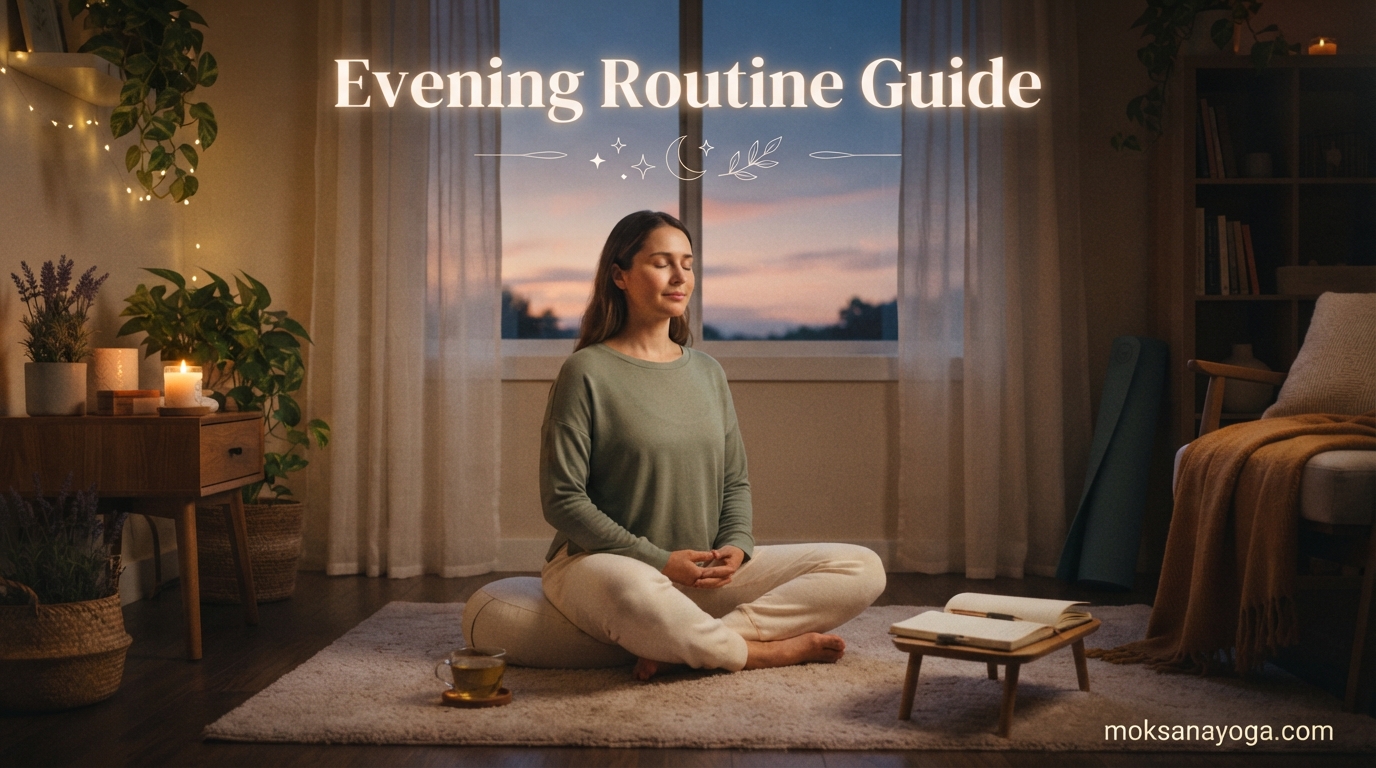
Most evenings end the same way for a lot of us. You finish work, scroll through your phone for an hour, watch something half-heartedly, and then lie awake wondering why your brain will not switch off. If that sounds familiar, learning how to create an evening routine that helps you unwind can change the way you sleep and the way you feel the next morning.
An evening routine gives your nervous system a clear signal that the day is done. Instead of crashing into bed with a racing mind, you transition gently from doing mode into resting mode. The result is deeper sleep, less anxiety, and mornings that do not feel like a fight.
At Moksana Yoga, we have spent years helping people build wind-down practices that actually stick. The key is not a complicated 15-step ritual. It is a small set of consistent cues that tell your body and mind it is safe to let go. In this guide, we will walk you through every step, including yoga poses and breathing techniques that no one else is talking about.
You do not need special equipment, a perfectly quiet house, or an hour of free time. You need a structure that fits your real life. Let us build one together.
Table of Contents
What Is an Evening Routine?
An evening routine is a set of intentional activities you perform in the 30 to 90 minutes before bed that signal to your brain and body that the workday is over and it is time to rest. Think of it as a bridge between the busy outer world and a calm inner state.
Many people confuse an evening routine with a bedtime routine. They are related but different. An evening routine is the broader wind-down period that starts after work ends. A bedtime routine is the final 10 to 15 minutes right before sleep, like brushing your teeth and turning off the lamp. Your evening routine leads naturally into your bedtime routine.
The science behind why evening routines work comes down to your circadian rhythm. This is your body’s internal 24-hour clock that regulates sleep, hormone production, and body temperature. When you repeat the same activities each evening in the same order, you train your brain to recognize these cues as a countdown to sleep. Your nervous system shifts from sympathetic activation, the fight-or-flight mode, into parasympathetic rest mode.
Melatonin, often called the sleep hormone, starts rising about two hours before your natural bedtime. But bright light, screens, and stress all suppress melatonin production. A consistent evening routine protects this natural melatonin rise by reducing stimulation at the right time.
Why an Evening Routine Matters: The Benefits
A well-designed evening routine is not just about feeling cozy. It produces measurable changes in your sleep quality, mental health, and overall wellbeing. Here is what happens when you wind down with intention.
1. Better sleep quality and faster sleep onset. When your brain receives consistent cues that it is time to rest, you fall asleep more quickly and spend more time in deep, restorative sleep stages. Research from sleep scientists consistently shows that predictable pre-sleep routines improve sleep architecture.
2. Lower stress and anxiety. A wind-down routine activates your parasympathetic nervous system, which counters the cortisol and adrenaline that build up during a stressful day. Activities like gentle stretching, journaling, and deep breathing directly reduce physiological stress markers.
3. Better emotional regulation. People who follow consistent evening routines report feeling more emotionally balanced. When you process your day through journaling or reflection instead of bottling everything up, you wake up with less emotional residue.
4. Reduced revenge bedtime procrastination. This is the tendency to stay up late reclaiming personal time after a demanding day. An evening routine gives you that personal time intentionally, so you do not need to steal it from your sleep hours.
5. Calmer mornings. When you prepare for tomorrow tonight, you eliminate decision fatigue in the morning. Picking clothes, prepping lunch, and writing a short to-do list the night before creates a smoother start to your day.
6. A sense of closure. Without an evening routine, the day never really feels finished. Work bleeds into personal time, and personal time bleeds into sleep. A closing ritual marks a clear endpoint so you can mentally release the day.
How to Create an Evening Routine That Helps You Unwind: 8 Steps
Building an evening routine does not require perfection. It requires consistency and a willingness to experiment until you find what works for your body and your schedule. Here are eight steps that form the backbone of a reliable wind-down routine.
Step 1: Choose a Consistent Start Time
Your evening routine begins with a single decision: when does your day end? Pick a time that works at least five nights a week. For most people, this falls between 60 and 90 minutes before their target bedtime.
The time itself matters less than the consistency. When you start your routine at the same time each evening, your circadian rhythm learns to anticipate the wind-down. Your body begins producing melatonin, lowering your core temperature, and slowing your heart rate before you even consciously try to relax.
If your schedule varies, anchor your routine to an event rather than a clock time. For example, start your wind-down 30 minutes after you finish dinner, or immediately after you close your laptop. Event-based anchors work well for shift workers, parents, and anyone with an unpredictable schedule.
Start small. If 90 minutes feels impossible, commit to 20 minutes. A short routine you follow nightly beats a perfect routine you abandon after a week.
Step 2: Dim the Lights and Reduce Stimulation
Light is the most powerful signal your brain uses to set its sleep-wake cycle. Bright light, especially blue light from screens, suppresses melatonin production and tricks your brain into thinking it is still daytime.
About an hour before bed, start dimming the lights in your home. Switch off overhead lights and use lamps, candles, or warm-toned bulbs instead. If you must use screens, turn on night mode or blue-light filters, but the goal is to reduce screen time as much as possible.
The science is clear on this. Blue light at wavelengths between 446 and 477 nanometers hits photoreceptors in your eyes that directly communicate with your brain’s master clock. Even brief exposure can delay melatonin release by up to 90 minutes.
This is also the time to reduce other forms of stimulation. Lower the volume on your music, avoid intense news or social media, and shift from active tasks to passive ones. Your nervous system needs a runway to land, not a sudden stop.
Reddit users in the r/sleep community consistently report that putting their phone on do not disturb and physically moving it away from the bed is the single most effective change they have made. The temptation to scroll disappears when the phone is not within arm’s reach.
Step 3: Do a Mental Unload
If racing thoughts keep you awake, a mental unload is your most powerful tool. This means getting everything out of your head and onto paper so your brain can stop rehearsing it.
Start with a brain dump. Write down everything on your mind without organizing or filtering. Work tasks, personal worries, random reminders, upcoming appointments, anything that is taking up mental space goes on the page. You are not solving these problems. You are simply acknowledging them.
Next, write a short to-do list for tomorrow. Limit it to three to five items. When your brain knows tomorrow’s priorities are captured, it stops trying to remind you at 2 a.m.
Many people in the productivity and self-care communities swear by this practice. Journaling before bed has been shown in studies to reduce sleep onset latency, meaning you fall asleep faster when you write down your thoughts first.
If journaling feels like homework, try a simpler format. Write three sentences: one thing that went well today, one thing you are letting go of, and one thing you are looking forward to tomorrow. This takes under two minutes and still provides the mental release.
Step 4: Add One Grounding Activity
Grounding means bringing your attention back to your body and the present moment. After a day spent in your head, grounding activities help you reconnect with your physical self and signal to your nervous system that you are safe.
Choose one grounding practice that resonates with you. Options include a body scan meditation, progressive muscle relaxation, a warm bath or shower, aromatherapy with calming scents like lavender or chamomile, or simply sitting quietly with a cup of herbal tea.
Progressive muscle relaxation is particularly effective for people who carry tension without realizing it. You systematically tense and release each muscle group, starting from your feet and moving up to your face. This takes about 10 minutes and can be done lying in bed.
A warm bath or shower is one of the most popular unwinding activities across every forum we reviewed. The warmth raises your core body temperature, and when you step out, the rapid cooling mimics the natural temperature drop your body uses as a sleep signal. Aim to finish your bath about 90 minutes before bed for maximum benefit.
The key is to pick one grounding activity, not five. Overloading your routine turns it into a chore, which defeats the purpose. Choose what feels nourishing, not productive.
Step 5: Move Gently With Restorative Yoga Poses
Gentle movement is one of the most underused tools in an evening routine. After sitting at a desk all day, your body holds tension in your hips, shoulders, and neck. Restorative yoga poses release that tension while simultaneously calming your nervous system.
This is where Moksana Yoga brings something unique. No major competitor in the sleep and wellness space covers yoga-specific evening poses. Yet yoga is one of the most effective ways to transition from a stressful day into restful sleep.
Here are five poses that work beautifully in an evening routine. Hold each for two to five minutes, breathing slowly and deeply. You do not need a mat or special clothing.
1. Child’s Pose (Balasana). Kneel on the floor, sit back on your heels, and fold forward, resting your forehead on the floor or a pillow. Let your arms rest alongside your body. This pose gently stretches your lower back and hips while encouraging deep, slow breathing. The forehead-on-floor position activates the vagus nerve, which triggers your relaxation response.
2. Legs-Up-the-Wall (Viparita Karani). Sit sideways next to a wall, then swing your legs up so they rest vertically against it. Lie back and let your arms relax at your sides. This gentle inversion relieves tired legs, reduces swelling, and quiets the nervous system. It is especially helpful if you have been standing or sitting for long periods.
3. Supine Spinal Twist (Supta Matsyendrasana). Lie on your back, draw one knee to your chest, and guide it across your body to the opposite side. Keep both shoulders on the floor and turn your head in the opposite direction. Twists release tension in the spine and stimulate digestion, which supports overnight recovery.
4. Reclined Bound Angle Pose (Supta Baddha Konasana). Lie on your back, bend your knees, and let them fall open with the soles of your feet together. Place pillows under your knees for support. This pose opens the hips, where many people store emotional tension, and encourages a feeling of surrender.
5. Corpse Pose (Savasana). Lie flat on your back with your arms at your sides and palms facing up. Close your eyes and let your body be completely still. This is the ultimate wind-down pose. It teaches your body what total relaxation feels like and prepares you for sleep.
Step 6: Practice Pranayama Breathing for Sleep
Breathwork, or pranayama, is another powerful tool that competitors overlook. Your breath is the fastest, most direct way to influence your nervous system. Slow, deliberate breathing shifts you out of fight-or-flight mode and into rest-and-digest mode within minutes.
Here are three breathing techniques that are perfect for an evening routine. Practice one of these for five to ten minutes, ideally after your yoga poses or while lying in bed.
1. The 4-7-8 Breath. Inhale through your nose for four counts, hold your breath for seven counts, and exhale through your mouth for eight counts. The long exhale is what makes this technique so effective for sleep. Extended exhalations activate the vagus nerve and slow your heart rate. Repeat this cycle four to eight times. Many people report falling asleep before they finish their repetitions.
2. Alternate Nostril Breathing (Nadi Shodhana). Use your right thumb to close your right nostril and inhale through the left. Close the left nostril with your ring finger, release the thumb, and exhale through the right nostril. Inhale through the right, close it, and exhale through the left. That is one round. Continue for five to ten rounds. This balancing breath calms the mind and harmonizes the left and right hemispheres of the brain.
3. Bhramari, or Humming Bee Breath. Inhale deeply through your nose, then exhale slowly while making a gentle humming sound, like a bee. The vibration in your throat and chest stimulates the vagus nerve and creates a soothing internal massage. This technique is especially helpful for people who struggle with overthinking at bedtime.
Pick one technique per evening. You do not need to do all three. The goal is to use your breath as an anchor, something that pulls your attention away from the day’s worries and into your body.
Step 7: Prepare for Tomorrow, Briefly
Spend five minutes preparing for the next day. This step prevents morning chaos and gives your brain permission to stop planning for the night.
Lay out your clothes. Pack your bag. Prep your breakfast or lunch. Glance at your calendar so there are no morning surprises. Write down your top three priorities for tomorrow.
Keep this step short. The goal is to remove morning friction, not to start working on tomorrow’s tasks. If you find yourself pulled into work mode, set a timer for five minutes and stop when it goes off.
People who prepare for tomorrow tonight consistently report sleeping better. Your brain knows everything is handled, so it stops cycling through reminders.
Step 8: Create a Closing Ritual
A closing ritual is the final act that marks the end of your day. It is the psychological equivalent of closing your laptop at the office. Without it, your day never officially ends.
Your closing ritual should be the same every night. It could be turning off the last light, saying a short phrase like “the day is done,” placing a book on your nightstand, or taking three final breaths before lying down.
This sounds simple, but the repetition is what makes it powerful. Over time, your brain associates this specific action with sleep onset. The moment you perform your closing ritual, your body begins its final descent into sleep.
Choose something that takes less than 30 seconds. The simpler, the better. You want this to be effortless, even on your most exhausted nights.
What to Avoid in Your Evening Routine
Knowing what to skip is just as important as knowing what to include. These common evening habits sabotage your sleep without you realizing it.
Avoid caffeine after 2 p.m. Caffeine has a half-life of about five to six hours. If you drink coffee at 4 p.m., a quarter of that caffeine is still in your system at 10 p.m. If you are sensitive to caffeine, cut it off even earlier.
Avoid heavy meals within three hours of bed. Digestion raises your core body temperature and heart rate, both of which interfere with sleep onset. If you are hungry, choose a light snack with protein and complex carbohydrates.
Avoid intense exercise in the evening. Strenuous workouts raise cortisol, adrenaline, and body temperature, all of which keep you alert. Save high-intensity training for mornings or afternoons. Gentle stretching and restorative yoga are fine in the evening.
Avoid doomscrolling. Mindless phone scrolling is the number one evening routine killer. It provides dopamine hits without any real satisfaction, and before you know it, an hour has disappeared. If you cannot put your phone away entirely, use an app blocker that limits social media after a certain time.
Avoid working in bed. Your brain associates locations with activities. If you work in bed, your brain learns that bed is a place for thinking, stress, and productivity. Keep your bed reserved for sleep and intimacy only.
Adapting Your Evening Routine for Real Life
Not every evening goes according to plan. Here is how to adapt your routine for the messy, unpredictable reality of daily life.
For busy nights: Shrink your routine to 10 minutes. Do a quick brain dump, two minutes of 4-7-8 breathing, and your closing ritual. A mini routine done consistently is far more valuable than a perfect routine you only manage twice a week.
For ADHD adults: External structure is your friend. Use visual cues like a printed checklist on your nightstand. Link each routine step to an existing habit, a technique called habit stacking. For example, start your wind-down right after you brush your teeth. Keep the routine short and the steps visible.
For anxiety and overthinking: Prioritize the mental unload and grounding steps. Journaling and body-based practices like yoga and breathwork are more effective than meditation alone for anxiety-driven sleep issues. The humming bee breath is particularly calming for a racing mind.
For remote workers: Create a commute substitute. Since you cannot physically leave the office, you need a transition ritual that signals work is over. Change your clothes, take a short walk, or do a five-minute tidy of your workspace. This creates a psychological boundary between work and home.
For shift workers: Adapt the principles, not the timing. Your routine still needs a consistent start cue, light reduction, a mental unload, and a closing ritual. Use blackout curtains and white noise to simulate nighttime conditions regardless of when you sleep.
Quick Evening Routine vs Full Evening Routine
Sometimes you have 60 minutes. Sometimes you have 10. Here is how to scale your routine to fit the time you have.
10-minute quick routine: Two-minute brain dump, three minutes of legs-up-the-wall pose, three minutes of 4-7-8 breathing, two-minute closing ritual. This covers the essentials and works even on your most exhausting nights.
30-minute standard routine: Five-minute mental unload, 10 minutes of restorative yoga, five minutes of pranayama, five minutes preparing for tomorrow, five-minute warm shower or tea. Perfect for weeknights when you want substance without overcommitting.
60-minute full routine: Add a warm bath, a longer journaling session, a body scan meditation, or a few extra yoga poses. Use this on weekends or evenings when you have more time to enjoy the process.
The trick is to never skip the routine entirely. Even three minutes of breathing and a closing ritual is enough to maintain the habit and protect your sleep.
How to Stick to Your Evening Routine
The biggest challenge is not building a routine. It is sticking with it. Here are the strategies that actually work, based on what real people report in forums and our own experience.
Start with one step. Do not try to implement all eight steps on day one. Pick one, like the mental unload, and do it every night for a week. Then add a second step. Build slowly so the routine feels sustainable.
Lower the bar on hard nights. Your routine does not need to look the same every evening. On exhausted nights, do the 10-minute version. Consistency matters more than completeness.
Track your routine for two weeks. Put a simple checkmark on a calendar for every night you complete your routine, even partially. Seeing the streak builds momentum.
Forgive slip-ups. Missing a night does not mean you failed. Pick up where you left off the next evening. Routines are practices, not performances.
Make it enjoyable. If your routine feels like a chore, you will quit. Choose activities you genuinely look forward to. Light a candle you love. Drink tea from a favorite mug. Play music that calms you. The pleasure is the point.
FAQs
How do I create a relaxing evening routine?
To create a relaxing evening routine, start by choosing a consistent start time 30 to 60 minutes before bed, dim the lights and reduce blue light exposure, do a mental unload through journaling or a brain dump, add one grounding activity like gentle stretching or a warm bath, practice a few minutes of breathing, and finish with a consistent closing ritual. Keep it simple and personal. The best routine is one you will actually stick to.
How long should an evening routine take?
An evening routine can take anywhere from 10 minutes to 90 minutes depending on your schedule. A 10-minute routine covering a brain dump, two yoga poses, and breathing is effective on busy nights. A 30-minute routine is ideal for most weeknights. The key is consistency rather than length. Even a short routine done nightly improves sleep quality over time.
What is the difference between an evening routine and a bedtime routine?
An evening routine is the broader wind-down period that starts after work ends and includes activities like journaling, yoga, and dimming lights. A bedtime routine is the final 10 to 15 minutes right before sleep, focused on hygiene tasks like brushing teeth and turning off the lamp. Your evening routine leads naturally into your bedtime routine.
What is the 10 5 3 2 1 rule for sleep?
The 10-5-3-2-1 rule is a sleep preparation guideline. No caffeine 10 hours before bed, finish eating dinner 5 hours before, stop exercising 3 hours before, log off work devices 2 hours before, and turn off all screens 1 hour before sleep. Following this timeline helps your body naturally prepare for restful sleep.
What is the 123 bedtime rule?
The 123 bedtime rule is a simplified sleep guideline. Stop using screens 1 hour before bed, finish eating 2 hours before, and avoid strenuous exercise 3 hours before sleep. This helps your body temperature, digestion, and nervous system shift into sleep mode naturally.
How do I stick to an evening routine when I am busy?
Shrink your routine to fit the time you have. A 10-minute version with a quick brain dump, two yoga poses, and three minutes of breathing is enough on busy nights. The key is to never skip entirely. Consistency, even at a reduced length, keeps the habit alive and protects your sleep quality.
What should I avoid in an evening routine?
Avoid caffeine after 2 p.m., heavy meals within three hours of bed, intense evening exercise, doomscrolling on your phone, and working in bed. These habits raise cortisol, suppress melatonin, and keep your nervous system in alert mode. Replace them with calming activities like reading, gentle stretching, or herbal tea.
What time should I start my evening routine?
Most people should start their evening routine 30 to 90 minutes before their target bedtime. If you want to sleep at 10:30 p.m., begin your wind-down between 9:00 and 10:00 p.m. If your schedule varies, anchor your routine to an event like finishing dinner rather than a specific clock time.
Final Thoughts: Building Your Evening Routine
Learning how to create an evening routine that helps you unwind is one of the highest-impact changes you can make for your sleep, stress levels, and overall wellbeing. The steps are simple. Choose a consistent start time, dim the lights, do a mental unload, add a grounding activity, move gently with yoga, breathe with intention, prepare for tomorrow, and close the day with a ritual.
You do not need to do everything at once. Start with one step tonight. Maybe that is two minutes of 4-7-8 breathing, or maybe it is a single child’s pose before bed. Build from there, one habit at a time, until your evening routine feels like a natural part of your day rather than another task on your list.
Your evenings are yours. Claim them, protect them, and use them to rest well. Tomorrow will be better for it.