
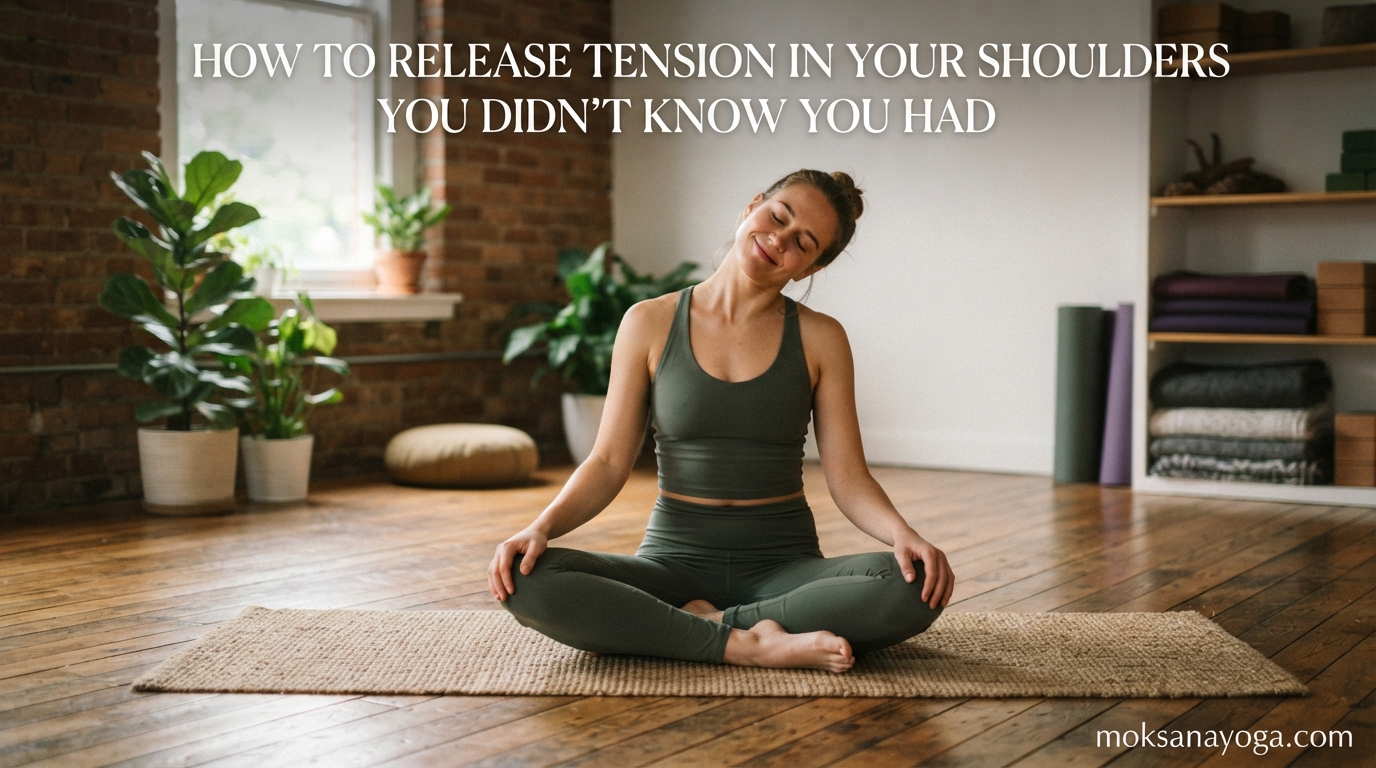
You reach up halfway through the workday and realize your shoulders are hovering somewhere near your ears. You did not put them there on purpose. They crept up on their own, slowly tightening over hours of typing, worrying, and holding yourself together. If this sounds familiar, you are in the right place.
Most advice on how to release tension in your shoulders stops at stretching. You roll your shoulders, maybe do a quick neck tilt, feel better for ten minutes, and then the tightness comes creeping back before lunch. That cycle is exhausting. It is also a sign that something deeper than tight muscles is going on.
At Moksana Yoga, we have watched hundreds of students walk through this same pattern. The tension in your shoulders is rarely just a muscle problem. It is a nervous system pattern, a breathing habit, an emotional holding, and a postural story all woven together. When you learn to address all of those layers, the release lasts longer than a single stretch ever could.
This guide walks through the hidden causes of shoulder tension, the yoga poses and breathing practices that actually create lasting change, and a simple daily routine you can use to keep your shoulders soft and grounded. We will also look at the emotional weight many of us carry in this part of the body, because ignoring that piece is why so many stretching routines fail.
Table of Contents
Why Your Shoulders Hold Tension You Don’t Know About
Hidden shoulder tension is the kind you cannot feel until someone touches it or until you finally let it go. Your body has been holding the contraction so long that your brain stopped registering it as tension and started treating it as normal. This is called sensory adaptation, and it is one of the main reasons people walk around with shoulders near their ears without noticing.
The muscles most often involved are the upper trapezius, which runs from your neck to your shoulder blade, and the levator scapulae, which lifts the shoulder blade itself. These muscles are designed to fire briefly and release. When they stay switched on for hours, they develop what feels like knots, tight bands, and a constant low-grade ache that spreads into the neck and base of the skull.
Several things feed this pattern. Poor posture at a desk collapses the chest and rounds the shoulders forward, forcing the upper back muscles to constantly pull against gravity. Shallow chest breathing keeps the accessory breathing muscles in the neck and shoulders working overtime. Chronic stress triggers the startle reflex, a survival response that draws the body inward and pulls the shoulders up toward the ears as a protective gesture.
Even your sleep position plays a role. Side sleeping with the shoulder pinned under the body, or stomach sleeping with the head cranked to one side, can lock in tension for seven or eight hours a night. By morning the pattern is so deeply set that no amount of stretching can fully undo it before you sit back down at a desk and start again.
The Nervous System Connection: Why Stretching Alone Falls Short
If you have ever stretched your shoulders diligently, felt great, and then noticed the tension return within hours, you have experienced the missing piece most advice ignores. Your shoulders are not just muscles. They are wired directly into your autonomic nervous system as part of your protective startle circuitry.
When your nervous system detects stress, real or perceived, it activates the sympathetic branch. This is the fight-or-flight response. One of its fastest physical signatures is a lift in the shoulders. The body is protecting the neck, the most vulnerable part of the spine. The shoulders rise, the jaw tightens, the breath shortens. All of this happens in milliseconds, before you are even consciously aware of the stressor.
Here is where the problem compounds. In modern life, most stressors do not resolve through physical action. The email that stressed you out did not require you to sprint away or throw a punch. So the stress activation never completes its natural cycle. The shoulders brace for a threat that never arrives, and they never get the signal to stand down.
This is why you can stretch your trapezius for twenty minutes and feel it tighten again within the hour. The muscle is following orders from the nervous system. Until you signal to the nervous system that you are safe, the tension pattern will keep reasserting itself.
The good news is that the same wiring works in reverse. Slow breathing, gentle movement, and certain types of touch can activate the parasympathetic branch, sometimes called the rest-and-digest state. When that switch flips, the shoulders often drop on their own without any forced stretching at all. We will cover specific practices for this below, but the principle is simple. Calm the nervous system first, and the muscles will follow.
The Emotional Dimension: What Your Shoulders Might Be Carrying
Many traditions, from yoga philosophy to somatic therapy, suggest that the shoulders are one of the main places we store emotional weight. This is not just metaphor. People who carry heavy responsibilities, who feel they cannot put their burdens down, who are holding grief or worry for others, very often present with chronic shoulder and upper back tension that does not respond to physical treatment.
If you have ever noticed your shoulders drop dramatically after a deep cry, a long laugh, or a moment of genuine relief, you have felt this connection. The shoulders seem to hold not just physical load but the felt sense of obligation, pressure, and caretaking. Releasing that load can require more than a stretch. Sometimes it requires permission to set things down.
We mention this not to be mystical but because ignoring the emotional layer is why so many people get stuck. You can do every pose in this article perfectly and still feel tight if underneath it all you are carrying something you have not yet allowed yourself to put down. In our experience, the deepest shoulder releases come when the body feels genuinely safe, supported, and unburdened, even briefly.
Seven Yoga Poses to Release Tension in Your Shoulders
These seven poses work with both the muscle layer and the nervous system layer. Move slowly, breathe deeply throughout, and let the release happen rather than forcing it. Hold each pose for the suggested duration and notice what shifts between sides and over the course of the sequence.
1. Child’s Pose With Extended Arms
Come to hands and knees, then bring your big toes to touch and your knees as wide as your mat. Sit your hips back toward your heels. Walk your arms forward on the floor until your forehead rests down. Let your chest melt toward the floor.
This pose gently opens the upper back and creates traction through the shoulder joints. The forward-fold shape also signals safety to the nervous system, which helps the shoulders release at a deeper level. Hold for ten to fifteen slow breaths. If your hips do not reach your heels, place a cushion between them for support.
2. Thread the Needle
From hands and knees, inhale and reach your right arm up toward the ceiling, opening the chest. Exhale and thread your right arm under your left arm, lowering your right shoulder and the side of your head to the floor. Keep your left hand pressing down or walk it forward for a deeper stretch.
This pose targets the back of the shoulder blade and the rotator cuff muscles, areas that are difficult to reach with standard stretches. The gentle twist through the upper spine also releases the thoracic region, which is often stiff in people with chronic shoulder tension. Hold for eight to ten breaths on each side.
3. Cat-Cow With Shoulder Focus
Start on hands and knees with wrists under shoulders and knees under hips. As you inhale, drop your belly, lift your chest forward and up, and draw your shoulder blades together behind your heart. As you exhale, round your spine toward the ceiling, spread your shoulder blades wide, and let your head drop.
This flowing movement lubricates the entire shoulder girdle and encourages the shoulder blades to move through their full range. Move slowly and let the breath lead each transition. Continue for eight to ten rounds, syncing one full breath with each movement.
4. Eagle Arms
Sit or stand tall. Reach both arms forward at shoulder height. Cross your right arm under your left, then bend both elbows. Wrap your forearms around each other until your palms meet, or simply hold onto your shoulders if the full bind is not accessible. Lift your elbows to shoulder height and draw your hands slightly away from your face.
Eagle arms stretch the rhomboids and the back of the rotator cuff while opening the space between the shoulder blades, a spot where many people carry deep, nagging tension. Hold for five to eight breaths, then unwind slowly and switch sides. This pose was repeatedly recommended by yoga practitioners in online forums as one of the most effective moves for stubborn shoulder blade tightness.
5. Puppy Pose
From hands and knees, walk your hands forward one hand length. Keep your hips stacked directly over your knees. Lower your forehead toward the floor, or rest it on a block. Let your chest melt down between your arms.
Puppy pose is essentially a heart-opener that targets the front of the shoulders and the chest. This matters because tight shoulders are almost always paired with a tight, collapsed chest. Opening the front of the body gives the shoulders room to settle back and down. Hold for ten breaths, using a bolster under the chest if the position feels intense.
6. Supported Fish Pose
Place a yoga block or firmly rolled blanket lengthwise along your mat. Lie back so the support runs along your spine from the base of your skull to the bottom of your ribcage. Open your arms out to the sides like a T, palms facing up. Let your shoulders relax completely toward the floor.
This restorative pose passively opens the chest and fronts of the shoulders while letting gravity do the work of releasing the upper back. Because it is fully supported and requires no effort, it strongly activates the parasympathetic nervous system. Stay here for three to five minutes. This is one of the most powerful poses for the kind of deep, lasting release that stretching alone rarely achieves.
7. Standing Forward Fold With Shoulder Clasp
Stand with feet hip-width apart. Clasp your hands behind your back. Inhale and lift your clasped hands away from your body, opening the chest. Exhale and fold forward from your hips, letting your arms drift over your head toward the floor.
This pose combines a chest opener with an inversion, which helps drain tension from the neck and upper back. The weight of the arms creates a gentle traction through the shoulder joints. Hold for eight to ten breaths, bending your knees as much as needed to keep the neck and lower back comfortable.
Breathing Practices That Unlock Shoulder Tension
Breath is the fastest route to your nervous system, and your nervous system controls whether your shoulders stay braced or finally let go. The following three practices can be done on their own or paired with the poses above for deeper release.
Diaphragmatic Breathing
Lie on your back with knees bent and one hand on your belly. Breathe slowly through your nose so that the hand on your belly rises and falls while your chest stays mostly still. Aim for a count of four on the inhale and six on the exhale.
Chest breathing keeps the shoulders working as accessory breathing muscles, which is a major hidden cause of chronic tension. Belly breathing shifts the work back to the diaphragm and gives the shoulder muscles permission to switch off. Practice for five minutes and notice whether your shoulders have dropped by the end.
The Long Exhale
Inhale through your nose for a count of four, then exhale through your mouth for a count of eight. If eight is too long, start with six and build up. The longer exhale activates the vagus nerve, which is the main pathway of the parasympathetic nervous system.
This is one of the most direct ways to tell your body it is safe. Do six to ten rounds, then return to natural breathing and feel your shoulders. Most people notice an immediate softening.
The Sigh and Sound Release
Inhale fully through your nose, then exhale through your mouth with an audible sigh. Let the sound be louder than feels comfortable at first. Repeat three to five times, allowing whatever sound wants to come out.
This practice is rarely mentioned in mainstream content but it is remarkably effective. The shoulders and jaw tend to hold not just muscle tension but pent-up activation from incomplete stress responses. An audible sigh gives that activation somewhere to go. Many people report their shoulders dropping noticeably after just a few rounds.
How to Release Tension in Your Shoulders at Your Desk
If you sit at a computer for hours, no amount of evening yoga will fully offset the tension you build up during the day. You need micro-practices woven into your work hours. Here is a three-step sequence you can do at your desk in under two minutes.
First, sit forward on the edge of your chair with both feet flat on the floor. Roll your shoulders up toward your ears, then back and down, letting them settle into a low, wide position. Repeat this slow shoulder roll five times.
Second, do Eagle Arms right at your desk. Cross one arm under the other, wrap the forearms, and lift the elbows. Hold for five breaths, then switch sides. This directly targets the space between the shoulder blades where desk tension accumulates.
Third, take three long exhale breaths. Inhale through your nose for four counts, exhale through your mouth for six. Let each exhale be a deliberate signal to your shoulders to drop. Set a reminder to do this sequence every hour or two throughout the workday.
The key is consistency, not intensity. Small, frequent resets prevent tension from accumulating to the point where it takes an hour of yoga to undo.
A Five-Minute Daily Shoulder Release Routine
If you want one simple practice to do every morning, this five-minute routine combines the most effective elements from the sections above. It addresses muscle tension, nervous system activation, and breath pattern in a single short sequence.
Minute one: Lie on your back and practice diaphragmatic breathing with a four-count inhale and six-count exhale. Let your shoulders melt toward the floor with each exhale.
Minute two: Come to hands and knees and do five slow rounds of Cat-Cow, letting the shoulder blades move through their full range.
Minute three: Move into Thread the Needle, holding for five breaths on each side.
Minute four: Sit back into Child’s Pose with arms extended forward. Rest your forehead down and breathe deeply for eight to ten breaths.
Minute five: Sit comfortably and take five long-exhale breaths, then three audible sighs. Roll your shoulders slowly three times. Notice how your shoulders feel compared to when you started.
Do this every morning for one week and you will likely notice a shift not just in your shoulders but in how you carry yourself all day. The goal is not perfection. The goal is to remind your nervous system, daily, that it is allowed to set the burden down.
FAQs
How do I stop unconsciously tensing my shoulders?
Set a gentle reminder every 60 to 90 minutes to check in with your shoulders. When the reminder fires, drop your shoulders, take one long exhale, and soften your jaw. Over time this trains your nervous system to release the bracing pattern automatically. Pairing the check-in with diaphragmatic breathing makes it even more effective.
What emotion is held in the shoulders?
In yoga and somatic therapy traditions, the shoulders are associated with responsibility, burden, and the weight of carrying others. Grief, worry, and the pressure of feeling you cannot put things down often manifest as chronic upper back and shoulder tension. Emotional release through breath, movement, or tears can create physical relief that stretching alone cannot.
How to quickly release shoulder tension?
Do three things in under two minutes: roll your shoulders slowly back and down five times, practice Eagle Arms for five breaths on each side, and take three long exhale breaths with an audible sigh. The combination addresses the muscles, the joints, and the nervous system for the fastest relief.
What causes tight shoulders?
The most common causes are poor posture from prolonged sitting, shallow chest breathing, chronic stress that keeps the nervous system in fight-or-flight mode, sleep positions that lock the shoulders in place, and emotional holding patterns. Tight shoulders are rarely caused by one factor alone and usually respond best to a multi-layered approach.
Why are my shoulders always tense and raised?
Shoulders that sit constantly near the ears usually indicate a nervous system stuck in low-level sympathetic activation. Your body is holding a protective startle pattern because it has not received a clear signal that it is safe. Slow breathing, restorative poses like Supported Fish, and addressing underlying stress are more effective than stretching for this pattern.
How to relieve tension in neck and shoulders from anxiety?
Focus on nervous system regulation rather than stretching alone. Practice diaphragmatic breathing with a longer exhale than inhale, try restorative poses like Supported Fish or Child’s Pose, use the sigh release to discharge activation, and consider working with a therapist or somatic practitioner if the anxiety is chronic. Yoga sequences that combine gentle movement with deep breathing are particularly effective.
Bringing It All Together
Learning how to release tension in your shoulders is less about finding the perfect stretch and more about understanding what your body is trying to protect. The tightness in your upper back and neck is not a malfunction. It is your nervous system doing exactly what it was designed to do, keeping you guarded against perceived threats. The invitation is to show your body, gently and repeatedly, that the threat has passed.
The yoga poses in this guide will open the muscles and mobilize the joints. The breathing practices will speak directly to your nervous system. The desk resets and daily routine will keep the pattern from rebuilding throughout your day. And the acknowledgment that your shoulders may be carrying more than physical load opens the door for the kind of release that lasts.
Start with the five-minute morning routine. Add a desk reset or two during the day. Try Supported Fish in the evening if your shoulders feel heavy. Notice what changes over a week, then over a month. The goal is not to never feel tension again. The goal is to build enough body awareness that you notice the tension early and have tools to meet it with breath, movement, and patience.
Your shoulders have been holding on for a long time. With consistent practice and a little kindness toward yourself, they can learn that it is safe to let go.