
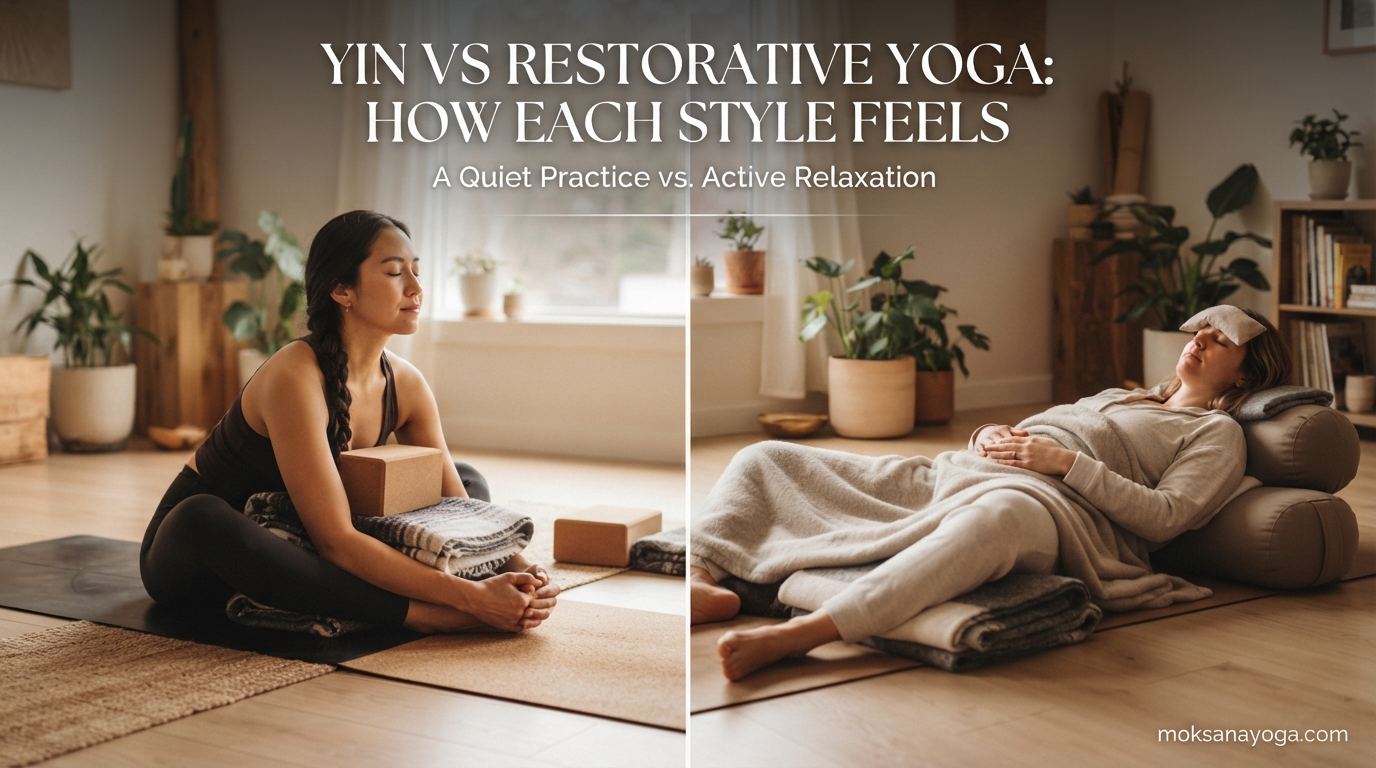
If you have ever walked out of a slow yoga class unsure whether you just did Yin or Restorative, you are not alone. Studios mislabel these styles constantly, and many teachers blend them together in the same sequence without explaining which is which. The confusion is understandable because both practices look identical from the outside. You spend most of the class on the floor, you hold poses for several minutes, and you use props. From a distance, they seem interchangeable.
They are not. Understanding the difference between how Yin and Restorative Yoga feel matters because each practice serves a completely different purpose for your body and your nervous system. One asks you to find an edge and stay with it through building sensation. The other asks you to surrender every ounce of effort and disappear into complete comfort. Knowing which one you are doing, and which one you need, changes everything about what you get from the practice.
The fastest way I have found to explain the Yin vs Restorative Yoga distinction comes down to one simple rule: Yin creates sensation, Restorative removes it. That single sentence captures the heart of how each practice feels in your body. From there, the differences ripple outward into props, hold times, target tissues, philosophy, emotional texture, and the way you feel when you roll up your mat and walk out the door.
In this guide, we break down exactly what each style feels like from the inside, why they are so often confused, and how to choose the right one based on what your body and mind need on any given day. Whether you are stiff and craving mobility or depleted and desperate for rest, there is a slow yoga practice built precisely for you.
Table of Contents
What Is Yin Yoga?
Yin Yoga is a slow, floor-based practice that applies gentle, sustained stress to your connective tissues through poses held for three to five minutes or longer. Instead of stretching muscles, Yin targets the deeper layers of your body: fascia, ligaments, tendons, and joint capsules. The goal is not to relax in the traditional sense. The goal is to create healthy, deliberate stress in tissues that rarely get direct attention in more active styles of yoga or exercise.
Paulie Zink developed the foundations of Yin Yoga in the 1970s from his training in Taoist arts and martial arts. Paul Grilley and Sarah Powers later popularized the practice by blending Taoist philosophy with traditional Hatha postures and adding elements of mindfulness meditation. The result is a style that asks for both physical patience and mental steadiness in equal measure.
The practice draws heavily on Traditional Chinese Medicine meridian theory. Teachers who follow this approach hold that long, steady pressure along specific lines of tissue stimulates energy flow through the body’s meridians and nadis. Whether you interpret that energetically or purely physically, the result is the same. Tissue that has been tight, dry, or stuck begins to soften, hydrate, and move more freely.
When you practice Yin, your teacher will tell you to find your “edge.” That edge is the place where you feel a moderate, tolerable stretch sensation. Not pain. Not numbness. A clear signal that tissue is being loaded. You then settle into stillness and stay. Muscles stay relaxed so that the stress passes through them and reaches the connective tissue underneath.
This is where the Goldilocks position comes in. Not too deep, not too shallow. If you push too far, your body fights back with muscle tension and the tissue cannot release. If you do not go far enough, nothing happens and you may as well be resting. The practice trains you to occupy that middle ground with patience and honest self-awareness.
How does Yin Yoga feel during a session? Expect a slow-building intensity in the target area. A quad stretch in Sleeping Swan might start as a gentle tug and gradually grow into a deep, aching pull that demands your full attention. A hip opener like Butterfly can feel almost meditative for the first ninety seconds and then transform into something that requires real mental discipline to hold. Some poses feel peaceful. Others feel like honest, hard work disguised as stillness.
After a Yin session, most practitioners describe what is called the rebound. You come out of a long-held pose, lie flat on your back, and feel a wave of release, tingling, warmth, or spaciousness flood through the area you just worked. Some people feel pulsing. Others feel like the tissue is breathing on its own. It is one of the most distinctive sensations in all of yoga and a reliable sign that you were in a true Yin practice rather than a Restorative one.
The long-term effects of a consistent Yin practice are equally notable. Over weeks and months, students typically notice increased joint range of motion, less stiffness in the morning, deeper forward folds, and a greater sense of ease in everyday movements. The connective tissue becomes more pliable, better hydrated, and more resilient to injury. None of that happens overnight, but it does happen reliably with regular practice.
What Is Restorative Yoga?
Restorative Yoga is a prop-supported practice designed to remove all effort, all stretch sensation, and all physical stress from the body. Where Yin deliberately loads tissue, Restorative deliberately unloads it. The body is fully supported by bolsters, blankets, blocks, straps, sandbags, and sometimes chairs so that no muscle ever has to hold you in position. Gravity becomes your assistant rather than your opponent.
B.K.S. Iyengar developed the foundations of Restorative Yoga in Pune, India, as a therapeutic practice for students recovering from illness, injury, or exhaustion. He recognized that some students needed the benefits of yoga without the physical demands of active postures. By using props to support the body in positions of comfort, he made the healing aspects of yoga accessible to people who could not do a single pushup or chaturanga.
Judith Hanson Lasater, a physical therapist and senior Iyengar teacher, later formalized the practice in her influential book “Relax and Renew.” Her framework gave teachers around the world a clear system for sequencing supported postures that activate the parasympathetic nervous system, the branch responsible for rest, digestion, and repair. Her work essentially defined what we now recognize as modern Restorative Yoga.
In a Restorative class, you might do only five or six poses in an entire hour. Each pose is an exercise in arrangement first and surrender second. Your teacher will spend real time tucking folded blankets under your knees, positioning a long bolster along the length of your spine, draping a soft blanket over your eyes, and weighting your palms with sandbags so that your body has no reason to brace or hold.
How does Restorative Yoga feel? The honest answer is: like nothing. That is the entire point. If you feel a stretch, you add a prop. If you feel effort, you add a prop. If you feel yourself holding on, your teacher adjusts the props until the holding stops. The practice aims for what Yoga Journal calls the state of ashunya, a Sanskrit-derived term meaning a feeling of emptiness, fullness, and timelessness experienced all at once.
People often describe leaving a Restorative class feeling like they just had a full-body massage or a two-hour nap. The nervous system has shifted fully into rest and digest mode. Heart rate drops, blood pressure lowers, breath deepens and slows on its own, and the mental chatter that normally fills your head goes quiet. For people who live in a constant state of low-grade alert, this can feel almost disorienting at first. Then it feels like relief.
The long-term effects of a regular Restorative practice are backed by growing research on the parasympathetic nervous system. Studies have shown that supported relaxation postures can lower cortisol levels, improve sleep quality, reduce symptoms of anxiety and depression, and support recovery from chronic stress and burnout. None of this requires sweat, strength, or flexibility. It simply requires willingness to stop.
Yin vs Restorative Yoga: 5 Key Differences Explained
Now that you have a feel for each practice individually, let us place them side by side. These five differences cover the core distinctions that separate a true Yin class from a true Restorative class. If you remember nothing else from this article, remember these five points.
1. The Core Principle: Gentle Stress vs Complete Rest
Yin Yoga applies intentional, mild stress to connective tissue. The body is doing passive work even though the muscles stay relaxed. That stress is what creates long-term changes in joint mobility and fascial health. Without the stress, nothing adapts. The tissue stays exactly as it was.
Restorative Yoga removes stress entirely. The body does zero work. Props bear your weight so that tissue can soften, the nervous system can down-regulate, and healing can happen without interference. The principle is the exact opposite of Yin. No load, no stretch, no effort, no goal other than deep rest.
2. Physical Sensation During Practice
This is the difference your body will notice first and most clearly. In Yin, you should always feel something. A dull ache, a tugging sensation, a building warmth in the target area, a slight tremor as tissue resists and then yields. Your teacher will often say that if you feel nothing, you should come slightly deeper into the pose. Sensation is the compass that tells you the practice is working.
In Restorative, you should feel nothing. Comfortable, supported, almost floating. If a pose creates stretch or strain, you modify with more props until the sensation disappears entirely. One practitioner on Reddit described the distinction perfectly: Yin involves sensation, Restorative prioritizes complete ease. If you are feeling a stretch in Restorative, something is wrong with your setup.
3. Props and Setup Philosophy
Yin uses props sparingly. A block under a hip in Square pose, a blanket rolled under a sensitive knee, maybe a strap to help you reach a foot in Caterpillar. The props assist your alignment and help you find the right depth, but they do not hold you up. You are still working with gravity to load tissue, and that relationship with gravity is part of what makes the practice effective.
Restorative uses props lavishly. A single pose might involve two bolsters, three blankets, two blocks, an eye pillow, and a sandbag placed across the hips or hands. The props are the practice. Without them, the poses would not exist in their intended form. Setup can take five minutes for a single posture, and that careful preparation is part of the therapy. Your teacher is essentially building a custom nest for your body to disappear into.
4. Duration and Pace
Both styles move slowly, but their relationship to time is fundamentally different. Yin holds each pose for three to five minutes, sometimes up to ten minutes for experienced practitioners, with brief rests between sides. The long holds are the mechanism that allows connective tissue to respond. You need that sustained loading for fascia and ligaments to gradually release and reshape.
Restorative holds poses for five to twenty minutes, and that time is not loading tissue but giving the nervous system permission to let go completely. The pace feels luxurious rather than demanding. You are not waiting for a stretch to deepen or for an edge to soften. You are waiting for the mind to stop bracing against stillness so that the body can do what it already knows how to do, which is heal.
5. Intent and Outcome
Yin builds something. Over weeks and months, the practice increases joint range of motion, thickens and hydrates fascia, strengthens ligaments, and trains interoception, your ability to feel what is happening inside your own body. It is mobility work disguised as stillness. The outcomes are physical, measurable, and cumulative.
Restorative restores something. The practice reverses the damage of chronic stress by activating the parasympathetic nervous system, lowering cortisol, improving sleep quality, supporting digestion, and giving the body the conditions it needs to repair itself. It is recovery work disguised as lounging. The outcomes are systemic, deeply felt, and often life-changing for people who have been running on empty for years.
How Each Style Actually Feels: A Sensation Comparison
Definitions only get you so far. If you are trying to decide which class to book this weekend, what you really want to know is how each practice feels in your body and mind, not just on paper. Here is a comparison drawn from experienced practitioners who have spent years inside both styles.
Yin feels like a deep, satisfying ache that slowly opens over the course of several minutes. You settle into Butterfly pose and at first it seems completely manageable. Around the two-minute mark, the sensation sharpens. Your mind starts negotiating with itself. Can I come out yet? Is this supposed to hurt? This is where Yin teaches you something profound about your relationship to discomfort. You stay. The tissue softens. The ache shifts into a warm, releasing sensation that spreads through the hips and lower back. When you finally come out, the area you worked feels alive, open, and strangely euphoric.
Restorative feels like the floor is holding you and the ceiling has dissolved. You lie back over a bolster in Supported Bound Angle pose and within thirty seconds your shoulders drop away from your ears without you telling them to. Your breath slows on its own. Time stretches and bends in strange ways. Ten minutes can feel like an hour, or it can feel like ten seconds, depending on how deeply your system lets go. When the class ends, you may not want to stand up. Your body has found a state it forgot existed.
The mental experience differs just as sharply. Yin demands focused attention. You are tracking sensation, watching your mind react, deciding when to stay and when to back off. It is a meditation on discomfort and impermanence. Many practitioners say Yin feels more mentally demanding than physically demanding, especially in the longer holds.
Restorative invites mental softening. There is nothing to track because there is no sensation to follow. The mind may resist at first, especially if you are used to constant stimulation. But eventually it lets go, and what remains is a quiet, spacious awareness that feels almost dreamlike. Some people fall asleep. Others enter a state between sleep and wakefulness that is deeply restorative on its own.
The emotional texture differs too, and this is something most articles gloss over. Yin is well known among teachers for surfacing emotions. Long holds in deep hip openers like Sleeping Swan or Dragon can trigger unexpected tears, memories, waves of frustration, or sudden bursts of clarity. Teachers often warn new students about this. The connective tissue in the hips and pelvis holds more than physical tension, and sustained pressure can release what has been stored there for years.
Restorative tends to produce a quieter emotional experience. People do sometimes cry in Restorative classes, but the tears usually come from relief rather than release. The body finally feels safe enough to stop holding, and whatever was being held simply dissolves without drama. One practitioner described it as feeling like you have been given permission to stop existing for a little while, and that nothing bad will happen if you do.
Here is a quick way to tell which class you are actually in, even if the studio labeled it wrong. If your teacher is telling you to find your edge and stay with sensation, you are in Yin. If your teacher is adding blankets until every trace of stretch disappears, you are in Restorative. The instructions reveal the practice far more honestly than the class title on the schedule.
When to Choose Yin vs Restorative Yoga
Neither style is universally better. The right choice depends entirely on what your body and mind need on a given day, in a given season, under given circumstances. Here is how I think about it after years of practicing and observing both styles closely.
Choose Yin Yoga when you feel physically stiff, tight, or restricted in your joints. If your hips groan when you sit down on the floor, your lower back aches from hours at a desk, or your shoulders have crept up toward your ears and refuse to come down, Yin gives those tissues the sustained attention they need to open. It is also the right choice when you want to build long-term mobility rather than just feel good for an hour after class.
Choose Restorative Yoga when you feel depleted, anxious, burned out, or running on fumes. If you have been sleeping poorly for weeks, your mind will not stop racing when you lie down, or you are recovering from illness, surgery, grief, or emotional exhaustion, Restorative gives your nervous system the deep rest it has been begging for. It is the practice to reach for when even Yin feels like too much work.
Choose Yin when you want to feel something. Choose Restorative when you want to feel nothing. That simple guideline handles most day-to-day decisions and is more useful than any complex framework.
Here are a few specific scenarios that might help clarify the choice. If you are an athlete wanting to improve recovery and flexibility on rest days, Yin is your friend. If you are a new parent running on three hours of fragmented sleep, Restorative is what your body is crying out for. If you sit at a desk all week and your body feels locked up by Friday, Yin will help you unpack. If you are going through a major life transition and feel emotionally frayed, Restorative will give your nervous system a safe place to land.
You can absolutely combine both practices in a single weekly routine. Many practitioners do two or three Yin sessions for mobility and tissue health, plus one or two Restorative sessions for nervous system recovery. They complement each other beautifully when used this way. One addresses the physical scaffolding of your body. The other addresses the regulatory system that keeps everything running.
If you want to practice both on the same day, start with Yin while your body is warm and your mind is engaged. Finish with twenty minutes of Restorative to integrate the work and down-regulate before you head home. Doing them in reverse tends to leave you too relaxed and too unfocused to find the edge that Yin requires.
One important caution worth repeating. If you have hypermobility, Ehlers-Danlos syndrome, or any condition involving loose or overstretched connective tissue, approach Yin with significant care. The practice loads the very tissues that are already vulnerable in your body, and a qualified teacher with training in this area is essential. Restorative, by contrast, is generally safe and beneficial for almost everyone, including during pregnancy, injury recovery, chronic illness, and advanced age.
FAQs
Is Yin Yoga the same as Restorative Yoga?
No. Yin Yoga applies gentle stress to connective tissue through long-held stretches, while Restorative Yoga uses extensive props to remove all effort and stretch sensation. They feel completely different in the body and serve different purposes.
Which is more relaxing, Yin or Restorative Yoga?
Restorative Yoga is more relaxing by design. It removes all physical sensation and activates the parasympathetic nervous system. Yin Yoga can feel meditative but involves sustained stretch sensation that requires focus and tolerance of mild discomfort.
Can I practice Yin and Restorative Yoga on the same day?
Yes. Start with Yin while your body is warm and finish with twenty minutes of Restorative to integrate and down-regulate. Practicing them in reverse is harder because Restorative leaves you too relaxed to find the edge Yin requires.
What are the disadvantages of Restorative Yoga?
Restorative Yoga does not build strength, flexibility, or joint mobility. If your goal is physical conditioning, you will need a more active practice. Some people also find the extreme stillness mentally challenging, especially if they struggle with anxiety or restlessness.
Yin vs Restorative: which is better for sleep problems?
Restorative Yoga is generally better for sleep. Its emphasis on complete support and parasympathetic activation directly addresses insomnia and overstimulation. Yin can help with sleep indirectly through stress release, but its physical intensity may leave some people too alert before bed.
Who should not do Yin Yoga?
People with hypermobility, Ehlers-Danlos syndrome, or very loose joints should approach Yin with caution because the practice loads connective tissue that is already overstretched. Pregnant students, anyone with acute joint injuries, or people with osteoporosis should consult a qualified teacher before practicing.
Conclusion
The Yin vs Restorative Yoga distinction ultimately comes down to one felt difference that your body will recognize immediately. Yin creates sensation in connective tissue to build long-term mobility and joint health. Restorative removes all sensation to heal an overworked nervous system and give the body permission to repair itself. One is slow, deliberate work. The other is deep, supported rest. Both are valuable, and both have a place in a well-rounded yoga practice.
Try both. Notice how your body responds during and after each one. Over time you will develop an instinct for which style you need on any given day, and that kind of embodied self-awareness is worth more than any single class could ever deliver on its own. The right practice is always the one that meets you exactly where you are.