
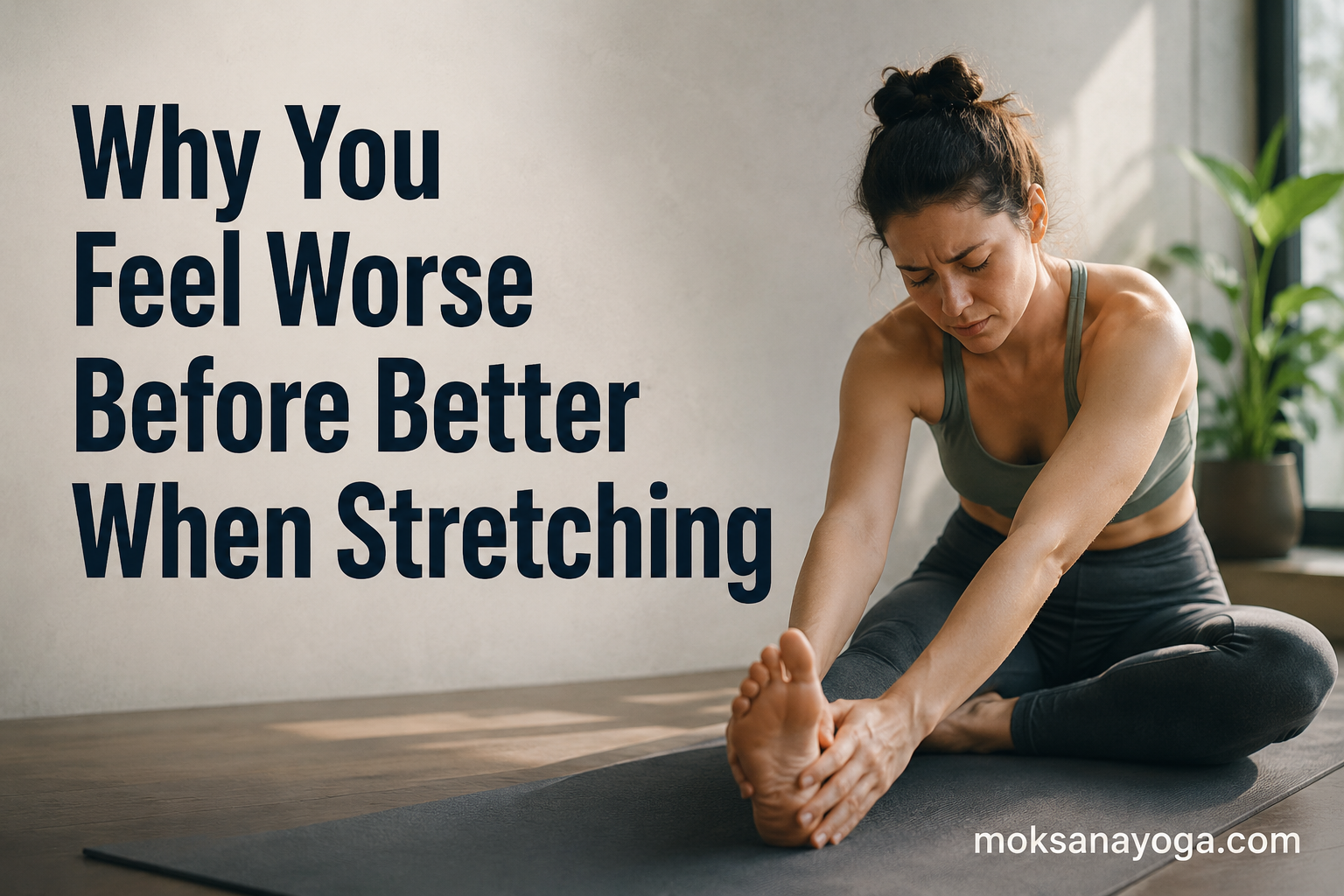
You started stretching to feel better, and now you feel worse. Sound familiar? Maybe your muscles ache, you feel stiff the morning after a session, or you wonder whether you are doing something wrong. This is one of the most common concerns we hear from people beginning a yoga or flexibility routine, and the answer is more reassuring than you might think.
Feeling worse before you feel better when starting to stretch is completely normal. When you stretch beyond your usual range of motion, you create microscopic tears in muscle fibers that trigger a temporary inflammatory healing response. As your body repairs those microtears over the following 24 to 72 hours, your tissues rebuild stronger and more flexible, which is why the discomfort fades and the good feelings eventually take over.
In other words, the soreness is not a sign that something is wrong. It is a sign that your body is doing exactly what it should. Let us look at why this happens, how long it lasts, and how to tell the difference between productive discomfort and a warning you should not ignore.
Table of Contents
Why Do I Feel Worse Before I Feel Better When Starting to Stretch?
The short answer is adaptation. Your muscles, connective tissues, and nervous system are all being asked to do something they have not done before, or have not done in a while. Any time you introduce a new physical demand, your body responds with a stress-and-repair cycle.
When you stretch a muscle beyond its current comfortable range, the muscle fibers and the surrounding connective tissue experience tiny amounts of strain. These are called microtears, and they are exactly what they sound like: microscopic damage to muscle fibers. Before you panic, understand that this is the same process that happens when you lift weights or start a new running program. It is how tissue gets stronger.
Those microtears trigger an inflammatory response. Blood flow to the area increases, bringing oxygen, nutrients, and immune cells that begin the repair process. Inflammation is what causes the soreness, stiffness, and tenderness you feel the day or two after stretching. This is known as delayed onset muscle soreness, or DOMS, and it is the primary reason you feel worse before you feel better.
The key insight is that the discomfort is temporary and productive. Once the repair process completes, your muscle fibers are stronger, your connective tissue is more resilient, and your nervous system is more comfortable allowing a greater range of motion. That is when the “feel good” phase begins.
People on fitness and flexibility forums consistently confirm this. Many experienced practitioners describe the early soreness as “totally normal” and explain that the body is simply tearing and rebuilding muscle fibers. The reassurance is universal across communities: the worse-before-better phase passes, usually within the first one to two weeks.
The Science: What Happens Inside Your Muscles
To really understand why you feel worse before you feel better, it helps to look at what is happening at the tissue level. Stretching is not just about lengthening muscle. It involves a complex interaction between muscle fibers, connective tissue, and sensory organs that monitor tension.
Microtears and the Inflammatory Cascade
When you stretch a muscle to its end range, individual muscle fibers experience mechanical stress. If the stretch is more intense than what the tissue is accustomed to, small tears form in the fiber structure. These microtears are invisible to the eye and cause no immediate harm, but your body treats them as a repair priority.
Within hours, inflammatory markers arrive at the site. Blood vessels dilate, fluid accumulates, and you start to feel tenderness. This is the same process that makes you sore after a hard workout. The inflammation peaks between 24 and 48 hours after the stretching session, which is why DOMS often feels worst on the second day.
Connective Tissue and Fascia Also Adapt
Muscle fibers are only part of the picture. Every muscle is wrapped in connective tissue called fascia, and connected to bones via tendons made largely of collagen. When you stretch, these connective tissues also experience mechanical load. Collagen fibers reorganize and align along the lines of stress, which gradually increases tensile strength and elasticity.
This remodeling process takes longer than muscle repair. It is one reason why flexibility gains feel slow at first and then accelerate after a few weeks of consistent practice. The tissue has to physically restructure, not just recover.
Muscle Spindles and the Stretch Reflex
Inside every muscle are sensory organs called muscle spindles. Their job is to detect how fast and how far a muscle is being stretched. If a muscle stretches too quickly or too far, the spindles trigger a stretch reflex that causes the muscle to contract protectively. This is your body’s built-in safety mechanism against overstretching injuries.
When you first start stretching, the stretch reflex fires aggressively because your nervous system is not yet convinced that deeper ranges of motion are safe. This makes stretching feel harder and more uncomfortable than it will later. Over time, your stretch reflex threshold increases, meaning your nervous system learns to tolerate greater length without panicking. This concept is called stretch tolerance, and it is a major reason stretching gets easier.
Golgi Tendon Organs and Relaxation
At the other end of the muscle-tendon unit sit the Golgi tendon organs. These sensors monitor tension in the tendons. When tension gets too high, they trigger an inverse stretch reflex that tells the muscle to relax. This protective relaxation response is what allows you to eventually sink deeper into a stretch after holding it for 20 to 30 seconds.
In the early days of a stretching routine, your Golgi tendon organs are highly sensitive and may fire before you reach a satisfying stretch. As your nervous system adapts, this threshold shifts, and you gain access to deeper ranges without triggering an early shutdown.
Your Nervous System Has to Adapt Too
People often assume that flexibility is purely a physical property of muscle length. In reality, much of what limits your range of motion is your nervous system refusing to allow it. Your brain holds muscles tight for a reason: stability, habit, or protective guarding after past injury.
When you start stretching regularly, you are essentially renegotiating with your nervous system. You are teaching it that moving into new ranges is safe. Early on, this negotiation feels uncomfortable because your nervous system is still on high alert. The muscle contracts against the stretch, you feel tension and resistance, and you might even feel a strange or electric sensation as nerves and surrounding tissues are pulled in unfamiliar ways.
That weird feeling is normal. Nerves travel through muscles and connective tissue, and when you stretch tight areas, those nerves get mobilized too. A tingling, pulling, or warming sensation is common and usually harmless. It tends to fade as your tissues adapt and your nervous system stops treating every new range as a threat.
This is also why stretching activates the parasympathetic nervous system, the branch responsible for rest and digestion. Slow, deliberate stretching signals to your brain that you are safe. Over time, this parasympathetic activation becomes stronger, which is why regular stretching eventually feels calming and restorative rather than uncomfortable.
The Timeline: When Does Stretching Start to Feel Good?
One of the biggest content gaps we found across competitors is a clear timeline. Most articles tell you that stretching gets better over time, but few explain when. Based on the physiological processes described above, here is a realistic progression you can expect.
Days 1 to 3: The Soreness Phase
This is when you feel the worst. After your first few stretching sessions, expect DOMS to peak between 24 and 72 hours. Muscles feel tender, stiff, and possibly slightly weak. This is the inflammatory response doing its job. Gentle movement and light activity can help, but do not push into deep stretches during this window.
Week 1: Nervous System Calibration
By the end of the first week, your stretch reflex starts to recalibrate. Stretching still feels challenging, but the sharp resistance begins to soften. You may notice that the same stretch which felt impossible on day one feels merely uncomfortable by day seven. This is your nervous system beginning to trust the new range.
Weeks 2 to 4: Tissue Remodeling
This is the transitional phase where most people start to feel the “good” side of stretching. Collagen in connective tissue is reorganizing, muscle spindles are less reactive, and DOMS becomes minimal. Many people report that stretching starts to feel relieving rather than painful during this window. You may also notice tangible flexibility gains.
Beyond 4 Weeks: The Feel-Good Phase
After a month of consistent stretching, the worst is behind you. Stretching now triggers endorphin release, parasympathetic activation, and increased blood flow without significant soreness afterward. This is the phase where people often describe stretching as addictive, because the body begins to crave the mobility and relaxation it provides.
Keep in mind that progress is rarely linear. If you take a break and return to stretching, you will go through a milder version of this adaptation curve again. The principle of use it or lose it applies to flexibility just as it does to strength.
Good Soreness vs Bad Soreness: How to Tell the Difference
Not all discomfort is created equal. One of the most valuable skills you can develop as you start stretching is learning to read your body’s signals. Forum communities consistently emphasize that knowing the difference between productive discomfort and harmful pain is the single most important thing a beginner can learn.
Signs of Normal Adaptation Soreness
Normal post-stretch soreness feels dull, achy, and symmetrical. It shows up 12 to 48 hours after your session and affects the muscle belly rather than the joint. It fades within a few days and leaves you feeling looser once it passes. You might feel stiff in the morning but better after moving around. This kind of soreness is your body rebuilding, and it is a positive sign.
Warning Signs You Should Not Ignore
Sharp, sudden, or electric pain during a stretch is never normal. Stop immediately if you feel it. Pain located in a joint rather than the muscle is also a red flag, especially around the lower back, knees, shoulders, and neck. Pain that lingers beyond four days, worsens instead of improving, or is accompanied by numbness, tingling that does not resolve, or visible swelling warrants professional evaluation.
A simple rule of thumb that experienced practitioners share: discomfort that fades as you ease into a stretch is fine. Discomfort that intensifies the deeper you go, or that lingers after you release the stretch, is a signal to back off.
The Gray Zone
Sometimes the line between productive and problematic is blurry. If you are unsure, the safest approach is to reduce intensity rather than push through. Scale back to a gentler version of the stretch, hold for less time, or take an extra rest day. You can always build back up, but pushing through genuine pain can set you back weeks.
Different Stretch Types and How They Affect Soreness
The type of stretching you do influences how sore you feel afterward. Understanding the differences helps you choose the right approach, especially in the early weeks.
Static Stretching
Static stretching involves holding a position for 15 to 60 seconds. It is the most common style in yoga and flexibility routines. Static stretching produces the most tissue remodeling and is the type most likely to cause DOMS when you are new to it. It is best done after a warm-up or at the end of a workout, not on cold muscles.
Dynamic Stretching
Dynamic stretching uses controlled movement through a full range of motion, such as leg swings, arm circles, or cat-cow flows. It is gentler on the nervous system and produces less soreness because the muscle is never held at end range for long. Dynamic stretching is ideal for warm-ups and for the first week or two of a new routine.
PNF Stretching
Proprioceptive Neuromuscular Facilitation, or PNF, combines stretching with brief muscle contractions. It is highly effective for increasing range of motion because it leverages the Golgi tendon organ response. However, PNF is also the most intense form of stretching and tends to produce the most soreness. It should be approached gradually, ideally with guidance, and avoided entirely during the first couple of weeks of a new stretching practice.
If you are just starting out, favor dynamic stretching for the first one to two weeks. Add static stretching once your body has adapted, and reserve PNF for when you have built a solid foundation.
Tips to Reduce Soreness When Starting a Stretching Routine
You cannot skip the adaptation phase entirely, but you can make it shorter and milder. These practical strategies help your body adjust without unnecessary suffering.
Always Warm Up First
Cold muscles tear more easily and recover more slowly. Spend five minutes doing light aerobic activity before stretching. Brisk walking, jumping jacks, or a few rounds of sun salutations raise your core temperature, increase blood flow, and make your tissues more pliable. A warm muscle stretches more easily and is less likely to develop significant microtears.
Frequency Beats Intensity
One of the most common mistakes beginners make is going too hard in a single session. Forum users consistently recommend the opposite approach: it is better to stretch gently every day than to stretch painfully once a week. Short, daily sessions of 10 to 15 minutes produce faster adaptation with less soreness than marathon sessions that leave you incapacitated for days.
Progress Slowly
Increase your range, hold time, or number of stretches by no more than 10 percent per week. This gives your connective tissue time to remodel without being overwhelmed. If you feel significant DOMS after a session, you went too hard. Scale back the next time.
Stay Hydrated
Hydration directly affects tissue quality. Fascia and connective tissue rely on adequate fluid to remain supple. Dehydrated tissues are stiffer, more prone to microtears, and slower to recover. Drink water before and after stretching, and maintain consistent daily hydration, especially in the early weeks.
Support Recovery with Nutrition
Your body needs protein to rebuild muscle fibers and adequate calories to fuel the repair process. Magnesium-rich foods like leafy greens, nuts, and seeds may help reduce muscle tension. There is no magic supplement that eliminates soreness, but a balanced diet gives your body the raw materials it needs to adapt efficiently.
Take Rest Days Seriously
Rest is when adaptation happens, not during the stretch itself. If you are sore, light movement is fine, but skip intense stretching sessions until the soreness fades. Plan for at least one or two full rest days per week, especially in the first month.
When Stretching Makes Pain Worse: The Over-Lengthened Muscle Trap
Here is a counterintuitive truth that most stretching articles never mention: sometimes a muscle feels tight because it is already too long, not too short. This insight comes up repeatedly in physical therapy and chronic pain forums, and it explains why stretching can sometimes make discomfort worse instead of better.
When a muscle is overstretched, it loses its ability to generate stable force. Your nervous system senses this instability and responds by increasing tension to protect the joint. The muscle feels tight, but stretching it further only increases the instability and the protective guarding. People describe this as an endless cycle of tightness that never resolves no matter how much they stretch.
If you have been stretching consistently for several weeks and a specific area feels tighter or more painful rather than looser, this could be the issue. The solution is not more stretching. It is strengthening and stabilizing the area so the nervous system no longer feels the need to guard it. Working with a physical therapist or qualified movement professional can help you determine whether your tightness is a flexibility problem or a stability problem.
This distinction matters especially for people with joint hypermobility. If your joints move beyond a normal range, stretching can worsen instability and increase pain. Hypermobility requires a different approach focused on strength and control rather than range of motion.
FAQs
Why do I feel worse after I stretch?
You feel worse after stretching because extending muscles beyond their usual range creates microscopic tears in the muscle fibers, triggering an inflammatory healing response called DOMS. This soreness peaks 24 to 72 hours after stretching and fades as your body repairs the tissue. The discomfort is temporary and signals that your muscles and connective tissue are adapting.
What chemical is released when you stretch?
Stretching triggers the release of several feel-good chemicals, including endorphins, serotonin, and dopamine. It also activates the parasympathetic nervous system, which promotes relaxation. These chemical responses are why stretching eventually feels calming and rewarding, although the effect is more noticeable once your body has adapted to regular stretching.
Why do I get a weird feeling when I stretch?
The unusual sensations you feel when stretching come from your nervous system reacting to new ranges of motion. Muscle spindles detect the stretch and may trigger a protective contraction, while nerves running through tight tissue get mobilized. Tingling, warmth, or a pulling sensation are common and usually harmless as long as they fade after the stretch.
Should I stretch if I am sore from stretching?
If the soreness is mild DOMS, gentle dynamic stretching and light movement can help increase blood flow and speed recovery. Avoid deep or intense static stretches until the soreness subsides, usually within 48 to 72 hours. If the soreness is sharp, joint-centered, or worsening, rest entirely and consult a professional if it persists.
Is it good to be sore after stretching?
Mild soreness after stretching is normal and indicates your tissues are adapting, but excessive soreness means you pushed too hard. A productive level of soreness feels like a dull ache in the muscle belly that fades within a few days. Soreness that lingers beyond four days, affects your joints, or feels sharp is a sign to reduce intensity.
How long does post-stretch soreness last?
Post-stretch soreness typically lasts 24 to 72 hours and peaks around the second day. As your body adapts to regular stretching over two to four weeks, soreness becomes minimal. After a month of consistent practice, most people experience little to no soreness and stretching starts to feel relieving.
Conclusion: The Worst Part Comes First
Understanding why you feel worse before you feel better when starting to stretch transforms the experience from discouraging to empowering. The soreness, stiffness, and resistance you feel in those first days and weeks are not signs of failure. They are the visible evidence of your body rebuilding itself: microtears healing, connective tissue remodeling, and your nervous system learning to trust new ranges of motion.
The adaptation curve is predictable. Expect the worst soreness in the first 72 hours, nervous system calibration in the first week, visible improvement in weeks two through four, and the feel-good phase to settle in after about a month of consistent practice. Stretch gently and often, warm up first, and respect your rest days. Before long, the discomfort fades and stretching becomes something your body actually craves.