
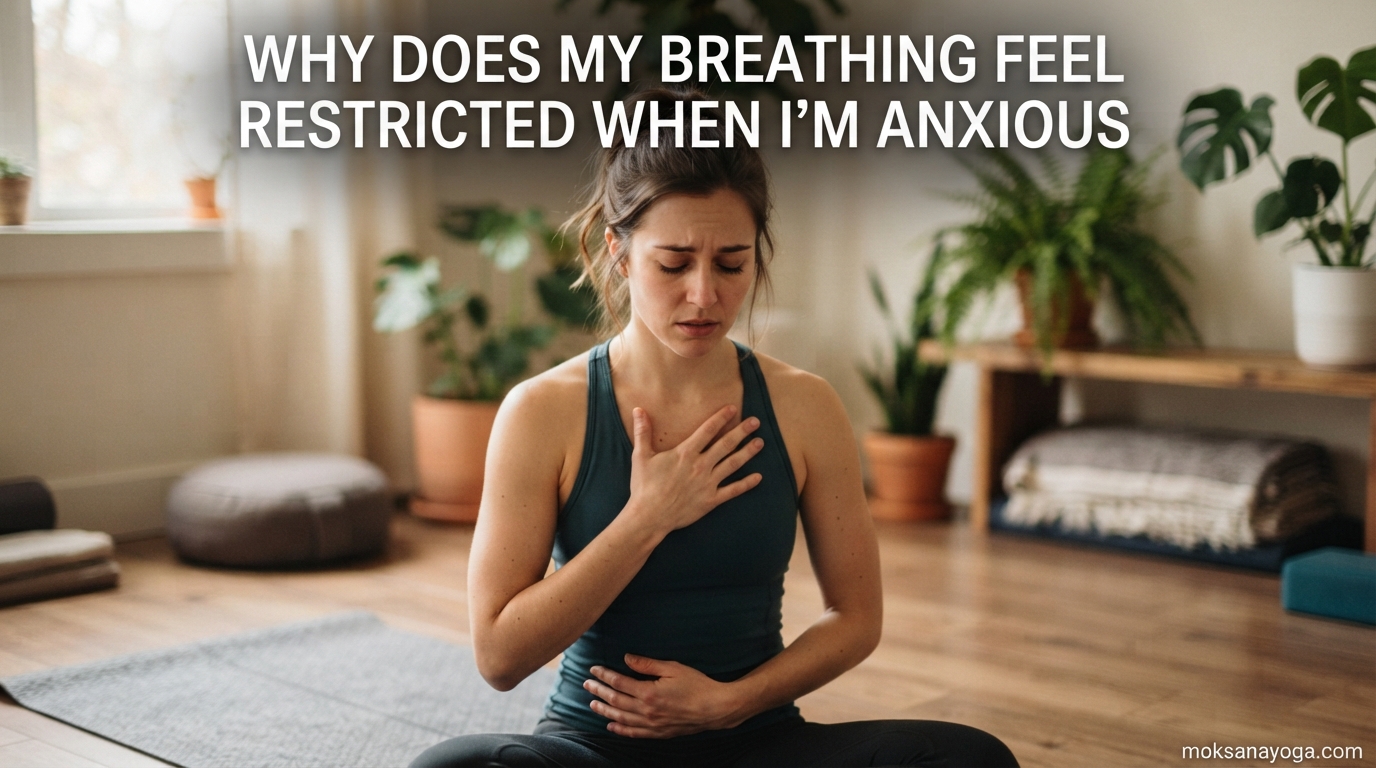
That sudden, terrifying sensation that you cannot fill your lungs fully. Your chest tightens, your throat narrows, and each breath feels shallow and unsatisfying. If you have ever wondered why does my breathing feel restricted when I’m anxious, you are far from alone. Reddit communities, Quora threads, and Mayo Clinic forums are filled with people describing this exact experience. It is one of the most common and distressing physical symptoms of anxiety.
Here is the most important thing to know right away: anxiety-related breathing restriction is not dangerous. Your body is not failing. What you are feeling is a built-in survival mechanism misfiring, and it can be calmed. In this guide, I will walk you through exactly what happens in your body, how to tell anxiety breathing apart from medical conditions, and the specific techniques that help. We will also cover the yoga and pranayama connection, which most anxiety resources completely overlook.
Whether you experience occasional breathlessness during stressful moments or a constant 24/7 awareness of your breathing, understanding the mechanism is your first step toward freedom from it.
Table of Contents
Why Does My Breathing Feel Restricted When I’m Anxious: The Fight-or-Flight Response
Your breathing feels restricted when anxious because your sympathetic nervous system activates the fight-or-flight response, triggering rapid and shallow breathing that creates the sensation of not getting enough air. This is the short answer, but understanding why it happens makes a massive difference in how you respond.
When your brain perceives a threat, whether real or imagined, it sends an immediate signal to your adrenal glands to release adrenaline and cortisol. These stress hormones prepare your body to either fight a threat or run from it. Your heart rate increases, your muscles tense, and your breathing accelerates to deliver more oxygen to your limbs.
The problem is that your brain cannot tell the difference between a charging predator and a stressful email, an anxious thought, or even just a vague feeling of worry. The same survival system fires regardless. And since your modern anxiety rarely requires physical fighting or running, the extra oxygen your body prepared goes unused. This creates a cascade of uncomfortable physical sensations.
For many people I have spoken with through yoga practice, this fight-or-flight activation happens even without a clear trigger. You might be sitting on the couch watching television when suddenly your breathing feels off. That is because chronic anxiety keeps your nervous system on a hair-trigger, ready to fire at the slightest internal sensation.
The Hyperventilation Trap
One of the most confusing aspects of anxiety breathing is hyperventilation. Most people associate hyperventilation with dramatic, visible gasping for air. But anxiety-related hyperventilation is often subtle. You might breathe slightly faster and more shallowly than normal without even noticing it.
Here is what happens biochemically. When you overbreathe, even mildly, you exhale too much carbon dioxide. Counterintuitively, your blood needs a certain level of carbon dioxide to release oxygen into your tissues. When CO2 drops too low, oxygen stays bound to your hemoglobin, and your tissues actually receive less oxygen despite you breathing more.
This creates a vicious cycle. You feel like you are not getting enough air, so you breathe harder. Breathing harder drops your CO2 further, which makes the sensation worse. The harder you try to breathe, the worse it gets. Many people I work with describe this exact trap, and the frustration of trying to take a satisfying deep breath that never feels like enough.
The red urine output, tingling in your fingers, lightheadedness, and chest tightness that often accompany anxiety are all downstream effects of this subtle hyperventilation pattern.
Muscle Tension and Chest Tightness Anxiety
Have you noticed that your chest physically feels tight when anxious, almost like a band is squeezing your ribcage? That is real muscle tension, not your imagination. When the fight-or-flight response activates, the muscles in your chest, shoulders, neck, and abdomen all tighten in preparation for physical action.
This tension directly restricts your breathing mechanics. Your diaphragm, the large dome-shaped muscle beneath your lungs, cannot move as freely when the muscles around it are contracted. Instead of deep, easy belly breathing, you shift to shallow chest breathing. Shallow breathing uses secondary muscles in your neck and shoulders, which were never designed for everyday breathing. These muscles fatigue quickly, adding to the sensation of breathlessness.
This is why chest tightness anxiety feels so physical and so real. It is real. Your intercostal muscles (between your ribs) are tight, your diaphragm is restricted, and your accessory breathing muscles are overworked. The good news is that all of this responds well to the techniques we will cover shortly.
One yoga student of mine described the sensation perfectly. She said it feels like wearing a corset that someone keeps tightening. That compression is muscle tension, and learning to release it is a skill you can build.
Interoceptive Sensitivity: Why You Notice Every Breath
This is where most anxiety resources stop, but there is one more piece that explains the chronic, 24/7 nature of anxiety breathlessness that so many forum users describe. It is called interoceptive sensitivity, and it means your brain has become hyper-aware of internal body sensations.
Normally, breathing is automatic and unconscious. You do not think about it any more than you think about digesting your lunch. But when you have had a frightening experience with breathlessness, your brain starts monitoring your breathing constantly, scanning for danger. The more you focus on your breathing, the more abnormal it feels.
This explains why so many people in anxiety forums report feeling like they need to manually take a deep breath every 40 to 60 seconds. Their brain has essentially put breathing on the conscious radar. Every breath gets evaluated, judged, and often found wanting. The awareness itself creates anxiety, which creates more symptoms, which creates more awareness.
Breaking this loop is not about breathing harder or deeper. In fact, that often makes things worse. It is about teaching your nervous system that your breathing is safe to ignore again.
How to Tell if It’s Anxiety vs a Physical Condition
One of the most searched questions on this topic is how to tell the difference between anxiety shortness of breath and a genuine heart or lung problem. This distinction matters, and I want to give you clear guidance while encouraging you to always check with a doctor if you are unsure.
Anxiety-related breathing issues typically come with a specific set of characteristics. The breathlessness feels like you cannot get a satisfying deep breath, often described as air hunger. It tends to fluctuate, getting worse when you focus on it and improving when you are distracted. It usually comes with other anxiety symptoms like racing thoughts, restlessness, tingling, or a sense of dread. It often improves with exercise or distraction, not worsens.
Cardiac or pulmonary shortness of breath behaves differently. It typically worsens with physical exertion. It may wake you from sleep with genuine gasping. It often comes with chest pain that radiates to your arm or jaw, swelling in your legs, or a history of heart or lung disease. If you experience any of these, seek medical attention immediately.
Here is a helpful insight from anxiety communities. If you can talk yourself into being distracted and the breathlessness eases, it is almost certainly anxiety. Genuine cardiopulmonary issues do not care whether you are distracted.
That said, anxiety can coexist with physical conditions. Getting a medical evaluation to rule out heart and lung problems is always a wise first step. Once you have that reassurance, the work of retraining your nervous system can begin.
How to Fix Your Breathing When Anxious: Proven Techniques
The most effective way to fix breathing when anxious is to slow your exhale, not to force a deeper inhale. This is the single most important principle, and it runs counter to what most people instinctively do. Let me walk you through four techniques that work.
1. Diaphragmatic Breathing (Belly Breathing)
Diaphragmatic breathing is the foundation of every effective anxiety breathing protocol. It re-engages your diaphragm and signals safety to your nervous system.
Place one hand on your chest and the other on your belly. Breathe in slowly through your nose for 4 seconds, feeling your belly hand rise while your chest hand stays relatively still. Hold for 2 seconds. Exhale slowly through pursed lips for 6 seconds, feeling your belly hand fall. Repeat this cycle for 2 to 5 minutes.
The longer exhale is the key. It activates your parasympathetic nervous system, which is your body’s rest-and-digest mode. Most anxious people inhale too much and exhale too little, so extending the exhale rebalances your CO2 levels and calms the fight-or-flight response.
Practice this when you are calm, not just during anxiety spikes. Building the muscle memory makes it far easier to access during a panic episode.
2. Pursed Lip Breathing
Pursed lip breathing is simpler and works wonders for acute episodes when diaphragmatic breathing feels too complex. Inhale through your nose for 2 counts. Pucker your lips as if blowing out a candle, and exhale slowly for 4 counts. That is it.
The resistance of the pursed lips naturally slows your exhale and creates back pressure in your airways, which helps keep them open. This technique is borrowed from pulmonary rehabilitation programs for COPD patients, but it works beautifully for anxiety too. I have seen yoga students go from gasping to calm in under two minutes using this method.
3. Box Breathing (4-4-4-4)
Navy SEALs use box breathing under fire, which tells you how effective it is for acute stress. Inhale for 4 seconds. Hold for 4 seconds. Exhale for 4 seconds. Hold empty for 4 seconds. Repeat the cycle.
The structure gives your busy anxious mind something to focus on besides the breathing sensation itself. Counting the seconds occupies the same mental bandwidth that would otherwise spiral into catastrophic thoughts about not getting enough air.
4. The Coherent Breathing Rate
Research shows that breathing at approximately 5 to 6 breaths per minute (roughly 10 seconds per breath, 5 seconds in and 5 seconds out) maximizes heart rate variability and activates the parasympathetic system. This is called the resonant or coherent breathing rate, and it is remarkably consistent across individuals.
You can use a free breathing app or simply count. Five seconds in, five seconds out, for 10 minutes. Many people I have worked with find this more sustainable than other techniques because it requires no breath holding and feels gentle rather than effortful.
The 3-3-3 Rule for Anxiety: Quick Grounding
You will find the 3-3-3 rule mentioned in many anxiety resources, but few explain it fully. It is a grounding technique, not a breathing technique per se, but it interrupts the anxiety spiral that drives breathlessness.
Here is how it works. When you feel anxious and your breathing tightens, look around and name 3 things you can see. Then name 3 sounds you can hear. Then move 3 parts of your body (wiggle your toes, roll your shoulders, clench and release your fists).
This works because anxiety lives in your internal sensations. By forcing your attention outward to sights, sounds, and physical movement, you interrupt the interoceptive loop where your brain monitors your breathing and panics. It is simple, fast, and requires no special setup, which makes it perfect for public situations.
Many people combine the 3-3-3 rule with pursed lip breathing for a powerful two-step reset. Ground yourself with 3-3-3, then settle your breathing with extended exhales.
Why Deep Breathing Sometimes Makes It Worse
This is a content gap I noticed across every major anxiety resource, and it comes directly from forum discussions. Many people report that trying to take deep breaths actually increases their anxiety and breathlessness. If that has been your experience, you are not doing it wrong.
Here is why. When you forcefully try to take a deep breath, you often inhale more than you exhale, which worsens the CO2 imbalance underlying hyperventilation. The harder you try to fill your lungs, the more air hunger you create. It is like trying to quench your thirst with salt water.
The fix is to stop chasing the satisfying deep breath. Instead, focus exclusively on a slow, gentle, extended exhale. Let the inhale take care of itself. Your body knows how to inhale. It is the exhale that needs your attention.
This shift in approach, from deep inhales to slow exhales, is the single most helpful reframing I share with yoga students who struggle with anxiety breathing.
Long-Term Strategies: Breaking the Anxiety-Breathing Cycle
Quick techniques are valuable, but lasting relief comes from addressing the underlying pattern. Forum users who report overcoming chronic anxiety breathlessness often share one common theme: they stopped fighting the sensation and learned to accept it.
Acceptance does not mean giving up. It means dropping the resistance that fuels the cycle. When breathlessness arrives, instead of panicking and trying to fix it, you acknowledge it. You say to yourself, this is anxiety, it is uncomfortable but not dangerous, and it will pass. Paradoxically, dropping the fight often causes the sensation to fade faster.
Several other long-term strategies consistently help. Daily aerobic exercise burns off excess adrenaline and improves your body’s confidence in its own breathing. Limiting caffeine reduces baseline nervous system arousal. Quality sleep restores nervous system resilience. Working with a therapist trained in cognitive behavioral therapy helps reframe catastrophic thoughts about breathing.
Medication can also play a role. SSRIs and other anxiety medications address the underlying anxiety rather than just the breathing symptom. If your anxiety is chronic and interfering with daily life, a conversation with a psychiatrist or your primary care doctor about medication options is worth having.
The Yoga and Pranayama Connection to Anxiety Breathing
As a yoga-focused resource, we would be remiss not to cover what yogis have known for thousands of years. The Sanskrit word pranayama translates to the expansion and control of life force through breath. Long before modern medicine described the parasympathetic nervous system, yogis developed breathing techniques that deliberately activate it.
Yoga offers several practices specifically suited to anxiety breathing. Nadi Shodhana, or alternate nostril breathing, balances the two hemispheres of your nervous system and is deeply calming. You close your right nostril with your thumb, inhale through the left, close the left with your ring finger, and exhale through the right. Reverse and repeat for 5 to 10 cycles.
Bhramari, or humming bee breath, uses vibration to stimulate the vagus nerve, which is the main highway of your parasympathetic system. Inhale through your nose, then exhale with a soft humming sound. The vibration in your throat and chest is instantly soothing to an activated nervous system.
Nasal breathing deserves special mention. Breathing through your nose produces nitric oxide, a gas that opens blood vessels and airways and has documented anxiety-reducing effects. Mouth breathing, which many anxious people default to, bypasses this system and actually increases stress hormones. Simply training yourself to breathe through your nose during the day can significantly reduce baseline anxiety and improve your breathing efficiency.
A daily 10-minute pranayama practice builds the nervous system resilience needed to prevent anxiety breathing episodes. You are not just managing symptoms. You are retraining the baseline state of your autonomic nervous system.
If you are new to yoga and pranayama, start with just 5 minutes of coherent breathing or alternate nostril breathing each morning. Consistency matters far more than duration. Over weeks, you will notice your breathing feels easier and your anxiety baseline drops.
FAQs
What is the 3-3-3 rule of anxiety?
The 3-3-3 rule is a grounding technique for anxiety. Name 3 things you can see, 3 sounds you can hear, and move 3 parts of your body. This interrupts anxious thought spirals by forcing your attention outward, away from internal sensations like breathlessness.
How to fix your breathing when anxious?
Focus on a slow, extended exhale rather than a deep inhale. Try pursed lip breathing: inhale through your nose for 2 counts, then exhale through pursed lips for 4 counts. Longer exhales activate your parasympathetic nervous system and rebalance carbon dioxide levels, which calms the sensation of breathlessness.
How long does anxiety shortness of breath last?
Anxiety shortness of breath typically lasts minutes to hours during an acute episode. With chronic anxiety, some people experience a low-level awareness of breathing difficulty for weeks or months. The sensation usually eases when you are distracted or engaged in physical activity, and intensifies when you focus on it.
Can anxiety cause constant chest tightness?
Yes, anxiety can cause constant chest tightness. Chronic muscle tension in the chest, shoulders, and diaphragm from ongoing anxiety can create a persistent feeling of pressure or constriction. This is not dangerous, but it should be evaluated by a doctor to rule out cardiac causes, especially if it is new or worsening.
Is shortness of breath from anxiety dangerous?
No, shortness of breath from anxiety is not dangerous, even though it feels terrifying. Your body is receiving enough oxygen. The sensation is caused by subtle hyperventilation and muscle tension, not by a lack of air. However, any new or concerning breathing symptom should be evaluated by a medical professional to rule out other causes.
Do anxiety meds help with breathing?
Yes, anxiety medications can help with breathing symptoms by addressing the underlying anxiety. SSRIs and similar medications reduce baseline anxiety over time, which decreases the frequency and intensity of fight-or-flight activation. Beta-blockers can also help by blocking the physical effects of adrenaline on your heart and breathing.
Conclusion: You Can Break Free From Anxiety Breathing
Understanding why does my breathing feel restricted when I’m anxious gives you power over the experience. Your fight-or-flight response is doing exactly what it evolved to do, just in a context where it is not helpful. The breathlessness, chest tightness, and air hunger are real physical sensations driven by hyperventilation, muscle tension, and hyper-awareness, none of which are dangerous.
The path forward is simple but requires practice. Stop chasing deep breaths and focus on slow exhales. Use the 3-3-3 rule to break acute spirals. Build a daily pranayama or coherent breathing practice to retrain your nervous system baseline. Get a medical evaluation for peace of mind if you have not already. Then practice acceptance, knowing that fighting the sensation only strengthens it.
You do not have to live at the mercy of every breath. With consistent practice and the right techniques, your breathing can return to the background where it belongs. Start with just 5 minutes of extended exhale breathing today, and notice the difference.