
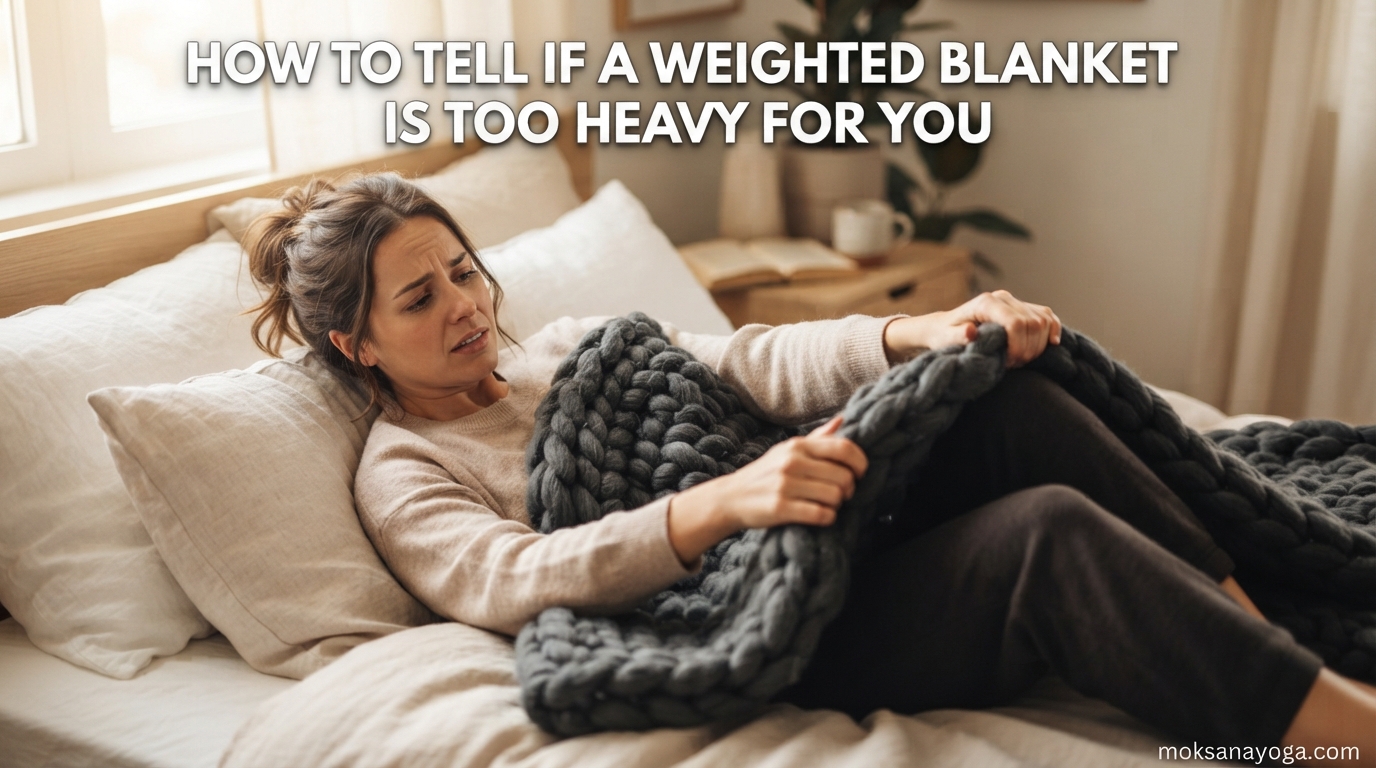
You crawl under your new weighted blanket, excited for that calming hug everyone raves about, but something feels off. Your chest feels tight. You cannot roll over easily. You wonder if you made a mistake picking the 20-pound option instead of the 15-pound one.
Learning how to tell if a weighted blanket is too heavy can save you from sleepless nights, sore muscles, and even safety risks. The general rule is that a weighted blanket should equal roughly 10 percent of your body weight, but personal comfort plays a huge role too.
In this guide, we break down the clear warning signs that your blanket is too heavy, explain the science behind deep pressure stimulation, share a weight chart by body weight, and walk you through simple tests you can try at home tonight.
Weighted blankets have exploded in popularity over the past few years, and for good reason. Studies suggest they can reduce anxiety, improve sleep onset, and even help with conditions like ADHD and restless leg syndrome. But that benefit only kicks in when the weight matches your body and your needs.
The problem is that most people buy based on a single chart or a friend’s recommendation without checking in with their own body. They push through discomfort thinking they just need to adjust, when in reality the blanket is simply too heavy for them.
Whether you are 120 pounds or 250 pounds, by the end of this article you will know exactly whether your blanket weight is helping or hurting your sleep, and what to do about it.
Table of Contents
Quick Signs Your Weighted Blanket Is Too Heavy
If you want the short version, here are the most common red flags. You should consider going lighter if you experience any of the following:
- Restricted breathing — you feel like you cannot take a full, deep breath.
- Feeling trapped or pinned down — you cannot reposition yourself freely during the night.
- Soreness or joint pain — you wake up with aches in your shoulders, hips, or back.
- Restlessness instead of calm — the blanket makes you anxious rather than relaxed.
- Overheating — you sweat excessively even with breathable fabric.
- Difficulty lifting the blanket — you struggle to adjust or remove it quickly when needed.
- Poor sleep quality — you toss and turn more than you did before using it.
- Claustrophobia or panic — you feel a sense of dread when the blanket settles over you.
- Numbness or tingling — your arms or legs fall asleep more than usual during the night.
If two or more of these sound familiar, your blanket is likely above your comfort threshold. The good news is that the fix is usually as simple as dropping down 2 to 5 pounds.
Keep in mind that some of these signs take a few nights to surface. You might feel fine on night one but start noticing soreness or restlessness by night three. Give your body time to respond before making a final judgment.
How Weighted Blankets Work: The Science of Deep Pressure Stimulation
Weighted blankets work through a process called deep pressure stimulation, sometimes referred to as deep touch pressure therapy. This is the same gentle, firm pressure you feel during a massage or a tight hug.
When evenly distributed weight covers your body, your parasympathetic nervous system kicks in. This is the branch of your nervous system responsible for rest and digestion. At the same time, your sympathetic nervous system, which drives fight-or-flight responses, calms down.
The result is a biochemical shift. Cortisol, your stress hormone, drops. Serotonin and dopamine, often called feel-good neurotransmitters, rise. Melatonin production also increases, helping you drift off to sleep faster and stay asleep longer.
Some research also points to improvements in heart rate variability, or HRV, which is a marker of how well your body handles stress. A higher HRV generally means your nervous system is flexible and resilient.
But here is the catch. The pressure has to be just right. Too little weight and you feel nothing. Too much weight and your body interprets the load as a threat rather than a comfort, which can spike anxiety and even restrict your breathing.
Think of it like a massage. The right pressure melts tension away. Too much pressure makes you wince and tense up. Your weighted blanket follows the same principle.
That sweet spot varies from person to person, which is exactly why knowing the signs of excess weight matters so much. Two people with the same body weight might need different blanket weights based on their sensory preferences, health conditions, and sleep positions.
How to Tell if a Weighted Blanket Is Too Heavy for You: Detailed Warning Signs
Let us go deeper into each sign so you can identify exactly what your body is telling you. We have drawn on real user experiences from forums like Reddit, expert recommendations, and clinical safety guidelines to build this list.
1. Breathing Feels Restricted or Shallow
This is the most important warning sign. A blanket that is too heavy can press down on your chest and diaphragm, making it harder to take a full breath. If you find yourself breathing shallowly or feeling like something is sitting on your lungs, the weight is too much.
Forum users on Reddit frequently mention this exact experience. People report waking up gasping or feeling like they need to push the blanket off just to get a satisfying breath. That is your body sounding an alarm.
If you have any respiratory condition like asthma or sleep apnea, this risk is even higher. You should talk to your doctor before using any weighted product, even a relatively light one.
Pay attention to how you feel when you lie on your back versus your side. Back sleepers tend to notice breathing restriction more quickly because the full weight rests on the chest. Side sleepers may not notice the problem until the blanket shifts during the night.
2. You Feel Trapped or Pinned Down
A properly weighted blanket should feel like a gentle hug. You should still be able to roll over, shift positions, and get up without effort. If you feel pinned to the mattress, the blanket is too heavy.
This sensation can trigger claustrophobia and anxiety, which is the exact opposite of what a weighted blanket is supposed to do. Some users describe it as feeling like a heavy sandbag is holding them in place.
That trapped feeling often leads to panic during the night, especially if you wake up disoriented. No calming tool should make you feel imprisoned in your own bed.
If you have a history of panic attacks, PTSD, or claustrophobia, this sign is especially important to watch for. Start with a lighter weight than the chart suggests and work your way up only if it feels right.
3. You Wake Up Sore or Stiff
Excess weight pressing on your joints for seven or eight hours can leave you achy by morning. Pay attention to soreness in your shoulders, hips, knees, and lower back.
If you have arthritis or any joint condition, even a slightly heavy blanket can aggravate your pain. The pressure that feels soothing at 10 PM can feel brutal by 6 AM.
Give yourself three to five nights to adjust. If the soreness continues beyond that window, drop down by 2 to 3 pounds. Your muscles and joints should not need weeks to adapt.
Side sleepers are particularly prone to hip and shoulder soreness from heavy blankets because the weight concentrates on those pressure points. Back sleepers may notice lower back stiffness instead.
4. The Blanket Causes Anxiety Instead of Calm
Weighted blankets are famous for reducing anxiety, but the wrong weight can do the opposite. If your heart races when the blanket settles on you, or if you feel restless and irritated rather than relaxed, your body may be interpreting the pressure as a threat.
This is particularly common for people with sensory processing differences, PTSD, or trauma histories. What feels grounding to one person can feel overwhelming to another.
Trust your instinct. If the blanket makes you tense up, it is not the right weight for your nervous system. Anxiety relief should feel like a slow exhale, not a brace for impact.
Some users report that their body adapted over a week or two. If the anxiety is mild, try the layering method described later in this article before giving up entirely.
5. You Overheat Quickly
Heavier blankets trap more body heat simply because they contain more material. Even breathable cotton covers can only do so much when you have 20 or 25 pounds of glass beads pressing against you.
If you wake up drenched in sweat or find yourself kicking the blanket off within an hour, the weight may be part of the problem. Try a lighter blanket paired with a cooling duvet cover.
Hot sleepers should also consider blankets with moisture-wicking bamboo or lyocell covers rather than minky or fleece fabrics. The fill material matters too. Glass microbeads tend to sleep cooler than plastic pellets.
Overheating does more than ruin your comfort. It disrupts your sleep cycle, since your body temperature needs to drop slightly for deep sleep. A blanket that cooks you can cancel out all the calming benefits.
6. You Struggle to Move or Adjust the Blanket
Practicality matters too. If you cannot comfortably lift the blanket with one hand or pull it up over your shoulders without bracing yourself, it is too heavy for everyday use.
This becomes especially important if you wake up during the night and need to reposition. A 25-pound blanket can feel like a workout at 3 AM.
People with limited mobility, older adults, and anyone recovering from injury should pay extra attention to this sign. A blanket you cannot manage independently is a safety risk, not just an inconvenience.
Also consider what happens if you need to get up quickly to use the bathroom or respond to an emergency. You should be able to shed the blanket in under two seconds.
7. Your Sleep Quality Drops Instead of Improving
The ultimate test is your sleep tracker or simply how you feel in the morning. If you used to sleep fine and now toss and turn, or if you wake up feeling groggy instead of refreshed, the blanket may be the culprit.
Give it a week. If things do not improve after seven nights, swap for a lighter weight. Sleep should get better, not worse.
Track specific metrics if you can. Note how long it takes to fall asleep, how many times you wake during the night, and how you feel on a 1 to 10 energy scale each morning. Comparing these numbers before and after will tell you whether the blanket is working.
8. Numbness or Tingling in Your Limbs
If your arms, hands, legs, or feet go numb more often than usual, the blanket may be restricting circulation. This is a serious sign that the weight is compressing blood vessels or nerves.
Side sleepers who tuck their arms under the pillow are especially vulnerable. The combined pressure of your body weight and the blanket can cut off circulation to your hands and fingers.
Numbness that lingers after you remove the blanket warrants a conversation with your doctor. Do not ignore this sign, especially if you have diabetes, neuropathy, or any circulatory condition.
The 10% Body Weight Rule Explained (With Chart)
The most widely recommended guideline is the 10 percent body weight rule. Take your body weight and multiply it by 0.10. That number is your starting point for blanket weight.
For children, the formula is typically 10 percent of body weight plus 1 to 2 pounds. For adults, some manufacturers suggest you can go up to 12 or even 15 percent depending on personal preference and experience level.
Here is a quick reference chart to help you find your ideal range:
| Your Body Weight | Recommended Blanket Weight | Maximum Safe Weight |
|---|---|---|
| 80 to 100 lbs | 8 to 10 lbs | 12 lbs |
| 100 to 120 lbs | 10 to 12 lbs | 15 lbs |
| 120 to 150 lbs | 12 to 15 lbs | 17 lbs |
| 150 to 180 lbs | 15 to 18 lbs | 20 lbs |
| 180 to 200 lbs | 18 to 20 lbs | 22 lbs |
| 200 to 230 lbs | 20 to 23 lbs | 25 lbs |
| 230 lbs and up | 23 to 25 lbs | 30 lbs |
Notice the maximum safe weight column. Most sleep experts recommend staying under 35 pounds total regardless of body weight, because beyond that point the risks begin to outweigh the benefits.
Also remember that this chart is a starting point, not a prescription. Some adults at 140 pounds happily use a 20-pound blanket, while others at the same weight find 15 pounds plenty. Your comfort is the final judge.
Reddit users frequently share their own ratios. One common observation is that neurodivergent users, especially those with autism or ADHD, often prefer heavier weights than the chart suggests. Sensory needs vary widely, so use the chart as a baseline and adjust from there.
Height also plays a role that the chart does not capture. A 5-foot-2 person at 150 pounds carries that weight differently than a 6-foot-1 person at 150 pounds. Shorter frames concentrate the blanket weight over less surface area, which means it feels heavier. If you are on the shorter side, lean toward the lower end of your range.
Similarly, if you sleep with a partner and share a blanket, the dynamics change completely. A shared 20-pound blanket splits across two bodies, so each person effectively feels less weight. Couples often need to go 5 to 10 pounds heavier than the chart suggests for a single sleeper.
How to Test if Your Blanket Is Too Heavy at Home
You do not need a sleep lab to figure out whether your blanket is the right weight. Try these simple home tests over the course of a week.
The Deep Breath Test
Lie flat on your back and let the blanket settle over you. Take the deepest breath you can. If you feel any resistance or have to work harder than usual to fill your lungs, the blanket is too heavy.
Try the same test lying on your side and your stomach. Your breathing should feel effortless in every position.
Do this test on the very first night with a new blanket. It takes 30 seconds and catches problems before they affect your sleep.
The Roll-Over Test
Without using your hands, try rolling from your back to your side, then to your stomach, then back again. You should be able to do this within a few seconds and without straining.
If you have to push the blanket off or brace yourself to turn over, drop down a weight class. Mobility in bed is non-negotiable for safe sleep.
The One-Handed Lift Test
Standing beside your bed, grab one corner of the blanket and lift it with a single hand. Can you comfortably pull it up and over your body? If not, the blanket may be too heavy for everyday use.
This test is especially important for older adults and anyone with shoulder or wrist issues. If the blanket sits on the floor because you cannot lift it back onto the bed, it has no business being in your bedroom.
The Three-Night Trial
Use the blanket for three consecutive nights and track how you feel each morning. Rate your sleep quality, soreness, and mood on a simple 1 to 10 scale.
If your scores drop below your baseline, the weight is wrong. Try one weight lighter and repeat the trial. This removes guesswork and gives you real data.
Some people need a full week to adapt. If your scores trend upward night over night, stick with it a little longer. If they flatline or decline, swap weights.
The Layering Method
If your blanket feels too heavy at first but you suspect you will adjust, try a layering approach. Start by placing the blanket over just your legs for the first two nights. Then move it up to cover your torso on nights three and four. By the end of a week, your body will have adapted.
This technique is popular with Reddit users who jumped straight to heavy weights and needed a gentler on-ramp. It works because your nervous system builds tolerance gradually, much like adjusting to a new exercise routine.
You can also layer the weighted blanket over a regular duvet or comforter. The extra fabric distributes the weight more evenly and softens the pressure on any single body part.
Take Advantage of Return Policies
Many weighted blanket brands offer 30-night sleep trials. Before you buy, check the return policy and keep the original packaging. If the weight feels wrong after a week of testing, you can exchange it for a lighter option without losing money.
Some companies even let you swap weights once for free, which is perfect if you are torn between two sizes. Always read the fine print on return shipping costs before committing.
This is one of the biggest content gaps we found across competitors. Most articles tell you what weight to buy but never mention that you can test and return if you guess wrong. Treat your purchase like a trial, not a final decision.
Safety Considerations and Who Should Avoid Heavy Blankets
Weighted blankets are generally safe for healthy adults, but certain groups should use caution or avoid them entirely. Always consult a healthcare provider if you are unsure.
Infants and Toddlers
Weighted blankets are not safe for babies under one year old or for any child who cannot remove the blanket independently. The risk of suffocation is too high.
For older children, always follow the 10 percent plus 1 to 2 pound rule. A 40-pound child should use a 5-pound blanket at most, and an adult should always supervise initial use.
People With Respiratory Conditions
If you have asthma, sleep apnea, COPD, or any condition that affects your breathing, talk to your doctor before trying a weighted blanket. The pressure on your chest can worsen symptoms for some people.
This is one of the most frequently asked questions in search results, and the answer is consistent across medical sources: get professional advice first. Your doctor may recommend a lighter weight or suggest avoiding weighted blankets altogether.
People With Circulation or Blood Pressure Issues
Heavy pressure can affect circulation, especially for people with low blood pressure, diabetes, or poor circulation in their extremities. If you have type 1 or type 2 diabetes, consult your physician before use.
The same applies to anyone with neuropathy, since extra pressure can increase discomfort in already sensitive nerves. Listen to your body and stop use if you notice numbness or tingling.
People With Limited Mobility
If you cannot easily remove the blanket yourself, it is not safe for unsupervised use. This includes older adults with mobility limitations and anyone recovering from surgery.
In these cases, a lighter lap blanket or weighted shoulder wrap may provide similar calming benefits without the safety risk.
The 35-Pound Ceiling
Most sleep experts agree that weighted blankets should not exceed 35 pounds for adults. Beyond that weight, the risks of restricted breathing, joint pain, and circulation problems rise sharply without adding meaningful calming benefit.
If you are above 230 pounds and feel you need more pressure, try layering a lighter weighted blanket over a regular duvet rather than going heavier than 30 pounds.
The same principle applies to couples sharing a blanket. Two people under a 35-pound blanket get about 17 pounds each, which is well within the safe range for most adults.
Tips for Adjusting to a New Weighted Blanket
If you have determined your blanket is not too heavy but your body is still getting used to it, try these adjustment strategies.
Start with short sessions. Use the blanket for 20 to 30 minutes while reading or watching TV on the couch before taking it to bed. This lets your nervous system acclimate without the pressure of trying to fall asleep.
Use it only on your lower body for the first few nights. Cover your legs and leave your torso free. This gives you a fraction of the pressure while you build tolerance.
Pair the blanket with other calming cues. Dim the lights, play soft music, or use aromatherapy. Your brain will start to associate the blanket with relaxation, which speeds up the adaptation process.
Stay hydrated. Deep pressure therapy can release tension you have been holding, and some people feel slightly dehydrated or emotional after their first few sessions. Drink water before and after use.
If after two weeks you still cannot get comfortable, the weight is simply wrong for you. There is no prize for pushing through. Switch to a lighter blanket and enjoy the benefits without the struggle.
What to Do When Your Blanket Stops Feeling Heavy
Here is a question that comes up constantly on Reddit. What does it mean when your weighted blanket no longer feels heavy? Does that mean it stopped working?
The short answer is no. Your nervous system has simply adapted to the pressure, which is exactly what it is supposed to do. The calming benefits come from the consistent sensory input, not from the novelty of the weight.
If you still feel calm, sleep well, and wake up rested, your blanket is doing its job. You do not need to go heavier just because the weight feels normal now.
If you genuinely feel nothing at all after months of use, you might benefit from a slightly heavier blanket. But increase by only 2 to 3 pounds at a time, and watch for the warning signs we covered earlier.
FAQs
Is a 20lb weighted blanket too heavy?
A 20-pound blanket is appropriate for adults weighing roughly 180 to 220 pounds. For someone under 150 pounds, 20 pounds is likely too heavy and may cause breathing discomfort or a trapped sensation. Use the 10 percent body weight rule as your starting point and adjust based on comfort.
Is a 25 lb weighted blanket too heavy?
A 25-pound blanket suits adults over 230 pounds. For lighter individuals, it can restrict movement, cause joint soreness, and make breathing feel labored. If you weigh less than 200 pounds, consider dropping to the 15 to 18 pound range instead.
What happens if a weighted blanket is too heavy?
A blanket that is too heavy can restrict breathing, cause chest tightness, trigger anxiety or claustrophobia, lead to joint and muscle soreness, disrupt sleep, and in rare cases affect circulation. You may also feel trapped or unable to reposition during the night.
Can I use a weighted blanket if I have sleep apnea?
You should consult your doctor before using a weighted blanket if you have sleep apnea. The pressure on your chest could potentially interfere with breathing during episodes. Some doctors approve light weights of 10 to 12 pounds, but this depends on the severity of your condition and the type of sleep apnea you have.
How heavy should a weighted blanket be for a child?
For children, the rule is 10 percent of body weight plus 1 to 2 pounds. A 50-pound child should use a 6 to 7 pound blanket. Children must always be able to remove the blanket on their own, and weighted blankets are never safe for infants under one year old.
Can a weighted blanket cause breathing problems?
Yes. If the blanket is too heavy, it can press on your chest and diaphragm, making full breaths difficult. People with asthma, COPD, or sleep apnea are at higher risk. If you notice shallow breathing or chest tightness, switch to a lighter blanket immediately.
Is it possible for a weighted blanket to be too heavy?
Yes. Weighted blankets absolutely can be too heavy. Signs include restricted breathing, feeling pinned down, morning soreness, anxiety instead of calm, overheating, and poor sleep quality. If you notice any of these, drop down by 2 to 5 pounds.
How heavy should a weighted blanket be for a couple?
Couples sharing a single blanket should add 5 to 10 pounds to what one person would use alone, since the weight splits across two bodies. A shared 25 to 30 pound blanket works well for most couples, but stay under 35 pounds total.
Conclusion
Finding the right weighted blanket weight is a personal journey, but the signs of excess weight are universal. Restricted breathing, feeling pinned down, morning soreness, heightened anxiety, overheating, and poor sleep are all clear signals that you need to go lighter.
Start with the 10 percent body weight rule, run the simple home tests we covered, and listen to what your body tells you over the first week. Knowing how to tell if a weighted blanket is too heavy for you puts you in control of your sleep quality and your safety.
If your current blanket is too heavy, do not tough it out. Swap for a lighter weight, take advantage of return policies, and give your nervous system the gentle pressure it actually craves. Better sleep is worth the adjustment.