
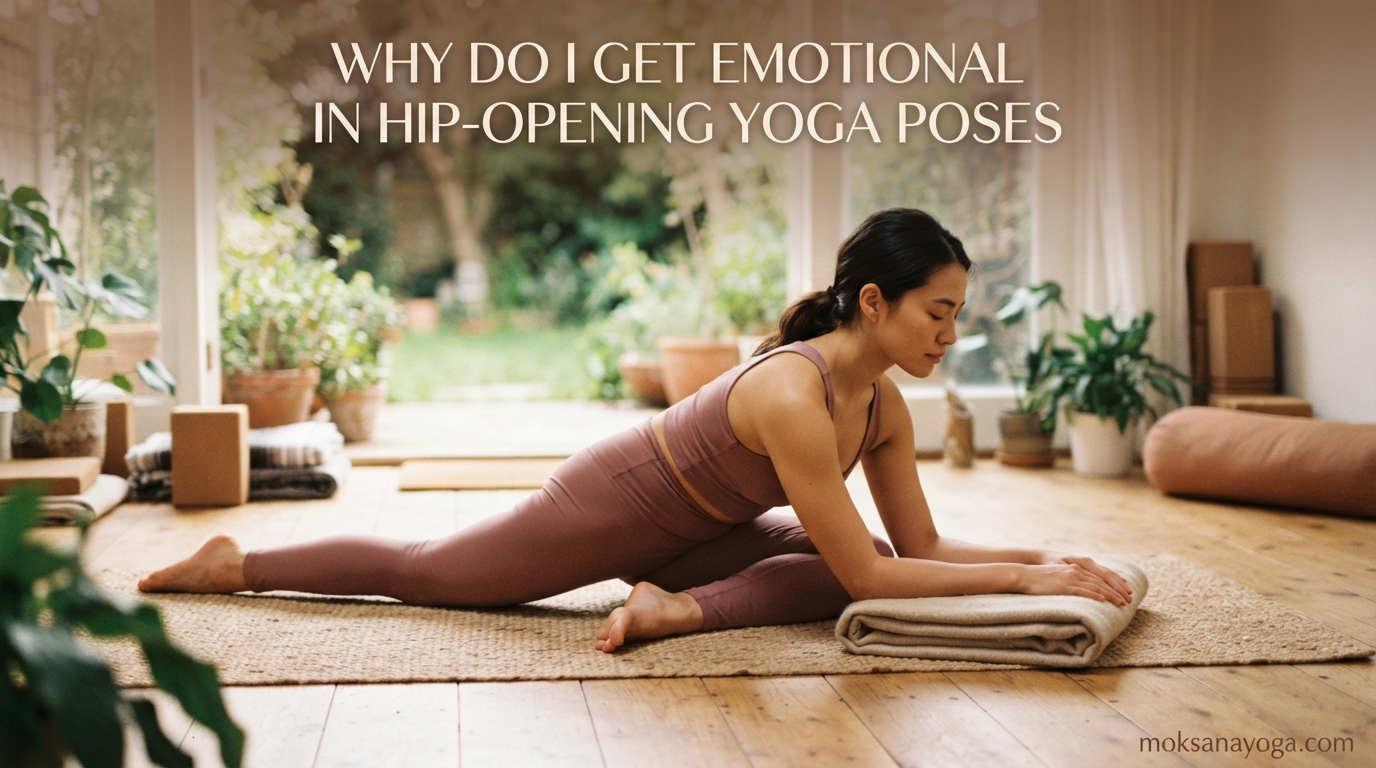
You are halfway through pigeon pose, breathing deeply, and suddenly your eyes well up with tears. Nothing upsetting happened today. No sad memory crossed your mind. Yet here you are, fighting back emotion on a yoga mat surrounded by strangers. If this has happened to you, you are far from alone.
Countless yoga practitioners describe this exact experience on forums, in studios, and in conversations with teachers. The hip-opening sequence rolls around, and emotions surface without warning. Some people cry. Others feel a wave of anxiety or a racing heart. A few sit in confusion wondering why their body is reacting this way.
Reddit threads with titles like “Does anyone else get emotional during hip opening poses?” fill up with dozens of responses from people who thought they were the only one. Yoga teachers hear about it after class, whispered in embarrassed tones. The experience is so universal that entire teacher trainings now include modules on how to hold space for students during emotional release.
This guide explains exactly why you get emotional in hip-opening yoga poses. We will walk through the anatomy of the psoas muscle, the science of how stress gets stored in the body, and practical strategies for handling emotional release when it happens on the mat. Whether you have experienced this once or every time you practice, understanding the mechanism behind it changes everything.
Understanding the body-mind connection in your hips validates what you feel and helps you process emotions instead of suppressing them. This is one of the most powerful, and sometimes surprising, aspects of a consistent yoga practice. It is also one of the most healing.
Table of Contents
Why Do I Get Emotional in Hip-Opening Yoga Poses? The Short Answer
You get emotional in hip-opening yoga poses because the psoas muscle, a deep hip flexor connecting your spine to your thighs, stores physical tension from stress, fear, and trauma. When hip openers stretch this muscle, the stored tension releases, and the emotional residue tied to that tension surfaces. Your body literally holds onto stress, and hip openers create the physical opening for it to exit.
This response is not a sign of weakness or instability. It is a well-documented physiological reaction rooted in how your nervous system processes stress. The fight-or-flight response contracts the psoas, and hip openers reverse that contraction. When the muscle lets go, the nervous system lets go with it.
Think of your hips as an emotional junk drawer. Throughout your life, every stressor that your body could not fully process gets tucked away in the deep muscles of the pelvic region. Hip-opening poses are what finally open that drawer and let everything inside it see the light of day.
The Psoas Muscle: Your Body’s Stress Storage Center
The psoas muscle (pronounced “so-as”) is one of the largest muscles in the body, yet most people have never heard of it. It originates from the lumbar spine, runs through the pelvis, and attaches to the top of the femur. This deep-core muscle is the only muscle that connects your spine to your legs, making it a bridge between your upper and lower body.
The psoas works together with the iliacus muscle to form the iliopsoas, the most powerful hip flexor in the body. Every time you walk, climb stairs, or lift your leg, the iliopsoas engages. But its job goes far beyond movement.
Here is what makes the psoas unique: it responds directly to your nervous system. When you experience stress, fear, or any perceived threat, the psoas contracts as part of the fight-or-flight response. It literally pulls your body into a protective curl, the same fetal position you would assume to protect your vital organs. This is an ancient survival mechanism shared by all mammals.
Liz Koch, one of the foremost authorities on the psoas and author of “The Psoas Book,” describes this muscle as a messenger of the central nervous system. She explains that the psoas reacts to every stress response, whether you are dodging traffic, receiving difficult news, or reliving a painful memory. The muscle tightens, and if that tension is never fully discharged, it accumulates.
Over months and years of sitting at desks, driving, and absorbing daily stress, the psoas becomes chronically tight. It holds onto the physical imprint of every stressor it has processed. The hip flexors shorten, the pelvis tilts, and the body adopts a posture of constant low-grade protection. Lower back pain, hip pain, and restricted movement often follow.
When you finally stretch the psoas deeply in yoga, you are not just lengthening a muscle. You are releasing years of stored tension and the emotional energy bound up in it. This is why the release can feel so disproportionate to the stretch itself. A simple pigeon pose can unlock a flood of feeling that has been locked away for years.
How Emotions Get Stored in the Hips
The idea that emotions are “stored” in the body is not just a yoga concept. It has a growing body of scientific research behind it. Dr. Candace Pert, a neuroscientist and pharmacologist who discovered the opiate receptor, pioneered research on neuropeptides, the biochemical messengers that link the brain to the body.
Pert discovered that neuropeptides and their receptors exist throughout the entire body, not just in the brain. Every emotion you feel triggers a cascade of these chemical messengers. They attach to receptors in your organs, muscles, and connective tissue. As Pert famously stated, “Your body is your subconscious mind.”
When you experience an intense emotion and do not fully process it, the chemical residue can remain in the tissue. The fascia, the web of connective tissue that wraps around every muscle and organ, plays a key role here. Fascia can thicken and harden in response to physical and emotional stress, trapping tension in place like a cast around an old injury.
The hips, particularly the pelvic region, are a primary storage site for this tension. The pelvis houses the adrenal glands, which release stress hormones like cortisol and adrenaline. The muscles around the pelvis are among the first to contract during stress and among the last to let go. This makes the hip region a natural collection point for unresolved stress.
A 2014 study by researchers at Aalto University on body maps of emotions found that people consistently map different emotions to specific areas of the body. Fear and anxiety were most intensely felt in the chest and the upper abdominal and pelvic region, the exact area where hip openers target. Sadness was felt throughout the chest and throat. Anger concentrated in the arms and upper chest. These findings suggest that emotional storage in the body is not random.
This is why you might feel emotional in hip openers even when nothing upsetting is happening in your current life. The body is releasing old emotional residue, not reacting to present circumstances. The tears that surface in pigeon pose may belong to a stressful week six months ago, a childhood fear, or a moment of grief that you never had time to fully feel.
Why Hip Openers Trigger Emotional Release
Hip-opening poses create a very specific kind of stretch. They target the deep muscles and connective tissue in the pelvic region where stress accumulates. When these muscles finally begin to release, the physical and emotional tension bound up in them releases too.
The process works through both mechanical and neurological pathways. Mechanically, stretching lengthens the muscle fibers and the surrounding fascia, releasing hardened tissue that has been locked in place. Neurologically, deep stretching activates the parasympathetic nervous system, the rest-and-digest mode that allows suppressed emotions to surface. The combination of physical opening and nervous system relaxation creates the perfect conditions for emotional release.
Yoga also gives you something rare in modern life: time and space. During a typical day, you move quickly from task to task. Stress gets shoved down and ignored. On the mat, you hold a pose for a minute or more, breathing deeply, with nowhere to go and nothing to distract you. The emotional backlog finally has room to surface. Your phone is off, your obligations are paused, and the only thing left to feel is what your body has been carrying.
Pigeon pose is the classic trigger. It stretches the psoas and the deep external rotators of the hip more intensely than almost any other pose. People who feel nothing in other hip openers often find themselves unexpectedly emotional in pigeon. The depth of the stretch reaches tension that other poses cannot access, and the long hold gives the nervous system time to unwind.
This is also why the emotional response can build over time. Someone might practice yoga for months without any tears, and then one day the tension finally lets go. The accumulated stress reaches a tipping point, and the body releases it all at once. Many practitioners describe this as a sudden, surprising experience that seems to come out of nowhere.
The connection between breathing and emotional release is worth noting. Deep, slow breathing stimulates the vagus nerve, which shifts the body out of fight-or-flight and into rest-and-digest. This is why teachers constantly remind you to breathe. The breath is not just for focus. It is the physiological mechanism that makes emotional release possible.
The Sacral Chakra Connection
In yogic and energetic traditions, the hips are associated with the sacral chakra, known in Sanskrit as Svadhisthana. This energy center sits in the lower abdomen and pelvic region, and it governs emotions, creativity, sensuality, and relationships. The word Svadhisthana translates roughly to “one’s own abode” or “the dwelling place of the self.”
According to this tradition, when the sacral chakra is blocked or imbalanced, emotions become difficult to process. You might feel emotionally numb, creatively stuck, or unable to connect deeply with others. Repressed feelings accumulate in the pelvic region, creating both energetic and physical blockages. Physical tension in the hips is seen as the bodily manifestation of this energetic congestion.
Hip-opening poses are believed to stimulate and balance Svadhisthana, allowing trapped emotional energy to flow freely again. Whether or not you subscribe to the chakra system, the energetic description maps closely onto what modern science tells us about the psoas, neuropeptides, and emotional storage. Ancient wisdom and modern biology point to the same conclusion.
Many yoga teachers intentionally sequence hip openers near the end of class for this reason. The body is warm, the nervous system is calm, and the practice has created a safe container for whatever emotions need to move. The peak poses are behind you, and the body can finally soften enough to let go.
Not Just Tears: Panic, Anxiety, and Numbness
One of the most overlooked aspects of emotional release in hip openers is that it does not always look like crying. While many people experience tears, others feel entirely different responses that can be just as intense and confusing. The diversity of emotional responses is rarely discussed, which leaves practitioners wondering if their reaction is normal.
Some practitioners describe a sudden wave of anxiety or panic during hip openers. Their heart races, their hands go numb, and they feel an urgent need to leave the pose or the room entirely. This is the nervous system interpreting the release of stored tension as a present-moment threat. The body is reliving the stress that was stored, not responding to anything happening right now.
Others experience nausea or a physical sinking sensation in the stomach. Some feel profound sadness without knowing why, a heaviness that seems to come from nowhere. A few describe a floating, dissociated feeling, as if they are watching themselves from outside their body. This dissociation is a protective mechanism, a way the nervous system distances itself from overwhelming input.
Some people get angry. Rage can surface in hip openers, surprising both the practitioner and anyone practicing nearby. Anger is often a deeply stored emotion, one that society trains us to suppress, and the hip release can bring it forward unexpectedly.
All of these responses are valid. They are all different expressions of the same underlying process: the body releasing stored stress. The specific emotion you feel depends on what was stored, how it was stored, and how your nervous system tends to process release. There is no wrong way to have an emotional release.
If you have ever felt anxious or panicky during hip openers instead of tearful, you are not doing yoga wrong. You are having a real and recognized response. Knowing this in advance can remove the confusion and fear that makes the experience harder. Forum discussions on Reddit and yoga communities are filled with people asking whether their panic response is normal. It is.
It is also completely normal to feel nothing at all. Some people have less stored tension in the hips, or their nervous system processes release differently. The absence of emotional response does not mean your practice is less meaningful or that you are somehow blocked. Bodies are different, and emotional release shows up differently for everyone.
Poses Most Likely to Trigger Emotions
Not all hip openers carry the same emotional weight. Some poses access the deep psoas and pelvic floor more directly than others, making them more likely to trigger a release. Knowing which poses tend to hit hardest lets you prepare mentally and emotionally before they arrive in a sequence.
Pigeon Pose (Eka Pada Rajakapotasana) is the most commonly cited emotional trigger. The deep external rotation and hip flexion stretch the psoas, the piriformis, and the deep rotators simultaneously. Holding pigeon for several breaths gives the nervous system time to let go. If there is one pose that reliably unlocks stored emotion, it is this one.
Frog Pose (Mandukasana) opens the inner thighs and groin, areas connected to the pelvic floor. The vulnerability of the position, with knees wide and groin exposed, can intensify the emotional response. Frog requires surrender, and that surrender can open emotional floodgates.
Butterfly Pose (Baddha Konasana) is gentler but sustained. Sitting with the soles of the feet together and knees falling open creates a slow, gradual release in the inner hips that can build over minutes. The subtlety of butterfly means the emotion often sneaks up rather than arriving suddenly.
Malasana (Garland Pose) is a deep squat that opens the hips while simultaneously grounding the body. The combination of opening and grounding can bring up emotions while also providing stability to process them. Feet on the floor and a low center of gravity create a sense of safety.
Low Lunge (Anjaneyasana) directly stretches the psoas of the back leg. Many people feel the emotional shift in this pose before any others because the psoas stretch is so direct and accessible. The backbend variation of low lunge intensifies the stretch and, often, the emotional response.
Happy Baby (Ananda Balasana) is surprisingly potent. Lying on the back and holding the feet while opening the hips mimics a vulnerable, playful position. The combination of physical opening and psychological vulnerability can trigger unexpected release, even in a pose that seems gentle.
How to Handle Emotions When They Surface
Knowing what to do when emotions arise during hip openers can transform a frightening experience into a healing one. Here is a step-by-step approach you can use on the mat, whether you are in a class or practicing at home.
Step 1: Stay and breathe. Your first instinct may be to leave the pose immediately. Unless you are in physical pain, try to stay. Take slow, deep breaths into the area that feels intense. Breathing signals to your nervous system that you are safe. Count your breaths if it helps you stay anchored.
Step 2: Let it happen. If tears come, let them. If your body shakes or trembles, allow it. Resistance creates more tension. Surrendering to the release helps it move through faster. You do not need to understand the emotion intellectually for it to process. The body knows what to do if you stop getting in the way.
Step 3: Back off if needed. If the emotion feels overwhelming or you start to panic, gently come out of the pose. Move into child’s pose or savasana. There is no prize for pushing through. Honoring your limits is part of the practice, not a failure of it.
Step 4: Ground yourself. After an intense release, spend a few minutes grounding. Press into the floor, feel the mat beneath you, and take several slow breaths. A long savasana helps integrate what came up. Do not skip it. Savasana is where the body processes what the practice released.
Step 5: Journal afterward. Writing about what you felt, even if you do not fully understand it, helps process the experience. The Yoga Collective recommends journaling as a way to make sense of the body’s emotional releases and track patterns over time. You may notice that certain poses consistently trigger certain emotions, which can be deeply insightful.
Step 6: Be gentle with yourself. Emotional release can leave you feeling raw and tired. Drink water, eat nourishing food, and avoid scheduling anything demanding right after a deep hip-opening session. Your body has just done significant work, even though you were only lying on a mat.
Remember that emotional release in yoga is a sign the practice is working. Your body is processing and letting go of what it no longer needs to carry. Each release creates more capacity for ease, clarity, and presence in your daily life.
When to Seek Professional Support
While occasional emotional release during yoga is normal and healthy, certain signs may indicate that additional support would be helpful. This is not a topic most yoga articles cover, but it matters deeply for anyone using yoga as part of their healing journey.
If you find yourself experiencing intense panic, flashbacks, or dissociation during hip openers, consider working with a trauma-informed yoga teacher. These instructors are trained to create safer environments for processing stored trauma and can help you pace your practice appropriately. They understand how to recognize when a student is outside their window of tolerance.
Somatic experiencing therapy, developed by Dr. Peter Levine, is another powerful resource. This body-based therapy helps release stored trauma gradually and safely, and it pairs well with a yoga practice. A licensed somatic therapist can help you understand and process what your body is releasing on the mat. Martha Eddy, a somatic educator cited by Healthline, emphasizes that body-based approaches are particularly effective for trauma that talk therapy alone cannot reach.
If emotional responses in yoga are interfering with your daily life, causing you to avoid practice entirely, or triggering symptoms of post-traumatic stress, reach out to a mental health professional. Yoga is a wonderful tool, but it is not a substitute for professional care when deeper healing is needed.
Knowing when to ask for help is a sign of self-awareness, not weakness. Your yoga practice should support your wellbeing, not overwhelm it. A therapist who understands the body-mind connection can help you integrate what yoga surfaces in a way that feels safe and sustainable.
Conclusion
Getting emotional in hip-opening yoga poses is one of the most common and most misunderstood experiences on the mat. It is rooted in real physiology: the psoas muscle stores stress, neuropeptides carry emotional information throughout the body, and deep stretching creates the conditions for release.
Whether you experience tears, anxiety, anger, or simply a deep sense of relief, your response is valid. Knowing why you get emotional in hip-opening yoga poses gives you the tools to navigate the experience with confidence instead of confusion.
Keep showing up. Keep breathing. Trust that your body knows exactly what it needs to release, and let your practice hold space for whatever comes up.
FAQs
Does opening your hips release emotions?
Yes. Hip-opening poses stretch the psoas muscle and surrounding fascia where stress and tension accumulate. When this stored tension releases, the emotional energy bound up in it surfaces as well. This is why many people experience tears, anxiety, or relief during deep hip openers.
What chakra is hip openers?
Hip openers are associated with the sacral chakra, or Svadhisthana, located in the lower abdomen and pelvic region. This energy center governs emotions, creativity, sensuality, and relationships. Opening the hips is believed to balance this chakra and allow trapped emotional energy to flow freely.
Why do hip openers make me cry?
Hip openers make you cry because they release tension stored in the psoas muscle, which contracts during the fight-or-flight stress response. When you stretch this muscle deeply, the physical and emotional tension trapped inside releases simultaneously, often surfacing as tears. This is a normal physiological response, not a sign of distress.
What emotion is trapped in the hip?
There is no single emotion trapped in the hips. The hips can store a range of emotional residue including fear, anxiety, grief, anger, and shame. The specific emotion that surfaces depends on what stressors or experiences your body has processed and held onto. Fear and anxiety are the most commonly reported, since the psoas directly responds to the fight-or-flight response.