
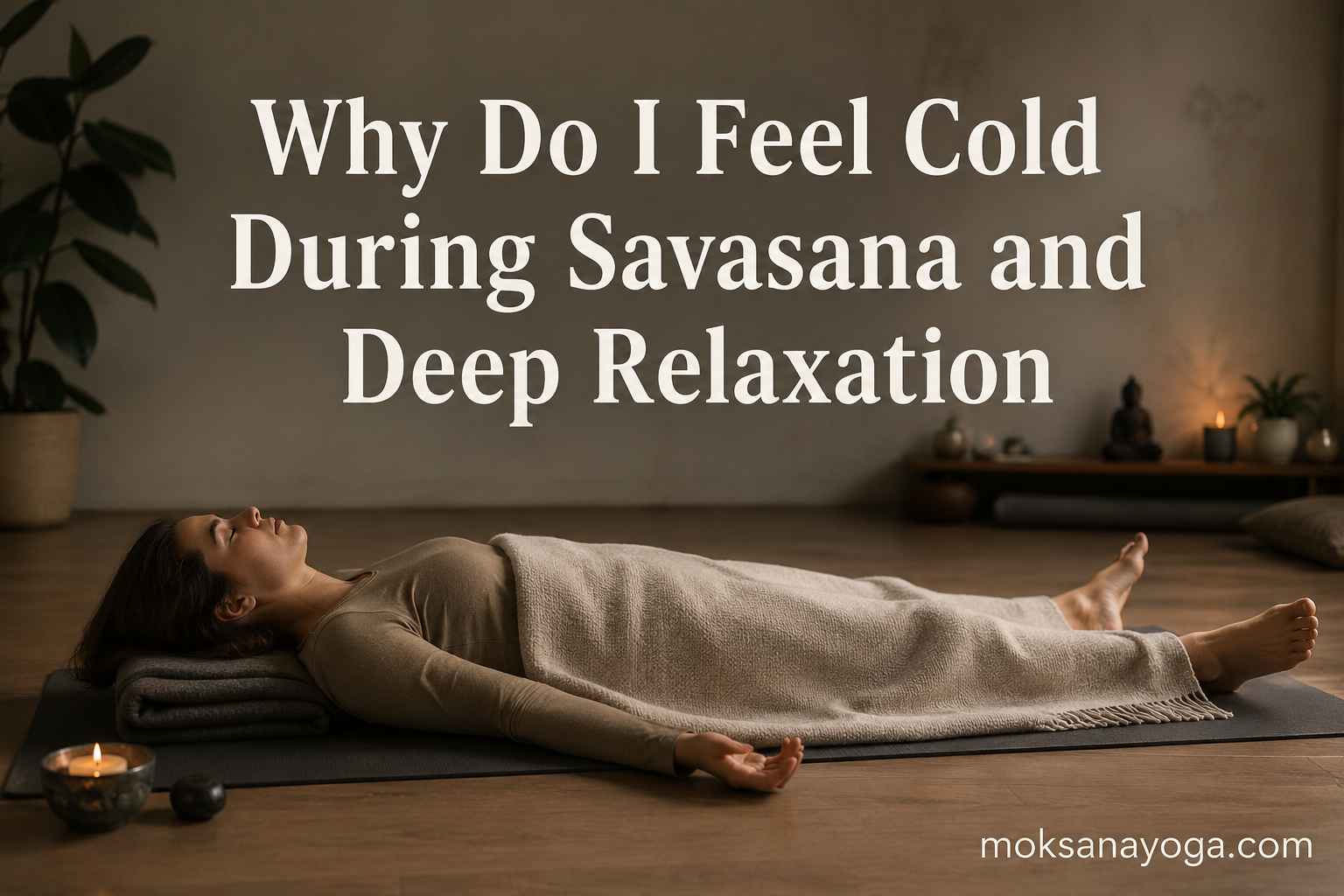
Have you ever settled into Savasana, felt your body finally let go, and then suddenly started shivering with goosebumps covering your arms? You are not alone. In my years of teaching and practicing yoga, I have seen countless students wrap themselves in blankets mid-class, confused about why the deepest part of their practice triggers such an intense chill.
The good news is that feeling cold during Savasana and deep relaxation is one of the most common and well-documented phenomena in meditation practice. Some experienced teachers estimate that up to 85 percent of regular practitioners experience it at some point. It is not a sign that anything is wrong. In fact, it often means your practice is working exactly as it should.
In this guide, I will walk you through exactly why you feel cold during Savasana and deep relaxation, what is happening in your nervous system, what it means spiritually, and what you can do to stay comfortable without breaking your meditative state.
Table of Contents
Why Do I Feel Cold During Savasana and Deep Relaxation
You feel cold during Savasana and deep relaxation because your parasympathetic nervous system activates, causing blood vessels to dilate, your heart rate to slow, and your metabolic rate to drop. As stress hormones like cortisol decrease, your body’s internal thermostat shifts, lowering your core temperature. This is a completely normal physiological response to deep rest.
Several factors contribute to this temperature shift:
1. Parasympathetic activation: Your body shifts from fight-or-flight mode into rest-and-digest mode, and your internal temperature gauge resets.
2. Decreased metabolic rate: As your muscles relax and your breathing slows, your body produces less heat naturally.
3. Blood vessel dilation: Blood vessels near the skin open up, releasing warmth outward, which can make your core feel cooler.
4. Stress hormone release: Stored cortisol and adrenaline leave your system during deep relaxation, and that chemical shift changes how your body regulates temperature.
The Science Behind the Temperature Drop
To understand what happens when you feel cold during Savasana, it helps to understand your autonomic nervous system. This system runs automatically in the background, controlling everything from your heart rate to your digestion to your body temperature. It has two main branches that work like a gas pedal and a brake.
The sympathetic nervous system is your gas pedal. It kicks in during physical activity, stress, and intense asana practice. It raises your heart rate, tightens your blood vessels, and generates heat. When you are flowing through Sun Salutations or holding a challenging Warrior pose, this is the system running the show.
The parasympathetic nervous system is your brake. It activates during rest, digestion, and deep relaxation. When you lie down in Savasana, this system takes over within minutes. Your heart rate drops, your blood pressure lowers, and your blood vessels dilate. That dilation sends warm blood toward your skin and extremities, which is why your hands and feet often feel the chill first.
At the same time, your metabolic rate slows. During active yoga practice, your muscles generate significant heat as they contract and release. In Savasana, your muscles go quiet. The internal furnace that was keeping you warm during your practice essentially turns down to its lowest setting. With less heat being produced and more warmth radiating out through dilated blood vessels, the result is a noticeable drop in body temperature.
Research also points to cortisol as a key player. Cortisol is a stress hormone that helps regulate metabolism and immune response. During intense physical or mental activity, cortisol levels stay elevated. When you enter deep relaxation, cortisol levels begin to fall. That drop can trigger a temporary chill as your endocrine system recalibrates.
What Happens in Your Body During Savasana
Savasana, or corpse pose, is unique among yoga postures because it asks for complete stillness while remaining fully conscious. Unlike seated meditation, where your postural muscles stay slightly engaged to keep you upright, Savasana lets every muscle group release. This total physical surrender is what makes the cold response so pronounced.
Many practitioners notice that the cold does not appear immediately. It creeps in during the later stages of Savasana, often five to ten minutes in. This delay matches the timeline of parasympathetic activation. Your nervous system needs time to fully shift gears, and once it does, the temperature drop becomes noticeable.
One of the most fascinating aspects reported by practitioners on forums like Reddit’s r/Meditation is how quickly the cold disappears after practice ends. Within seconds of opening your eyes or sitting up, the chill vanishes. This happens because standing up or moving reactivates the sympathetic nervous system. Your blood vessels constrict, your muscles start generating heat again, and your internal thermostat snaps back to its normal setting.
That rapid reversal is actually one of the clearest signs that the cold is tied to your nervous system rather than to the room temperature. If you were simply cold because the studio was chilly, you would stay cold after Savasana ended.
Cold Sensations During Yoga Nidra
Yoga Nidra, sometimes called yogic sleep, takes the relaxation response even deeper than traditional Savasana. Practitioners are guided through stages of body awareness, breath observation, and visualisation while lying completely still. The goal is to hover in the state between waking and sleeping consciousness.
Because Yoga Nidra drives the nervous system into such profound rest, the cold response tends to be stronger than in a standard Savasana. I have had students describe full-body shivering, intense goosebumps, and a sensation of cold radiating from their core outward. Some even report feeling physically warm before practice begins, only to feel freezing once they reach the deeper stages of the guided session.
If you practice Yoga Nidra regularly, expect the cold sensations to intensify over time. As your nervous system becomes more efficient at entering deep parasympathetic states, the temperature drop becomes more pronounced. This is not a setback. It is evidence that your practice is reaching deeper layers of your physiology.
Is Feeling Cold a Sign of Deep Meditation?
In many traditions, yes. Feeling cold during deep relaxation is widely considered a sign that you have moved past surface-level awareness into a genuinely meditative state. When your mind stops chasing thoughts and your body stops holding tension, the nervous system finally has permission to do its reset work.
Common signs that your cold sensation is connected to deep meditation include:
– The cold appears gradually, not suddenly
– It intensifies as your relaxation deepens
– It disappears within seconds of returning to normal awareness
– You feel mentally clear and calm despite the physical chill
– The cold feels different from being cold in a chilly room
Practitioners who track their sessions often notice a direct correlation between meditation depth and cold intensity. Shallow sessions produce little to no temperature change. The deepest sessions, where time seems to stretch and the body feels almost nonexistent, often come with the strongest cold sensations.
Cold vs Hot Sensations During Practice
While many practitioners feel cold during deep relaxation, others experience the opposite. Heat, warmth, tingling, and flushing are also reported, sometimes by the same person in different sessions. Both responses are normal, and they often reflect what your nervous system is processing in that moment.
Cold sensations typically accompany the release of stored tension and stress. When your body lets go of long-held muscular contractions and the associated stress hormones begin clearing from your system, the result is a chill. Think of it as a release response.
Heat sensations, on the other hand, often accompany energy movement and increased circulation. In traditions that work with prana or chi, heat is sometimes interpreted as energy flowing through previously blocked channels. Some practitioners alternate between hot and cold in a single session, which can feel disorienting but is simply the body processing different layers of tension and activation.
Neither sensation is better than the other. Both indicate that your practice is reaching beneath the surface of ordinary awareness.
Energy Movement and Spiritual Interpretation
In yogic and spiritual traditions, the cold response during Savasana carries meaning beyond biology. Many teachers interpret it as a sign of prana, the subtle life force energy, moving through the body. When deep relaxation opens energetic pathways that were previously blocked, the movement of prana can register as a chill or a cool breeze on the skin.
In Kundalini traditions, temperature fluctuations are considered one of the classic signs that dormant energy at the base of the spine is beginning to stir. The cold you feel may reflect old or stuck energy being dislodged and cleared from the body’s energy channels, known as nadis. This purification process is not always comfortable, but it is generally seen as a positive development in long-term practice.
Some traditions also view the cold as a signal that awareness is withdrawing from the physical body and turning inward toward subtler dimensions of consciousness. The sensation of a cool breeze, in particular, is described in several contemplative traditions as a sign of spiritual opening. If you have wondered what feeling cold means spiritually, these frameworks offer a context that goes beyond simple physiology.
Whether you interpret the cold as a nervous system response, an energetic shift, or both, the practical takeaway is the same. It is a sign of deep release, and you do not need to resist it.
How to Stay Warm During Deep Relaxation
Understanding why the cold happens does not make it any less distracting when you are trying to meditate. Forum discussions are full of practitioners asking how to stop shivering long enough to actually enjoy their practice. The good news is that a few simple adjustments can make a big difference.
Here are the strategies I recommend:
1. Layer up before Savasana begins. Keep a sweater, socks, or a light jacket near your mat. The key is to put layers on before you start cooling down, not after the shivering begins.
2. Use a blanket deliberately. A blanket over your body during Savasana is not a luxury. It is a standard prop in many traditions. Cover yourself from feet to chest so your core stays warm.
3. Try Ujjayi breathing to generate internal heat. If you feel cold creeping in, gently engage a soft Ujjayi breath for several rounds. This slight constriction at the back of the throat creates gentle internal warmth without breaking your meditative state.
4. Use warming visualisation. Instead of fighting the cold, imagine warmth spreading from your abdomen outward to your limbs. While some practitioners find this difficult when shivering is intense, many report it effective when started early.
5. Cover your head and feet. A significant amount of body heat escapes through the head and extremities. A light scarf over your hair or socks on your feet can dramatically reduce the chill.
6. Warm the room slightly. If you practice at home, set the temperature a degree or two warmer than you think you need. Your body temperature will drop during practice, so the room should feel slightly too warm when you begin.
7. Sip warm tea or water before practice. Warming your core from the inside before Savasana gives your body a head start. Ginger tea is especially effective because it supports circulation.
The goal is not to eliminate the cold response entirely. That response is a sign your practice is working. The goal is to stay comfortable enough that the cold does not pull you out of the deep state you have worked to reach.
When to Be Concerned About Cold Sensations
In the vast majority of cases, cold during Savasana is completely harmless. However, there are a few situations worth paying attention to. If you experience cold sensations accompanied by dizziness, numbness that does not resolve after practice, extreme fatigue, or a racing heart, it is worth speaking with a healthcare provider.
Persistent cold intolerance outside of meditation, dry skin, unexplained weight changes, or hair thinning can sometimes point to an underactive thyroid. If the cold feeling lingers long after your practice ends or shows up in everyday life, a simple blood test can rule out underlying issues.
Frequently Asked Questions
Why do I feel cold during meditation?
You feel cold during meditation because your parasympathetic nervous system activates, slowing your heart rate, dilating blood vessels, and lowering your metabolic rate. As stress hormones decrease, your body’s internal thermostat shifts, producing a noticeable drop in temperature that disappears within seconds of ending your practice.
What does feeling cold mean spiritually?
Spiritually, feeling cold during deep relaxation is often interpreted as a sign of prana or life force energy moving through the body. Many traditions view it as stuck or old energy being released and cleared, a purification process that accompanies deeper states of meditation and energetic opening.
Why does my body core feel cold?
Your body core feels cold during deep relaxation because your metabolic rate drops as your muscles fully release tension. With less internal heat being generated and blood vessels dilating to send warmth toward the skin, your core temperature can dip enough to register as a chill radiating from your center outward.
What are the signs of deep meditation?
Common signs of deep meditation include slowed breathing, a sense of time distortion, reduced awareness of the physical body, feeling cold or experiencing temperature changes, mental clarity and calm, and a sense of heaviness or lightness. These signs indicate your nervous system has entered a profound parasympathetic state.
Conclusion
Feeling cold during Savasana and deep relaxation is one of the clearest signals that your nervous system is doing exactly what it is supposed to do. Your parasympathetic response is activating, your stress hormones are receding, and your body is finally getting the deep rest it has been craving. Rather than fighting the chill, treat it as feedback that your practice is reaching the layers where real release happens.
The next time you settle into Savasana or Yoga Nidra, arrive prepared. Layer up, grab a blanket, sip something warm beforehand, and let yourself drop into the experience without resistance. The cold is not a problem to solve. It is a sign you are exactly where you need to be.