
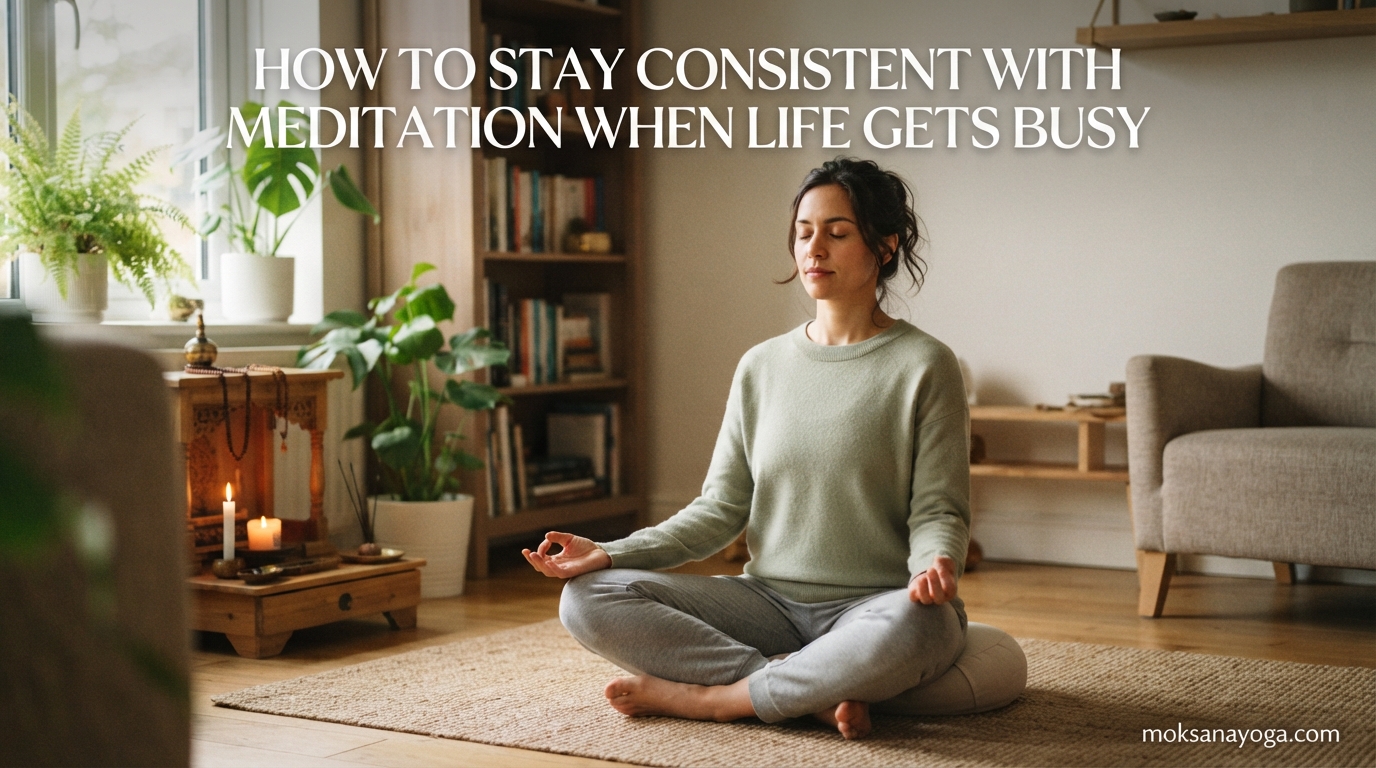
You started meditating with the best intentions. Maybe you managed a solid week of morning sits, felt calmer, slept better, and told yourself this time would be different. Then a deadline hit at work, your kid got sick, or you simply hit snooze one too many times. Before you knew it, three weeks had passed without a single session.
If that sounds familiar, you are in good company. Nearly every meditator I have talked to describes this exact cycle. The problem is not a lack of willpower. The problem is that most advice about building a meditation practice ignores the messy reality of a busy life.
Learning how to stay consistent with meditation when life gets busy is not about forcing yourself to sit for 30 minutes no matter what. It is about building a flexible framework that bends without breaking. In this guide, I will walk you through practical strategies that real people use to maintain a daily meditation practice even during their most chaotic seasons.
Table of Contents
Why Meditation Consistency Beats Long Sessions
Consistency in meditation matters far more than session length. This is the single most important principle to understand, and it changes everything about how you approach your practice.
Your brain builds neural pathways through repetition, not marathon sessions. Ten minutes of meditation every day will rewire your stress response far more effectively than a single 70-minute sit once a week. Research on neuroplasticity shows that regular, repeated practice is what creates lasting changes in the brain regions responsible for focus, emotional regulation, and self-awareness.
Think of it like watering a plant. A small amount of water every day keeps the soil consistently moist and the roots growing. Dumping a bucket of water once a week floods the plant, then leaves it dry for six days. Your meditation practice works the same way.
This is why the most experienced meditators I know rarely talk about long sessions. They talk about showing up daily. Once you internalize this, the pressure lifts. You do not need to find an hour. You need to find five minutes and keep finding them.
Start Small: The 3-Minute Rule That Changes Everything
The biggest mistake people make when building a meditation habit is starting too big. They decide they are going to meditate for 20 minutes every morning, succeed for three days, then quit when life interferes. I see this pattern over and over in meditation communities online.
Instead, commit to a 3-minute minimum. Three minutes is so short that you cannot reasonably argue you do not have time. It is the threshold below which resistance loses its power. On busy days, three minutes becomes your full session. On easier days, you will often find that three minutes naturally stretches into ten or fifteen because you are enjoying it.
One meditation teacher I follow describes this as setting the bar low enough that you can step over it every single day. The goal at the beginning is not enlightenment. The goal is building the identity of someone who meditates daily. Once that identity takes root, longer sessions come naturally.
After two weeks of consistent 3-minute sessions, try adding one minute per week. Within two months, you will be sitting for 10 to 12 minutes without it feeling like a chore. The progression feels effortless because your brain has already accepted daily meditation as part of your routine.
Anchor Meditation to an Existing Daily Habit
Willpower is unreliable. If you rely on remembering to meditate, you will forget. Instead, link your meditation practice to something you already do every single day without fail.
This technique, often called habit stacking, works because you are not building a brand new trigger. You are piggybacking on a neural pathway that already exists. Your existing habit becomes the cue, and meditation becomes the routine that follows.
Here are some anchors that work well for busy people. Meditate right after you pour your morning coffee or tea. Sit for a few minutes after you brush your teeth at night. Do a short session in your car before walking into the office. Meditate during the first five minutes of your lunch break.
The key is choosing an anchor that happens at a consistent time and in a place where you can actually sit quietly. If your mornings are chaotic, try anchoring to your evening routine instead. If your lunch break varies, use your morning coffee. Test different anchors for a week each until you find the one that sticks.
Same time, same place is the formula. When your brain learns that pouring coffee means sitting on the meditation cushion, the practice starts to feel automatic. You stop negotiating with yourself about whether to do it today.
Track Your Progress Visually
One of the most underused strategies for meditation consistency is visual tracking. Almost none of the top articles on this topic mention it, which is surprising because it works incredibly well.
Print a simple calendar and put it somewhere you will see it every day. Each day you meditate, even for three minutes, mark a big X or put a sticker on that date. There is something deeply satisfying about watching a chain of X marks grow. The longer the chain, the more motivated you become to avoid breaking it.
This is the same psychology behind the well-known “don’t break the chain” method, often attributed to Jerry Seinfeld. The technique works because it makes your progress tangible. Meditation progress is invisible by nature. You cannot see your stress tolerance increasing or your focus improving on a daily basis. But you can see a calendar full of gold stars.
If you prefer digital tracking, many meditation apps include streak counters. Insight Timer, Calm, and Headspace all track consecutive days. Some people find app streaks motivating, while others feel pressured by them. Try both approaches and see which one feels encouraging rather than stressful.
One caution: use tracking as motivation, not as a weapon. If you miss a day, the calendar is not there to shame you. It is there to remind you how many good days you have already built.
Practice Self-Compassion When You Miss Days
Here is a truth that took me years to learn. Missing a day is not failure. Treating that missed day as proof you cannot meditate is what actually kills your practice.
In every meditation forum I have explored, the number one pain point is the same. People fall off after a few consistent days, feel like failures, and then quit entirely. The guilt spiral is more destructive than the missed session ever could be. One missed day becomes two, then five, then a month, all because of the story we tell ourselves about what missing means.
Adopt what I call the never-miss-twice rule. If you miss a day, that is completely fine. Your only goal is to make sure you meditate the next day. One missed session has essentially zero impact on your progress. Two weeks of missed sessions does. The difference between people who maintain a lifelong meditation practice and those who quit is not that consistent meditators never miss days. It is that they return quickly when they do.
When you miss a day, notice the urge to criticize yourself. Then deliberately replace that voice with something kinder. Try saying, “I missed yesterday, and that is okay. I am sitting now.” This response is not just nicer. It is more effective, because self-compassion actually increases the likelihood that you will practice again tomorrow.
Sneak Meditation Into Busy Days With Micro Mindfulness
Some days, a formal seated meditation simply will not happen. That is where micro mindfulness comes in. These are tiny moments of present-moment awareness that you weave throughout your day, and they can be surprisingly powerful.
Think of micro mindfulness as snacks rather than meals. No single snack replaces a full meal, but snacking throughout the day keeps you nourished. Here are specific micro mindfulness practices you can do in under two minutes.
Try desk meditation between tasks. Before starting a new project, sit upright, close your eyes, and take ten slow breaths. Notice the sensation of your feet on the floor and your hands on the desk. This takes about 90 seconds and resets your nervous system between different types of work.
Use commute meditation if you take public transit. Instead of scrolling your phone, pick a single anchor like the rhythm of the train or the feeling of your breath. When your mind wanders, gently return to that anchor. If you drive, you cannot close your eyes, but you can practice mindful driving by fully noticing the steering wheel, the sounds, and the road.
Practice mindful transitions. Every time you move from one room to another, take one conscious breath before stepping through the doorway. Every time you sit down to eat, pause for three breaths before your first bite. These tiny practices keep you connected to the present moment all day long.
Try mindful walking between meetings. Even a two-minute walk from your desk to the kitchen becomes a practice when you focus on the sensation of each footstep, the air on your skin, and the sounds around you. You are not adding anything to your schedule. You are changing how you experience what you already do.
Find Your People: Community and Accountability
Meditation is often described as a solitary practice, but community support plays a massive role in helping people stay consistent with meditation over the long term. Most articles barely mention this, but the meditators I know who have maintained their practice for years almost always have some form of community connection.
Joining a meditation group, whether in person or online, creates gentle accountability. When you know others are sitting at the same time, you are more likely to show up. You do not want to let the group down, even if the group is just a forum of strangers on the internet.
The r/Meditation subreddit on Reddit has hundreds of thousands of members sharing their daily experiences, struggles, and breakthroughs. Reading about other people falling off and getting back on is surprisingly comforting. You realize that your challenges are universal, not personal failings.
Many meditation apps offer live group sessions. Insight Timer hosts live group meditations at various times throughout the day. Knowing that real people are meditating alongside you at that moment can transform a practice that felt like a chore into something that feels shared and meaningful.
If you prefer something more personal, find one accountability partner. Check in with each other daily, even if it is just a quick text saying “sat for five minutes today.” Simple accountability structures like this dramatically improve consistency.
What to Do When Life Suddenly Gets Overwhelming
Life has a way of throwing curveballs. A family emergency, a job change, a move, an illness. These transitions can derail even the most consistent meditation practice. No competitor article I found addresses this scenario, so let me share what has worked for experienced meditators I have learned from.
The golden rule during chaotic times is to scale down, not opt out. If you have been meditating for 20 minutes and life explodes, drop to five minutes. If five feels impossible, drop to two. If two feels impossible, take three conscious breaths before getting out of bed. The practice shrinks but never disappears entirely.
When traveling, use environmental cues instead of your usual routine. The hotel room chair becomes your meditation spot. The flight becomes an opportunity for extended breath awareness. Travel disrupts your anchors, so create temporary ones for the duration of the trip.
After a long break, do not try to pick up where you left off. Start back at three minutes, just like the beginning. Your practice will rebuild faster than you expect because the neural pathways are still partially there. Be patient with yourself during the first few sessions back. Your mind will be noisier than you remember, and that is completely normal.
Remember that meditation is not something you master and then have forever. It is a practice you return to throughout your life, sometimes daily, sometimes sporadically. The goal is not perfection. The goal is a relationship with practice that survives the ups and downs of real life.
FAQs
How to meditate when busy?
Meditate in short bursts of 3 to 5 minutes rather than skipping entirely. Anchor your practice to an existing daily habit like your morning coffee or evening tooth-brushing routine. Use micro mindfulness techniques like taking ten conscious breaths between tasks, practicing mindful walking during your commute, or pausing for three breaths before meals.
How long does it take to build a consistent meditation habit?
Research on habit formation suggests it takes an average of 66 days to build a new automatic habit, though this varies widely from person to person. If you start with just 3 minutes daily and anchor it to an existing routine, you can establish a basic meditation habit within 3 to 4 weeks. Longer, deeper sessions develop naturally over the following months.
Is it normal to fall off meditation after a few days?
Yes, falling off after a few consistent days is extremely common and happens to nearly every meditator. The key is not to interpret a missed day as failure. Use the never-miss-twice rule: if you miss one day, simply make sure you meditate the next day. Returning quickly after a lapse is what builds long-term consistency.
Can meditation help with stress from a busy schedule?
Yes, regular meditation is one of the most effective tools for managing schedule-related stress. Even short daily sessions of 5 to 10 minutes have been shown to lower cortisol levels, improve focus, and reduce reactive emotional responses. The key is consistency rather than duration, which is why building a sustainable daily practice matters more than occasional long sessions.
Your Consistent Practice Starts Today
Staying consistent with meditation when life gets busy is not about having more time or more discipline. It is about working with your real life instead of against it. Start with three minutes. Anchor your practice to something you already do. Track your progress visually so you can see the chain grow. And when you inevitably miss a day, treat yourself with kindness and come back tomorrow.
Every strategy in this guide exists to serve one principle: show up small but show up often. The meditators who maintain a lifelong practice are not the ones with the most willpower. They are the ones who learned to keep their practice alive even when everything else in life was demanding their attention.
So here is your next step. Pick one anchor from your daily routine. Decide right now that you will meditate for three minutes immediately after that anchor tomorrow. That is it. Do not worry about next week or next month. Just do three minutes tomorrow, and see what happens.
Your meditation practice does not need to be perfect. It just needs to keep going.