
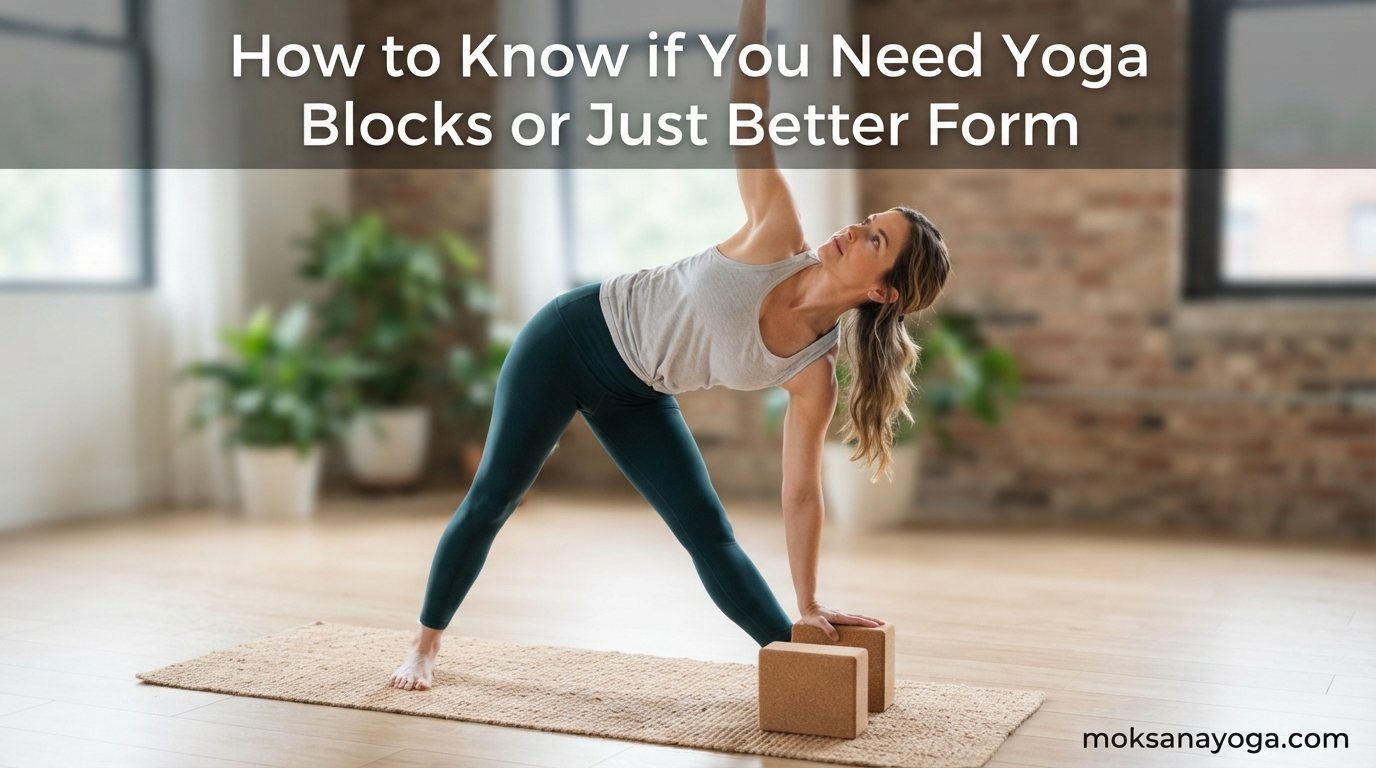
You showed up to class, watched the person next to you float effortlessly into a half moon pose, and wondered: should I grab a block, or do I just need to fix my form? It is one of the most common questions I hear from students at every level. The decision between yoga blocks or better form is not about weakness versus strength. It is about understanding what your body actually needs in this moment.
After teaching for over a decade and watching hundreds of practitioners wrestle with this exact question, I can tell you that the answer is rarely simple. Sometimes a block is the smartest tool in the room. Other times, it becomes a Band-Aid that masks a deeper technique issue. The goal of this guide is to help you tell the difference.
Here is what we will cover: what yoga blocks actually do, the clear signs you need one, the signs you need to work on form instead, a practical self-assessment you can run today, and a path for progressing beyond props when the time is right. By the end, you will have a confident answer tailored to your body and your practice.
Table of Contents
What Yoga Blocks Actually Do
A yoga block is a dense, rectangular prop, typically around 9 by 6 by 4 inches, that serves one of three core purposes in your practice. It can bring the floor closer to you, provide support for a joint or spine, or create resistance that helps you feel the correct muscle activation. That is it. Everything else flows from those three functions.
Think of a block the way a guitarist thinks of a capo. The capo does not make you a better player. It changes the geometry of the instrument so certain songs become playable in your current range. A yoga block does the same thing for your body. It changes the geometry of a pose so you can access the shape, feel the alignment, and build the neuromuscular pattern that eventually lets you do it without the prop.
This is the critical distinction between a prop and a crutch. A prop teaches your body something it can eventually do alone. A crutch replaces a capability your body is not building. Blocks, used well, are always props. They are tools for learning, not substitutes for learning. The problem arises when we reach for a block out of habit instead of asking whether the block is still teaching us something new.
I remember a student who used blocks under her hands in every standing forward fold for two years. When I finally asked her to try without them, she discovered her hamstrings had actually loosened significantly months earlier. The block had stopped teaching her anything. It had just become familiar. That is the moment to reassess.
Signs You Need Yoga Blocks
Certain situations call for a block almost unconditionally. If any of the following describe your body or your practice right now, a block is likely the right call rather than a form fix.
You Have Short Arms or Long Legs
Body proportions are not a flexibility problem and they are not a technique problem. They are geometry. If you have a long torso and shorter arms, your hand may simply never comfortably reach the floor in a pose like Trikonasana, no matter how clean your alignment becomes. In this case, a block is not compensating for poor form. It is honoring your skeleton.
I have seen advanced practitioners with a decade of training still use blocks in certain poses because their bones are shaped a particular way. There is no amount of hip work or hamstring stretching that changes the length of your humerus. Recognizing this frees you from the false goal of someday reaching the floor.
You Are Recovering From an Injury
Wrist pain in downward dog, a healing hamstring, a tender lower back, or recent surgery all change the math. When tissue is repairing, the priority is not building new range or strength. The priority is keeping the area safe while maintaining circulation and movement. Blocks reduce load, shorten lever arms, and let you practice without aggravating the injury.
For wrist pain specifically, placing blocks under your hands in tabletop or downward dog shifts weight distribution and reduces flexion. For back pain, a block under the sacrum in supported bridge takes the spine out of compression. These are medical-grade uses of a simple tool.
You Hit a Flexibility Plateau
If you have been working on the same pose for months and feel stuck, a block can help you break through by allowing you to experience the shape at a higher elevation. Sometimes your nervous system needs to feel safe in a position before it will release tension and let you go deeper. The block creates that safety.
For example, in half moon pose, many students wobble and fall because their bottom hand cannot reach the floor without compromising their torso rotation. A block at its highest height gives them something stable to press into, which lets them focus on the hip stacking and core engagement that actually drive the pose. Once those patterns are grooved, lowering the block becomes easy.
You Are a True Beginner Building Confidence
Beginners benefit from blocks because they reduce the cognitive load. When you are learning a pose, you are processing alignment cues, balance demands, breath, and muscle engagement all at once. Adding the stress of reaching for a floor that is too far away overwhelms the system. A block removes one variable so you can focus on the others.
The forum consensus across r/yoga and other communities backs this up. Practitioners consistently report that blocks helped them feel alignment for the first time, which then carried over to their unassisted practice. The prop accelerated learning rather than replacing it.
Signs You Need Better Form Instead
On the other side, there are clear signals that a block is masking a form problem you should address directly. If any of these sound familiar, the work is not in the prop aisle. It is in your technique.
You Feel Pain in the Same Spot Every Class
Recurring pain is not a flexibility issue. It is an alignment issue. If your lower back aches after every forward fold, your wrist hurts after every downward dog, or your knee complains in every lunge, the problem is likely how load is traveling through your joint, not how far you can stretch.
A block will not fix this. In fact, it can make the problem worse by letting you hold a misaligned position longer. The fix here is technique work: learning to hinge from the hips, distributing weight through the fingers, or tracking the knee over the ankle. This is where a qualified teacher and a mirror are worth more than any prop.
You Use Blocks for the Same Pose at the Same Height for Months
Progress is the tell. If you have used a block at medium height in your standing forward fold for six months and nothing has changed, the block has stopped being a teacher. It has become furniture. This is the signal to try lowering it, removing it, or working on the underlying restriction.
Real progress with props looks like this: highest height for a few weeks, medium height for a few weeks, lowest height, then no block. If you are stuck at one rung of that ladder indefinitely, either the block is masking a form issue or you need targeted mobility work rather than more time in the pose.
You Compensate Around the Block
Watch yourself in a mirror or film your practice. If you are using a block in a seated twist, for instance, and notice your spine is rounding to reach it, or your opposite shoulder is collapsing, the block is not helping your alignment. It is creating a new misalignment.
I see this constantly in bound angle pose. Students place blocks under their knees, which is fine, but then let their entire torso slump because the support lets them zone out. The block is supposed to create space for length, not permission to collapse. If your form gets worse when you add the prop, the prop is not the answer.
You Feel Disconnected From the Working Muscles
A well-used block heightens body awareness. A poorly used one numbs it. If you finish a pose and cannot name which muscle group was working, or if the pose felt like passive hanging rather than active engagement, you may be using the block to avoid the effort the pose requires.
Chaturanga is the classic example. Some students do the pose on their knees and feel nothing because they are dumping weight rather than engaging. The modification is not the problem. The lack of engagement is. Better form, not a different prop, is the path forward.
How to Know if You Need Yoga Blocks or Just Better Form
This is the heart of the question, and the honest answer is that most practitioners need both at different times. But if you want a clear framework for deciding in any given pose, here is the test I use with my students.
Ask yourself three questions. First, is the limitation skeletal or proportional? If your arm is simply too short to reach the floor with clean alignment, you need a block. No amount of form work changes bone length. Second, is the limitation due to injury or acute sensitivity? If yes, you need a block to reduce load while you heal. Third, is the limitation due to flexibility, strength, or technique that you could improve with focused work? If yes, you need better form, possibly supported by a block temporarily while you build the capacity.
The first two answers point clearly to blocks. The third points to form work, with blocks used strategically as training wheels rather than permanent fixtures. The confusion arises because most students assume every limitation is the third type. They think reaching for a block means admitting weakness. In reality, ignoring proportional or healing limitations is the bigger mistake.
Here is a quick comparison that helps students visualize the distinction.
You likely need a block when: the floor is physically unreachable without rounding your spine, you are protecting healing tissue, you are learning the basic shape of a pose for the first time, or your body proportions make a particular hand-to-floor connection impossible regardless of flexibility.
You likely need better form when: the floor is reachable but you choose the block out of habit, you feel pain the prop does not resolve, your alignment worsens with the block, or you have not progressed in the pose for months despite regular practice.
One more consideration. Some poses genuinely require blocks forever for most bodies. Supported fish, restorative bridge with a block under the sacrum, and supported child’s pose are designed around the prop. In these restorative shapes, the block is not compensating for anything. It is the pose. Do not apply the form-versus-prop framework to restorative practice. That is a different category entirely.
The Prop-Versus-Crutch Test: A Quick Self-Assessment
To make this practical, I developed a simple checklist you can run through after your next practice. Be honest. The point is not to judge yourself but to gather data about what your body actually needs.
1. Remove the block and try the pose. If your form stays clean and you simply feel more stretch or effort, you may be ready to reduce block height or drop it. If your form falls apart the instant the block leaves, you either still need it or you need form work. The next questions sort out which.
2. Check your spine. Without the block, does your back round, twist, or collapse? If yes, the block is doing postural work you have not yet built internally. Keep it for now but add targeted core or back strengthening outside the pose.
3. Check your joints. Without the block, do you feel pinching, grinding, or sharp pain in a joint? That is a structural limitation. The block stays until the tissue heals or you build enough supporting strength to protect the joint. Sharp pain is never something to push through.
4. Check your breath. Without the block, can you breathe smoothly, or do you hold your breath? Breath holding signals your nervous system does not feel safe in the shape. That can be a flexibility issue, a strength issue, or a technique issue. A block while you sort it out is smart, not lazy.
5. Track your progression over weeks. Every two weeks, try lowering your block one height setting. If you can maintain form and breath at the lower height, you are progressing. If you stall at the same height for over a month, ask a teacher to look at your alignment. The stall is your signal to shift from prop work to form work.
This five-point check takes about three minutes and tells you far more than guessing. Run it monthly and you will catch the moment a helpful prop becomes a stagnant habit.
How to Progress From Blocks to Unassisted Poses
If your assessment shows you are ready to reduce reliance on blocks, do it gradually and strategically rather than going cold turkey. Sudden removal usually leads to compensation, which leads to the form problems we are trying to avoid.
Start by working the block down through its three heights. Most blocks offer low, medium, and high settings. Spend one to two weeks at each level for any given pose. This gives your connective tissue time to adapt to the new demand without strain. Rushing this phase is how injuries happen.
Pair the height reduction with targeted strength and mobility work outside the pose itself. If you are weaning off blocks in standing poses, add calf and hip strengthening drills. If you are weaning off them in forward folds, add active hamstring stretches rather than passive hanging. The block masked a strength or mobility gap. Fill that gap directly and the prop becomes unnecessary.
Another effective strategy is to alternate. Use the block for your first two rounds of a pose, then remove it for the third. This lets you feel the correct alignment with support, then immediately reproduce it without. Over weeks, shift the ratio until the unassisted version is your default.
Finally, accept that some days you will need the block again. Fatigue, stress, cold muscles, and hormonal cycles all affect your range of motion. Pulling a block back out on a tough day is not regression. It is intelligent practice. The goal is not to never use props. The goal is to use them intentionally rather than automatically.
FAQs
Do I really need yoga blocks?
You need yoga blocks if the floor is physically out of reach without compromising your spine, if you are healing an injury, or if you are learning a new pose and need to reduce cognitive load. You probably do not need them if your limitation is strength, flexibility, or technique that you could improve with focused work. Run the five-point self-assessment above to decide.
Can yoga blocks help with wrist pain?
Yes. Placing blocks under your hands in poses like downward dog or tabletop shifts weight distribution and reduces wrist flexion. This is especially useful if you are recovering from a wrist strain or carpal tunnel symptoms. However, if wrist pain persists in every session, you also need to address hand alignment, finger spreading, and shoulder engagement, which are form issues a block alone will not fix.
Can yoga blocks help with back pain?
Blocks can reduce back pain in two ways. In supported bridge, a block under the sacrum takes the spine out of compression, which relieves acute lower back strain. In seated forward folds, a block under the forehead or hands prevents the spine from rounding excessively. If your back pain is caused by poor hip hinging or weak core engagement, however, you need form work rather than props.
Is using yoga blocks cheating?
No. Blocks are props that teach your body correct alignment by making poses accessible at your current range. Even advanced practitioners use blocks for restorative work, deep backbends, and poses that exceed their proportional reach. Cheating implies you are avoiding effort. Using a block intentionally to learn better form is the opposite.
How do I know if my yoga form is correct?
Signs of correct form include smooth breathing throughout the pose, no sharp or pinching joint pain, a long and neutral spine, and the ability to feel which muscle group is working. Signs of poor form include breath holding, recurring pain in the same spot, visible compensation like rounding or twisting, and feeling disconnected from the effort. A qualified teacher and a mirror are the fastest ways to confirm.
Conclusion
The choice between yoga blocks or better form is not binary. Most of us need both at different points in our practice. Blocks are tools for learning alignment, protecting healing tissue, and honoring skeletal proportions that no amount of stretching will change. Better form is the work of addressing strength gaps, compensation patterns, and recurring pain that props alone cannot solve.
Run the five-point self-assessment, track your progression honestly, and remember that pulling a block back out on a tough day is intelligence, not regression. If you found this guide helpful, the best next step is to film yourself in two or three poses where you currently use a block and compare what you see to the criteria above. Your body is already telling you the answer. This framework just helps you hear it.