
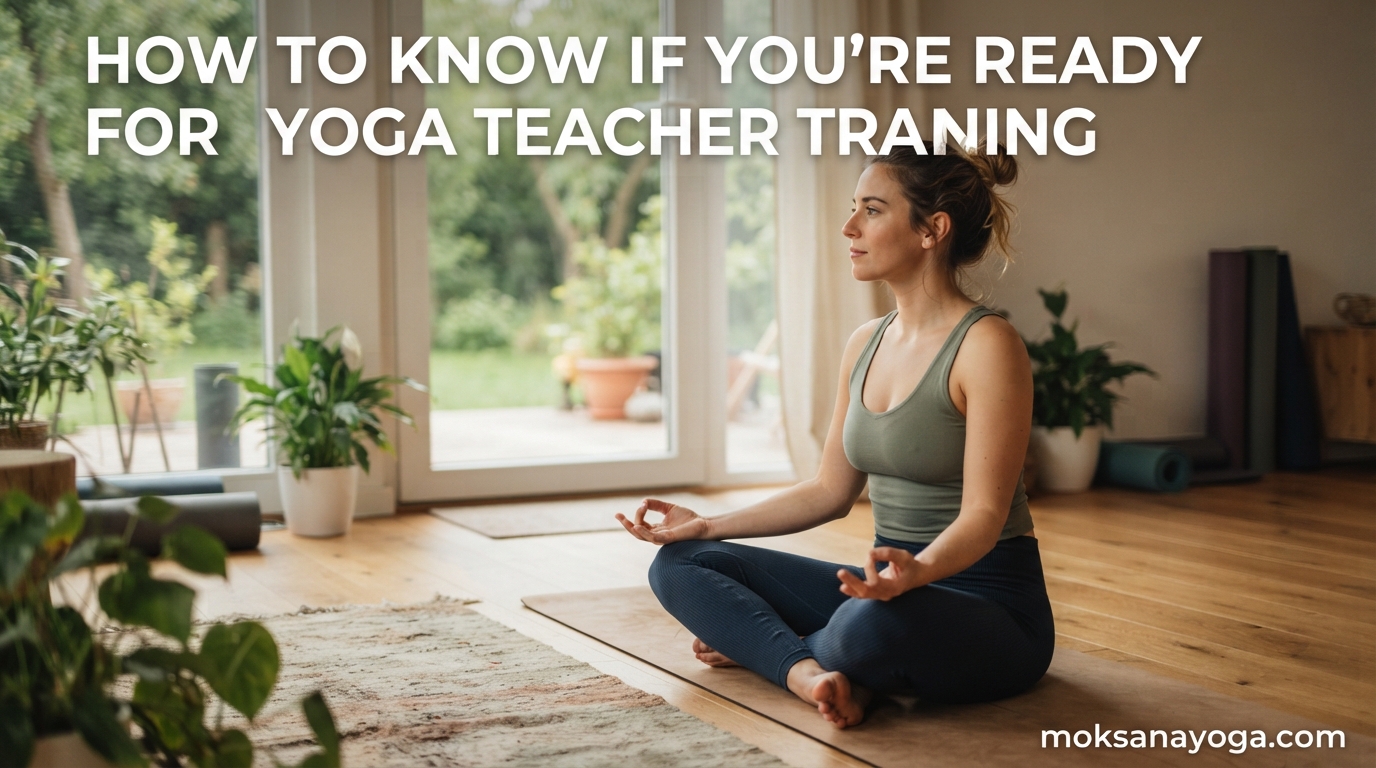
If you’ve been staring at a yoga teacher training application wondering whether you’re “good enough” to apply, you’re in good company. Nearly every trainee I’ve spoken with — including seasoned teachers with decades of experience — recalls that same doubt before enrolling. The question of how to know if you’re ready for yoga teacher training gets asked constantly in yoga forums, in studio lobbies, and in quiet moments on the mat.
Here’s the truth that took me years to understand: readiness is a choice, not a feeling. You don’t wake up one morning suddenly qualified. You decide to begin, and the training itself shapes you into someone who is prepared.
This guide walks through the real signs of readiness, the myths that hold people back, a practical self-assessment checklist you won’t find elsewhere, and the practical questions — including age, cost, and tax considerations — that most articles skip.
Table of Contents
What Readiness for Yoga Teacher Training Really Means
Readiness for yoga teacher training has almost nothing to do with touching your toes or nailing a handstand. It has everything to do with curiosity, consistency, and a willingness to be changed by what you learn.
When I asked graduates what actually made them ready, the answer was never about physical ability. It was about reaching a point where surface-level practice no longer satisfied them. They wanted to understand why a pose works, where the philosophy comes from, and how the breath connects to the nervous system.
That intellectual and emotional hunger — not physical prowess — is the real signal. If you find yourself lingering after class to ask questions, reading books about yoga philosophy on your own, or geeking out over anatomy videos, you’re already demonstrating the mindset that training is built on.
7 Signs You May Be Ready for Yoga Teacher Training
If you’re wondering whether the time is right, look for these seven signs. You don’t need all of them — even three or four strongly resonating is a good indicator.
1. You Keep a Consistent Personal Practice
The most reliable sign is a steady practice that survives life’s chaos. If you roll out your mat even when work is demanding, your routine shifts, or motivation dips, you’ve built the discipline training requires. Most programs recommend at least one year of consistent practice before enrolling — not because you need to be advanced, but because consistency shows commitment.
2. You’re Curious About the “Why” Behind the Practice
You’ve stopped being satisfied with just following along in class. You want to know why breath cues matter, what the yamas and niyamas actually mean in daily life, and how sequencing choices affect the body. This intellectual curiosity is the engine that carries trainees through 200 hours of study.
3. Yoga Has Become Part of How You Think and Move
You catch yourself noticing your posture at your desk. You breathe deliberately when stressed. You’ve started applying yoga principles — like non-attachment or contentment — to situations off the mat. This integration signals that yoga has moved from a workout into a worldview.
4. You’ve Felt the Benefits Personally and Want to Understand Them
Maybe yoga helped you through anxiety, an injury, a life transition, or simply made you feel more at home in your body. When you’ve experienced transformation firsthand, the desire to understand the mechanics behind it is natural. That’s exactly the energy training channels.
5. You Can Sit With Discomfort Without Running
YTT involves emotional work alongside physical and intellectual study. You’ll confront your patterns, your self-talk, and sometimes your tears. If you’ve already developed the capacity to stay present during hard moments — on the mat or off — you have the emotional foundation training asks for.
6. You Have a Sustainable Motivation, Not a Fling
Training is a significant investment of time, money, and energy. The people who get the most from it aren’t chasing a credential or a lifestyle image. They’re called by something steadier — a genuine desire to deepen their relationship with yoga, whether or not they ever teach a single class.
7. You’re Willing to Be a Beginner Again
Training will humble you. Advanced practitioners discover they’ve been misaligning a pose for years. Confident students realize how much philosophy they don’t know. If you can approach training with a beginner’s mind — curious, open, and unattached to being the best in the room — you’re ready for what it offers.
You Don’t Need to Want to Teach
This is the most common misconception I encounter, and it stops countless practitioners from ever enrolling. You do not need to want to teach to do a yoga teacher training.
In most 200-hour cohorts, roughly a third of students enroll purely for personal growth. Some end up teaching later. Some never do. Both paths are valid, and both are common.
Teacher training is fundamentally an immersion in yoga — its history, philosophy, anatomy, energetics, and practical application. Whether you share that knowledge with a classroom of strangers or simply bring it into your own life and relationships is a decision you can make after the training, not before.
I’ve met graduates who used their training to lead corporate wellness sessions, to deepen their work as therapists or nurses, to guide their families, or simply to enrich a practice they love. The credential opens doors, but the knowledge itself is the real reward.
Busting the Flexibility and Advanced Pose Myths
“I’m not flexible enough” is the single most common reason people give for delaying or avoiding YTT. It’s also completely unfounded.
Yoga teacher training is not an advanced asana audition. You will not be asked to demonstrate a perfect split or press into a handstand on day one. The curriculum focuses on alignment principles, anatomy, sequencing methodology, philosophy, breathwork, and teaching mechanics — none of which require you to perform advanced poses yourself.
In fact, many of the best teachers I know are not the most flexible people in the room. They understand modifications. They can meet students where they are. They’ve had to work with their own limitations, which makes them far more empathetic and effective than someone for whom every pose comes easily.
If you have a body, you have a yoga body. If you can breathe and move with awareness, you have the foundation training builds on.
Is 40 Too Old for Yoga Teacher Training?
No. Emphatically, no — and neither is 50, 60, or beyond.
This question comes up constantly in yoga forums, usually from people who feel intimidated by images of young, lithe teachers on social media. The reality of who actually trains and teaches is far more diverse. Most YTT cohorts include students ranging from their early twenties to their sixties, and many studios actively value the life experience that older trainees bring.
Older students often have advantages that younger trainees lack: steadier self-awareness, more comfort with their bodies, patience developed through decades of living, and a clearer sense of why they’re there. Studios hiring teachers consistently report that maturity and presence matter more than physical demonstration ability.
Some of the most respected teachers working today began training in their forties, fifties, or later. The idea that yoga teaching is a young person’s path is a marketing fiction, not a reality.
Choosing the Right Format: Intensive vs Hybrid vs Online
The format you choose affects how readiness translates into actual training. Each structure suits different life circumstances.
Intensive programs condense 200 hours into three to four weeks, often full-time. These immersions work well for people who can step away from work and want a transformative, focused experience. The intensity builds deep bonds with cohort members but demands full availability.
Hybrid programs blend in-person weekends or retreats with online coursework. This format suits working professionals and parents who need flexibility. You still get face-to-face teaching practice and community, but the schedule bends around your life. Many students find hybrid the most sustainable option.
Online programs deliver the full curriculum remotely, sometimes with optional in-person intensives. These work for rural practitioners, those with unpredictable schedules, or anyone for whom travel is a barrier. The trade-off is less hands-on adjustment practice, so look for programs with strong practicum components and live teaching time.
Whichever format you choose, verify it’s registered with Yoga Alliance if you want the RYT-200 credential. That registration ensures the curriculum meets the minimum standards most studios and employers recognize.
What to Expect in a 200-Hour Yoga Teacher Training
Understanding the curriculum helps you assess whether you’re ready for the commitment. A Yoga Alliance-registered 200-hour YTT covers several core areas.
Techniques, Training, and Practice (100 hours): Daily asana, pranayama, meditation, mantra, and kriya practice. You’ll study alignment, modifications, and the energetic effects of each technique.
Teaching Methodology (25 hours): How to sequence classes, give verbal cues, demonstrate safely, observe students, adjust with consent, and hold space for a room full of people.
Anatomy and Physiology (20 hours): Functional anatomy, biomechanics, the nervous system, breath mechanics, and how yoga affects the body at a physiological level.
Yoga Philosophy, Lifestyle, and Ethics (30 hours): The Yoga Sutras of Patanjali, the eight limbs, yamas and niyamas, the history of yoga, and ethical considerations for teachers.
Practicum (10 hours): Actual practice teaching — leading peers, receiving feedback, and refining your voice as a teacher.
Electives and Independent Study (15 hours): Varies by program. May include specialty topics like prenatal yoga, restorative yoga, trauma-sensitive approaches, or Ayurveda.
The remaining hours are distributed across the categories above. Programs spread this content over weeks or months depending on format.
Your Readiness Self-Assessment Checklist
No competitor offers this, so here’s a practical tool. Read each statement and answer honestly — yes, no, or somewhat.
Practice and Commitment
1. I have a personal yoga practice I return to regularly, even when life gets busy.
2. I’ve been practicing consistently for at least one year.
3. I practice at home on my own, not only in led classes.
Curiosity and Motivation
4. I actively want to learn about yoga philosophy, anatomy, and history — not just poses.
5. I find myself reading, watching, or discussing yoga outside of class time.
6. My interest in deepening my practice has lasted months or years, not weeks.
Emotional Readiness
7. I can sit with discomfort and stay present during challenging moments.
8. I’m willing to confront my habits, self-talk, and emotional patterns.
9. I can receive feedback without collapsing into self-criticism.
Practical Readiness
10. I have — or can create — the time for training alongside my current commitments.
11. I’ve researched program formats and have a sense of what suits my life.
12. I have a financial plan, even if it involves saving or payment plans.
How to Interpret Your Score
If you answered “yes” to 8 or more: You’re likely ready. Trust that and start researching specific programs. The remaining hesitation is normal pre-commitment nerves.
If you answered “yes” to 5 to 7: You’re close. Focus on the areas where you answered “no” or “somewhat.” Building a home practice or researching programs may be your next step.
If you answered “yes” to fewer than 5: That’s okay. Spend a few more months deepening your practice and curiosity. Readiness grows — it doesn’t need to be forced.
Remember: this checklist is a guide, not a gate. Some people are ready with fewer “yes” answers because their hunger and willingness are strong. Others benefit from more time. Use this to inform your decision, not to delay it indefinitely.
FAQs
How do you know if you’re ready for yoga teacher training?
You know you’re ready when you maintain a consistent personal practice, feel genuine curiosity about yoga beyond the physical poses, and are willing to approach training as a beginner again. Readiness is a decision to begin, not a feeling of being ‘good enough.’ If your curiosity about yoga’s deeper dimensions outweighs your hesitation, that is the signal.
How much does a 200 hour yoga teacher training cost?
A 200-hour yoga teacher training typically costs between $1,500 and $4,000 depending on location, format, and program reputation. Online programs often run $1,000 to $2,500, while in-person intensives at retreat centers can exceed $4,000 including accommodation. Many programs offer payment plans.
Can I write off yoga teacher training on my taxes?
In the United States, if you are already a yoga teacher or are training to enter the yoga teaching profession, your YTT tuition, travel, and related expenses may be tax-deductible as business or education expenses. If you take the training purely for personal growth with no intention to earn income from it, it generally is not deductible. Always consult a qualified tax professional about your specific situation.
Is 40 too old to become a yoga teacher?
No, 40 is not too old to become a yoga teacher — and neither is 50 or 60. Most YTT cohorts include students across a wide age range, and studios consistently value the life experience, emotional maturity, and steadiness that older trainees bring. Some of the most respected teachers working today began training in midlife or later.
Trusting Yourself to Begin
If you’ve read this far, something is calling you toward training. That pull itself is a form of readiness — the part of you that knows there’s more to yoga than you’ve experienced so far.
Knowing how to know if you’re ready for yoga teacher training comes down to this: you maintain a steady practice, you’re curious about more than poses, you’re willing to be changed, and you can make the time and space to commit. The rest — flexibility, age, teaching ambition — is noise.
Talk to graduates. Research programs registered with Yoga Alliance. Sit with the self-assessment above. And when the curiosity outweighs the fear, trust that as your answer. The mat is waiting.