
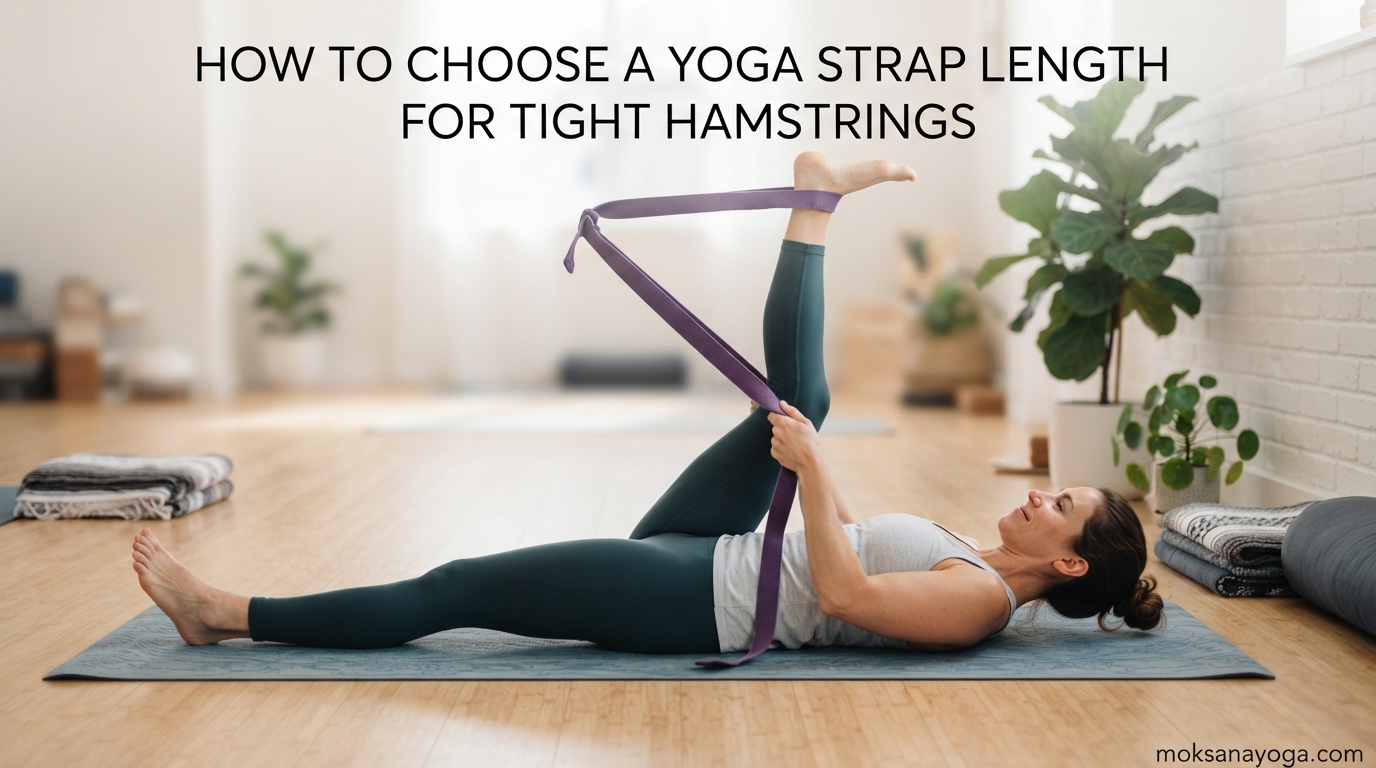
If you have tight hamstrings, a yoga strap can be the single most useful prop in your practice. But pick the wrong length and you will either fight the strap or get zero benefit from it. I have spent years teaching students with stubborn hamstrings, and I want to walk you through exactly how to choose a yoga strap length that actually helps.
This guide covers why length matters, the three standard strap sizes, a height-based chart, a simple measurement method, and the best poses for opening tight hamstrings safely. Everything here is written so you can pick the right strap on your first try and avoid the common mistakes I see in every beginners workshop.
Table of Contents
Quick Answer: What Length Yoga Strap Do I Need for Tight Hamstrings?
For tight hamstrings, most people do best with an 8-foot (240 cm) strap. If you are taller than 6 feet or your flexibility is very limited, a 10-foot (300 cm) strap gives you the extra slack you need to keep good alignment without straining. A 6-foot strap is generally too short for hamstring work unless you are quite flexible and under 5’4″.
Why Yoga Strap Length Matters for Tight Hamstrings
A yoga strap works as an extension of your arms. When your hamstrings are tight, you cannot comfortably reach your foot in poses like reclining hand-to-big-toe (supta padangusthasana) or seated forward fold (paschimottanasana). The strap bridges that gap so you can hold the pose with a long, neutral spine instead of rounding your back.
If the strap is too short, you will yank yourself into the stretch and recruit the wrong muscles. I see this constantly. Students grip hard, their shoulders crawl up toward their ears, and they end up stretching their shoulders more than their hamstrings. The wrong length also tends to pull you out of alignment, which defeats the whole point of using a prop.
A strap that is too long is less harmful but still annoying. You end up with bunched-up webbing in your hands, the buckle slips, and you lose the clean tension that makes a strap effective. The goal is to choose a length that lets you hold the strap ends comfortably while keeping your spine long.
Standard Yoga Strap Lengths Explained (6ft, 8ft, 10ft)
Yoga straps almost always come in three standard lengths: 6 feet (180 cm), 8 feet (240 cm), and 10 feet (300 cm). Some brands offer a 12-foot option for very tall practitioners or restorative setups. Here is how each size breaks down.
6-foot strap: Best for smaller-framed people with decent flexibility. It works well for binding poses like cow face arms or gomukhasana. For tight hamstrings, this length is usually too short to give you the slack you need for reclined or seated hamstring stretches.
8-foot strap: The most versatile option and the one I recommend for most people, especially anyone with tight hamstrings. It gives you enough length for hamstring work, basic bindings, and shoulder openers without excess webbing getting in the way.
10-foot strap: Ideal for taller practitioners (over 6 feet), anyone with very limited flexibility, and restorative poses that require a large loop. If you can barely lift your leg to 45 degrees in a reclined hamstring stretch, this is the length that will keep you safe and comfortable.
Height-Based Yoga Strap Length Chart
Use this chart as a starting point, then factor in your flexibility level in the next section. These are the recommendations I give students in person.
- Under 5’4″ (162 cm): 8-foot strap if hamstrings are tight, 6-foot if flexibility is good.
- 5’4″ to 5’10” (162 to 178 cm): 8-foot strap for almost everyone in this range.
- 5’10” to 6’2″ (178 to 188 cm): 8-foot strap for moderate flexibility, 10-foot for very tight hamstrings.
- Over 6’2″ (188 cm): 10-foot strap, no exceptions for hamstring work.
Notice that I lean toward the 8-foot strap for almost everyone. That is intentional. An 8-foot strap covers the widest range of bodies and poses, and you can always grip further down the webbing if you want less slack.
How to Choose a Yoga Strap Length for Tight Hamstrings: The Flexibility Factor
Height is only half the equation. Your current flexibility level matters just as much, sometimes more. Two people who are both 5’8″ might need completely different strap lengths depending on how tight their hamstrings are.
If you can barely straighten your leg when lying on your back and lifting it toward the ceiling, your hamstrings are very tight. In that case, choose the longer option for your height range. The extra length lets you keep the strap slack enough that you are not forcing the stretch before your muscles are ready.
If you can get your leg to about 70 to 80 degrees with a gentle pull, you have moderate flexibility. The 8-foot strap will likely suit you perfectly. You have enough room to grip with relaxed shoulders, and you can shorten the loop as you open up over weeks and months.
One thing I always tell students: it is better to have too much strap than too little. Extra webbing in your hands is a minor inconvenience. A strap that is too short is a real problem because it forces bad mechanics and can strain your shoulders and lower back.
How to Measure Yourself for the Right Strap Length
If you want a more precise method than the chart, you can measure yourself. This is the technique I learned from a physical therapist years ago, and it works surprisingly well. All you need is a soft tape measure or a piece of string you can measure afterward.
Step 1: Lie on your back on the floor with both legs extended.
Step 2: Lift one leg as high as you comfortably can while keeping it straight. This is roughly the angle where you would use the strap for a reclined hamstring stretch.
Step 3: Have a friend measure from the heel of your lifted foot to your hand position. For most people, your hand should rest comfortably near your hip or side rib, not stretched overhead.
Step 4: Add about 12 to 18 inches to that measurement so you have room to grip the strap ends and create a loop. That total is your minimum usable strap length.
Step 5: Round up to the nearest standard size (6, 8, or 10 feet). For most adults with tight hamstrings, this lands at 8 or 10 feet.
Best Yoga Strap Poses for Tight Hamstrings
Knowing how to choose a yoga strap length for tight hamstrings only matters if you actually use it well. These are the five poses I rely on most for opening tight hamstrings safely.
1. Reclining Hand-to-Big-Toe Pose (Supta Padangusthasana): Lie on your back, loop the strap around the ball of one foot, and hold both ends in the same-side hand. Keep both shoulders grounded. This is the gold-standard hamstring stretch with a strap.
2. Seated Forward Fold (Paschimottanasana): Sit with both legs extended, loop the strap around both feet, and hold an end in each hand. Hinge from your hips, not your lower back. The strap lets you keep a long spine even when your hands are nowhere near your feet.
3. Half-Reclined Hero Variation: If your quads are also tight, the strap can help you ease into this deep stretch without forcing the knee joint. Use a longer strap so you can hold the ends behind your back.
4. Standing Forward Fold with Strap: Stand and loop the strap around your feet, holding the ends as you fold forward. This gives you something to pull against so you can keep your spine long.
5. Restorative Reclined Stretch: Loop a long strap around one foot, then bring that foot overhead toward the floor behind you. A 10-foot strap makes this much more accessible if your hamstrings and hips are tight.
Hold each stretch for 30 to 60 seconds. Anything shorter and your muscles will not relax enough to actually lengthen. Breathe slowly through your nose the entire time.
Buckle and Material Choices That Affect Function
Length gets most of the attention, but the buckle and material also affect how well the strap works for tight hamstrings. The two most common buckle types are the D-ring and the cinch (or slide) buckle.
The D-ring buckle is the classic yoga studio style. It is simple, lightweight, and easy to adjust. The downside is that it can slip if you do not set the buckle correctly. Make sure the webbing passes over the flat bar and back through the rings to lock it.
The cinch buckle holds tighter and is less likely to slip under tension. If you are using the strap at near-max length for hamstring stretches, a cinch buckle gives you more confidence to relax into the pose. I personally prefer cinch buckles for therapeutic work.
For material, always choose a non-stretchy cotton or hemp webbing. Elastic resistance bands look similar but do something completely different. A yoga strap holds a fixed length, which is what allows your nervous system to relax into the stretch. Elastic bands create ongoing tension that keeps your muscles engaged.
Progressing as Your Hamstrings Open Up
One of the most common questions I hear from students is, “When do I shorten my strap?” The short answer is gradually, over weeks or months, not days. Hamstring flexibility changes slowly because the muscles are dense and the connective tissue is tough.
As your flexibility improves, you will naturally grip further down the webbing. You do not need to cut the strap or buy a shorter one. The beauty of an adjustable strap is that it grows with you. The same 8-foot strap that gave you slack on day one will still work when you can nearly reach your foot with your hands.
If you start with a 10-foot strap because your hamstrings were very tight, you may eventually find the extra webbing gets in the way. At that point, usually after several months of consistent practice, you can switch to an 8-foot strap for daily use. Keep the 10-footer for restorative sessions and large loops.
Common Mistakes to Avoid
Even with the right length, a few mistakes will hold back your progress. The most common one is pulling too hard. The strap is meant to support a passive stretch, not to crank your leg further than it wants to go. If your shoulders are tense and your jaw is clenched, you are working too hard.
Another mistake is rounding your spine to reach the strap. Keep your back long and your chest open. The strap exists so you do not have to collapse your posture to get a stretch. If you find yourself hunching, you need a longer strap.
Finally, do not skip the warm-up. Cold hamstrings do not stretch well, and forcing them is how strains happen. Spend five minutes doing gentle movement before you pick up the strap.
FAQs
What length of yoga strap do I need?
For most adults, an 8-foot (240 cm) strap is the best all-around choice. If you are over 6’2u0022 or have very tight hamstrings, choose a 10-foot (300 cm) strap. A 6-foot strap works only for smaller, more flexible practitioners.
How to use a yoga strap for hamstrings?
Loop the strap around the ball of your foot and hold both ends in your hand. Keep your spine long and your shoulders relaxed. Hold the stretch for 30 to 60 seconds per side, breathing slowly, and never pull hard enough to cause pain.
How to choose the right yoga strap?
Base your choice on your height and flexibility. Taller or less flexible practitioners need longer straps. Always choose non-stretchy cotton or hemp webbing with a secure buckle, and pick an 8-foot length if you are unsure.
Does yoga fix tight hamstrings?
Yoga can significantly improve hamstring flexibility with consistent practice. A strap makes poses more accessible so you can stretch safely. Most people see noticeable improvement in 4 to 8 weeks of regular, gentle stretching.
How long should I hold hamstring stretches with a strap?
Hold each hamstring stretch for 30 to 60 seconds. Shorter holds do not give the muscles and connective tissue enough time to release. Repeat each stretch 2 to 3 times per side for the best results.
Conclusion
Choosing the right yoga strap length for tight hamstrings comes down to two factors: your height and how flexible you currently are. For most people, an 8-foot strap is the safest, most versatile choice. If you are tall or your hamstrings are very tight, go with 10 feet. Once you know how to choose a yoga strap length for tight hamstrings, the prop becomes one of the most reliable tools you own for safe, steady progress. Pick the right size, stretch patiently, and let your hamstrings open on their own timeline.