
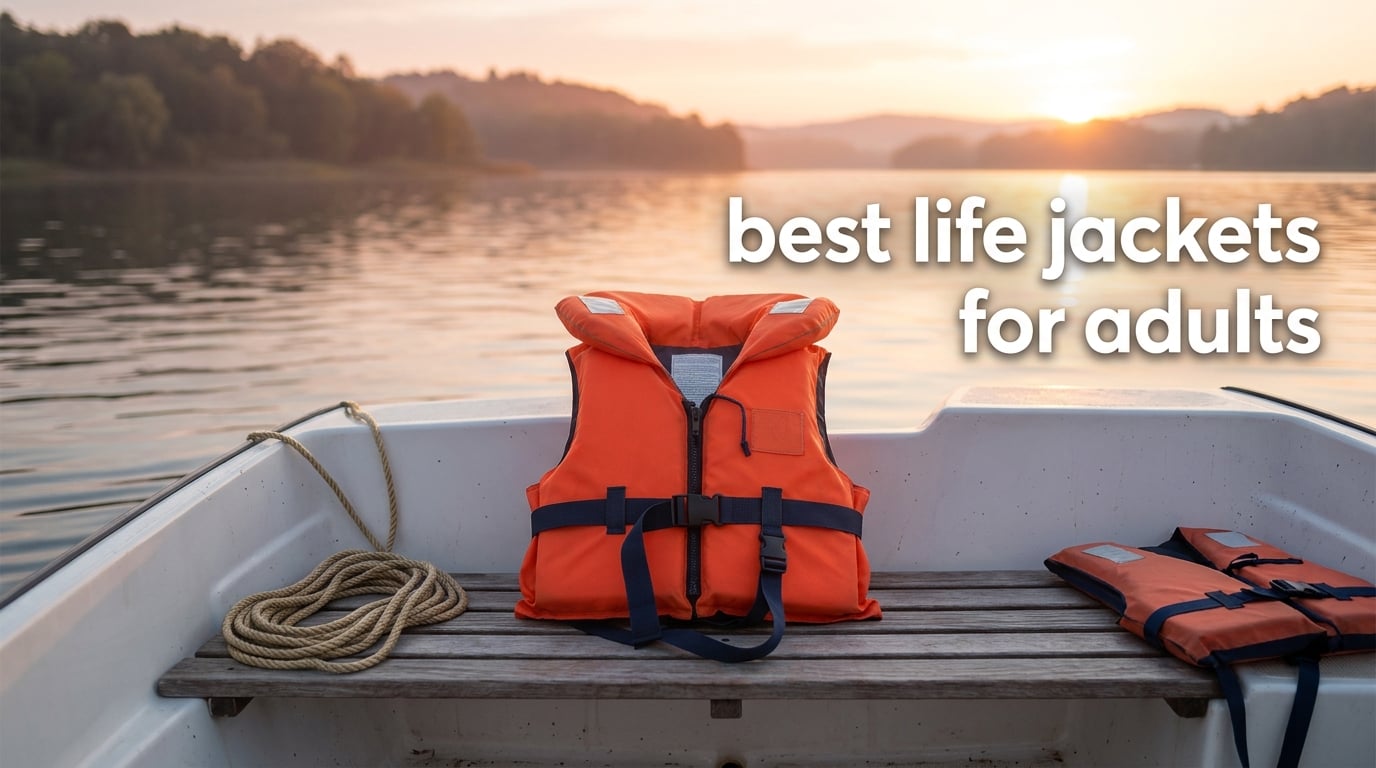
The Coast Guard’s drowning data is the reason this roundup exists. In more than 80 percent of fatal boating accidents, the victim was not wearing a personal flotation device, and putting one on once you are already in the water is close to impossible. That single fact reframes how you should shop: not by price or color, but by whether you will actually keep the vest on for the whole day.
Our quick answer: the O’Neill SuperLite is the best life jacket for adults overall, because it holds more than 9,000 reviews at 4.7 stars, weighs only 16 ounces, and stays out of the way whether you are tubing, kayaking or sitting in a boat for eight hours. If your time is spent on the water in a seat rather than behind a paddle, the Onyx MoveVent Curve is the more comfortable pick, and for kayak anglers the Onyx Kayak Fishing vest is purpose-built.
To be precise about what these products are: an adult life jacket is a USCG-approved PFD, usually a Type III, that adds buoyancy to keep an adult afloat. A true life jacket adds head support to roll an unconscious person face-up. A USCG Type III flotation aid is the correct starting point for most adults, and the USCG sizing standard runs to people 90 pounds and over with a 30-52 inch chest. If you are outfitting a pet rather than yourself, our dog life jacket guide covers the canine side.
We compared 12 USCG-approved adult vests, reading the technical specifications, the sizing charts and thousands of buyer reviews, and we weighted comfort over spec-sheet wins because comfort is what decides whether a vest gets worn. We have not personally tested these in open water, and we say so plainly where it matters.
Table of Contents
Top 3 Life Jacket Picks for Adults in 2026

O’Neill SuperLite Life Vest
- USCG Type III certified
- Lightweight 16 ounce polyethylene foam core
- Four quick-release safety buckles
- Expanded sizing from S to 4XL

Onyx MoveVent Dynamic Paddle Vest
- Dual USCG and Transport Canada approved
- Front and back mesh ventilation
- Back panel fits most kayak and canoe seats
- SOLAS reflective accents and built-in whistle

Stearns Adult Life Vest
- USCG approved Type III adult vest
- Open-sided design with three adjustable buckles
- Nylon shell with lightweight PE flotation foam
- Rated for adults weighing 90 pounds or more
The SuperLite takes the top slot on evidence rather than novelty: more reviews than any other vest here, and a rating that sits at the top of the field. The MoveVent Dynamic is the highest-rated single model at 4.8 stars and the best choice for anyone in a kayak or on a paddleboard. The Stearns is the pick if you want a proven, no-fuss Type III that costs little and covers a wide adult range.
The 12 Best Life Jackets for Adults Side by Side in 2026
Every vest below is USCG-approved and sized for adults at 90 pounds and over. The table covers the full lineup so you can scan buoyancy approach, entry style and intended activity before reading any individual write-up.
| Product | Specifications | Action |
|---|---|---|
| O’Neill SuperLite Life Vest |
|
Check Latest Price |
| Onyx MoveVent Dynamic Paddle Vest |
|
Check Latest Price |
| Stearns Adult Life Vest |
|
Check Latest Price |
 Onyx Kayak Fishing Life Jacket Onyx Kayak Fishing Life Jacket |
|
Check Latest Price |
 O’Brien Impulse Women’s Life Jacket O’Brien Impulse Women’s Life Jacket |
|
Check Latest Price |
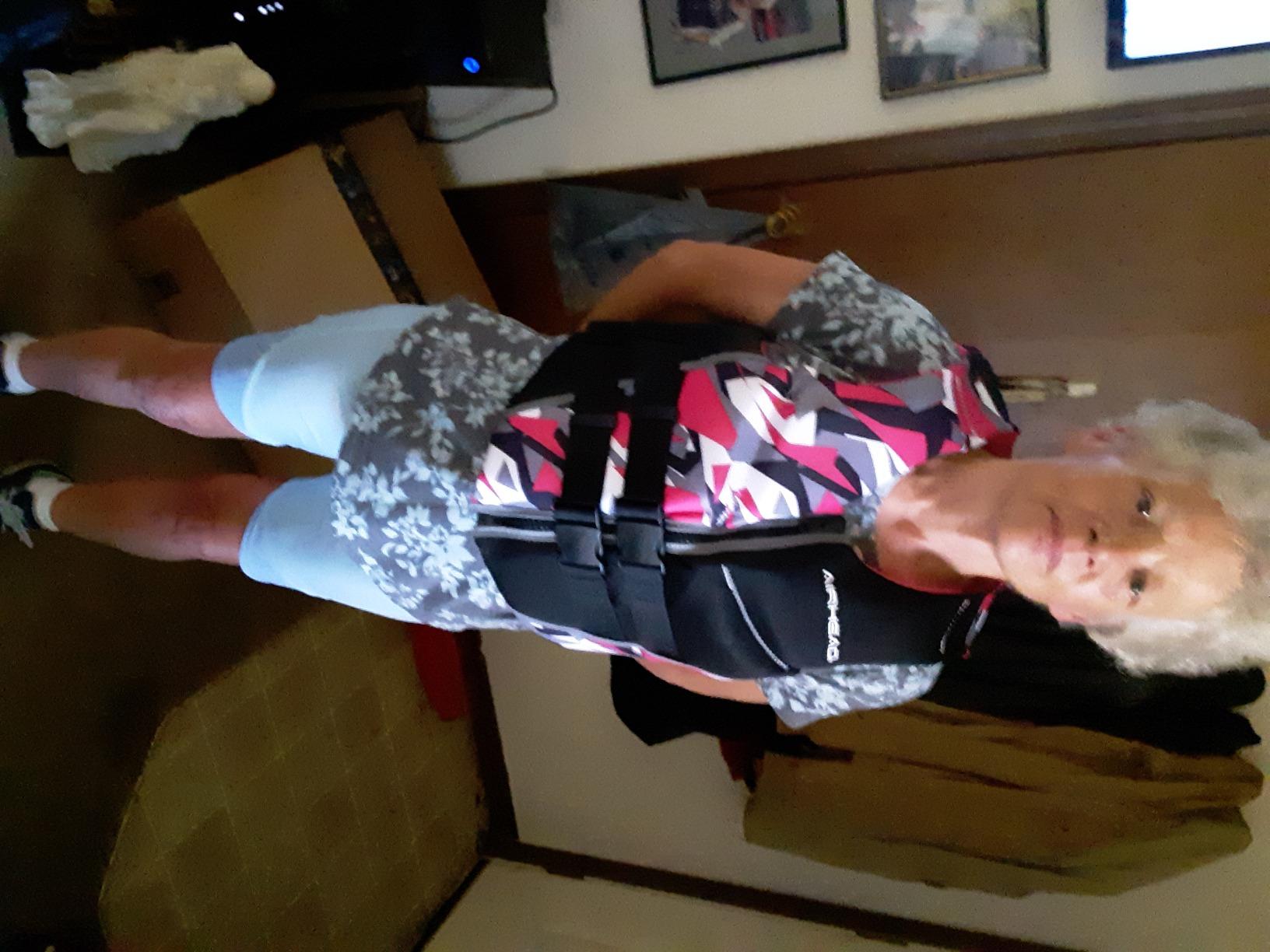
 Airhead Trend Life Jacket Airhead Trend Life Jacket |
|
Check Latest Price |
 Onyx MoveVent Curve Paddle Vest Onyx MoveVent Curve Paddle Vest |
|
Check Latest Price |
 Stohlquist FIT Adult Life Jacket Stohlquist FIT Adult Life Jacket |
|
Check Latest Price |
 Airhead General Purpose Life Jacket Airhead General Purpose Life Jacket |
|
Check Latest Price |
 Airhead CAMO Cool Neolite Flex Vest Airhead CAMO Cool Neolite Flex Vest |
|
Check Latest Price |
 awesafe Adult Watersport Universal Vest awesafe Adult Watersport Universal Vest |
|
Check Latest Price |
 Seachoice Life Vest Type II Seachoice Life Vest Type II |
|
Check Latest Price |
Two things stand out. First, every product here is foam-based and inherently buoyant, which is the right default for most adults. Second, the lineup splits cleanly by use: seat-compatible and pocketed vests for anglers, ventilated mesh vests for paddlers, and shaped cuts for women and smaller adults.
How to Choose an Adult Life Jacket: Type, Level, Color and Fit
Life jacket vs life vest vs PFD vs buoyancy aid
These four words are used interchangeably in conversation but mean different things on a label. A buoyancy aid is the mildest category and is what swim schools and pool toys use. A PFD is the Coast Guard’s term for any approved flotation device. A life vest is the everyday word for a PFD, and a technical life jacket is one that also turns an unconscious wearer face-up. Almost every vest in our list is a Type III, which floats you but does not guarantee a face-up position if you are unconscious.
The distinction matters in one scenario above all. Offshore and cold water, where an unconscious face-down floater is the actual mechanism of death, is where a Type II with head support earns its bulk. If your boating happens on a lake or a river in summer, a Type III is lighter, cooler and cheaper, and it is what the vast majority of recreational adults should buy.
Type II vs Type III: which one adults actually need
For most adults, a Type III is the right choice. A Type II is designed with enough flotation behind the head to roll an unconscious wearer face-up in calm water, and that extra foam is why it feels heavier and restricts paddling motion more. Coast Guard Type II jackets are still common in commercial and passenger settings, and among recreational products the Seachoice four-pack is the clearest example.
Type III is the workhorse category for a reason. It is approved for boating, tubing, waterskiing, wakeboarding, kayaking, canoeing, sailing and general paddling, and it is what nearly every competitor’s top pick also is. Type V is a special-use designation for offshore racing and similar, and it is not part of this list.
Foam vs inflatable vs hybrid, and where inflatables are unsafe
Foam vests are inherently buoyant, meaning they work the instant they hit the water with no moving parts and no maintenance. That is the entire reason every pick in this roundup is foam. Inflatables store a CO2 bladder that deploys on a pull tab or a water-activated sensor, so they are cooler and lighter to wear, but they need a cartridge replaced after every deployment, they need to be re-armed on a schedule, and some automatic models have fired unexpectedly in cold water.
There are hard limits on inflatables. They are not appropriate for whitewater, wakeboarding, waterskiing or any high-impact tow activity, because you need flotation at the moment of impact rather than after a pull. They are also not recommended for anyone who is not a confident swimmer, or for children under 16. For an angler who sits in a boat seat for eight hours in July, an inflatable may feel right until you remember the annual cartridge cost and the re-arming routine.
What color life jacket is safest
High-visibility orange, red and international orange are the safest colors on the water, because they hold contrast against both dark and bright water and stand out in low light. Yellow reads as high-vis to most people and is a common paddling choice, but it blends into glare off calm water in the middle of a sunny day. Dark navy and black vests are the least visible and are really only acceptable if the wearer also has reflective detailing. For night watches and dusk paddling, SOLAS-grade reflective tape matters more than the base color, and several vests here include it.
The Seachoice Type II in this list is pure high-visibility orange, and the Onyx MoveVent Dynamic carries SOLAS reflective accents. Match the color to the light: a bright shell for daylight cruising, reflective trim if you will be out at dusk or on an early watch.
How to measure your chest and test the fit in three steps
Size by chest circumference, not by body weight. Measure across the fullest part of your chest, keep the tape level all the way around, and compare that number to the brand’s size chart before you order. The USCG adult standard covers a 30-52 inch chest at 90 pounds and up, but graded sizing varies wildly between brands, so an XL from one maker can be a medium from another.
Then run the three-step fit check. First, tighten every strap and buckle so the vest is snug, not loose. Second, grab the vest at the shoulders and pull upward, which should not move it more than an inch or so. Third, confirm it sits snug at the waist and ribs and does not ride up when you bend forward. If it rides up in the shop, it will ride up on the water, and that gap between the foam and your chest is what keeps an adult from floating at the right height.
What not to buy: unapproved marketplace PFDs
The single most useful thing you can check before buying anything is the USCG approval label sewn into the shell. Every legitimate PFD carries one, listing the Type, the level, the manufacturer’s name and the approval number. If a listing shows no interior label, or a product claims approval without one, walk away. Buyers on the forums report that unapproved and counterfeit PFDs sold on major marketplaces are a documented problem, and a vest that has never been through approval testing is a decoration, not a flotation device.
The other two red flags are a label listing no applicable water activities, and a vest with no way to adjust the torso length when you sit down. If the sizing chart is missing entirely, assume the seller could not find one.
Care, storage and when to replace a life jacket
Rinse with fresh water after use in salt or muddy water, dry it out of direct sun, and store it somewhere dry rather than in a hot car or a damp locker. UV exposure degrades the shell fabric and webbing over time, and the hardware is the part that fails first. Check the buckles, zippers and stitching each season before you rely on it, and replace the whole vest if the foam feels compressed, the shell is faded or the webbing looks thin or fuzzy.
Treat an unexplained drop in buoyancy as a retirement signal rather than something to work around. Foam does not recover from compression, and a vest that once held you high enough will not again. Whatever interval the label gives you, replace on condition rather than on the calendar, and never use a life jacket as a seat cushion, a tow rope anchor or a kennel pad.
1. O’Neill SuperLite Life Vest – Best Overall for Adults
O’Neill Men’s Superlite USCG Life Vest,Black/Lime/Smoke:Lime,XL
Type III certified
16 ounce PE foam core
100% polyester shell
Engineered drain holes
Sizing S to 4XL
Pros
- Very low-profile foam that avoids arm chafing when paddling
- Four adjustable buckles hold a secure snug fit
- Runs true to size and holds larger adults in place
- Expanded sizing from S to 4XL
- Styling owners frequently compliment
Cons
- Men's medium can run small for some wearers
- Basic buoyancy level rather than heavy flotation
- Snug fit is not ideal for anyone uneasy in the water
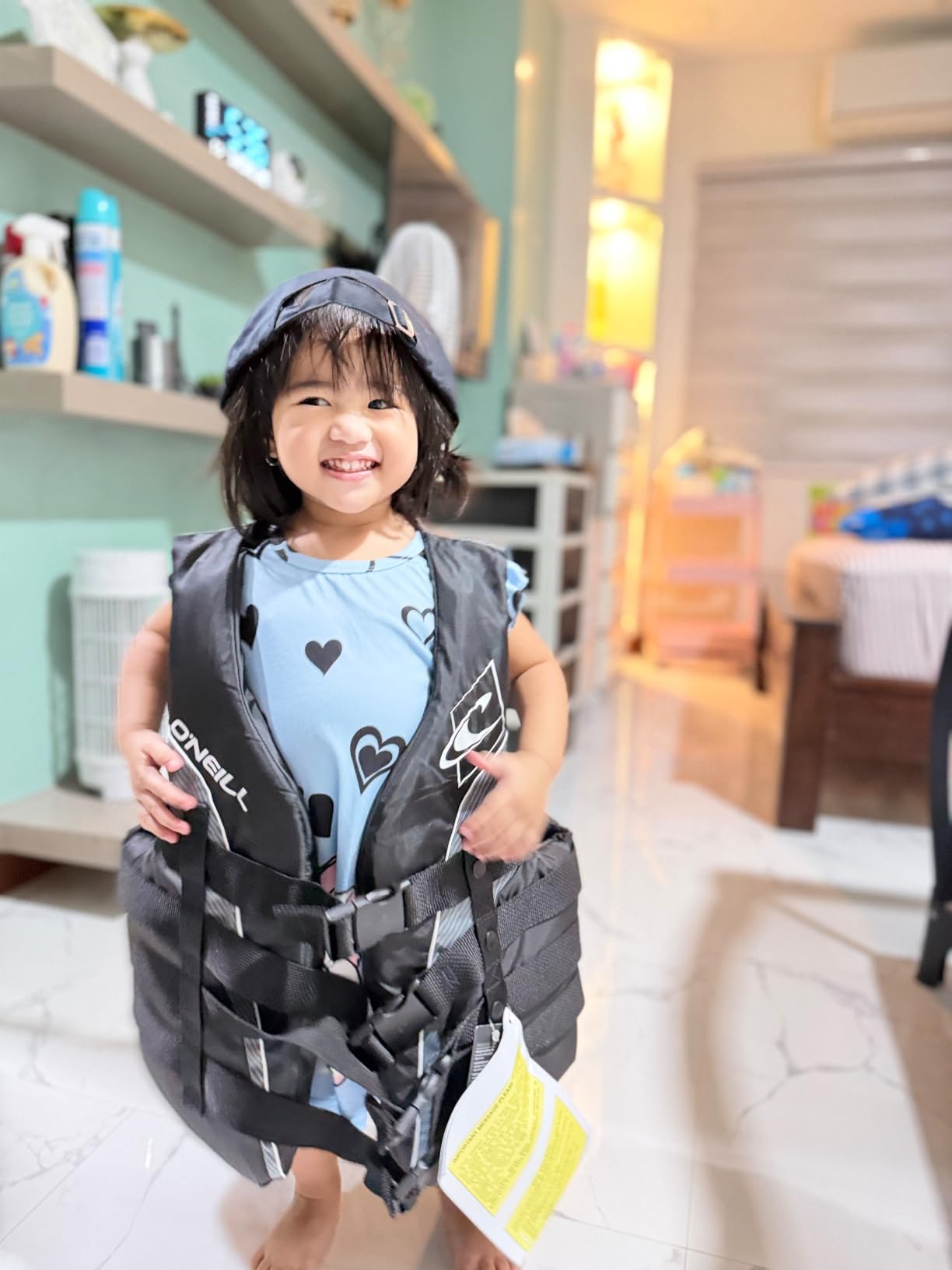
This is the vest I keep coming back to because the evidence base behind it is the deepest in the category. More than 9,000 reviews at 4.7 stars is not a thin sample, and the pattern in those reviews is remarkably consistent: people like that it disappears on the body. At 16 ounces with a thin polyethylene foam core, it is one of the least intrusive vests here, and that is exactly what determines whether you leave it on at hour six.
The four quick-release buckles are the detail that separates it from a three-buckle bargain vest. Three buckles tend to leave a gap, and that gap is where water gets in and where the vest rides up. With four, the SuperLite can be cinched snug at the ribs and stays there.
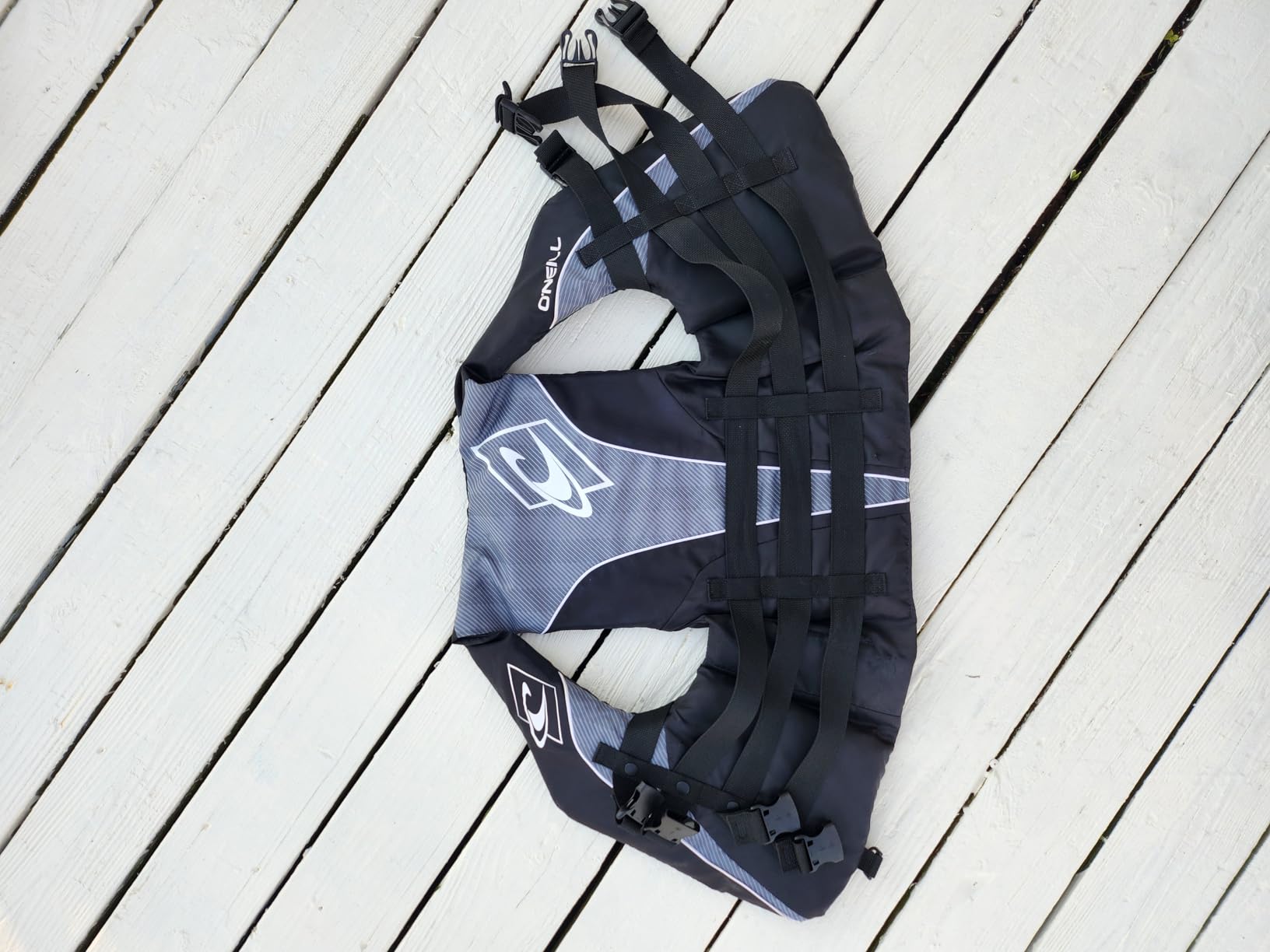
The USCG calls for a very snug fit, and this model is built for that, which is why the sizing advice matters. O’Neill recommends sizing up between sizes, and the run extends from small all the way to 4XL, one of the widest ranges in this roundup. For a taller adult who has been squeezed into an XL from a brand that grades small, that range is the reason to look here first.
The engineered drain holes and overlock stitching are unglamorous but real. Drain holes matter on a wet seat, and strong stitching is what separates a vest that survives five seasons from one that delaminates in two. The polyester shell also dries faster than neoprene, which matters if you are in and out of the water all day.
Who it fits and who it does not
This one suits confident swimmers and near swimmers in calm and warm water, anyone doing tubing, wake sports or general boating, and any adult who wants a vest light enough to forget. It is a genuinely strong choice for larger adults, because of the sizing range and because the four-buckle design holds a fuller frame properly.
It is a poor match for a non-swimmer. The thin foam here provides basic flotation, not enough to hold a weak swimmer’s head clear, and reviewers make that point consistently. If you are not confident in open water, buy something with more flotation behind the shoulders instead. The snug fit is also not ideal if you dislike the sensation of being held tightly.
Fit notes that matter before you buy
Measure your chest and check it against the size chart rather than assuming your usual size carries over. O’Neill explicitly recommends sizing up between sizes because the USCG fit standard is snugner than a streetwear fit. If you are between a small and a medium in the chart, take the medium and tighten the extra webbing.
Pay attention to whether you will be wearing it over a heavier outer layer. A vest fitted close over a t-shirt can feel restrictive once you add a windbreaker in the fall, and the low-profile foam gives you less give than a neoprene model would.
2. Onyx MoveVent Dynamic Paddle Vest – Best for Kayaking, Canoeing and SUP
Onyx MoveVent Dynamic Paddle Vest Adult Life Jacket, USCG/TC Approved
Dual USCG and Transport Canada approved
Front and back mesh panels
Back panel fits most seats
1.7 lb weight
Fits 90 pounds and over
Pros
- Excellent front and back mesh ventilation for long paddles
- Back panel clears most kayak and canoe seats
- Large armholes allow unrestricted paddle rotation
- Reflective accents whistle and lash tab add real utility
- Highest rating in this roundup at 4.8 stars
Cons
- Sculpted foam adds bulk against a low-profile vest
- Higher cost than basic foam alternatives
At 4.8 stars across 3,835 reviews, this is the highest-rated vest in the roundup, and for paddling the reasoning behind that rating is easy to see. The mesh ventilation panels run across both the front and the back, and on a long paddle in summer heat that is the difference between a vest you tolerate and one you look forward to wearing.
The back panel is the part that gets missed on generic vests. It is cut so the foam sits below the top of a typical kayak or canoe seat backrest, which means the seat does not press a hard block of foam into your spine for three hours. Anglers who switch from a boat seat to a kayak will recognize that immediately.
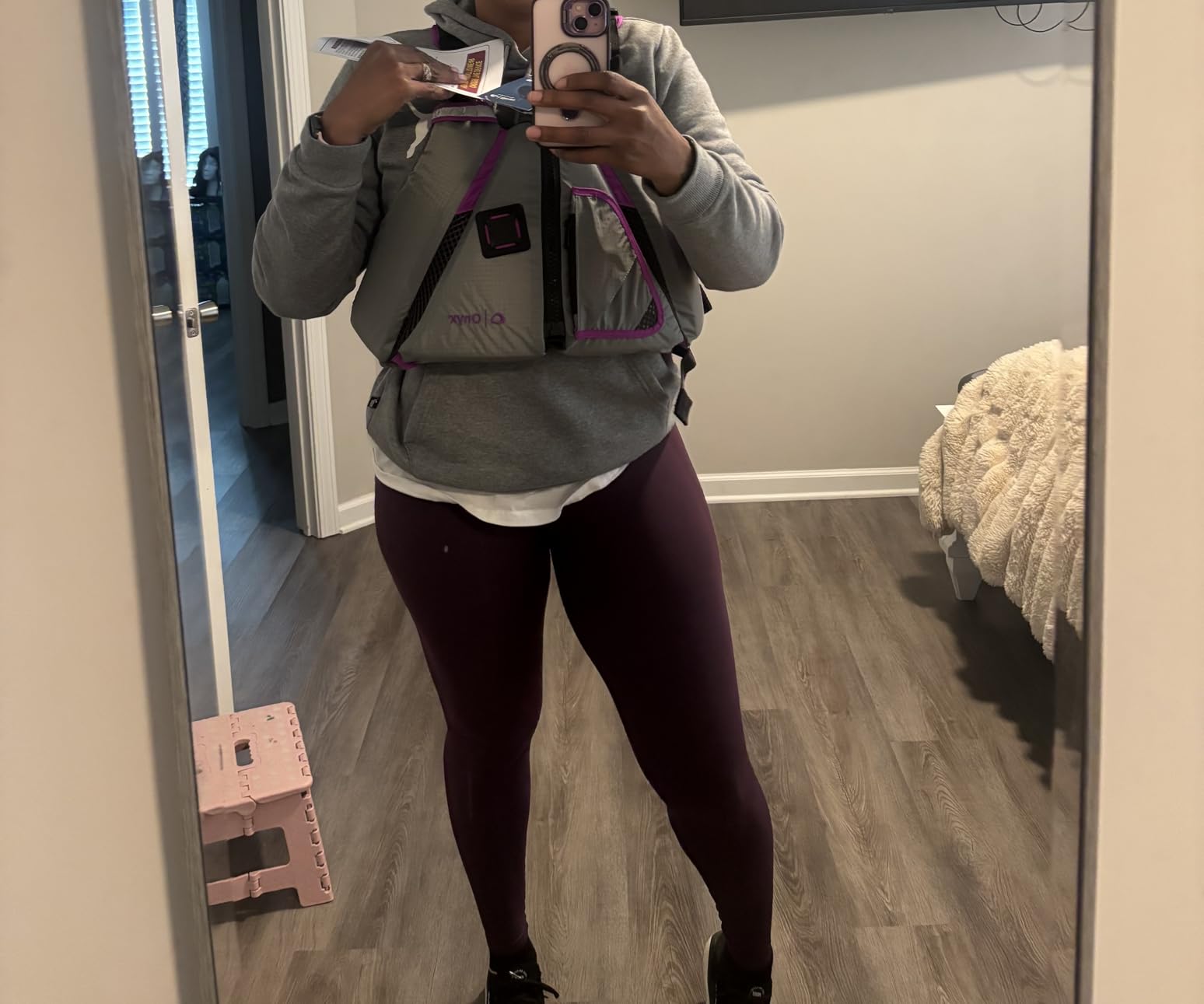
Large armhole openings are what make this a paddling vest rather than a boating vest. With open sides and generous armholes, the shoulder rotation through a full forward paddle stroke is unrestricted, and the adjustable side belts and shoulder straps with neoprene fabric keep the foam from sliding off the chest during a sprint to catch a wave.
The small details add up. There is a built-in whistle, a lash tab for clipping a knife or a strobe, SOLAS-grade reflective accents for dusk, and an expandable zippered pocket for a phone or a sandwich. Dual USCG and Transport Canada approval also means the vest is legal for Canadian waters, which matters if you cross the border.
Who it fits and who it does not
This is the right pick for recreational kayakers, canoeists, stand-up paddleboarders and anyone whose day on the water is measured in hours rather than minutes. It is also a strong general boating vest if you run hot or wear a lot of layers and need airflow.
It is the wrong choice if you need a genuinely flat profile under a seat harness or a spray skirt, because the sculpted soft foam is a full centimeter thicker than a minimalist vest. It is also a poor match for someone who needs maximum flotation in cold water, since a mesh-and-thin-foam design optimizes for airflow, not buoyancy.
What to check before ordering
Confirm the back panel clearance against your specific seat. Most canoe and kayak seats work, but molded rigid seats and high-back fishing chair frames can still push into the foam, and that is worth testing in a shop if you can.
Check the size range carefully, because Onyx grades by chest and the fit is snug by design. Reviewers note that the sculpted foam adds bulk, so if you are between sizes and want ventilation rather than buoyancy, take the smaller. If you want the vest to sit flat and stay high on the body, take the larger and cinch the side belts down.
3. Stearns Adult Life Vest – Best Value for Everyday Boating
Stearns Adult Life Jacket, USCG Approved, Standard & Oversized Fits
USCG approved Type III
Nylon shell with PE foam
Open-sided with three buckles
19.87 g weight
Standard and oversized fits
Pros
- Lightweight and not overly bulky for long wear
- Three adjustable buckles give a workable fit for many adults
- Bright red and blue options improve visibility
- Nylon shell holds up to repeated seasonal use
- Large base of 6700 plus reviews
Cons
- Standard fit can run loose on smaller adults
- Only two sizes cover the whole adult range
- Brand labeling of intended activities is unclear
The Stearns is the vest I would hand to a friend who wants a first adult PFD and does not want to think about it. It is a Coast Guard approved Type III with a soft nylon shell and lightweight PE flotation foam, and more than 6,700 reviews at 4.6 stars have settled the question of whether it works. It does.
The open-sided design is the smart part. Leaving the sides open lets air move across your torso instead of trapping it, which is why reviewers single this out as cooler than the brand’s closed-side models. It is a small thing that matters a great deal in July, and it is also why paddlers like the thinner front panels when they need clearance for a paddle shaft.
Three adjustable buckles give a workable fit across a wide adult range, and reviewers frequently note they prefer it to pricier alternatives for that reason alone. The bright red and blue color options are a genuine safety plus on open water, where a navy vest is very hard to spot from a distance.
It is rated for adults weighing 90 pounds or more, and it comes in standard and oversized fits. That is a narrower size ladder than the O’Neill SuperLite, so if you have a very large chest, check the chart before you settle, and consider the oversized version rather than relying on strap adjustment alone.
Who it fits and who it does not
This is a good fit for weekend boaters, anglers on a bass or pontoon boat, and anyone who wants a vest they will wear without thinking about it. Because it is open-sided and thin through the front, it also works for casual canoeing and flat-water kayaking.
It is not the right pick for a very small adult, because the standard fit runs loose on shorter, narrower wearers and a loose vest will ride up. It is also not a good match for offshore or cold-water work, where you want more flotation than this provides and a vest that holds you high rather than one that merely keeps you on the surface.
Fit notes that matter before you buy
Two sizes is the main limitation, so measure first and pick deliberately between standard and oversized. If your chest sits at either extreme of the range, the adjustment buckles have a lot of work to do, and a loose vest on a boat is exactly the failure mode the Coast Guard data warns about.
Reviewers also note the brand’s labeling of intended water activities is somewhat unclear, so check the USCG label inside the shell rather than relying on the product description. And if you will be wearing it over a jacket, size up, because nylon over nylon is a lot of bulk in cold weather.
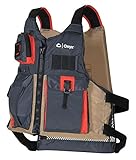
4. Onyx Kayak Fishing Life Jacket – Best for Anglers Who Sit All Day
Onyx Kayak Fishing Life Jacket – USCGA PFD/Life Jacket with Multiple Pockets, High-Back Design & Adjustable Straps for Paddle Sports & Fishing
High-back cut for kayak seats
Multiple zippered pockets and tool holders
Mesh lower back and shoulders
1.4 lb weight
Oversize universal fit
Pros
- Multiple pockets and tool holders keep gear within reach
- High-back design sits well against a kayak seat
- Mesh lower back and shoulders ventilate on long sessions
- Fleece-lined pockets and neoprene shoulder pads for all-day comfort
Cons
- Bulkier and heavier than minimalist paddling vests
- Oversize cut can feel roomy on smaller wearers
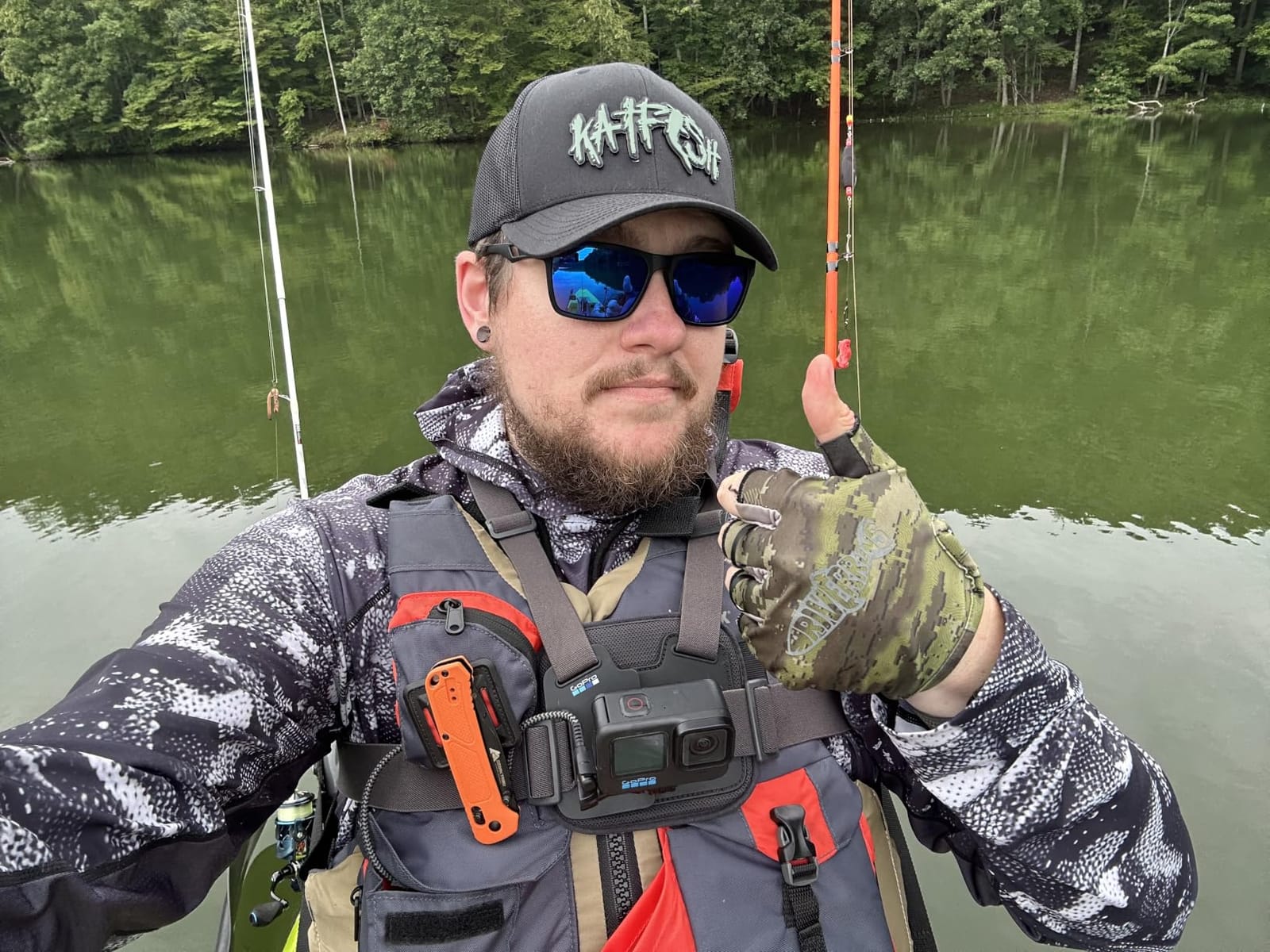
An angler wears a vest very differently from a paddler. You are not reaching overhead for a stroke, you are casting, baiting and then sitting still for a long time, and every pocket becomes a feature. Around 4,400 reviews at 4.7 stars describe exactly that experience with this vest, and the storage layout is the first thing buyers mention.
The multiple zippered pockets and tool holders keep lures, line and a small tool within reach without going to a tackle bag on the deck. The fleece lining stops hardware and hooks from digging into your hands, which over a full day is a bigger comfort factor than it sounds.
The high-back cut is the part that separates this from a fishing life jacket designed for a boat seat. Sitting in a kayak with a high-backed seat, a standard vest puts a flat slab of foam straight into your lower back. This one is cut so the seat supports you instead of fighting you, and reviewers consistently confirm it works.
Neoprene shoulder pads and mesh panels on the lower back and shoulders handle the other long-session problem, which is heat. The heavy-duty nylon shell is durable enough for repeated contact with a seat frame and for gear hooks, and the D-ring attachments give you somewhere to clip a net or a pair of pliers.
Who it fits and who it does not
This is the vest for kayak anglers and for anyone fishing from a seat for eight hours, whether that is a boat, a pontoon or a kayak. The pockets make it genuinely useful on a boat too, and the ventilation makes it a reasonable choice for warm-weather fishing generally.
It is a poor choice for a smaller adult. The oversize cut is roomy, and reviewers flag that directly, so a smaller wearer will spend the day cinching down straps to stop the vest shifting. It is also a poor match for waterskiing or wakeboarding, where you need a snug low-profile fit and do not want loose pockets swinging.
What to check before ordering
Measure your chest and compare it to the oversize range, because the roomy cut means a smaller wearer is at the wrong end of it. If you are between this vest and a minimalist paddling vest, the deciding question is how much gear you need to carry on your body rather than in a bag.
Also think about your seat. The high-back design works with kayak and canoe seats and with most boat seat backs. If you sit in a tall, rigid fishing chair with pronounced lumbar support, try it before committing, because that kind of support is exactly the shape the high-back cut is designed to accommodate.
5. O’Brien Impulse Women’s Life Jacket – Best Shaped Fit for Women
O’Brien Women’s Impulse Neo Life Vest, Purple, Medium
Women's specific cut with shorter torso
Type III approved
Neoprene construction
1.7 lb weight
Zip closure with adjustable straps
Pros
- Women's-specific cut gives chest room without squashing
- Shorter torso length sits well on a seat or ski
- Neoprene conforms to the body comfortably
- Does not ride up when correctly sized
- Styled colors and patterns
Cons
- Sizing runs small against some brand charts
- Neoprene is warm when worn out of the water
- Not ventilated like a mesh paddling vest
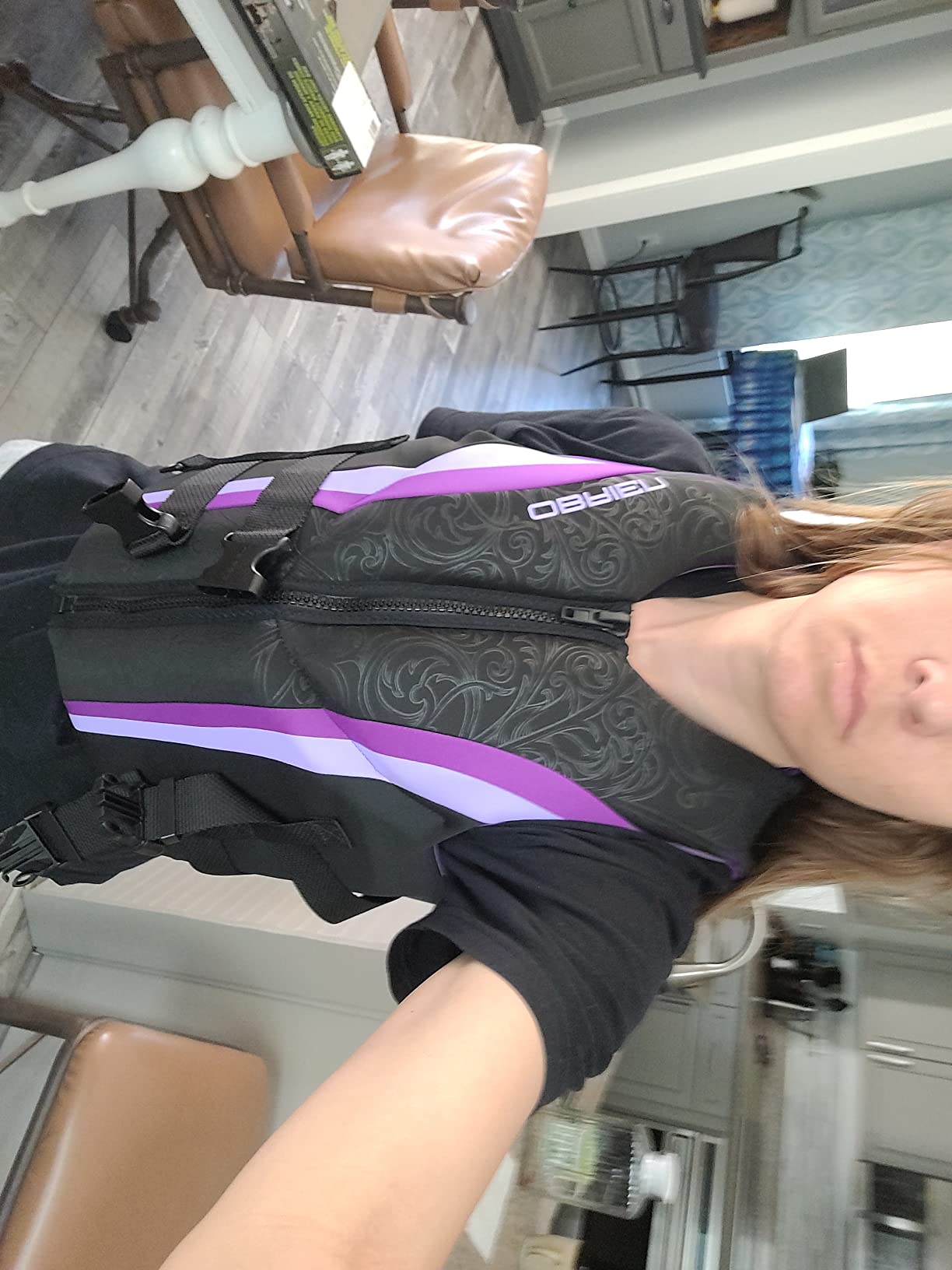
Almost every unisex PFD is built from a male torso template, and the result is a fit that either squashes the chest or leaves a loose panel across the front. Over 4,300 reviews at 4.7 stars single this out as one of the better women’s-specific PFDs, and the specific cut is the entire reason. The torso runs shorter so the vest does not bunch up under a boat seat or ride up on a water ski.
Neoprene is the material choice that makes the shaped fit work. It stretches and conforms to the body rather than fighting it, and it also grips, which is why reviewers report that once correctly sized it stays where it is in the water instead of sliding upward.
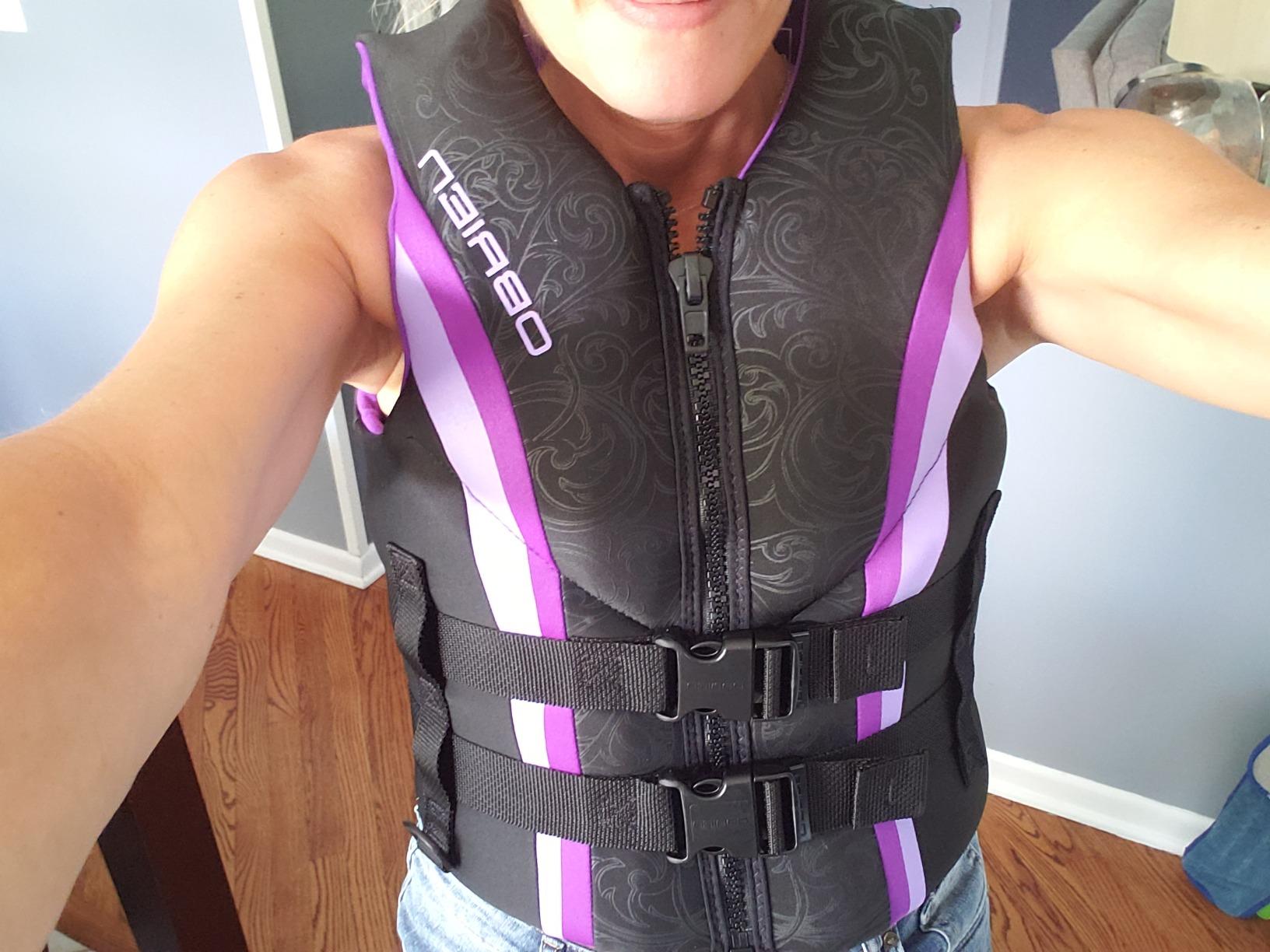
The full zip closure is worth mentioning because a zip is easier to get on and off in a sequence of moves than buckles, and on a PWC or a wakeboard you will be getting in and out of a seat several times a session. Adjustable straps let you dial in the fit, and the Coast Guard Type III approval covers waterskiing, wakeboarding, wakesurfing, PWC use and general boating.
If you have been sizing up in unisex vests to get room in the chest, this is the alternative. A shaped vest lets you take the size that fits your torso instead of the size that compensates for a pattern that was not designed for you, and that difference shows up as comfort rather than as a number.
Who it fits and who it does not
This is a good fit for women who have found unisex vests uncomfortable, and for anyone doing PWC, waterskiing, wakeboarding, wakesurfing or boating where a snug fit and easy on-off matter. It works well for a curvy fit because the neoprene gives rather than gaps.
It is a poor choice for hot-weather fishing or a long summer paddle, because neoprene is not ventilated and reviewers note it is warm out of the water. If you are out for eight hours in the sun, a mesh panel vest like the Onyx MoveVent Dynamic is a better tool, even if the fit shaping here is more flattering.
What to check before ordering
Sizing is the whole game with this one. Reviewers repeatedly warn that sizing runs small relative to brand charts, so measure your chest and check the manufacturer’s size chart rather than going by your usual label size. The consistent advice in the reviews is to size up.
Then test the torso length. The short cut is the whole advantage here, and it means less adjustment range if you are very tall. If you have a long torso and a high-backed seat, compare the shoulder strap position against the seat back before you commit.
6. Onyx MoveVent Curve Paddle Sports Life Vest – Best Low Profile for Seated Comfort
Onyx USCGA and Transport Canada Approved Curve Paddle Vest
Low-profile compact foam
Front and back mesh panels
Large armholes
1.2 lb weight
90 pounds and over
Pros
- Low-profile foam sits well without bunching at the neck
- Mesh ventilation stays cool including in salt water
- Large armholes leave the arms free for a full stroke
- Smooth easy-throw zipper with alignment tab
- Bright color adds visibility near boat traffic
Cons
- Back panel can sit higher than some kayak backrests
- Medium-large can run large for smaller paddlers
- Webbing and fabric are functional not premium
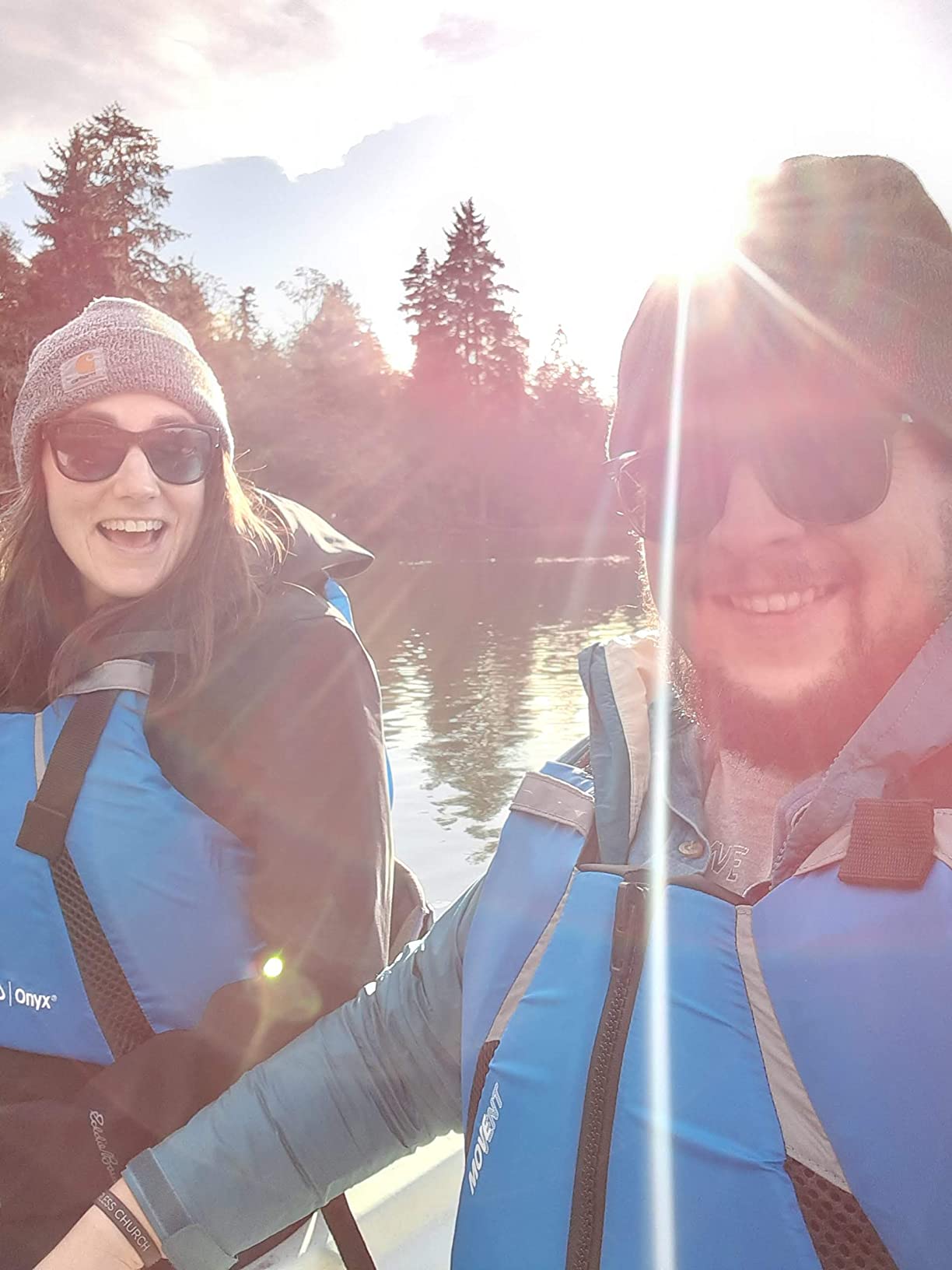
The Curve is the MoveVent Dynamic’s lower-profile sibling, and around 3,700 reviews at 4.7 stars describe it as the one to buy if the Dynamic feels like too much vest. The compact foam sits flat against the chest and, more importantly, does not bunch up around the neck when you sit down. That is a small detail until you spend four hours in a boat seat and the padding is pressing against your jaw.
It is also the lighter of the two at 1.2 pounds, and reviewers note the mesh ventilation holds up even in salt water, which is useful for anyone launching from a beach rather than a dock.
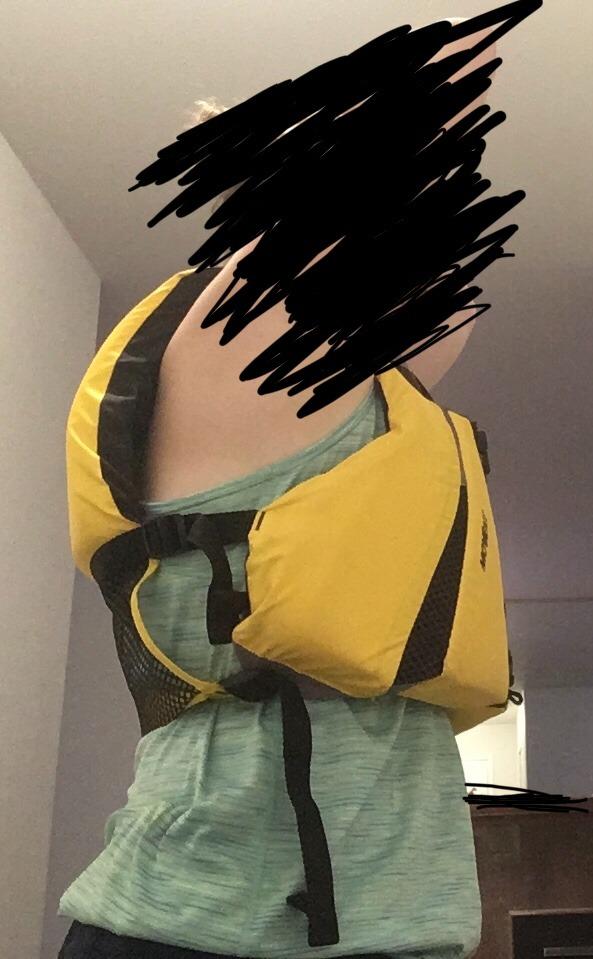
The zipper deserves a mention because it is a smooth easy-throw front zip with a small alignment tab, so you are not fighting the closure one-handed while standing on a swim platform. Large armholes leave the arms free for a full paddle stroke, and the open sides give the airflow that a closed-side foam vest cannot.
Dual Coast Guard and Transport Canada approval covers the same ground as the Dynamic, and the ripstop nylon shell with adjustable side belts and shoulder straps is built to survive years of sun and salt. It fits people 90 pounds and over.
Who it fits and who it does not
This is a strong pick for long days seated in a small boat, for SUP riders who want a flatter profile, and for anyone who finds the sculpted foam on the MoveVent Dynamic too thick. It is a very reasonable general boating vest for a family.
It is not the best choice if you need a high-back panel that sits below a tall kayak backrest, since some paddlers report the back sits slightly higher than they would like. It is also not the right pick for very small paddlers, because the medium-large runs generously.
What to check before ordering
Size down from your usual if you are small, because reviewers flag that this runs large. At the same time, do not size down far enough to compromise the strap adjustment, because a vest that cannot be cinched is a vest that rides up.
Compare the back panel height against your seat back before ordering. If you sit in a molded high-back kayak seat, spend a few minutes testing a similar low-profile vest in a shop first, since that is the one place this design gives ground to the MoveVent Dynamic.
7. Stohlquist FIT Adult Life Jacket – Best for Big and Tall Adults
Stohlquist FIT Adult Life Jacket, US Coast Guard Approved Type III Life Vest, PFD for Men and Women, Easily Adjustable, Lightweight and High Buoyancy – Universal Fit (30-52″ Chest)
Universal 30-52 inch chest fit
Sculpted low-profile foam panels
200D nylon with box-stitched webbing
0.7 lb listed weight
Three front buckles plus side straps
Pros
- Genuinely low profile and light with unrestricted arm movement
- Sculpted foam resists ride-up better than three-buckle vests
- Box-stitched webbing and 200D nylon hold up over time
- Wide 30-52 inch chest adjustment range
Cons
- PE foam feels firm rather than plush for long sessions
- Universal one size may not suit chest sizes at the outer edges
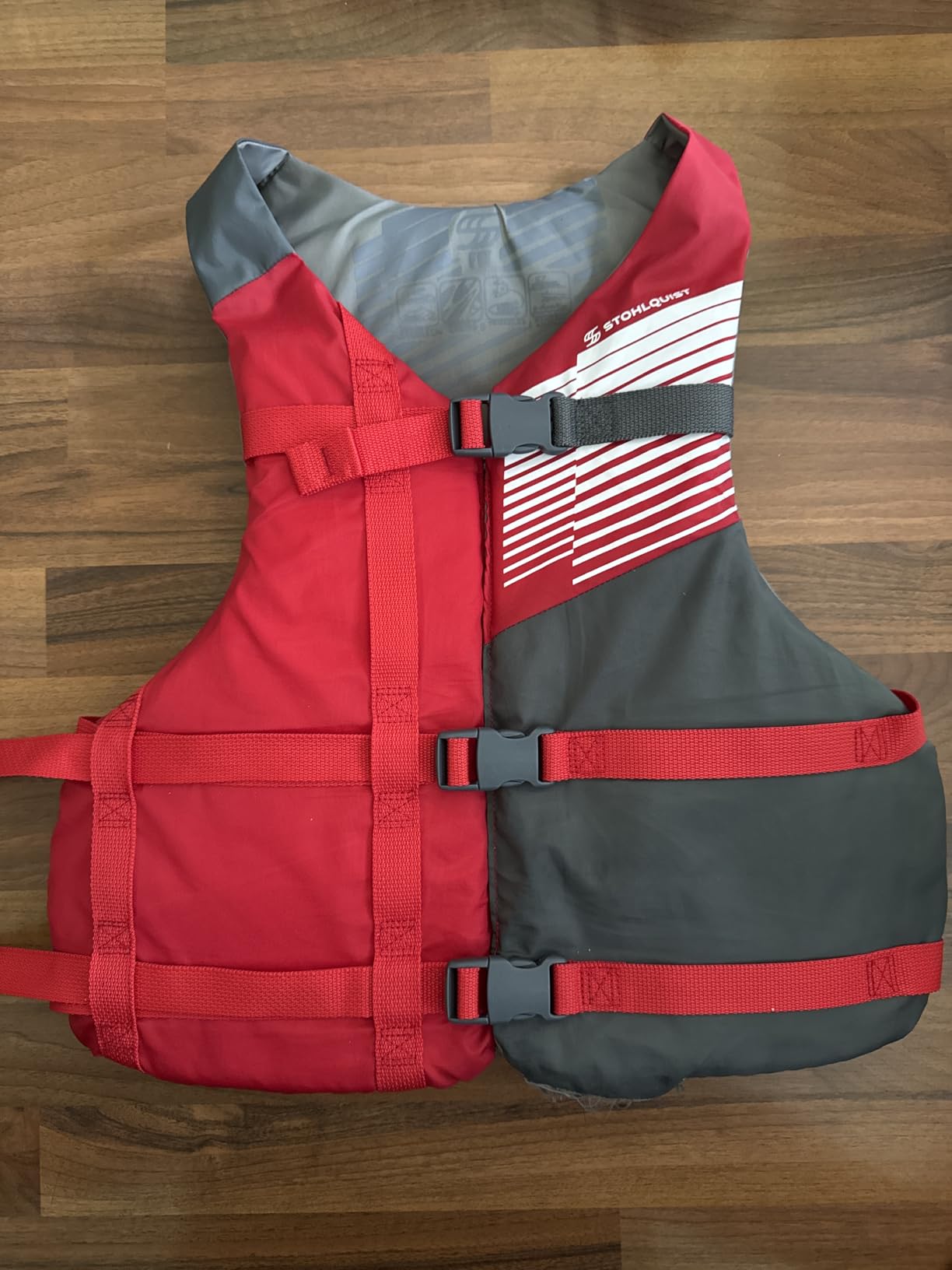
Stohlquist has been building PFDs since 1977, and the sculpted foam panel approach in this vest is the direct result of that history. The panels are shaped and the back is low-profile, which is a deliberate answer to the ride-up problem that the forums complain about most often. Buyers note that it resists shifting better than traditional three-buckle vests, and the three front buckles plus side straps give you more adjustment points than most.
The listed weight of 0.7 pounds makes this one of the lightest foam vests in the roundup, and reviewers single out how quickly they forget they are wearing it. That is the whole point for someone who has decided they dislike bulky foam.
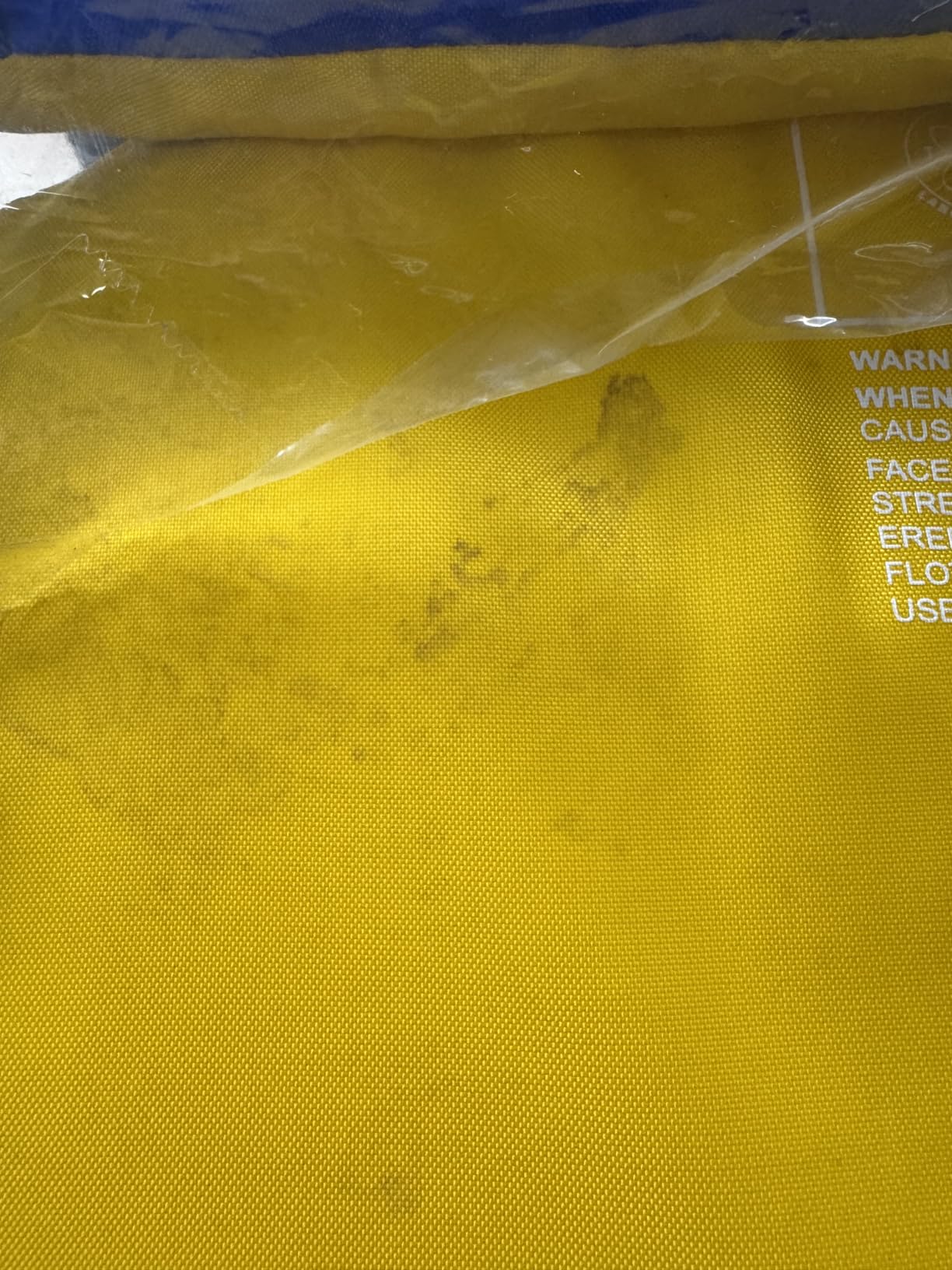
Construction details are what separate a vest that lasts from one that does not. Box-stitched webbing is stronger than a simple overlock seam at the same junction, and the 200D nylon outer shell resists abrasion from boat seats, tackle boxes and gear hooks. It is Coast Guard and Transport Canada certified as a Type III for adults 90 pounds and up.
Fit is adjustable across a 30-52 inch chest, which is the USCG adult range, and the sculpted panels mean the foam stays put rather than migrating. For fishing, paddling or SUP, that unrestricted arm movement is the practical advantage: you are not casting around a slab of foam.
Who it fits and who it does not
This is a good fit for larger adults who need a wide adjustment range without the bulk of a full vest, and for paddlers and anglers who want a very low profile. The sculpted panels are the strongest anti ride-up design in this roundup.
It is a less good fit if you plan to wear a vest for eight hours straight and prefer a plush, conformal feel, because PE foam is firm and does not mold to you the way neoprene does. Reviewers describe the feel as functional rather than premium, and that is accurate.
What to check before ordering
Because it is a universal one-size design, check that your chest sits comfortably inside the 30-52 inch range rather than at either extreme. At the very top and very bottom of the range, the adjustment will be stretched to its limit, and that is where ride-up returns.
Then check the strap layout against how you sit. Three front buckles plus side straps is generous, but the sculpted panels are cut in one shape, so a torso length outside the middle of the range can leave the back panel sitting a little high. Measure and compare rather than guessing.
8. Airhead Trend Life Jacket – Best Closed-Side Fit for Water Sports
Airhead Women’s Trend Life Jacket, Coast Guard Approved, Large/X-Large, Pink
Type III approved
Closed sides with adjustable belt closures
UV-resistant 200D polyester shell
16 ounce weight
Rated up to 300 pounds
Pros
- Lightweight PE foam gives buoyancy without adding weight
- Soft UV and stain resistant polyester shell in hot weather
- Multiple adjustable belt closures hold the vest secure
- Size range covers child through XX-Large adult
- Rated up to 300 pounds
Cons
- Closed sides ventilate less than open-sided vests in heat
- Styling is basic compared with neoprene models
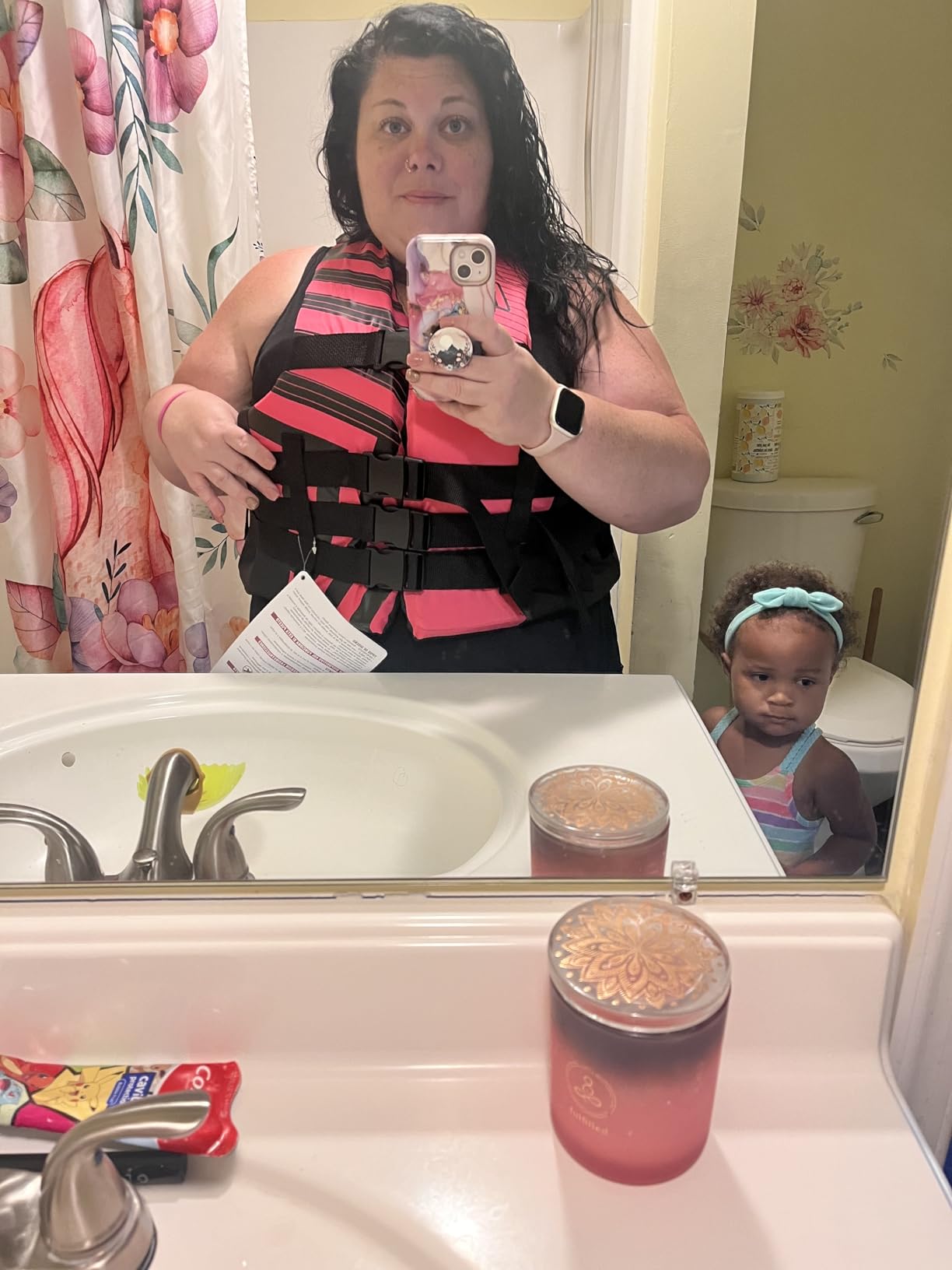
Where the Stearns uses open sides for airflow, the Airhead Trend goes the other way and closes them off with multiple adjustable belt closures. That is not a mistake, it is a design decision for water sports, because a closed side panel stops water sloshing and a loose vest from shifting when you are being pulled behind a boat at speed. Over 5,600 reviews at 4.6 stars describe it as a well-regarded general-purpose Type III.
The shell is a soft, UV- and stain-resistant 200-denier polyester, and reviewers consistently like how it feels in hot weather. It is a lighter fabric than neoprene, so it does not hold heat the way a shaped neoprene vest does.
The rating for a 300 pound maximum weight recommendation is unusually high for this category, and it comes with a size range that runs from child through XX-Large adult in the same family. That makes it the easiest option here for a household with mixed sizes who wants one brand and one set of buckles to understand.
Lightweight PE foam gives buoyancy without weighing the wearer down, which is the correct tradeoff for a vest that has to be worn continuously during tubing or skiing. The multiple external belt closures are the mechanical answer to a wet, moving, high-impact activity.
Who it fits and who it does not
This is a good fit for tubing, water skiing, wake sports and general boating, and for larger adults who want a rated ceiling of 300 pounds. It is a sensible single-brand choice for a family that spans several sizes.
It is a poor choice for a hot-weather angler or a paddler in an open boat, because closed sides mean less airflow than the open-sided vests in this roundup. It is also not a good match if you want a shaped or flattering fit, since the styling is basic compared with the neoprene models.
What to check before ordering
Check the size you select against the USCG size chart, and note that the large to X-Large variant is a specific cut rather than a graded one. Measure your chest first, because a closed-side vest cannot be adjusted inward as easily as an open-sided one.
Also think about layering. A closed-side vest over a wetsuit or a thick fleece will be hot, so if you plan to wear it over insulation, check the fit in the store with the layers you will actually use.
9. Airhead General Purpose Life Jacket – Best Budget Open-Sided Vest
Airhead General Purpose Life Jacket for Adults & Kids – US Coast Guard Approved Life Vest for Men, Women, Youth, Child & Infant, Boating Safety PFD for Fishing & Swimming, Adult Standard, Blue
Type III approved
Open-sided with three body belts
UV and stain resistant 200D polyester
16 ounce weight
30-52 inch chest
Pros
- Open sides improve ventilation for long wear periods
- Three secure body belt buckles open and close quickly
- Bright color options improve visibility
- Simple dependable construction with solid stitching
Cons
- Standard adult size runs small on tall or broad adults
- Oversized version is not much larger than standard
- Open sides give less flotation coverage than closed-side vests
This is the simplest thing on the list that still does the job correctly, and just over 4,300 reviews at 4.5 stars reflect an economy purchase that most people are happy with. It is a Coast Guard approved Type III with three body belts, an open-sided fit and a lightweight PE flotation device inside the same UV- and stain-resistant 200-denier polyester shell used on the Trend.
The open sides are the reason to pick it over the Trend if you will be out in the heat. Ventilation is the most common reason people say they stop wearing a vest, and this design addresses it directly rather than incidentally.
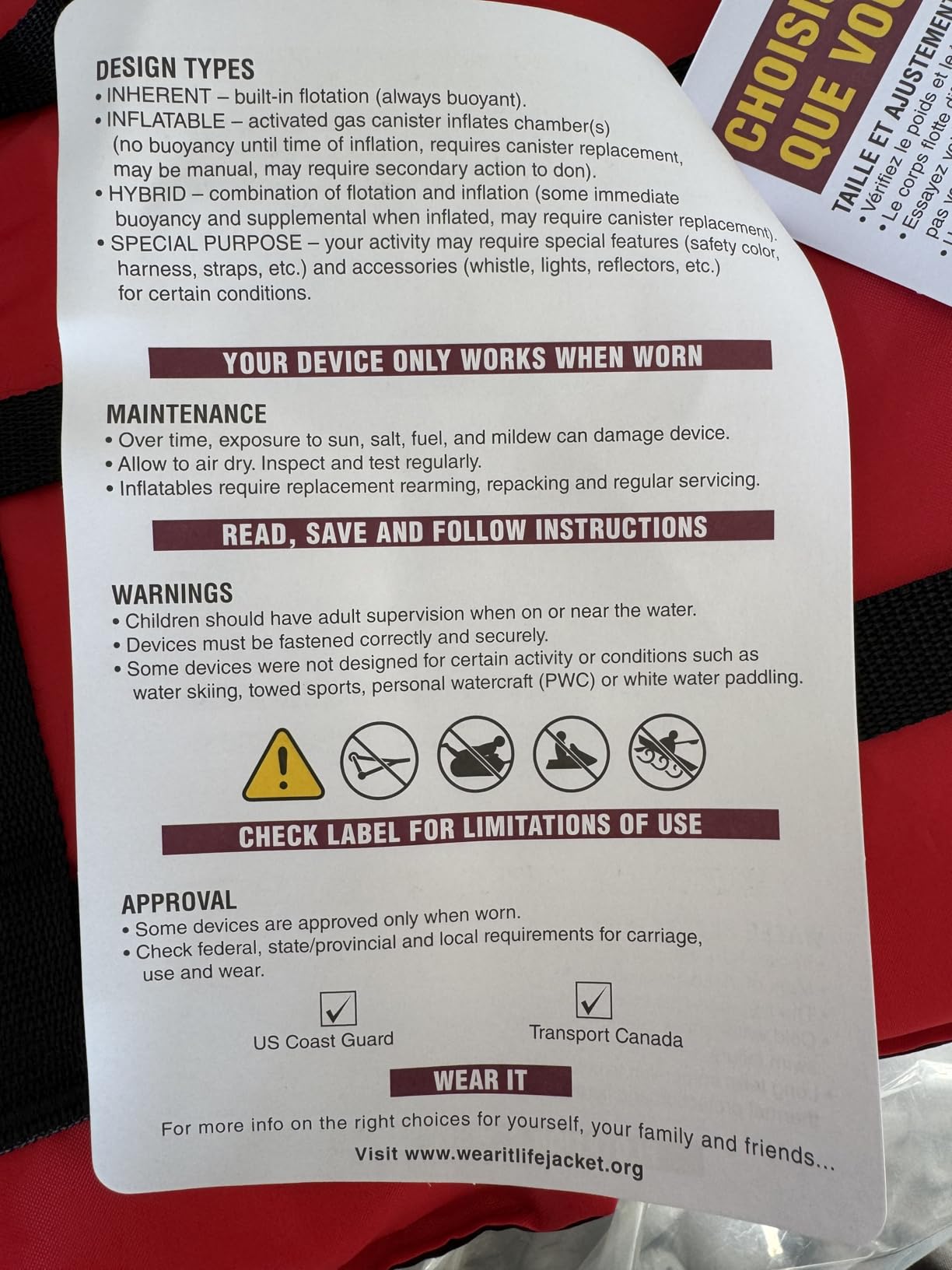
The three quick-release body belt buckles open and close fast, which matters when you are getting into a boat with a dock in the way. Solid stitching and sturdy buckles are the sort of unglamorous detail that determines whether a vest is still doing its job in season three.
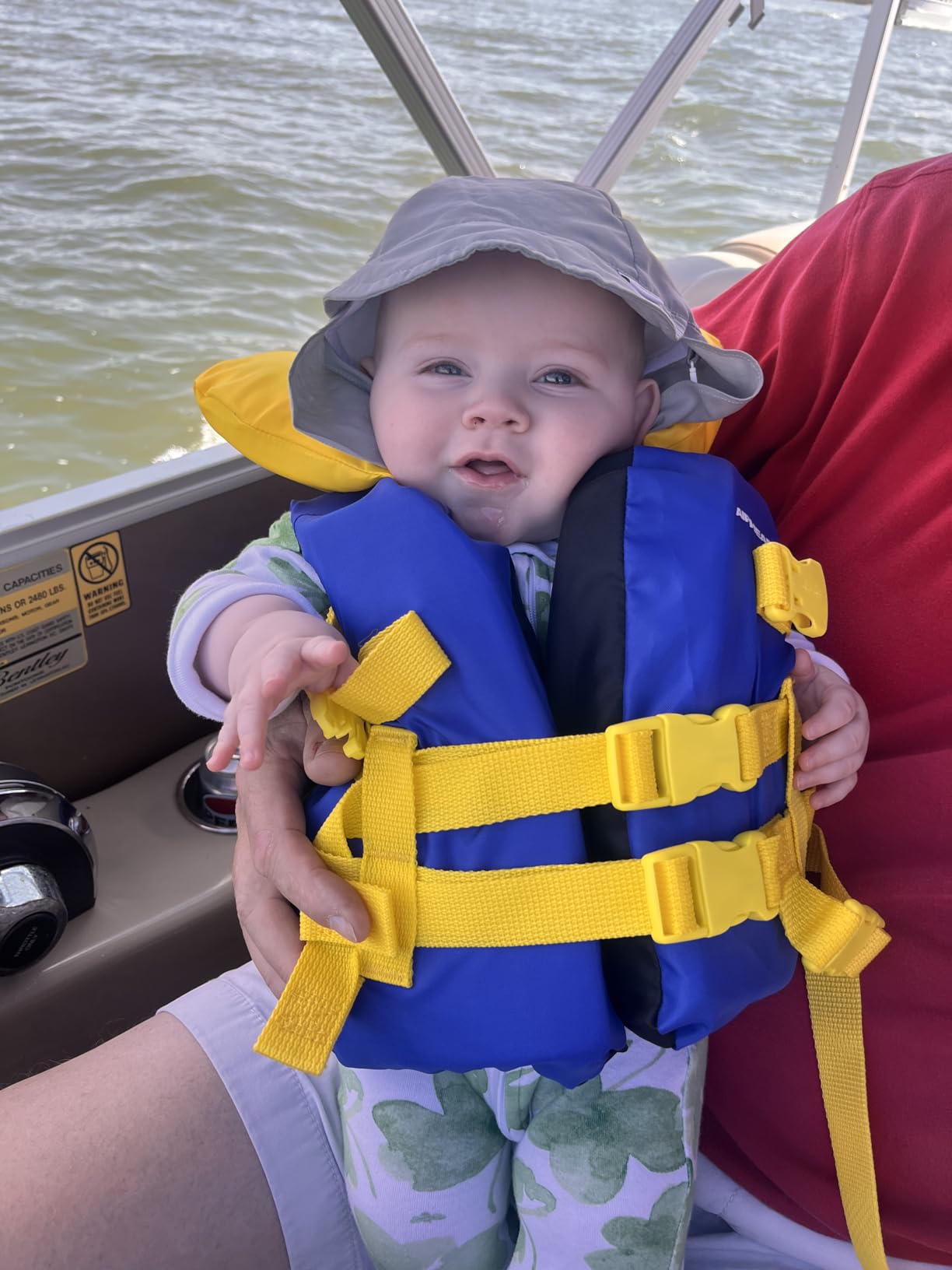
Sizing follows the USCG standard for adults 90 pounds and over with a 30-52 inch chest, and the same family includes infant, child, youth, standard and oversized variants, so it is easy to keep a household consistent. Bright color options add a real visibility benefit over a dark vest.
Who it fits and who it does not
This is a good fit for a first adult PFD, for casual boating, and for anyone who runs hot and needs airflow. It is a sensible choice for a family that wants one brand across a range of adult sizes.
It is a poor fit for very tall or broad adults, because the standard size runs small and reviewers say the oversized version is not a dramatic step up. It also gives less flotation coverage than a closed-side vest, so it is not the strongest choice for high-impact water sports or for cold water.
What to check before ordering
Measure your chest and be honest about the top of the range. If you are a large adult, this is the wrong vest to save money on, because an undersized PFD that rides up is a worse outcome than spending more somewhere else.
Then run the pull-up-on-the-shoulders test in the store if you can. Open sides can be adjusted tight at the front, but they have no side panel to stop the vest lifting, so the shoulder fit is doing more of the work than it would on a closed-side design.
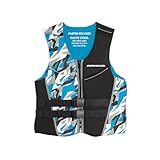
10. Airhead CAMO Cool Neolite Flex Vest – Best for Quick Drying and Jet Skiing
Airhead Men’s CAMO COOL Kwik-Dry Neolite Flex Life Jacket
Type III approved
Quick-drying neolite outer over PE foam
Closed sides with belt closures
2.4 lb weight
Supports 50 to 300 pounds
Pros
- Soft neoprene material does not chafe over long hours
- Quick-dry fabric genuinely dries instead of staying soaked
- Low-bulk design with a large range of arm motion
- Size range from X-Small-Small through X-Large-XX-Large
Cons
- Runs long and roomy in the smaller sizes
- Can ride up without a lower strap under the rib cage
- Some units arrive with a strong chemical odor
The argument for this vest is the fabric. The neolite outer is genuinely quick-drying, and owners report it dries out rather than staying waterlogged, which matters if you are in and out of the water all day on a PWC or in a warm climate. Over 2,400 reviews at 4.6 stars rate it highly on comfort, fit and drying performance for kayaking, boating and general watersports.
Low bulk is the other theme. Reviewers like the large range of motion it gives for paddling and watersports, and the soft neoprene does not chafe during long hours of wear, which is the other common reason vests come off before the day ends.
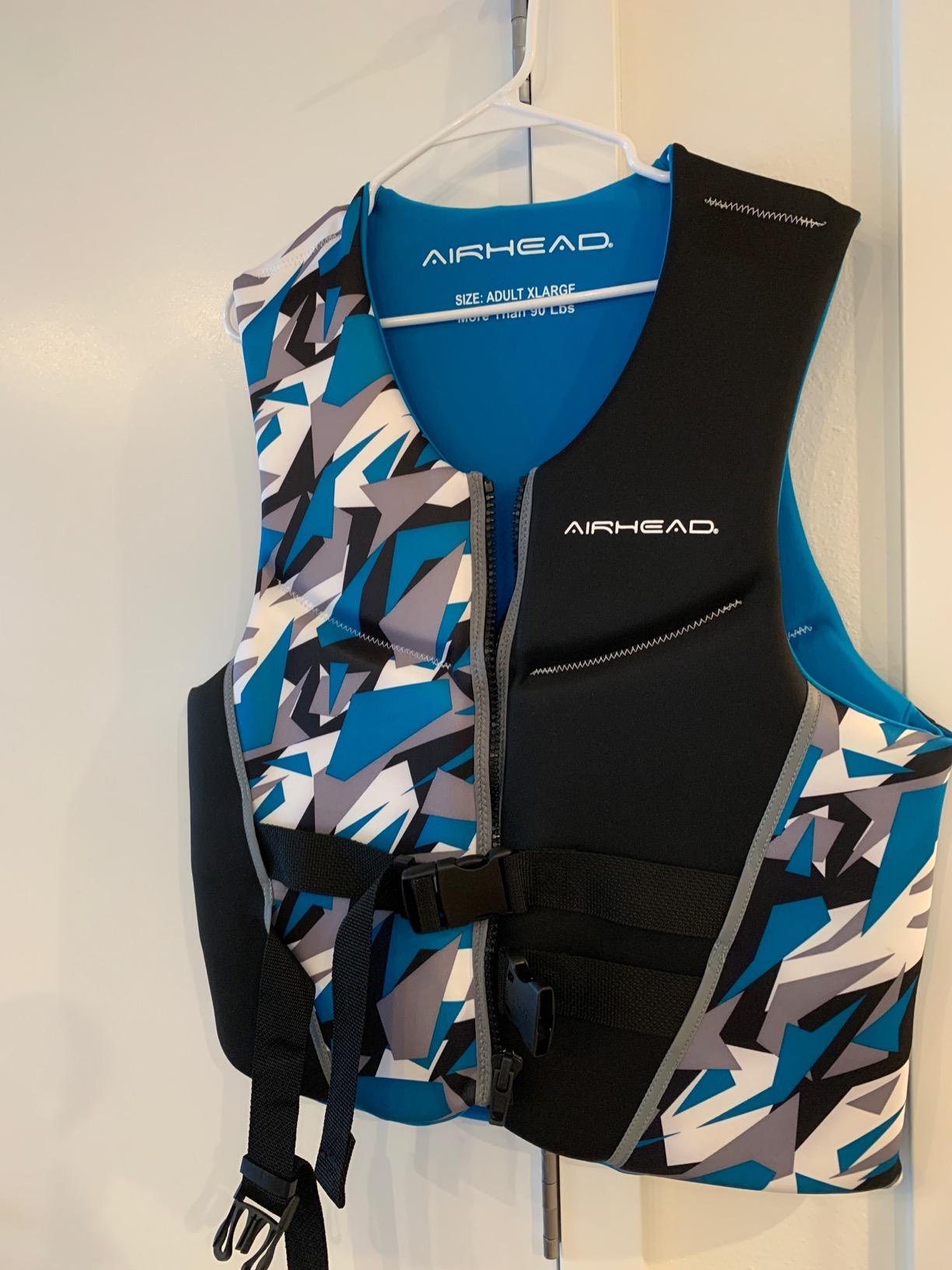
It is a Coast Guard approved Type III with closed sides and multiple adjustable belt closures, a quick-release buckle closure, and lightweight PE foam underneath for buoyancy. The supported range of 50 to 300 pounds is wider at the bottom end than most vests here, which makes it a candidate for a smaller adult who still meets the USCG minimum.
Two colorways and a size ladder from X-Small-Small through X-Large-XX-Large give more choice than most. Before you order, though, note the recurring caveat in the reviews: the smaller sizes run long and roomy, so the size chart is worth measuring against rather than approximating.
Who it fits and who it does not
This is a good fit for PWC and jet ski riders, waterskiers, and anyone who is wet all day and wants a vest that actually dries. It is also a reasonable choice for warm-weather boating generally, because the soft neolite is comfortable against skin.
It is a poor fit if you are buying for a small adult without measuring, because the smaller sizes run long. It is also a poor fit if you will be seated for hours in a rigid boat seat without a lower strap under the rib cage, since reviewers note it can ride up in that arrangement.
What to check before ordering
Measure your chest and compare it to the USCG size chart, and pay attention to torso length as well as girth, since the smaller sizes are described as running long. If you are between sizes and want a snug fit, take the smaller.
Air the vest out before its first outing, because a minority of buyers report a strong chemical or aftershave smell on arrival. If you are buying for PWC use specifically, check that your planned lower strap position falls under the rib cage, which is the fix for the ride-up issue.
11. Seachoice Life Vest Type II – Best for Face-Up Flotation and Groups
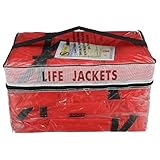
Seachoice Adult Type II Life Vest 4-Pack with Storage Bag, Orange
USCG approved Type II
Designed to turn wearer face-up
30-52 inch chest, 90 pounds and over
3.5 lb weight
Four-pack with marine-grade bag
Pros
- Type II flotation is designed to turn an unconscious wearer face-up
- High-visibility orange improves detection on the water
- Four-pack with a marine-grade carry bag suits boats and camps
- Adjustable belt closure fits a wide adult range
Cons
- Bulkier foam than minimalist Type III vests
- Adult version has limited adjustability versus closed-side models
Every other vest in this roundup is a Type III, which floats you but does not guarantee a face-up position if you are unconscious. This one is different, and the difference is the entire point. It is a Coast Guard approved Type II, designed with enough flotation behind the head to help turn an unconscious wearer face-up in calm water, and more than 5,200 reviews at 4.6 stars position it as a dependable flotation option for boaters.
That capability is what you want in offshore, cold or open water, where the mechanism that kills people is not sinking but going under face-down. On a lake in July, it is largely unnecessary, and the extra foam comes with a real cost in bulk.
It also arrives as a four-pack in a UV-resistant marine-grade vinyl carry bag, which is a genuinely different use case. Charter boats, camp floats, marina guest areas and families all have a reason to want four identical vests stored in one bag, rather than four individually wrapped ones in four cupboards. The high-visibility orange is a clear safety choice, and it is the only vest in this roundup offered in that color.
Sizing is the adult standard of 90 pounds and up with a 30-52 inch chest, with an adjustable belt closure. Note that there is a genuine trade-off here: the adult version has less adjustability than a closed-side model, and a 3.5 pound weight is roughly double what the lightweight foam vests come in at.
For a group scenario the arithmetic works well, because one bag covers everyone on the boat and there is nothing to sort through at the dock. For a solo paddler who wants to move fast, the bulk and the weight are harder to justify.
Who it fits and who it does not
This is a good fit for families, charter or camp operations, and anyone on open or cold water who wants the strongest face-up capability available in a recreational vest. It is a good fit for groups that want a single storage solution.
It is a poor fit for paddling, waterskiing or wake sports, because the bulkier foam restricts movement. It is also a poor fit for anyone who needs a snug adjustable fit, since the limited adjustability leaves little room to fine-tune the torso.
What to check before ordering
Check the chest range against your measurement, and be honest about the 3.5 pound weight if you will be wearing it continuously. If your boating is entirely on protected inland water in warm weather, the face-up capability is capability you will not use.
Think about where the bag will live. A four-pack of this size needs a dry, reachable storage spot on the boat, and a bag that lives in a garage means the vests are not on the boat when you need them, which defeats the purpose entirely.
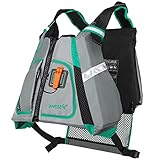
12. awesafe Adult Watersport Universal Vest – Best Size Range and Low-Light Visibility
awesafe Adult Watersport Universal Vest
Universal watersport vest
Neoprene shoulder panels
Breathable mesh high back
SOLAS reflective strips
14.08 oz weight
Pros
- Neoprene shoulder panels reduce chafing on long outings
- Expandable zippered front pocket and back pocket for valuables
- SOLAS reflective strips improve visibility in low light
- Breathable mesh high back runs cooler than solid foam
- Six colorways across sizes from XS-SM to XL-XXL
Cons
- Zippered shoulder style can feel restrictive in some strokes
- Pocket hardware and reflective detailing add a little weight
The awesafe vest is the one to look at if you have struggled to find a size that fits, because it carries the broadest size and color selection in the roundup, running from X-Small-Small through X-Large-XX-Large across six colorways. It also carries the strongest sales rank of anything here, which reflects how widely it turns up on general boating, skiing, fishing, canoeing and kayaking trips.
It is designed to hold a stable face-up position in calm water with the head tilted back, and the professional neoprene shoulder panels with a softer low-chafe lining are the detail reviewers praise most. Chafing under the arm is the quiet reason vests end up on a seat cushion rather than on a body.
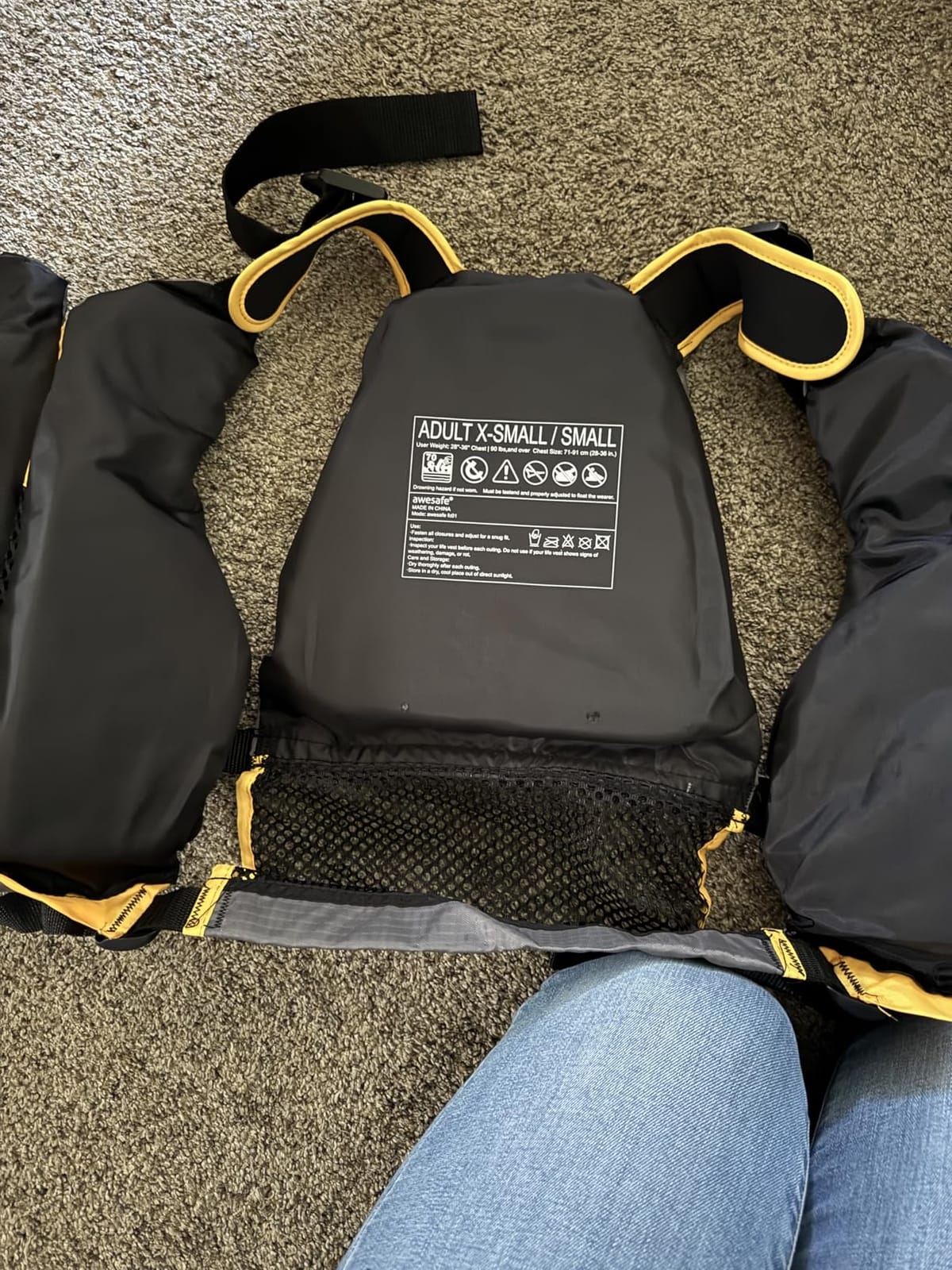
Storage is unusually generous for a vest at this weight. There is a double expandable zippered front pocket with mesh drainage for valuables, plus a back pocket for personal items, and the mesh drainage means a wet phone does not stay wet inside the pocket.
SOLAS-grade reflective strips are the reason this is worth a look for anyone on the water near dusk, and the breathable mesh high back keeps it cooler than a solid-foam vest. At 14.08 ounces it is one of the lighter designs here despite the extra pocket hardware.
Who it fits and who it does not
This is a good fit for paddlers and boaters who are between standard sizes, for anyone on the water around dusk, and for people who want pockets without moving up to a heavier fishing vest. The size range makes it a strong choice for a shared boat.
It is a poor fit if you need maximum buoyancy in cold or open water, because it is a mid-weight design rather than a high-float one. It is also a poor fit for paddlers with a very high shoulder range, since the zippered shoulder style is snug and some report it restricts certain strokes.
What to check before ordering
Measure your chest and then try the shoulder range, because the zippered shoulder construction is the one thing reviewers flag as restrictive. If you are tall with broad shoulders, do not rely on the size label alone.
Check your activity against the face-up design too, because the vest is built to hold a stable face-up position in calm water. That is a benefit on a lake and not a substitute for a proper high-float offshore vest in a seaway.
Frequently Asked Questions
Should you wear a life jacket when kayaking?
Yes, unconditionally. A US Coast Guard approved PFD is required for most adults in most US states whenever a vessel is underway, and in more than 80 percent of fatal boating accidents the victim was not wearing one. It is also extremely difficult to put a vest on once you are already in the water, which is why the best life jacket is the one you will actually wear rather than the most technical one.
What is the difference between a life jacket and a life vest?
In practice they are the same object, and a life vest is the everyday word for what the Coast Guard calls a PFD. The technical difference is that a true life jacket is designed to turn an unconscious swimmer face-up, while a PFD or flotation aid only provides buoyancy. Nearly every adult vest sold for boating, paddling and fishing is a Type III, which floats you but does not guarantee a face-up position.
What color life jacket is safest?
High-visibility orange, red and international orange are the safest colors on the water because they hold contrast against both dark and bright water. Yellow reads as high-vis but can blend into glare off calm water in full sun. Dark navy and black are the least visible, which is why SOLAS-grade reflective tape matters more than the base color for anyone on the water at dusk or on a night watch.
Is Type 2 or Type 3 life jacket better?
For most adults, a Type III is the right choice. A Type II is designed with enough flotation behind the head to roll an unconscious wearer face-up, but that extra foam is bulkier and restricts paddling motion, and it is mostly used in commercial and passenger settings. Choose a Type II for open or cold water where face-up flotation matters, and a Type III for boating, paddling, tubing and water sports.
What type of life jacket is best for kayaking?
A Type III foam PFD with a high mesh back and a chest range matching your measurement is the right answer for most kayakers. The high back clears the seat backrest, the mesh keeps you cool, and foam means buoyancy is instant with no moving parts. Avoid inflatable PFDs for whitewater and for anyone who is not a confident swimmer, since they cannot deploy instantly at the moment of a capsize.
How do you measure for a life jacket?
Measure your chest circumference across the fullest part, keeping the tape level all the way around, and compare that number to the brand size chart before ordering. Size by chest rather than body weight, because the USCG adult standard covers a 30-52 inch chest at 90 pounds and up. Then tighten every strap and pull up on the shoulders: the vest should not lift more than about an inch and should sit snug at the waist and ribs.
Are inflatable life jackets safe?
They are safe within clear limits, and the limits are narrow. Inflatables are not appropriate for whitewater, wakeboarding, waterskiing or any high-impact tow activity, because you need flotation at impact rather than after a pull. They are also not recommended for non-swimmers or for anyone under 16. Automatic models have fired unexpectedly in cold water, and every deployment consumes a CO2 cartridge that must be replaced and the unit re-armed.
How often do you replace a life jacket?
Replace on condition rather than on a calendar. Rinse it in fresh water after use in salt or muddy water, dry it out of direct sun, and check the buckles, zippers, webbing and stitching each season. Retire it if the foam feels compressed, the shell is badly faded, or the webbing looks thin or fuzzy, because compressed foam does not recover and a vest that once held you high will not again.
Which Life Jacket Should You Buy?
The best life jackets for adults all share one trait: you will keep them on. The O’Neill SuperLite wins this roundup because it has the deepest review history in the category, weighs 16 ounces, and cinches down with four buckles so it does not ride up. Buy the Onyx MoveVent Dynamic if your hours are spent behind a paddle, the Onyx Kayak Fishing vest if your hours are spent behind a rod, and the O’Brien Impulse if a shaped women’s cut is what finally fits you properly.
Whatever you choose, measure your chest, tighten every strap, and pull up on the shoulders before you leave the dock. A vest that is slightly too small and adjusted tightly will keep you afloat, and a vest that is loose will not. Check that the USCG approval label is sewn inside the shell, and store it on the boat rather than in a garage, because a perfectly good life jacket in a closet is the most common drowning scenario in this article.