
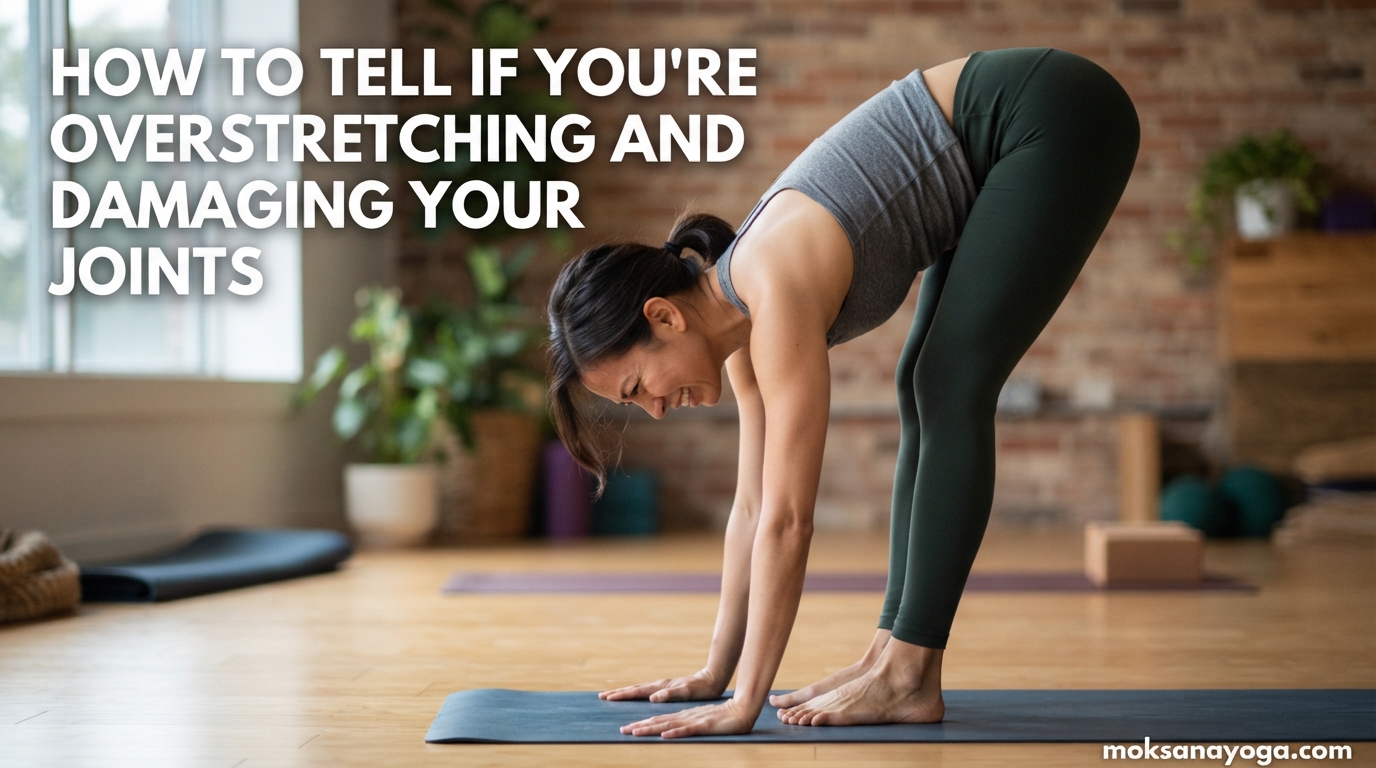
You finish a deep yoga session feeling amazing, but the next morning your knee aches and your hip feels oddly loose. Sound familiar? Many flexibility enthusiasts push past healthy limits without realizing it, and learning how to tell if you’re overstretching and damaging your joints can save you from months of frustration and chronic pain.
Overstretching happens when you force muscles, ligaments, or tendons beyond their natural range of motion. Instead of building flexibility safely, you create microtears in tissue that should be protecting your joints. The result is joint instability, lingering soreness, and a higher risk of injury every time you move.
I have worked with enough yoga students and athletes to know that the line between a productive stretch and a damaging one is surprisingly thin. This guide breaks down every warning sign, explains exactly how overstretching damages your joints, and gives you a clear recovery plan if you have already gone too far.
Table of Contents
What Is Overstretching?
Overstretching means pushing a muscle or joint past its current safe range of motion to the point where tissue damage occurs. A normal stretch creates a mild pulling sensation that eases as you breathe and relax. An overstretch creates sharp pain, joint looseness, or lingering discomfort that does not go away after a few minutes.
The confusion comes from the fact that stretching is supposed to feel uncomfortable. That mild tension you feel is your nervous system sending a protective signal called a stretch reflex. Your body is telling you that you are approaching the edge of your safe range. When you push aggressively past that signal, you stop stretching muscle fibers and start straining ligaments and tendons that are not designed to lengthen.
Think of your muscles like rubber bands designed to stretch and recoil. Your ligaments are more like sturdy straps meant to hold bones together with minimal give. When you force a stretch too far, you are asking those sturdy straps to behave like rubber bands. Once ligaments overstretch, they do not snap back to their original length. That is where joint damage begins.
Flexibility training should be gradual and controlled. The goal is not to force your body into a position but to slowly expand your range of motion over weeks and months. If you are chasing a deep split or an advanced yoga pose on a timeline, you are setting yourself up for overstretching injuries.
How to Tell if You’re Overstretching and Damaging Your Joints: 7 Warning Signs
Recognizing overstretching early can prevent long-term joint damage. Your body sends clear signals when a stretch has crossed the line from productive to harmful. Here are the seven warning signs you need to watch for.
1. Sharp or electrical pain during a stretch. A healthy stretch feels like a dull, pulling sensation in the belly of the muscle. If you feel a sharp, stabbing, or electrical pain, especially near a joint, stop immediately. Sharp pain means tissue is tearing or a nerve is being compressed.
2. Joint looseness or instability. After stretching, your joints should feel mobile and free, not wobbly or unsupported. If your knee feels like it might buckle during walking or your shoulder slips during simple movements, you have overstretched the ligaments that stabilize that joint.
3. Persistent soreness lasting more than 48 hours. Normal muscle soreness from a good workout peaks at 24 to 48 hours and then fades. If soreness from a stretching session lasts three days or longer, you have likely created microtears that go beyond typical training adaptation.
4. Tingling, numbness, or pins and needles. These sensations mean a nerve is being stretched or compressed. Nerves do not stretch the way muscles do. If you feel tingling in your hands during shoulder stretches or numbness down your leg during hip openers, you are overstretching nerve tissue, which can cause lasting damage.
5. Muscle spasms or twitching after stretching. When you overstretch, your nervous system may respond with protective muscle spasms. If your muscles twitch or cramp involuntarily after a stretching session, your body is trying to stabilize an area that has been pushed too far.
6. Bruising, swelling, or warmth around a joint. These are signs of acute inflammation from tissue damage. If a stretch causes visible swelling or a warm feeling around your knee, hip, or shoulder, you have torn something and need to rest and ice the area.
7. Reduced strength or coordination. Overstretching temporarily reduces a muscle’s ability to contract forcefully. If you feel weak, uncoordinated, or wobbly in the hours after stretching, your muscles cannot fire properly because they have been overstretched. This weakness increases your injury risk during other activities.
Joint-Specific Warning Signs
Different joints show overstretching damage in different ways. Knowing what to watch for in each area helps you catch problems before they become chronic.
Knees: A feeling that the knee might hyperextend or buckle backward. Pain behind the kneecap after deep lunges or hamstring stretches. Clicking or popping that accompanies discomfort rather than relieving it.
Hips: A deep ache in the hip socket after seated stretches or pigeon pose. A sensation that the hip is slipping or sliding out of position. Groin pain that lingers for days after a stretching session.
Spine: Lower back soreness that worsens after forward folds. A feeling of instability or weakness when standing up after deep backbends. Pain that radiates down one leg, which could indicate nerve compression from overstretching.
Shoulders: A clicking sensation during arm movement. Feeling like the shoulder might slip out of its socket during downward dog or overhead stretches. Pain at the front of the shoulder where the rotator cuff sits.
Good Stretch Pain vs Bad Pain: How to Tell the Difference
This is one of the most common questions I hear from students. Knowing the difference between productive stretch discomfort and injury pain is the single most important skill for safe flexibility training.
Good stretch pain feels like a mild to moderate pulling sensation in the thickest part of the muscle. It builds gradually, feels warm and wide, and eases when you breathe deeply and relax into the position. It should never make you hold your breath, wince, or feel anxious.
Bad pain from overstretching feels sharp, narrow, and specific. It hits suddenly rather than building slowly. It is often located near a joint rather than in the muscle belly. It does not ease with breathing and may intensify the longer you hold the position. If you find yourself holding your breath, clenching your jaw, or bracing your body, you are in the danger zone.
The Stretch Pain Scale: What Your Body Is Telling You
Using a 1 to 10 pain scale during stretching gives you an objective way to monitor your intensity. This simple tool helps you stay in a safe range and recognize when you are crossing into overstretching territory.
Levels 1-3: Mild tension. You feel a gentle pull but no real discomfort. This is the ideal range for warm-up stretches and gentle mobility work. Breathing is easy and relaxed.
Levels 4-6: Moderate stretch sensation. You feel a clear, intense pull in the muscle belly. It requires focus and steady breathing to maintain. This is where productive flexibility gains happen. You should be able to hold a conversation without strain.
Level 7: Strong discomfort. The stretch feels very intense. You have to concentrate hard on breathing. This is the upper limit of productive stretching for experienced practitioners. Beginners should never push to this level.
Levels 8-10: Sharp, alarming pain. At level 8, you start to feel pain near joints or in tendons. Level 9 involves sharp, stabbing sensations. Level 10 is unbearable pain meaning tissue is actively tearing. Never stretch above a level 7.
Physical therapist Leada Malek recommends keeping stretches in the 4 to 6 range for most people. If you have to hold your breath or brace your body, you have gone too far. Back off until your breathing returns to normal and the sensation settles into the muscle belly.
How Overstretching Damages Your Joints
Understanding the mechanics of overstretching damage makes the warning signs much easier to respect. When you overstretch, three types of tissue are at risk: muscle fibers, tendons, and ligaments. Each responds differently to excessive force.
Muscle fibers are designed to stretch and contract. When you stretch a muscle beyond its comfortable range, tiny microtears form in the fibers. This is actually how muscles grow longer over time. With proper rest, these microtears heal and the muscle adapts. The problem begins when you stretch so aggressively that the tears outpace your body’s ability to repair them.
Tendons connect muscle to bone. They have limited elasticity compared to muscles. When a stretch pulls hard on a tendon, the tendon can develop microtears that lead to tendinitis. Tendon injuries heal slowly because tendons have poor blood supply compared to muscles.
Ligaments connect bone to bone and stabilize your joints. They have very little elasticity by design. When you force a stretch past the point where your muscles can lengthen, the force transfers to your ligaments. Stretched ligaments become loose and cannot provide the stability your joints need.
Here is the critical difference: muscles and tendons have a good blood supply and can heal from stretching damage over time. Ligaments have almost no blood supply. Once a ligament over stretches, it may never return to its original length. This creates permanent joint laxity, meaning your joint becomes chronically loose and unstable.
Long-Term Consequences of Repeated Overstretching
Repeated overstretching compounds damage over months and years. Each time you push past your safe range, you stretch your ligaments a little further. Over time, this leads to chronic joint instability that makes everyday movements feel precarious.
People who repeatedly overstretch often develop recurrent injuries. An ankle that rolls easily, a knee that aches after walking, or a shoulder that slips during simple tasks. These are all signs that the ligaments have been stretched beyond their functional capacity.
In severe cases, chronic overstretching can contribute to early-onset osteoarthritis. When joints are unstable, the bones do not track properly. This causes uneven wear on the cartilage that cushions your joints. Over years, that wear can lead to cartilage breakdown and the pain and stiffness of arthritis.
Nerve damage is another under discussed consequence. Nerves run through tight spaces in your joints, surrounded by connective tissue. When you overstretch the tissue around a nerve, the nerve can become compressed or irritated. This leads to chronic tingling, numbness, or pain that persists long after the stretching session ends.
Yoga-Specific Overstretching Risks
Yoga practitioners face unique overstretching risks because the practice often encourages pushing deeper into poses. The combination of heated rooms, peer pressure in group classes, and the pursuit of advanced poses creates a perfect storm for joint damage.
Many popular yoga poses place joints at their end range of motion. Pigeon pose stretches the hip capsule to its limit. Forward folds place maximum tension on lower back ligaments. Deep lunges stress the knee and hip simultaneously. When practiced with proper awareness, these poses are safe. When forced, they become overstretching injuries waiting to happen.
Hot yoga deserves special attention. The heat makes muscles feel more pliable and flexible, which encourages practitioners to push deeper than they would at room temperature. The problem is that ligaments and tendons do not benefit from heat the way muscles do. You may feel loose enough to sink into a deep split, but your ligaments are being stretched to their structural limit. This is why so many hot yoga students report joint pain and instability after months of practice.
Common Yoga Poses That Cause Overstretching
Some poses deserve extra caution because they place joints under maximum stretch tension. If you have any warning signs of overstretching, modify or skip these poses until you recover.
Pigeon pose and sleeping pigeon place the hip in extreme external rotation and flexion. If your hip cannot comfortably reach the floor, forcing it down stretches the hip capsule and surrounding ligaments. Use a blanket or block under the hip for support.
Deep forward folds like paschimottanasana place intense tension on the lower back and hamstrings. If your hamstrings are tight, the force transfers to your lower back ligaments. Bend your knees generously until your flexibility improves.
Deep backbends like upward bow or wheel pose stress the spine and shoulders. Rushing into these poses without adequate warm-up can overstretch the ligaments that stabilize your vertebrae. Build backbend depth gradually over months.
Overstretching Risks for Hypermobile Practitioners
Hypermobile individuals can move their joints past the normal range of motion with ease. This natural flexibility is often mistaken for advanced yoga ability, but it comes with serious risks. Hypermobile joints already have loose ligaments. Stretching further pushes lax ligaments past their already generous limits.
If you can hyperextend your knees or elbows, lock your fingers backward, or touch your thumb to your forearm, you likely have some degree of joint hypermobility. For you, the standard stretching advice does not apply. Your goal is not to increase range of motion but to build strength and stability within the range you already have.
Hypermobile practitioners should focus on strength-based yoga rather than deep stretching. Hold poses with active muscle engagement rather than sinking passively into joints. Avoid hot yoga, which makes it even easier to overstretch. Work with a physical therapist who understands hypermobility to develop a safe practice.
Safe Stretching Guidelines to Protect Your Joints
Preventing overstretching is far easier than recovering from it. These guidelines will help you build flexibility safely while protecting your joints from damage.
Always warm up first. Cold muscles and ligaments are stiffer and more prone to tearing. Spend 5 to 10 minutes doing light cardio or dynamic movements before you stretch. Your body should feel warm and your heart rate slightly elevated before you begin any deep stretching.
Understand static vs dynamic stretching. Dynamic stretching involves moving through a range of motion continuously, like leg swings or arm circles. This is ideal before workouts. Static stretching involves holding a position for 20 to 60 seconds. This is best done after workouts when your muscles are already warm.
Hold each stretch for the right duration. For general flexibility, hold static stretches for 30 to 60 seconds. Longer holds do not necessarily produce better results and increase the risk of overstretching. If you feel the need to hold a stretch for several minutes, you may be trying to force progress too quickly.
Breathe steadily and never hold your breath. Your breath is your best stretch monitor. If you have to hold your breath, clench your jaw, or brace your body, you are stretching too aggressively. Back off until you can breathe slowly and evenly throughout the entire stretch.
Stretch regularly but not excessively. Aim for 3 to 5 stretching sessions per week, each lasting 10 to 20 minutes. Stretching every single day for long periods can overload your tissues and prevent adequate recovery. Consistency matters more than duration.
Focus on the muscle belly, not the joint. A productive stretch targets the thickest part of the muscle. If you feel the stretch concentrated at the joint itself, you are loading the ligaments and tendons rather than the muscle. Adjust your position until the sensation moves to the muscle belly.
Never stretch through pain. Discomfort is normal during stretching. Sharp pain, tingling, or joint looseness are not. If you experience any warning signs of overstretching, stop immediately. Pushing through pain turns a minor issue into a major injury.
How to Recover from Overstretching
If you recognize the warning signs of overstretching, take action immediately. Early intervention can prevent a minor strain from becoming a chronic problem. Follow this step-by-step recovery protocol to heal safely.
Step 1: Stop stretching the affected area completely. This is the most important step. Many people try to stretch through the pain, thinking it will help. It will not. Give the overstretched tissue time to heal by avoiding all stretches that target the injured area. Depending on severity, this rest period may last from a few days to several weeks.
Step 2: Apply the RICE protocol for acute symptoms. Rest the affected joint. Ice the area for 15 to 20 minutes several times a day to reduce inflammation. Compress with a gentle wrap if there is swelling. Elevate the area above heart level when possible. RICE is most effective in the first 48 to 72 hours after overstretching.
Step 3: Incorporate gentle movement after 48 hours. Complete immobilization is not ideal after the acute phase. After 2 or 3 days of rest, begin gentle, pain-free movements to promote blood flow and prevent stiffness. Walk slowly, do easy range of motion exercises, and avoid any movement that reproduces the pain.
Step 4: Rebuild strength before flexibility. Overstretched joints need muscular support to compensate for damaged ligaments. Focus on strengthening the muscles around the affected joint. If you overstretched your knee, strengthen your quadriceps and hamstrings. If you overstretched your shoulder, work on rotator cuff exercises. Strength provides the stability that overstretched ligaments cannot.
Step 5: Return to stretching gradually. Once you are pain-free for at least a week, slowly reintroduce stretching. Start at a much lower intensity than before. Keep stretches in the 3 to 4 range on the pain scale. Never push to the intensity that caused the original injury. If pain returns, back off immediately.
Step 6: Seek professional help if needed. If pain persists for more than two weeks despite rest, or if you experience severe joint instability, numbness, or inability to bear weight, see a physical therapist or orthopedic specialist. A professional can assess the extent of the damage and guide your recovery with targeted exercises and manual therapy.
Recovery times vary based on what tissue was damaged. Mild muscle strains may heal in 1 to 3 weeks. Tendon injuries can take 6 to 12 weeks due to poor blood supply. Ligament overstretching may take months and in some cases causes permanent changes to joint stability. This is why prevention is always the best strategy.
FAQs
What are two signs of muscle being overstretched?
Two clear signs of an overstretched muscle are sharp or stabbing pain during the stretch (rather than a dull pulling sensation) and persistent soreness lasting more than 48 hours after the stretching session. You may also notice muscle spasms or reduced strength in the affected area.
Can you recover from overstretching?
Yes, most people recover fully from overstretching with proper rest and rehabilitation. Mild muscle strains heal in 1 to 3 weeks. Tendon and ligament injuries take longer, often 6 to 12 weeks or more. The key is to stop stretching immediately, apply the RICE protocol, rebuild strength around the affected joint, and return to stretching very gradually.
Can overstretching cause joint pain?
Yes, overstretching is a common cause of joint pain. When you stretch past the point where muscles can lengthen, the force transfers to ligaments and tendons. Ligaments that overstretch become loose and cannot stabilize the joint properly, leading to pain, clicking, and a feeling of instability during movement.
How do I know if I’m overstretching?
You are overstretching if you feel sharp pain near a joint, experience tingling or numbness, notice joint looseness or instability, have soreness lasting more than 48 hours, or find yourself holding your breath and bracing during a stretch. On a 1 to 10 pain scale, anything above a 7 means you are overstretching and should back off immediately.
Can you overstretch in yoga?
Yes, yoga overstretching is very common. Poses like pigeon, deep forward folds, and advanced backbends place joints at their maximum range of motion. Hot yoga is especially risky because the heat makes muscles feel more flexible than the underlying ligaments actually are, encouraging practitioners to push past safe limits. Hypermobile practitioners face the greatest risk in yoga settings.
How long does an overstretched muscle take to heal?
An overstretched muscle typically takes 1 to 3 weeks to heal with proper rest. Mild strains may recover in just a few days, while more severe overstretching with significant microtears can take 4 to 6 weeks. Tendon and ligament injuries take longer, often 6 to 12 weeks, because these tissues have a much poorer blood supply than muscles.
Listening to Your Body: A Lifelong Skill
Learning how to tell if you are overstretching and damaging your joints is not just about avoiding injury. It is about building a sustainable relationship with your body that supports decades of healthy movement. The warning signs are always there. Sharp pain, joint looseness, persistent soreness, tingling, and breath-holding are your body’s way of asking you to back off.
Flexibility is worth pursuing, but never at the cost of joint stability. Stretch in the 4 to 6 range on the pain scale, warm up properly, breathe steadily, and focus on the muscle belly rather than the joint. If you do experience overstretching, stop immediately and follow the recovery protocol. Your ligaments cannot heal the way your muscles can, so protecting them is always worth the patience.
Your yoga practice and fitness routine should make you feel strong and stable, not loose and vulnerable. Trust the signals your body sends you, respect your current range of motion, and remember that the best flexibility gains come from consistency, not intensity. Stay safe, stretch smart, and your joints will thank you for years to come.