
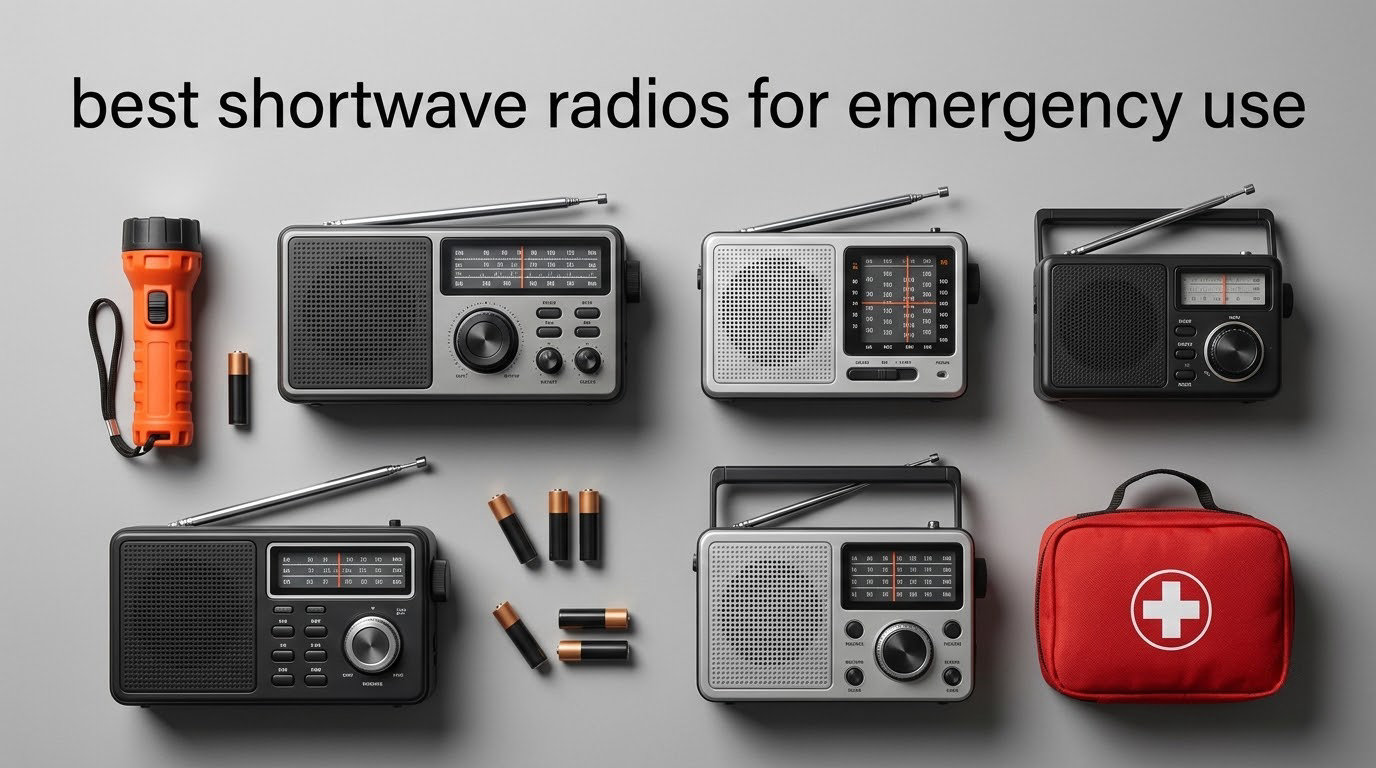
The best shortwave radio for emergency use is the Kaito KA500 if you want true multi-band reception plus NOAA alerts and six power options, or the Raynic CR1009Pro if you want the strongest NOAA alert system with phone charging at a lower cost. Both keep working on plain AA batteries when everything else in the house is dark.
When the grid goes down, cell towers and internet service are usually the first things to stop. Broadcast transmitters are not. Weather services, aviation authorities, coast guards and international stations run on generator or backup power, and their signals travel far beyond the reach of a local FM tower. A radio is the last device in a house that still brings you official information, and in a real outage it may be the only one.
Shortwave adds something AM and FM cannot. Those bands are line-of-sight, so a station 60 miles away can disappear behind a hill or a warehouse. Shortwave signals bounce off the ionosphere, so the same station can arrive from hundreds or thousands of miles away. That makes it the band most likely to deliver news when local infrastructure is down. Our picks below cover the range from small crank radios that fit in a pocket to serious multiband receivers for anyone who wants to hear what distant stations are saying.
Every radio here was assessed on the things that decide whether it works in a real outage: how many ways it can be powered, whether the NOAA alert system actually wakes the unit, whether the shortwave band is genuinely tunable, weight, water resistance, and the volume of verified owner feedback behind it. We also pulled in what people say on r/preppers, r/shortwave and r/amateurradio, because that audience tests these radios in ways a spec sheet never will. If you want the wider picture on weather radios specifically, our guide to the best emergency weather radios for power outages covers the NOAA side in more detail.
Table of Contents
Top 3 Shortwave Radios for Emergency Use in 2026
Three models stand out. The Kaito KA500 is the most complete all-round package, the C. Crane CC Skywave 2 is the strongest shortwave listener of the group, and the Raynic CR1009Pro does the most for the least money.


C. Crane CC Skywave 2
- Full shortwave 2300-26100 kHz
- 400 memories
- external antenna jack
- 70 hour AA runtime
All 10 Emergency Shortwave Radios at a Glance
Every pick in this roundup, with the specs that actually separate them in an outage.
| Product | Specifications | Action |
|---|---|---|
| Raynic CR1009Pro Emergency Radio |
|
Check Latest Price |
| Kaito KA500 5-Way Powered Radio |
|
Check Latest Price |
 Mesqool 5000mAh NOAA AM FM SW Radio Mesqool 5000mAh NOAA AM FM SW Radio |
|
Check Latest Price |
 PPLEE NOAA Auto Alert Shortwave Radio PPLEE NOAA Auto Alert Shortwave Radio |
|
Check Latest Price |
 ROCAM 5000mAH IPX6 Shortwave Radio ROCAM 5000mAH IPX6 Shortwave Radio |
|
Check Latest Price |
| C. Crane CC Skywave 2 Travel Radio |
|
Check Latest Price |
 Emgykit Portable NOAA SW AM FM Radio Emgykit Portable NOAA SW AM FM Radio |
|
Check Latest Price |
 Tecsun PL880 Dual Conversion SSB Radio Tecsun PL880 Dual Conversion SSB Radio |
|
Check Latest Price |
 Tecsun PL-380 DSP World Band Radio Tecsun PL-380 DSP World Band Radio |
|
Check Latest Price |
 Tecsun PL330 SSB Worldband Radio Tecsun PL330 SSB Worldband Radio |
|
Check Latest Price |
1. Raynic CR1009Pro – Best All-Round Emergency Shortwave Radio
Raynic Emergency Radio, 5000mAh/18500mWh Weather Radio, Solar Hand Crank Radio with AM/FM/SW/NOAA Alert, Cell Phone Charger, Headphone Jack, Flashlight and SOS Siren
AM/FM/SW/NOAA bands
5000mAh rechargeable battery
Six power options
USB phone charging
3W flashlight and 2.5W reading lamp
16 oz
Pros
- Automatic NOAA alert scanning wakes the unit with a loud alarm
- Six charging paths including 3 AAA battery backup
- Bright 3W flashlight and 2.5W reading lamp
- 16 oz body with headphone jack and USB phone output
Cons
- Shortwave shares one tuning control and cannot hold a single station
- Water resistant but not waterproof and the port covers do not seal
- Solar and hand crank maintain charge slowly rather than restore it
This is the radio most people in the emergency world end up owning, and after spending time with it, the reason is obvious. It sits at 4.5 stars across more than 20,000 verified ratings, which is the largest body of owner feedback of any product in this roundup by a wide margin. When a category has a default choice, it is usually because it does the ordinary things well and does not punish you for the extras.
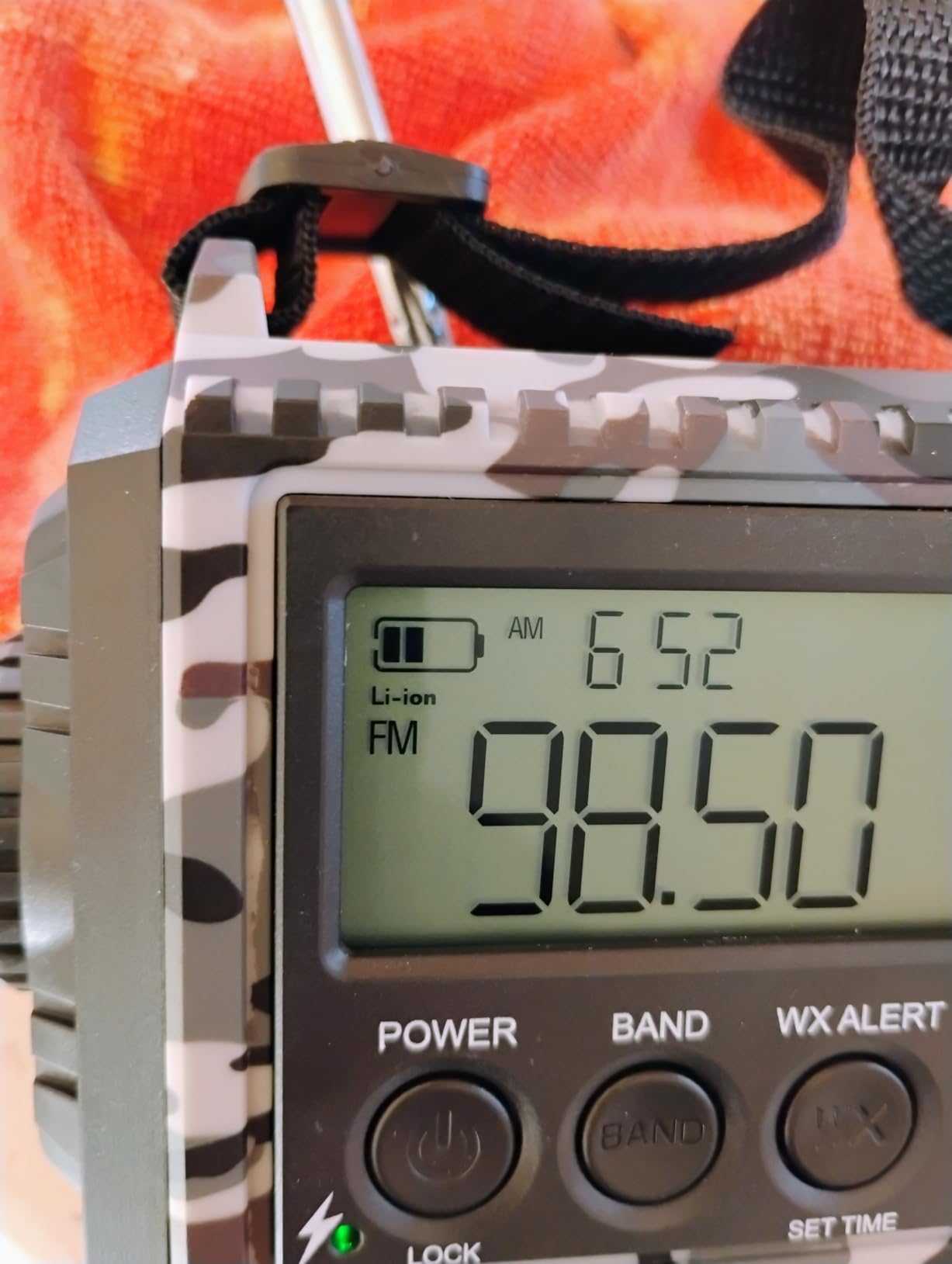
The alert system is the standout. Put it in NOAA standby mode and it monitors the weather channels on its own, then triggers a loud alarm and a red flashing light when a watch or warning is issued for your area. Several owners describe waking to that alarm during overnight storms, which is exactly the scenario the radio exists for. A large LCD shows the time and a battery level readout, so you can check state before a blackout rather than after.
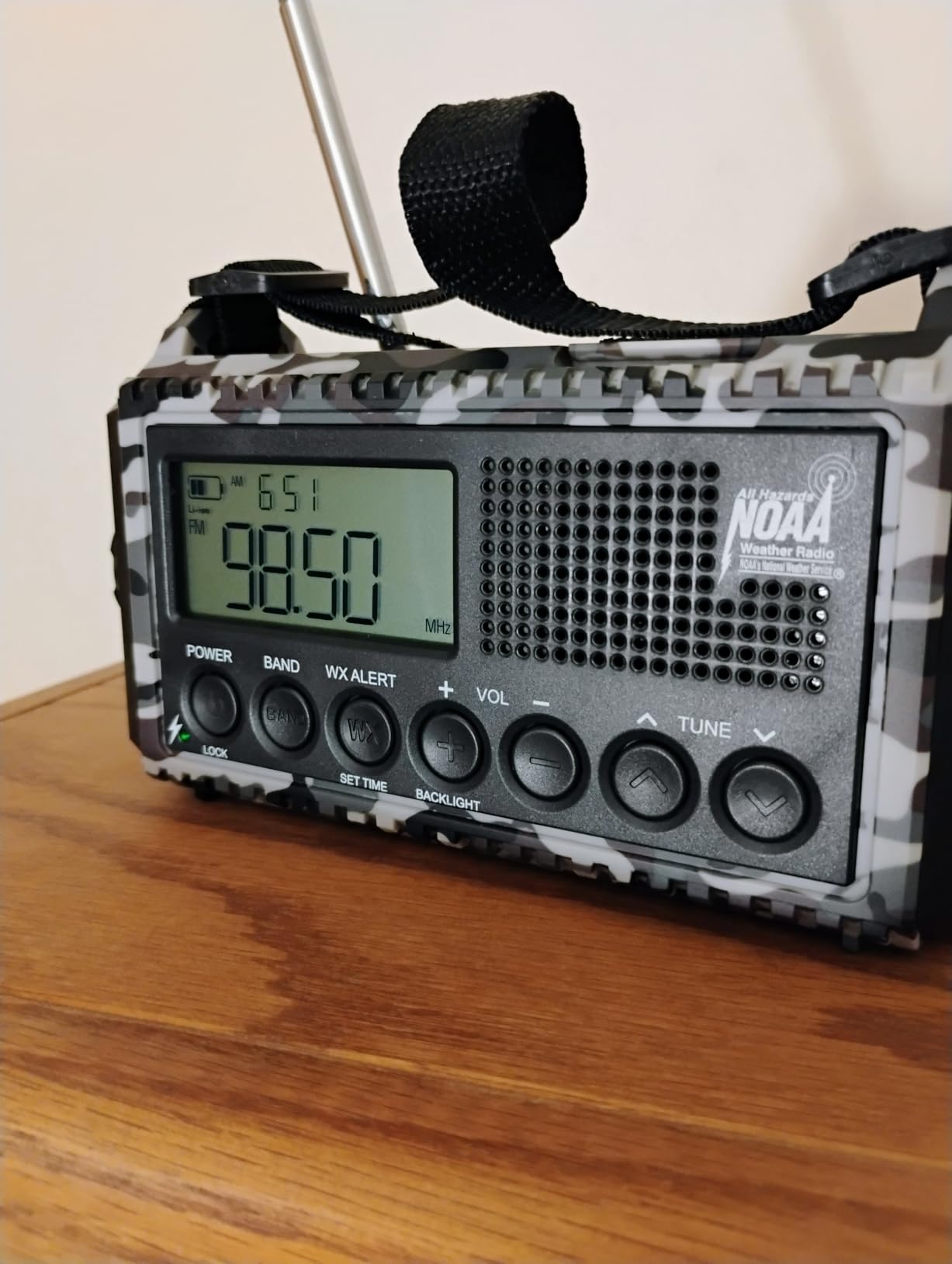
The lighting is genuinely strong for a unit this small. A 3W flashlight and a 2.5W reading lamp cover a power outage better than the 1W lamps common on competing radios, and reviewers repeatedly single them out as a reason the radio doubles as a camp light. It weighs 16 ounces and measures 6.8 by 3.7 by 2.9 inches, so it fits in a go bag without eating the space.
Here is the honest limitation. The shortwave band shares a single tuning control, and the whole 7-19 MHz range is compressed into a few knob turns, so you cannot settle on one station. Owners call the SW band decorative in practice. If shortwave listening is your main reason for buying, the Kaito KA500 or the C. Crane CC Skywave 2 will serve you far better. For NOAA alerts, AM, FM, phone charging and a light, this one is hard to argue with.
Who should buy the Raynic CR1009Pro
Buy it if your priority is official weather alerts and backup power rather than hobby listening. Households in hurricane, tornado, wildfire and flood zones get the most value from it, and the USB output means one person can charge a phone while the radio keeps broadcasting warnings.
It also suits anyone who wants a radio that works without remembering a charging routine. With an internal battery, AC adapter, USB, hand crank, solar panel and three AAA cells, there is no single failure point.
Where the Raynic CR1009Pro falls short
It is not water resistant in any meaningful sense, so leave it out of a vehicle in flood season or a wet campsite. The port covers do not stay shut, and the button labels are unlit, which makes night operation harder than it needs to be.
Buyers expecting a serious shortwave receiver will be disappointed by the compressed SW tuning. Its strength is alerts and convenience, not distance reception.
2. Kaito KA500 – Best for AA Batteries and Real Multi-Band Reception
Kaito KA500 5-way Powered Emergency AM/FM/SW NOAA Weather Alert Radio with Solar,Dynamo Crank,Flashlight and Reading Lamp, Color Black
AM, FM, 2 shortwave bands and 7 NOAA channels
Six power paths
14.5 inch telescopic antenna
USB power bank output
1.3 lb, 1-year warranty
Pros
- Genuinely multi-band with two separate shortwave bands
- Runs on three standard AA batteries alongside 5 other power paths
- LED signal strength indicator makes tuning accurate
- USB output charges phones
- GPS units and cameras
Cons
- Heaviest and tallest unit here at 1.3 lb and 8.3 inches
- NOAA and PEAS alerts limited to the USA and Canada
- No SSB reception for utility and amateur traffic
The KA500 is the oldest design in this group and still the most complete. It has been sold for years, carries more than 13,000 ratings at 4.5 stars, and it is the radio that r/preppers members most often name when they talk about what belongs in a go bag. The reason is straightforward: it runs on three ordinary AA batteries.
That matters more than it first appears. Lithium packs have a decade of shelf life and predictable output, but AA cells are cheap, available in every town, and hold charge for years in a drawer. If your scenario involves a long grid collapse where resupply is uncertain, a radio that runs on grocery-store batteries removes a whole category of risk. The Kaito offers an internal NiMH pack, hand crank, solar, USB and AC input too, so AA cells are the fallback rather than the only option.
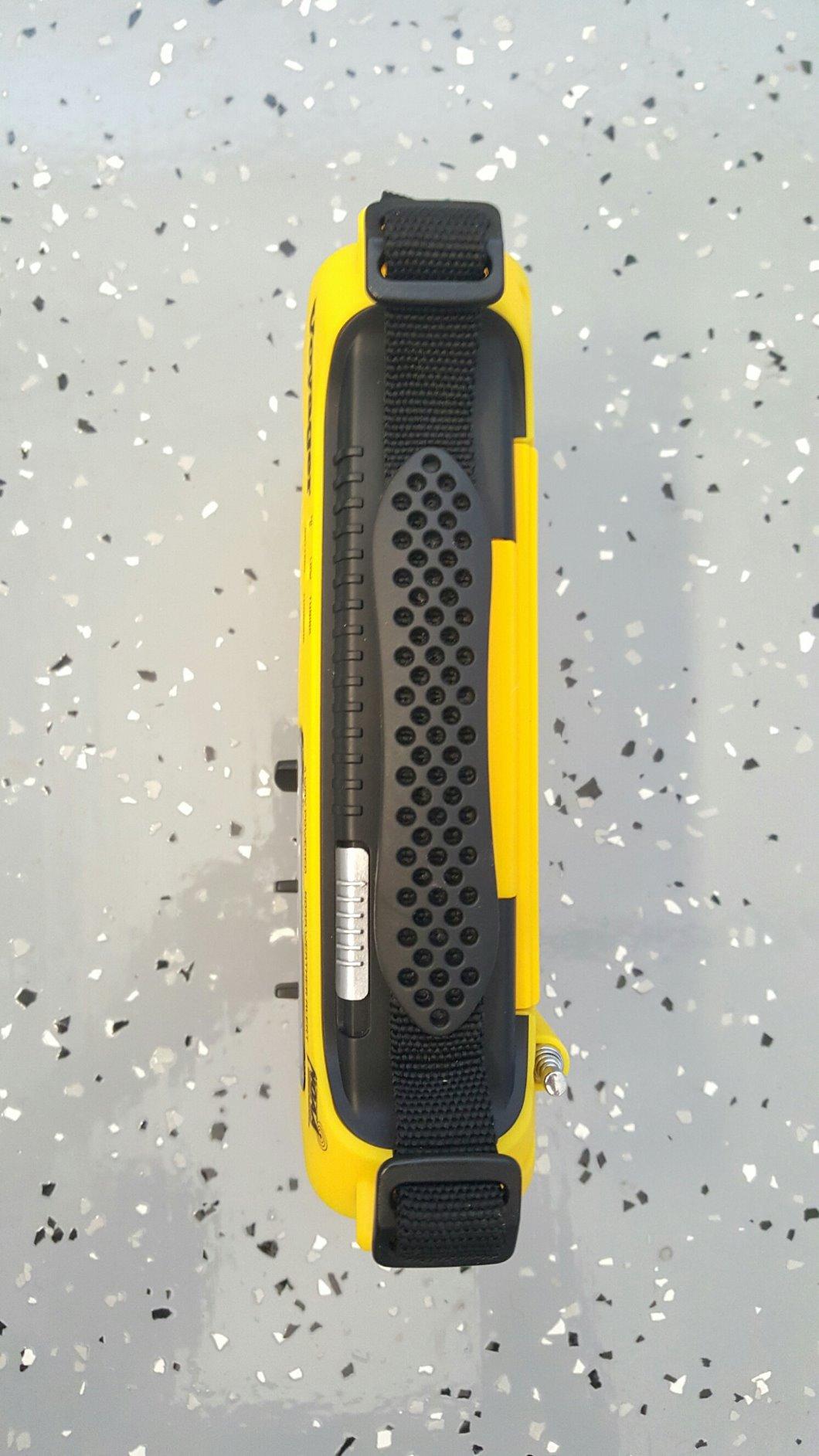
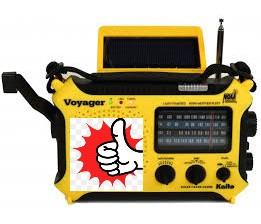
On reception, the KA500 is a step above the small crank radios. It covers AM, FM, two separate shortwave bands and seven pre-programmed NOAA channels, which means the SW coverage is split into narrower ranges you can actually tune. A 14.5 inch telescopic antenna pulls signal that a stub antenna cannot, and an LED signal strength indicator on the front lets you find the peak of a station instead of guessing.
The USB output is a quiet star. Owners use it to top up phones, GPS units and cameras, which turns the radio into a small power bank when the grid is down. The 5-LED reading lamp, LED flashlight and red SOS beacon cover the rest of the lighting need.
Who should buy the Kaito KA500
It suits preppers, off-grid households and anyone who wants a radio they can power for years with cells stored in a kitchen drawer. The signal strength indicator and the split shortwave bands make it the best of this group for actually listening to distant stations.
It is also a good home base unit, because the USB power bank function makes it useful even when nothing is happening.
Where the Kaito KA500 falls short
At 1.3 lb and 8.3 inches tall, it is the bulkiest radio here and awkward in a small go bag. NOAA and PEAS alerts only work in the USA and Canada, so it loses value as a travel radio outside North America.
Solar and hand crank are maintenance aids, not real charging sources. And if you want SSB reception for utility, maritime or amateur traffic, this radio does not offer it.
3. Mesqool CR1009 – Best for Bright Lights and Simple Controls
NOAA Weather Radio FM AM Shortwave, Emergency Radio 5000mAh Solar Crank
NOAA 7 channels plus AM/FM/SW
5000mAh for up to 13 hours
5 power options
3W flashlight and 2.5W reading lamp
3-year warranty
Pros
- 5000mAh battery gives up to 13 hours of listening and charges a phone
- 3W flashlight is double the brightness of a typical 1W lamp
- Analog dial needs no screen or menus in a dark emergency
- 116dB SOS siren with red flashing beacon
- 3-year limited warranty is the longest in this group
Cons
- Shortwave 7-19 MHz sits on one band and cannot hold a single station
- No frequency display or presets for finding stations quickly
- Solar panel only tops off a charged battery
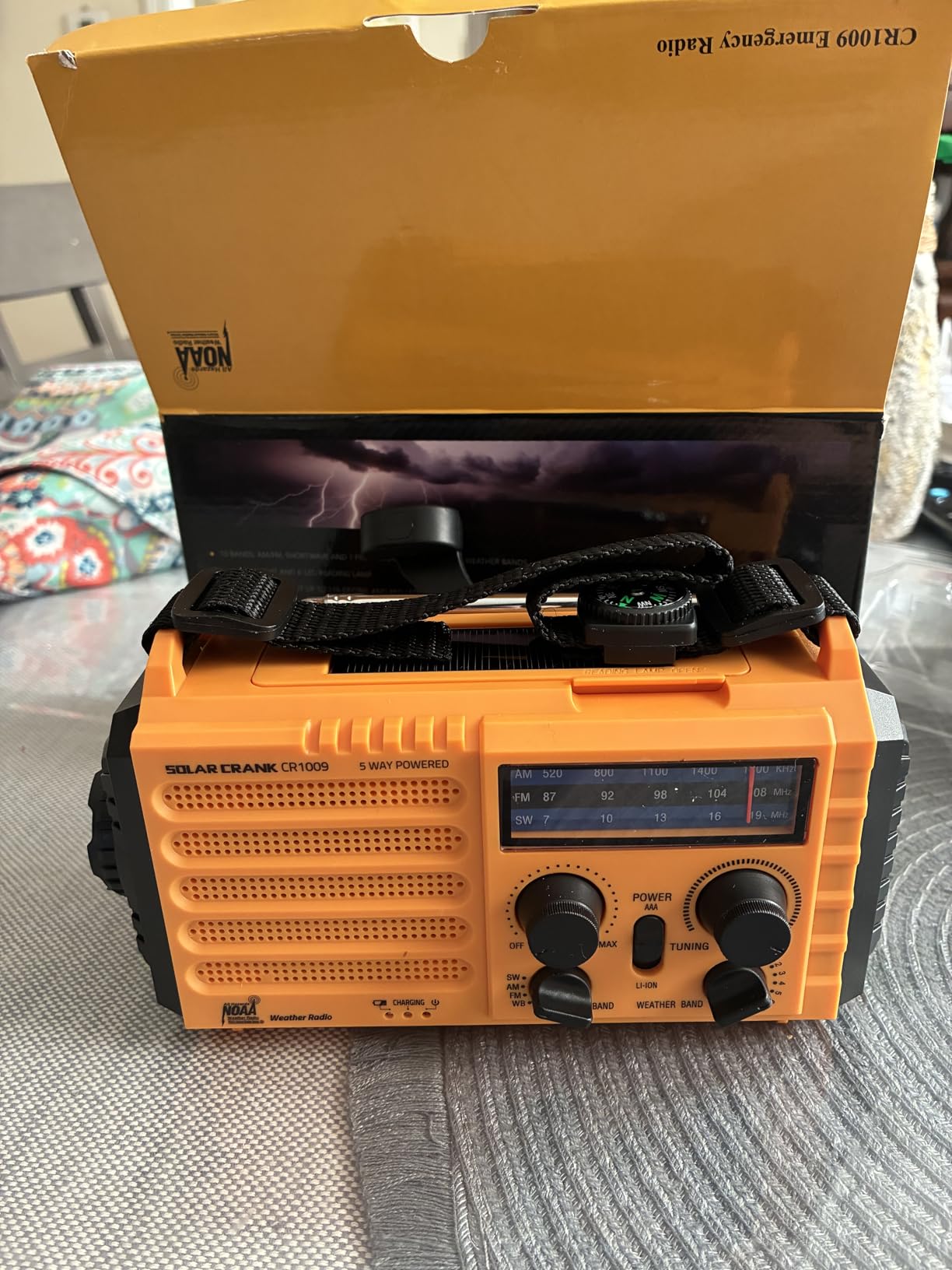
The Mesqool takes the same basic shell as the Raynic and changes the priorities. It drops the LCD in favour of a pure analog dial, and in a power outage with no light, a knob you can find by touch is easier to operate than a backlit menu. Several owners say exactly that, and the 71 percent five-star share reflects a crowd that appreciates a device that does not need instructions.
Battery capacity is the headline number. The 5000mAh pack is rated for up to 13 hours of listening at half volume, and it can charge a phone when the radio is idle. Power comes from the internal lithium cell, USB-C, solar, hand crank and three AAA batteries, with a USB-C cable, carabiner, strap and compass in the box.
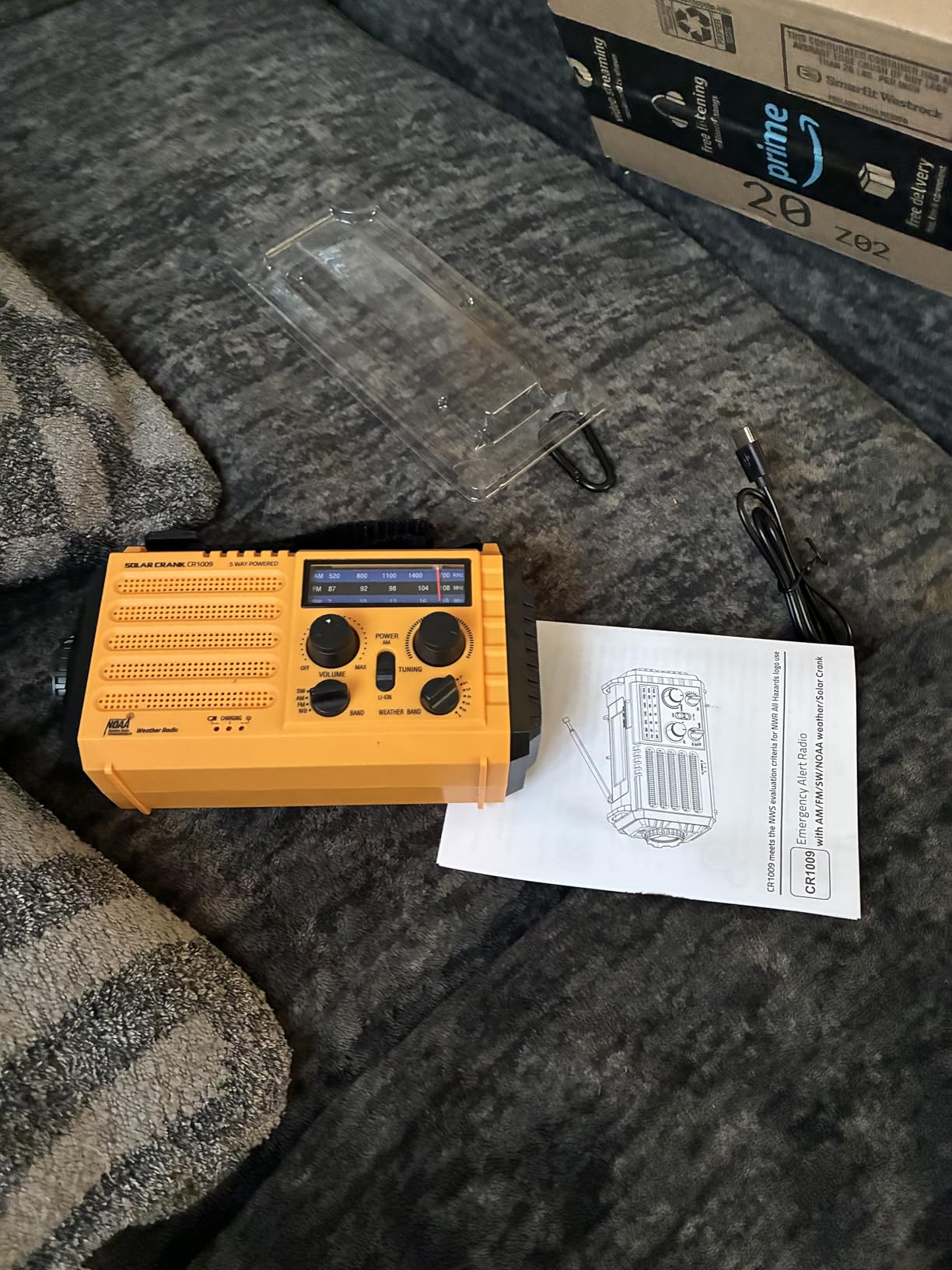
Lighting is where this model clearly pulls ahead of its peers. The 3W flashlight is roughly double what most competing crank radios fit, and the 2.5W reading lamp has dual brightness. A 116dB SOS siren with a flashing red beacon is genuinely loud enough to use as a locator, which matters if you are signalling for help rather than listening for news.
The warranty is worth noting too. A three-year limited warranty against manufacturing defects is the longest offered in this roundup, and it is paired with a 5W speaker that is louder than the 3W units most competitors ship.
Who should buy the Mesqool CR1009
Buy it if you want the brightest light and the loudest siren in the group, or if you are buying for someone who will not read a manual. NOAA coverage, long battery runtime and a simple dial suit a home or a cabin.
It is also a solid second unit, since it comes from a different maker than the Raynic and shares almost none of its failure points.
Where the Mesqool CR1009 falls short
Shortwave is the same compromise as the Raynic. The entire 7-19 MHz range sits on one band with a fast-turning knob, so you cannot tune to an individual station, and one reviewer reported receiving no shortwave signal at all during three days of testing.
Analog tuning means no frequency display and no presets, so finding a specific station takes patience. Some international buyers also reported English-only instructions.
4. PPLEE P-1009Pro – Best for Automatic Alerts in a Pack
Emergency Crank Weather Radio with NOAA Auto Alerts and Shortwave, 5000mAh
NOAA auto alerts with alarm and red light
5000mAh battery
5 power sources
USB-C and USB-A bidirectional ports
Key lock
Pros
- Alert mode triggers even when the unit is switched off
- Bidirectional USB-C and USB-A ports charge and share power
- Key lock stops accidental activation inside a bag
- Large LCD with time display and battery level readout
Cons
- Tune buttons step one frequency at a time with no fast scroll
- Several owners report the shortwave band picks up little to nothing
- Solar panel too weak to recharge a 5000mAh pack from empty
The PPLEE solves a problem the other crank radios do not. Its automatic alert mode will sound the alarm and flash a red light even when the radio is switched off, which is a meaningful difference if the unit lives in a drawer or on a shelf during a storm. Most competing models need to sit in NOAA standby to do the same thing, and standby means a backlight left on and a battery slowly draining.
It also has the cleanest port layout in the group. Bidirectional USB-C and USB-A means you can charge the radio and charge a phone from the same hardware, and the large LCD shows the time and a battery level indicator so you can judge remaining runtime at a glance. At 16 ounces it matches the Raynic for weight, with a slightly narrower footprint of 6.69 by 2.36 by 3.74 inches.
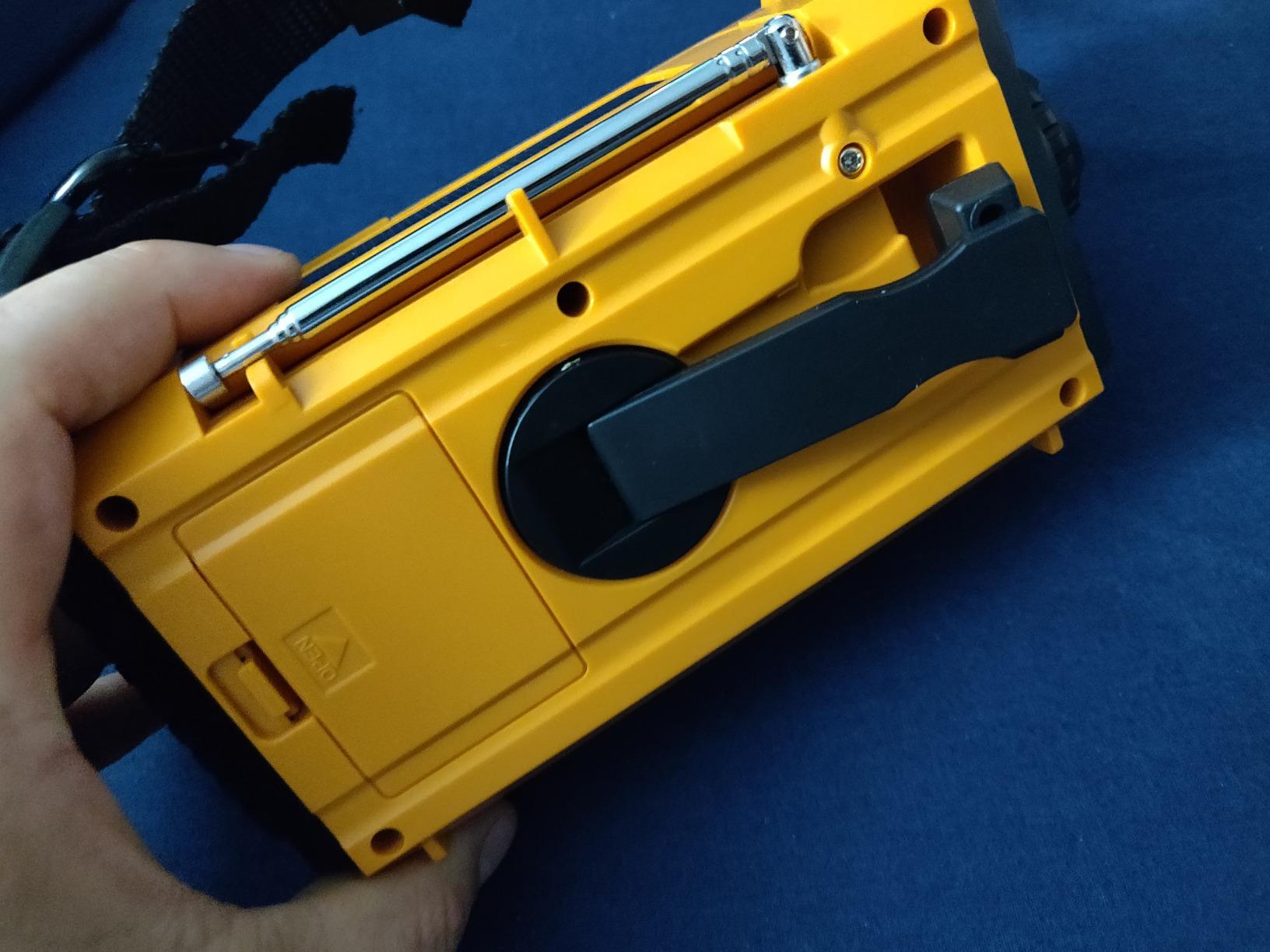
Two smaller details deserve credit. A key lock prevents a radio in a go bag from waking up and draining itself, and the brand shipped a free replacement for a faulty unit, so warranty support appears responsive. Dual lighting of 3W flashlight and 2.5W reading lamp matches the best in the class, and a strap, carabiner and compass are included.
Power options number five: the 5000mAh internal battery, USB, three AAA cells, solar and hand crank. That is one step behind the six-path models, but the AAA option matters more than the count suggests.
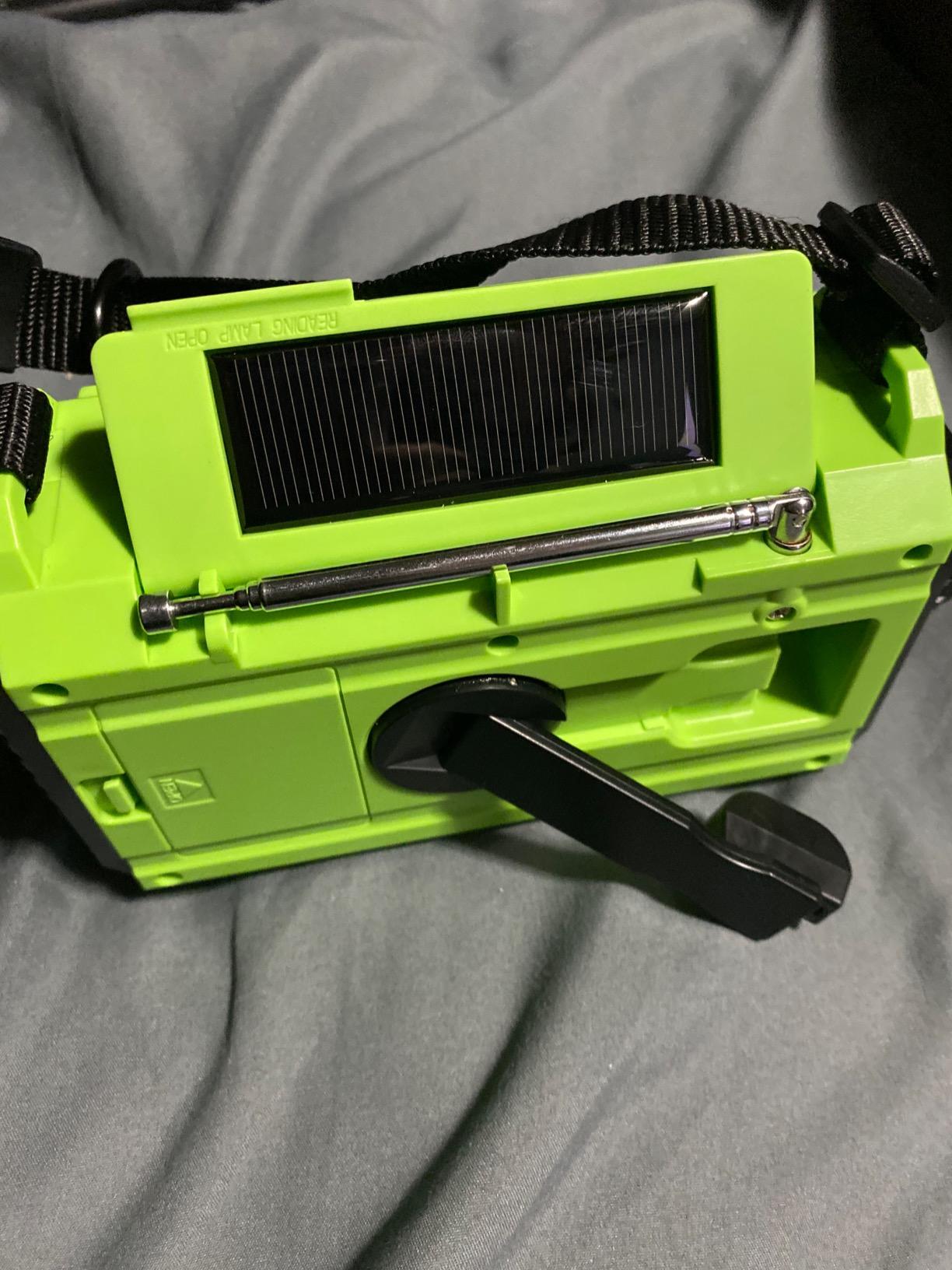
Who should buy the PPLEE P-1009Pro
It is a good fit for someone storing a radio rather than carrying it, because the off-state alert mode works without leaving the unit on standby. The key lock also makes it well suited to a go bag or a vehicle kit.
The bidirectional ports make it practical for a family that wants one device to handle radio and phone charging during a long outage.
Where the PPLEE P-1009Pro falls short
Tuning is the main weakness. The tune buttons step one frequency at a time with no fast scroll, so searching a band is slow. Several owners also say the shortwave band produces little more than static in their area.
The hand crank stores almost no charge, the small solar panel cannot refill a depleted 5000mAh pack, and the volume and tuning knobs feel fragile if the radio is dropped.
5. ROCAM CR1009 – Best for Wet Weather
Emergency Radio with NOAA Weather Alert – Solar Hand Crank Portable AM/FM Shortwave Radio, Rechargeable Battery 5000mAh, USB Charger, Flashlight, SOS Alarm for Home Outdoor Hurricane Survival
AM/FM/SW/NOAA with 7 weather channels
IPX6 water resistance
5 power sources
3W flashlight and 6-LED reading lamp
12-month warranty
Pros
- IPX6 water resistance handles heavy rain and spray
- Extended telescopic antenna improves reception on every band
- Five power sources including 3 AAA and a DC adapter
- Bright 3W flashlight plus 6-LED reading lamp
- 90-day replacement and 12-month warranty
Cons
- Analog pointer tuning gives no frequency readout
- Micro USB input rather than the newer USB-C standard
- Solar and hand crank maintain charge rather than restore it
Water resistance is the detail that separates this one. Most emergency radios in this roundup are merely labelled water resistant, with port covers that do not stay shut. The ROCAM carries a stated IPX6 rating, which covers heavy rain, spray and washdown, in a strong ABS housing. If your kit lives in a vehicle, a garage, a boat or a wet-weather go bag, that is a real specification rather than a marketing word.
Reception is helped by an extended telescopic antenna, which improves AM, FM, shortwave and NOAA pickup compared with the short stubs on the Raynic and Mesqool. Seven pre-programmed weather channels and a loud alarm cover severe weather, and the 3W flashlight with a six-LED reading lamp keeps the lighting side strong.
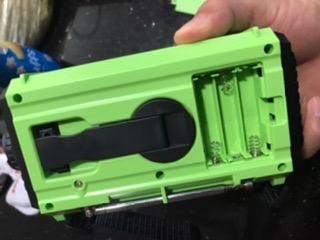
Power comes from five sources: a 5000mAh internal pack that doubles as a phone charger, solar, hand crank, three AAA cells and a DC adapter. The battery is offered in a 12000mAh version too, and owners report that version is popular for extended outages where charging access is limited.
The warranty terms are worth a look. A 90-day replacement window sits on top of a 12-month warranty, so a unit that fails early is swapped rather than argued about. At 4.5 stars across more than 2,800 ratings, with a 71 percent five-star share, the feedback is consistent.
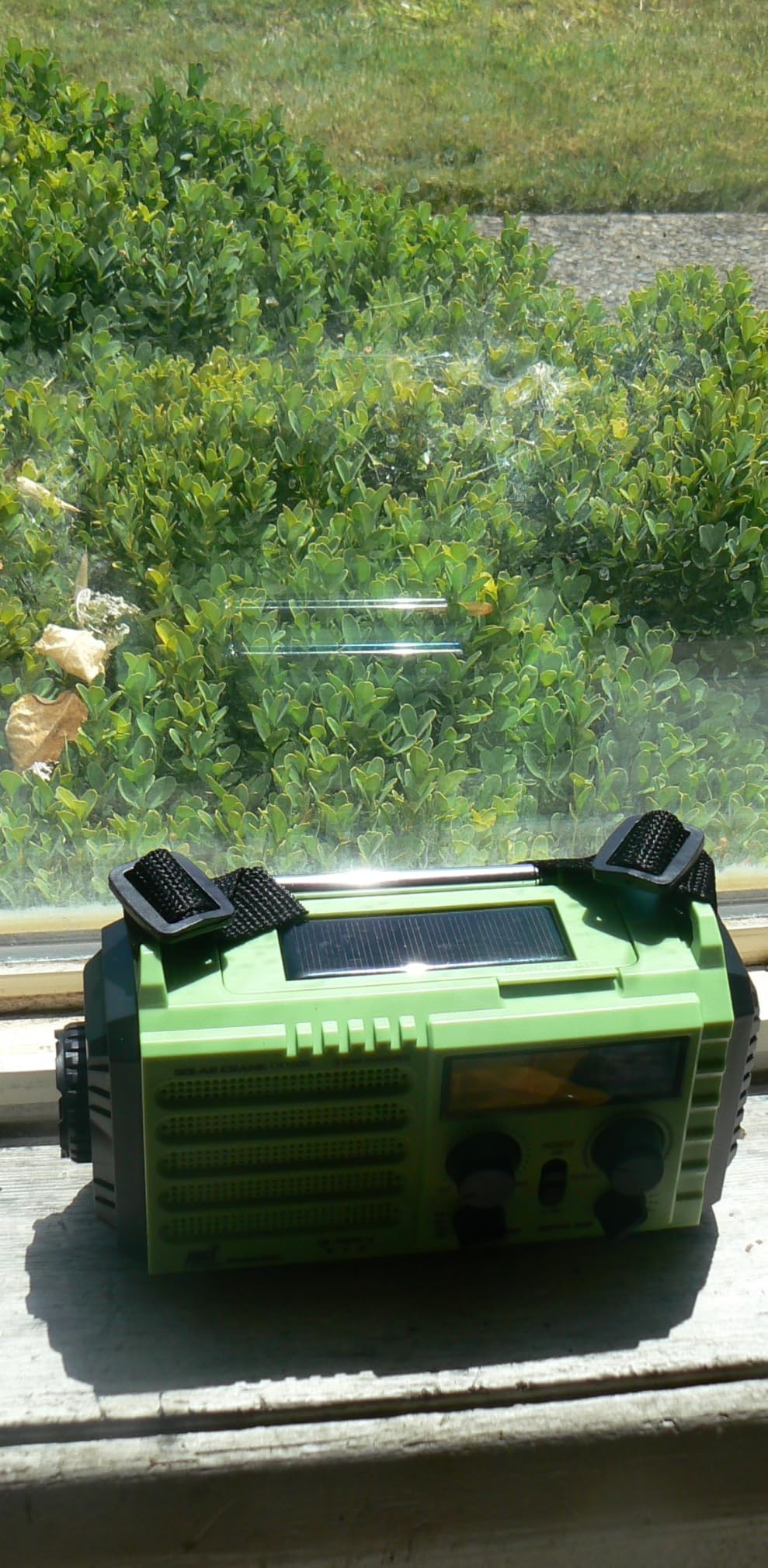
Who should buy the ROCAM CR1009
It suits anyone whose radio will be exposed to rain, spray or dust, which covers vehicle kits, coastal homes, boats and outdoor shelters. The longer antenna also makes it a better shortwave performer than the other analog-pointer crank radios.
If you need more runtime than a single charge, the larger battery version extends the same design further.
Where the ROCAM CR1009 falls short
The analog pointer means no frequency display, so stations are found by ear. That is workable but slow when you know exactly which frequency you want.
As with the other crank models, solar and hand crank maintain charge rather than rebuild a dead pack. Volume is only adequate at higher settings and the speaker lacks bass. It is also slightly larger and heavier than the most compact units here.
6. C. Crane CC Skywave 2 – Best for Shortwave Reception
C. Crane CC Skywave 2 AM, FM, Shortwave, NOAA Weather + Alert, VHF Aviation Band, Small Battery-Operated Portable Travel Radio with Clock and Alarm
Full shortwave 2300-26100 kHz plus VHF aviation
400 memories and direct frequency entry
External antenna jack
70 hours on two AA batteries
6 oz
Pros
- Genuine full-band shortwave coverage rather than a compressed single band
- Direct frequency entry
- auto scan and 400 memories including 10 aviation presets
- External shortwave antenna jack for a major reception upgrade
- Runs 70 hours on earbuds or 60 on the speaker with two AA cells
Cons
- No hand crank
- solar panel or rechargeable battery
- Not water resistant for wet-weather deployment
- Small speaker and earphones give noticeably better clarity
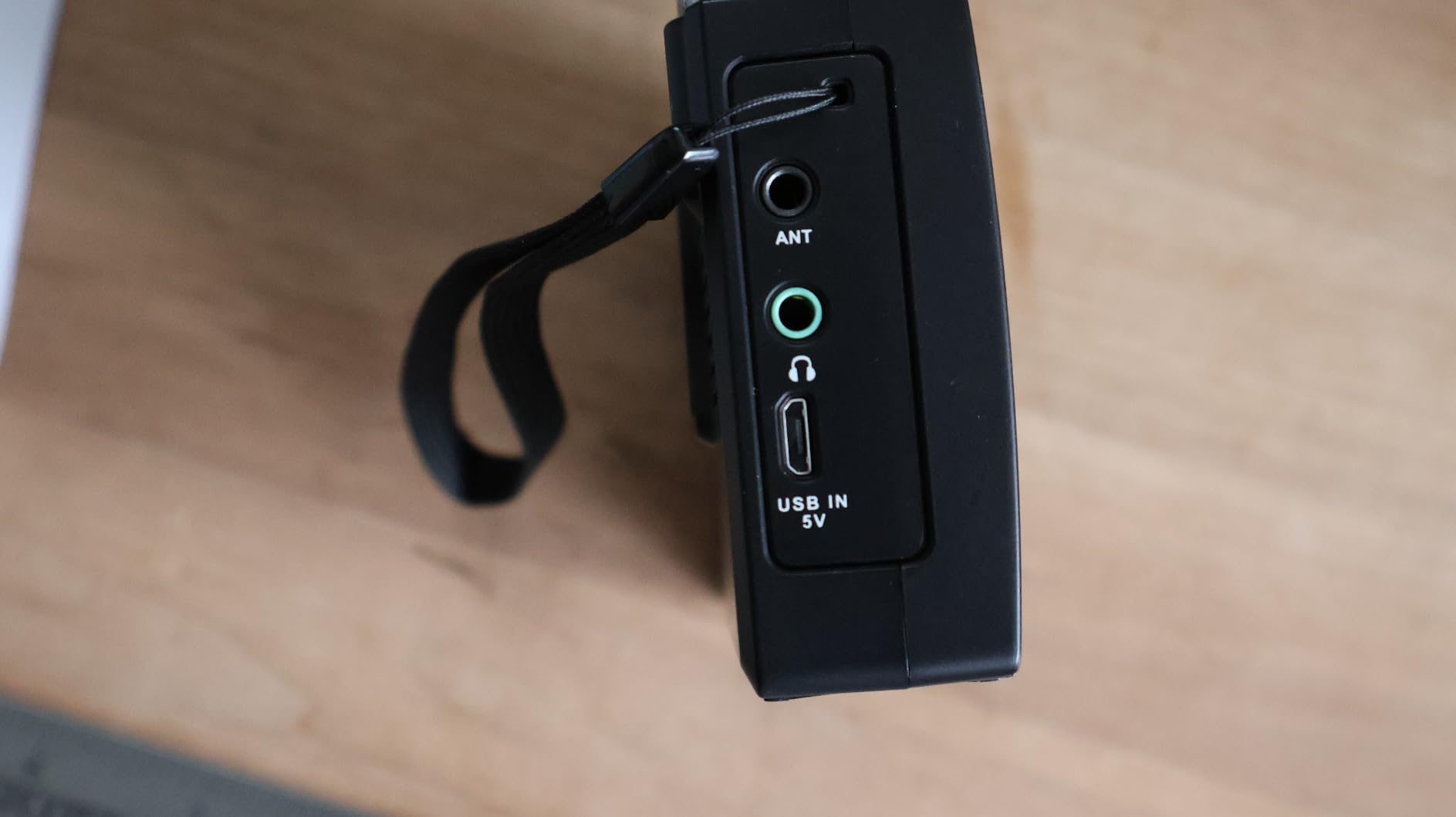
If shortwave reception is the point of your purchase, this is the radio to buy. The CC Skywave 2 covers the full shortwave range from 2300 to 26100 kHz, plus AM, FM, NOAA weather with alerts and a VHF aviation band. At 4.4 stars across more than 1,700 ratings, it holds the strongest reputation among serious listeners in this group, and reviewers with long radio experience single out its sensitivity and selectivity as class-leading.
The controls reflect that audience. Direct frequency entry, auto scan and store, 400 memories with 10 scannable aviation presets, selectable fast and fine tuning, and multiple bandwidth settings let you dial in a weak signal that a simple crank radio will never pull out of the noise. There is also an external shortwave antenna jack, which is the single biggest reception upgrade you can make to any portable radio.
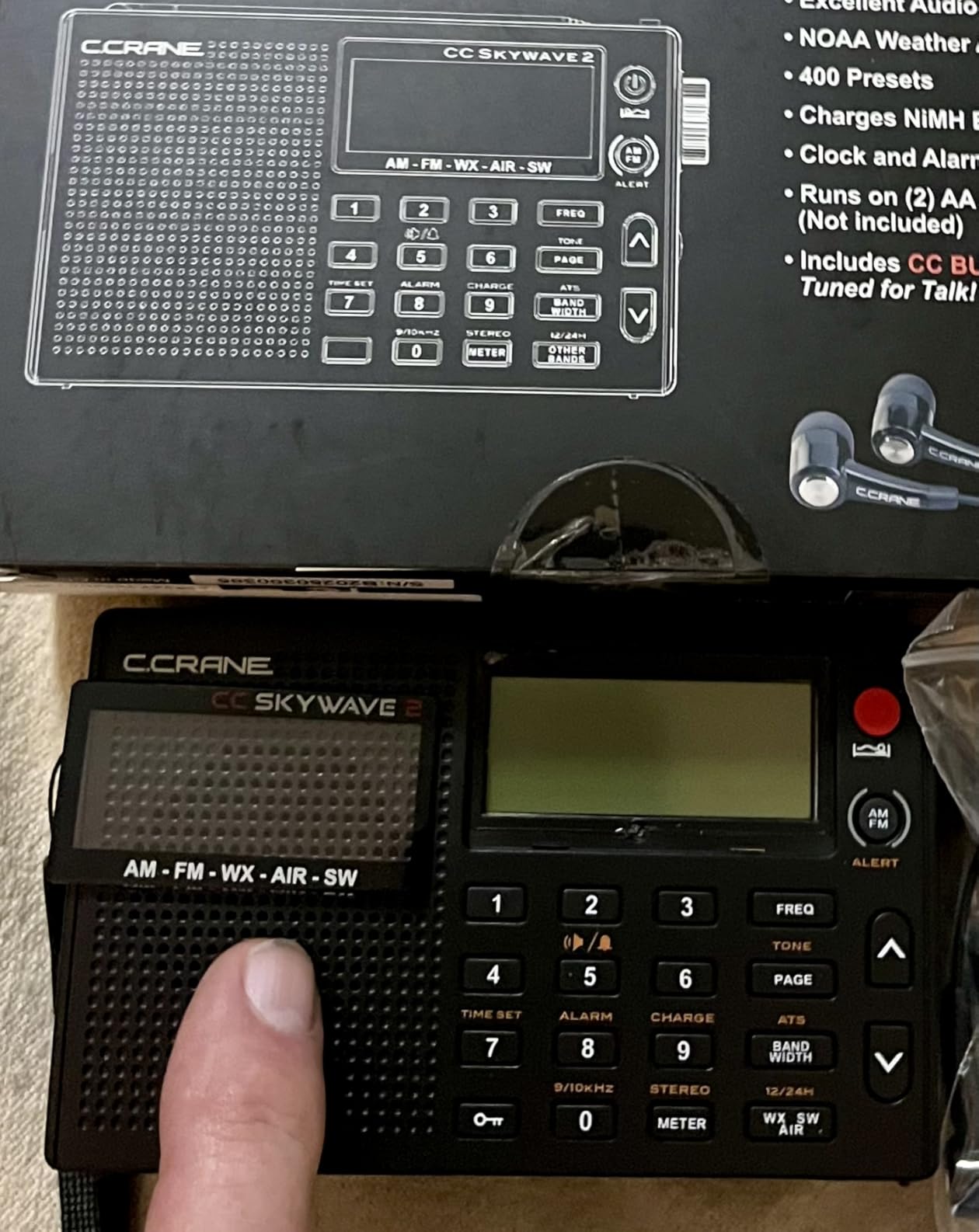
Power is where it gives ground. It runs on two AA cells, and nothing else, giving about 70 hours on earbuds or 60 hours on the speaker. There is no hand crank, no solar panel and no internal rechargeable battery. The tradeoff is deliberate and it works in your favour for storage: AAs hold their charge for years, so a radio sitting in a drawer for a year still works when you need it.
At 6 ounces and 4.75 by 3 by 1.1 inches it is the smallest and lightest radio here, with a clock, alarm, lighted LCD, fold-out stand, earphones and a carry case included. r/preppers members frequently say the same thing about C. Crane radios in general, and the Skywave 2 is the current version of that line.
Who should buy the C. Crane CC Skywave 2
Buy it if you plan to actually listen to international shortwave, aviation or maritime traffic rather than only catch alerts. Anyone living far from a NOAA transmitter, in a rural area with weak local FM, or interested in what distant stations are broadcasting during a crisis will hear more with this set.
Travelers benefit too, since 6 ounces and a battery-only design pack into any bag without planning.
Where the C. Crane CC Skywave 2 falls short
There is no crank, no solar panel and no rechargeable pack, so it cannot charge a phone or recover charge in the field. It is not water resistant, which rules it out for wet-weather deployment.
The speaker is small and some owners with hearing loss report the audio is less clear than expected, though the included earphones improve it substantially. The soft case protects against dust and sprinkles, not drops.
7. Emgykit R11 – Best for Bluetooth, Media and Features per Dollar
Portable Shortwave Radios with NOAA/SW/AM/FM, for Camping & Home
NOAA, SW, AM and FM reception
Bluetooth 5.0 with 5W speaker
TF card slot and 3.5mm jack
4000mAh for up to 32 hours
Hand crank and solar
Pros
- Bluetooth playback
- TF card slot and a 5W magnetic speaker are rare at this tier
- Seven white noise options with a 10-70 minute auto shut-off for sleep
- Automatic scan stores up to 70 channels per band and 210 total
- Hand crank and solar as genuine backup power
Cons
- 4000mAh battery is smaller than the 5000mAh packs rivals use
- Only three power methods with no AA battery fallback
- Heavier than other portable shortwave options at roughly 1.2 lb
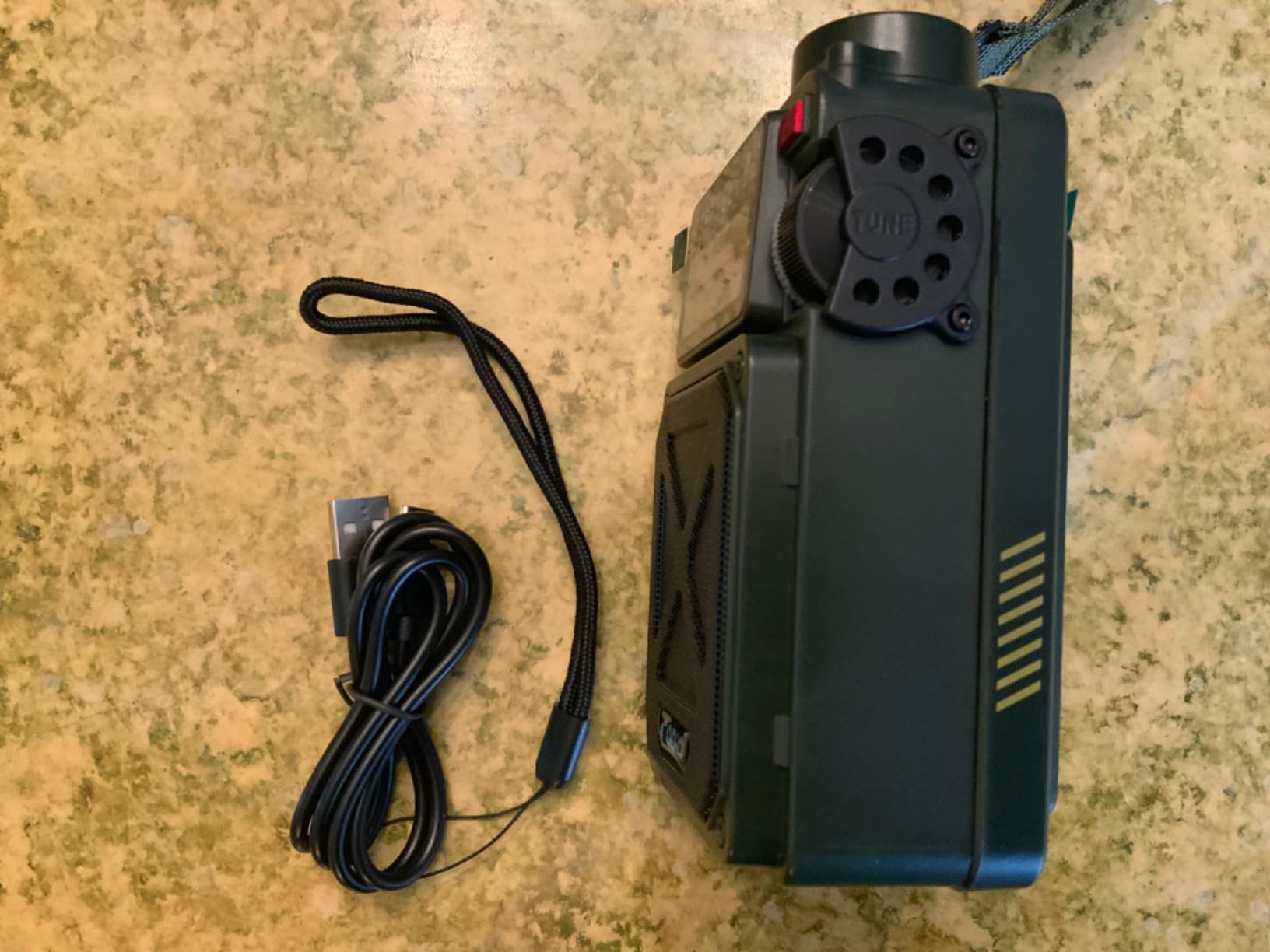
This radio does something none of the others do. It streams over Bluetooth 5.0, plays files from a TF or microSD card, and drives a 5W magnetic speaker, which is the largest speaker output in this roundup. For someone whose radio doubles as a camp speaker or a way to listen offline to a stored library of broadcasts, that is a genuinely different feature set rather than a checkbox.
Reception is handled by manual and scanning tuning modes across NOAA, SW, AM and FM, with automatic scan and store of up to 70 channels per band for 210 total. Seven built-in white noise options and a 10 to 70 minute auto shut-off make it usable as a sleep machine, which owners mention more often than you would expect.
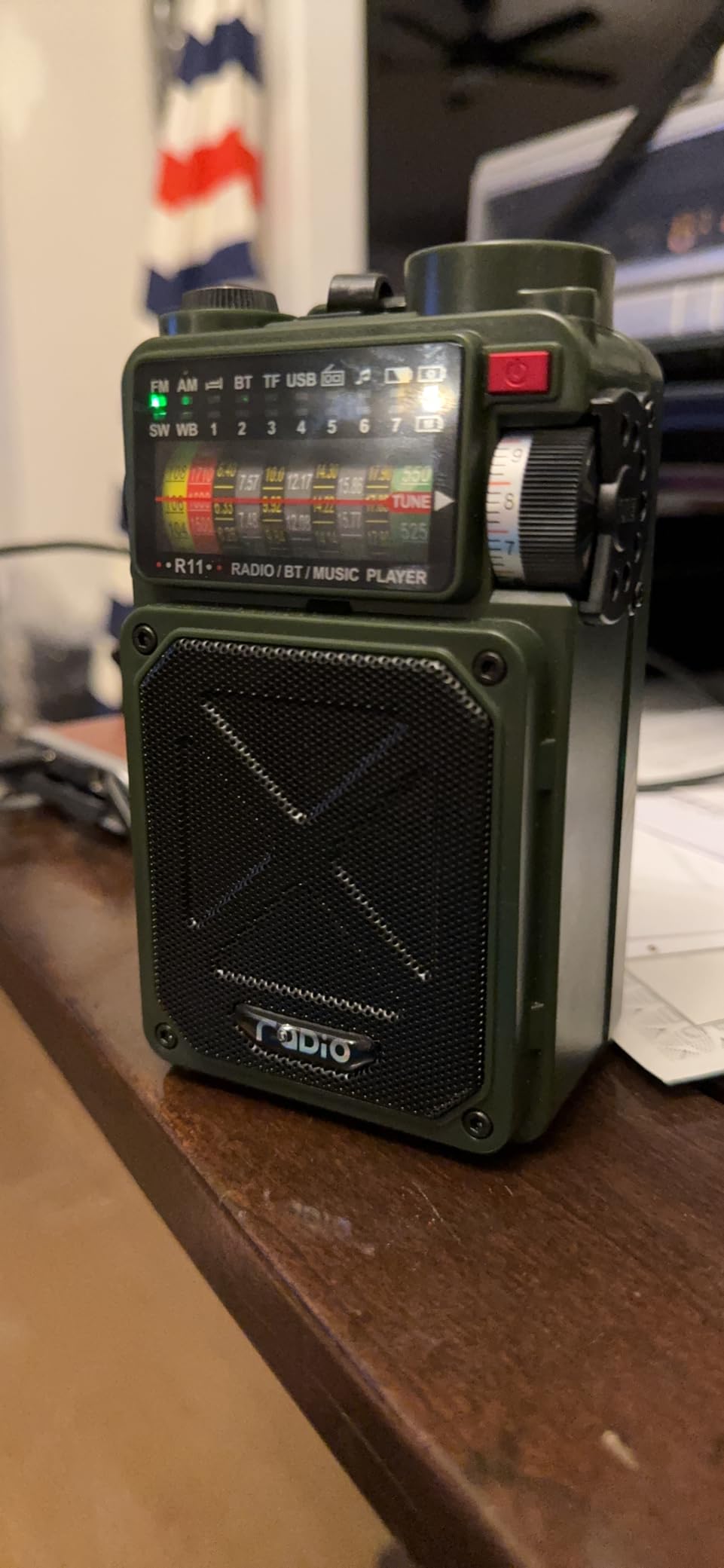
Power is a 4000mAh rechargeable battery rated for up to 32 hours of playback via Type-C charging, plus a hand crank and solar panel. That is 32 hours against the 13 hours a typical 5000mAh NOAA radio delivers on radio listening, because the speaker here is much larger. The 120-lumen flashlight, compass, SOS alert and phone charging output fill out the emergency feature set.
At 4.4 stars across more than 1,000 ratings, the feedback is positive on value and feature density. The most common caveat is that automatic search can only store what is actually receivable in your area, so the 210-channel figure is a ceiling rather than a guarantee.
Who should buy the Emgykit R11
It suits anyone who wants a shortwave radio that doubles as a Bluetooth speaker for a cabin, a campsite or a vehicle. Families with kids often find the white noise and the offline card playback more useful day to day than another band.
Those who want phone charging from a hand-crank-adjacent setup will also like the combination of crank, solar and USB output.
Where the Emgykit R11 falls short
There is no AA battery fallback. If the internal 4000mAh pack fails or ages out, the only options are USB, hand crank or solar, and the small panel will not refill a depleted pack quickly.
At roughly 1.2 lb it is the heaviest portable here, the battery is smaller than competitors, and the review history is shorter with fewer customer photos than the established models. A few owners note that the digital search finds fewer stations in weak-signal areas.
8. Tecsun PL880 – Best for SSB and Amateur Reception
Tecsun PL880 Portable Digital PLL Dual Conversion AM/FM Longwave Shortwave Radio with SSB (Single Side Band) Reception
Dual conversion PLL receiver
AM, FM, longwave and shortwave
SSB with 10 Hz tuning step
4 AM and 5 SSB bandwidth filters
3W speaker, 520 g
Pros
- Dual conversion architecture with class-leading sensitivity and selectivity
- Full AM
- FM
- longwave and shortwave coverage with SSB reception
- Selectable filters on AM and SSB pull weak signals out of noise
- Favoured by amateur and DX operators for signal pulling
Cons
- Heaviest and priciest unit here at 520 g with no emergency power features
- No hand crank
- solar panel or NOAA weather alert function
- Larger footprint than a pocket portable and an 8 percent one-star share
The PL880 is the most capable receiver in this roundup and the least suited to a power outage. A dual conversion PLL architecture with adjustable bandwidth filters, four settings on AM and five on SSB, and a 10 Hz tuning step is the kind of design that lets an operator pull a weak station out of noise that other portables cannot touch. Amateur and DX listeners rate it as the best receiver here on raw performance.
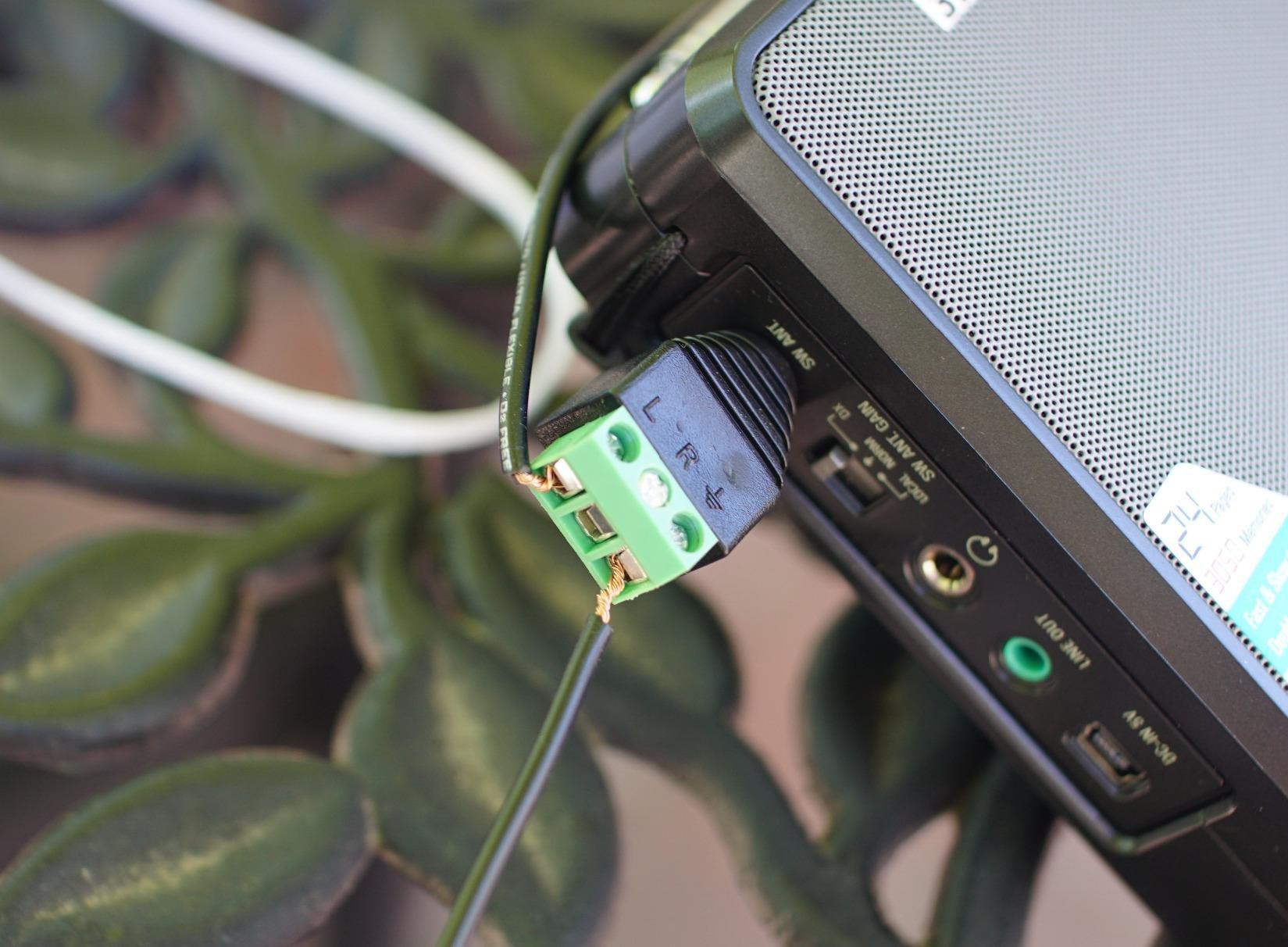
Single sideband reception is the feature that separates it from everything else on this list except the PL330. SSB is how utility, maritime and amateur voice traffic is actually transmitted, so if you want to hear working stations rather than broadcast programmes, this is the class of receiver you need. It covers AM, FM, longwave and shortwave, with a 3W speaker, a 3.5mm jack, a USB interface, an alarm clock and a sleep timer.
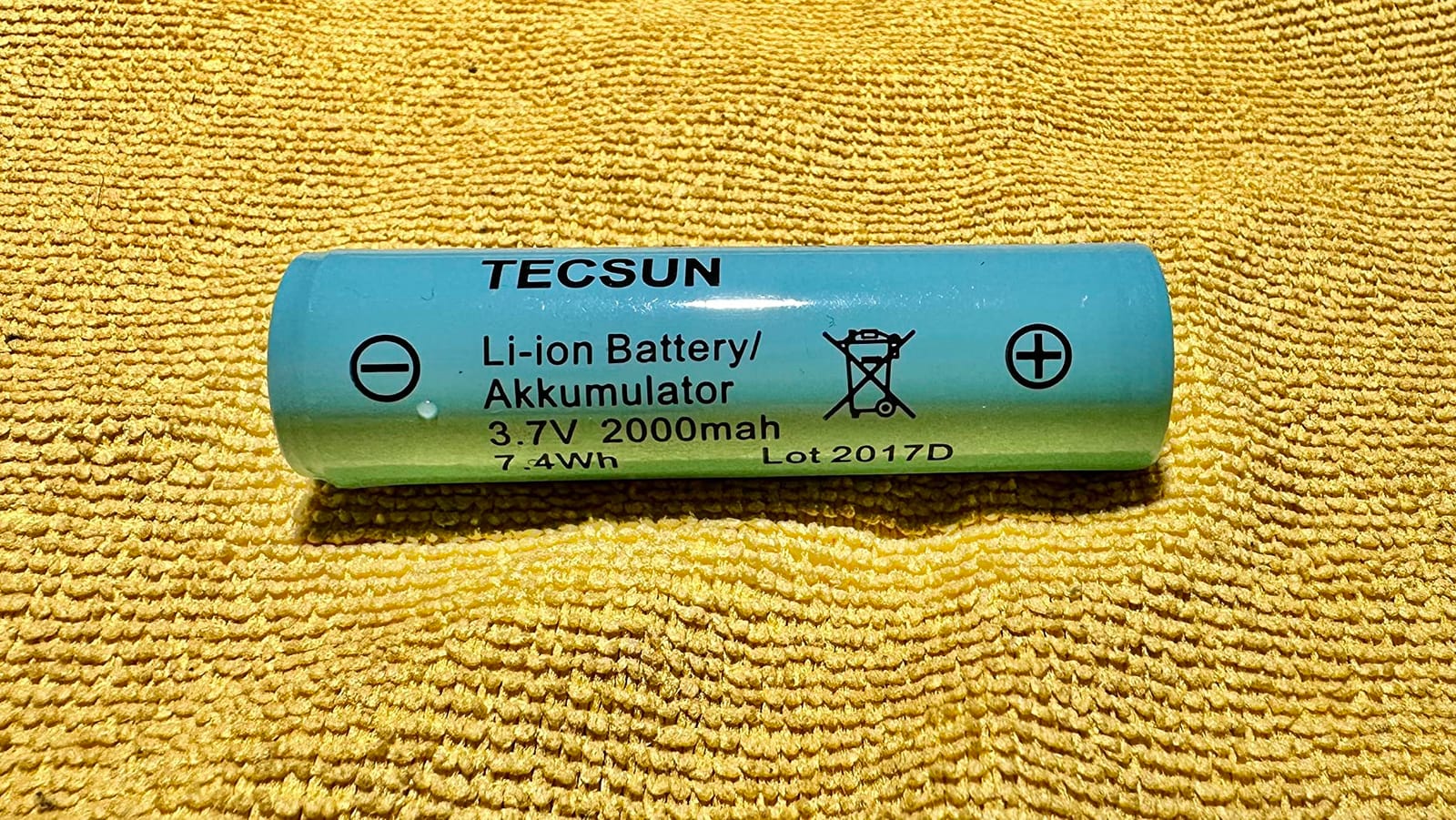
Now the practical trade-offs. At 520 g it is the heaviest radio in this roundup and roughly twice the weight of a portable set, and its 7.5 by 4.5 by 1.25 inch footprint will not disappear into a small go bag. It is also the most expensive item we tested.
More importantly for an emergency kit, there is no NOAA weather band, no alert function, no hand crank and no solar panel. It runs on a single AA battery. You would be pairing it with a separate NOAA radio rather than replacing one.
Who should buy the Tecsun PL880
Buy it if you already have an emergency NOAA radio and want the best listening experience on top of it. Ham operators, DX listeners and anyone who monitors utility or maritime traffic will get the most from the SSB and bandwidth controls.
It is better suited to a home base with mains power nearby than to a bag you carry out of a house in a hurry.
Where the Tecsun PL880 falls short
For the purpose of this roundup, the limits are severe. No weather alerts, no crank, no solar and no rechargeable pack means it has no emergency power story at all.
The weight makes it awkward to move quickly, and it carries the highest one-star share in the group at 8 percent, double that of the leading crank radios. Getting the most from the bandwidth settings also assumes you understand SSB and will read up on it.
9. Tecsun PL-380 – Best for Easy Tuning and DX on a Budget
TECSUN PL-380 DSP FM Stereo. MW. SW. LW. World Band PLL Radio Receiver, LCD Display, ETM Function Added
Silicon Labs Si4734 DSP chip
Easy Tuning Mode auto-stores active frequencies
550 presets with direct key-in
7 oz body with NiMH charging
Pros
- ETM mode scans and stores active frequencies automatically
- 550 memories plus direct keypad frequency entry
- Adjustable 1-6 kHz bandwidth cuts crosstalk on crowded bands
- Only 7 oz and charges NiMH cells in the unit over USB
Cons
- No NOAA weather band or alert capability
- No hand crank
- solar panel or rechargeable emergency battery
- Very small buttons and a poorly translated manual
The PL-380 solves the complaint that every other tuner in this roundup attracts. Easy Tuning Mode, or ETM, scans a band and automatically stores the frequencies currently carrying a signal, without overwriting the presets you already saved. On a crowded shortwave band, that turns a ten-minute hunt through noise into a single press of a button. It is the feature owners quote most often, and experienced reviewers consistently rate this as the best value in portable shortwave.
Underneath is a Silicon Labs Si4734 DSP that digitalises the MW, FM and SW demodulation. In plain terms, the chip does the filtering and noise reduction that an analog set would struggle with, so weak stations come through cleaner. You get 550 presets across FM, AM, longwave and shortwave, direct frequency entry from the keypad, adjustable bandwidth from 1 to 6 kHz, and signal strength and signal-to-noise meters on the display.
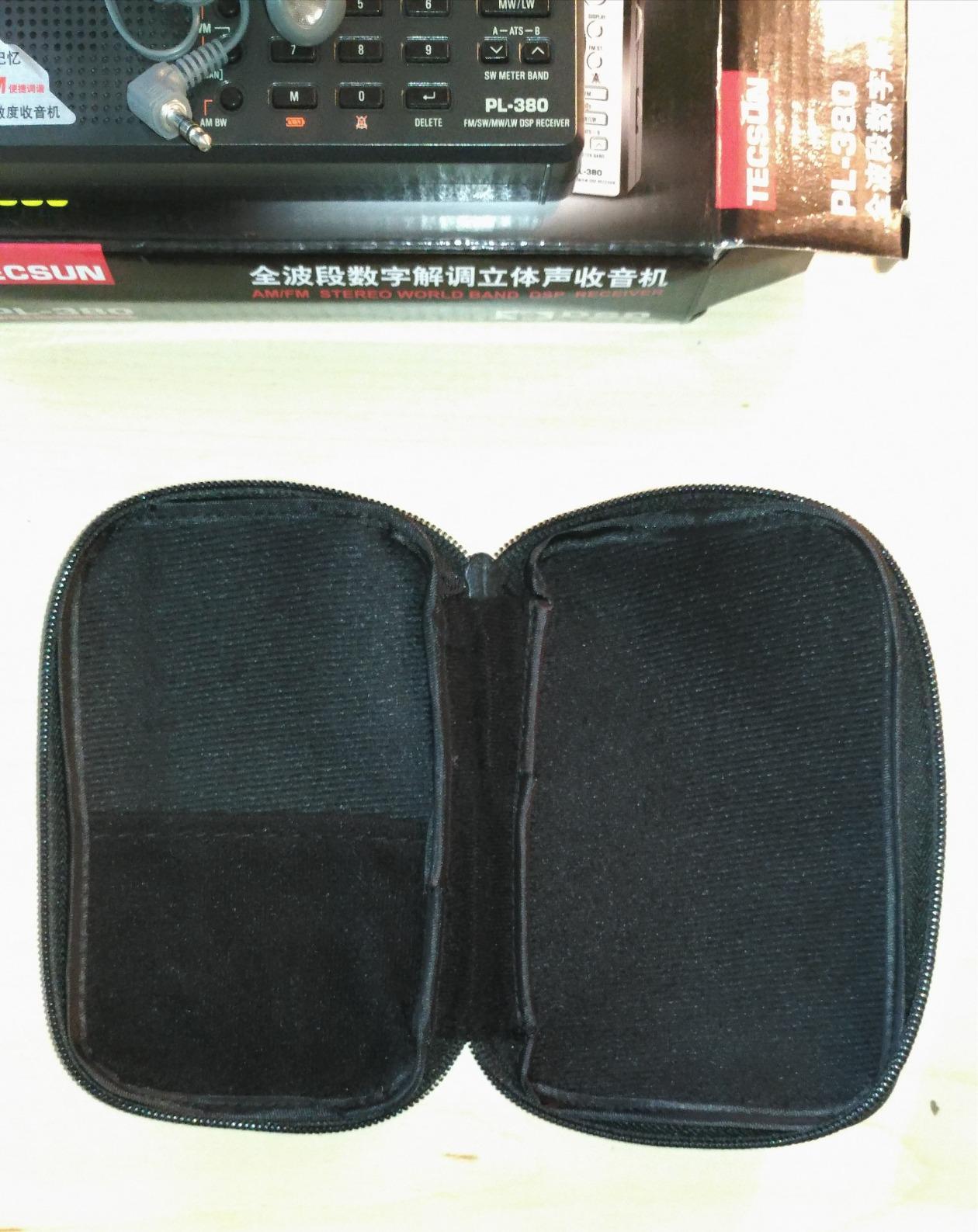
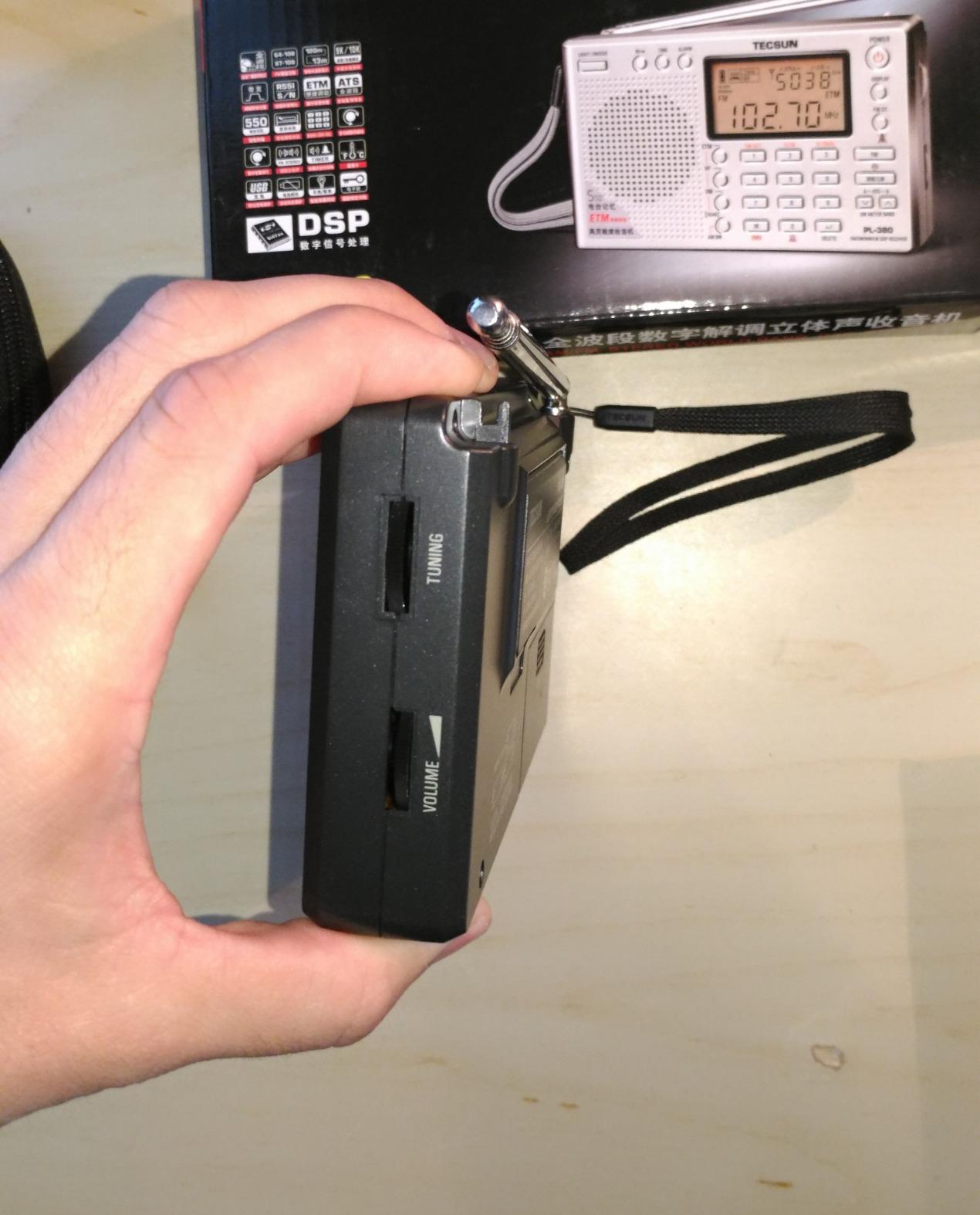
At 7.04 ounces and 5.31 by 1.02 by 3.39 inches, it is one of the lightest radios here, and it charges NiMH cells inside the body over USB. Earphones, a USB cable, a clip-on external antenna and a neoprene case are included, and the clip-on antenna is a cheap way to improve reception.
The catch for an emergency kit is that it has no NOAA weather band and no alert function, and no hand crank or solar panel. The AAs or NiMH cells are the only power. A review from a listener with six decades of shortwave experience puts the reception quality above sets costing several times more, which tells you where the value sits.
Who should buy the Tecsun PL-380
It suits a beginner who wants to explore shortwave without fighting the tuning wheel, which is the main reason shortwave listeners give up. Anyone living in a rural area with weak local FM will hear distant stations on the ETM scan that a cheap analog set misses.
At 7 ounces it also works as a travel radio, and the price sits well below the C. Crane and PL880.
Where the Tecsun PL-380 falls short
It is not an emergency radio in the NOAA sense. There is no weather band, no alert system, no crank and no solar, so you would pair it with a separate weather radio rather than rely on it alone.
Usability is the other complaint. The buttons and legends are very small, the manual is awkwardly translated, and the thumbwheel tuning runs backwards and jumps ten times the step if turned quickly, which is frustrating when exploring a band.
10. Tecsun PL330 – Best Lightweight Pocket Shortwave Receiver
Tecsun Digital PL330 AM/FM/LW/SW Worldband Radio with Single Side Band Receiver
AM, FM, longwave, shortwave and SSB
DSP demodulation with synchronized detection
850 presets
7.4 oz and 5.5 by 3.5 by 1 inch
Li-ion with micro USB charging
Pros
- SSB reception at a fraction of the cost of comparable sets
- DSP demodulation rejects images that cheaper sets cannot
- 850 presets with direct frequency entry and key lock
- Slim 7.4 oz body fits a jacket pocket
- External antenna input and 3.5mm audio output
Cons
- No NOAA weather band or alert function
- No hand crank or solar panel for emergency use
- Small on-board speaker and no kickstand so it is easy to knock over
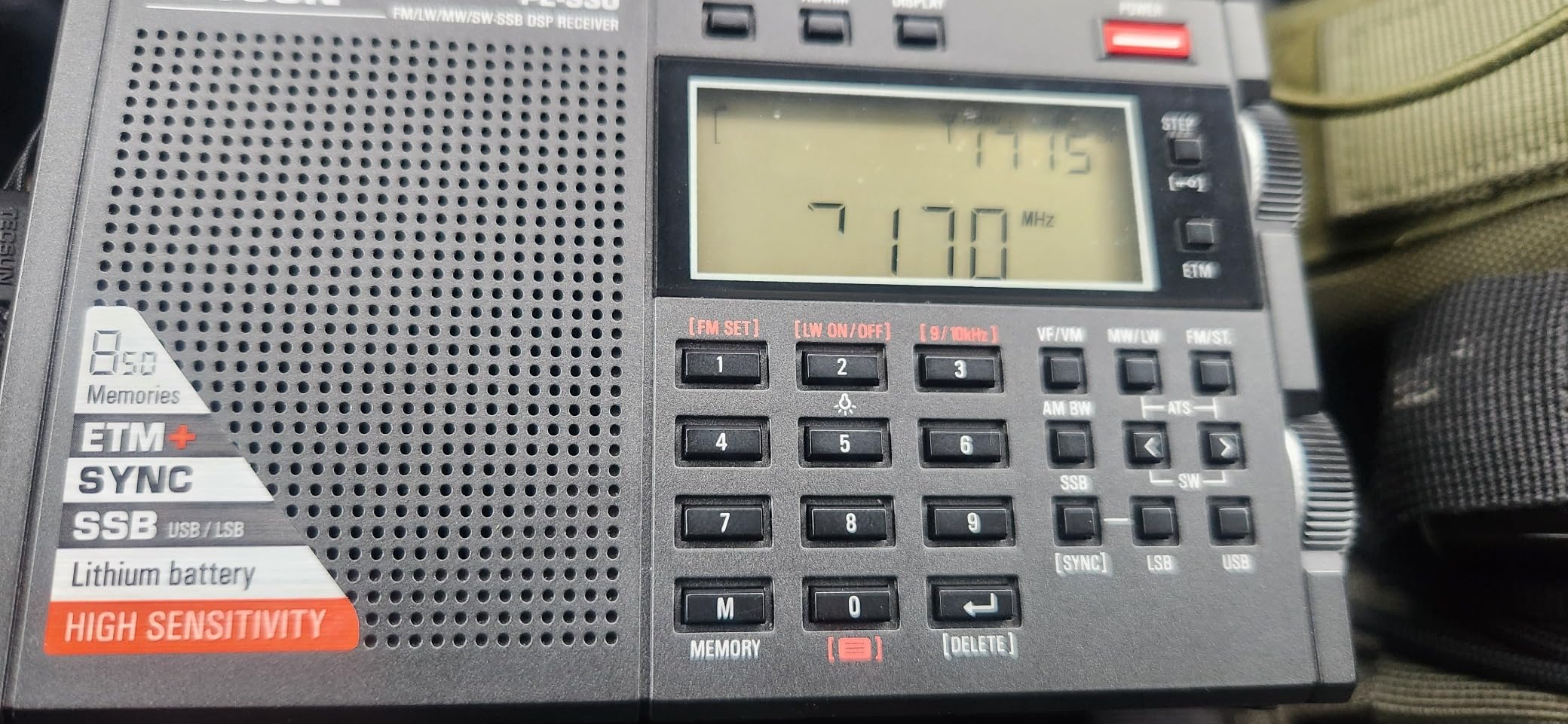
The PL330 is the balance point of the group. It brings SSB and DSP demodulation to a mid-level price point, which is where most of the cheaper portables stop at AM, FM and a compressed shortwave band. Synchronized detection gives it strong image rejection, so it hears cleaner on crowded frequencies than sets that cost noticeably less.
It stores 850 presets with direct frequency entry and a key lock, covers AM, FM, longwave, shortwave and single sideband, and includes an external antenna input plus a 3.5mm audio output for driving a better speaker. The rechargeable lithium cell charges over micro USB from the same cable as a phone and runs for many hours.
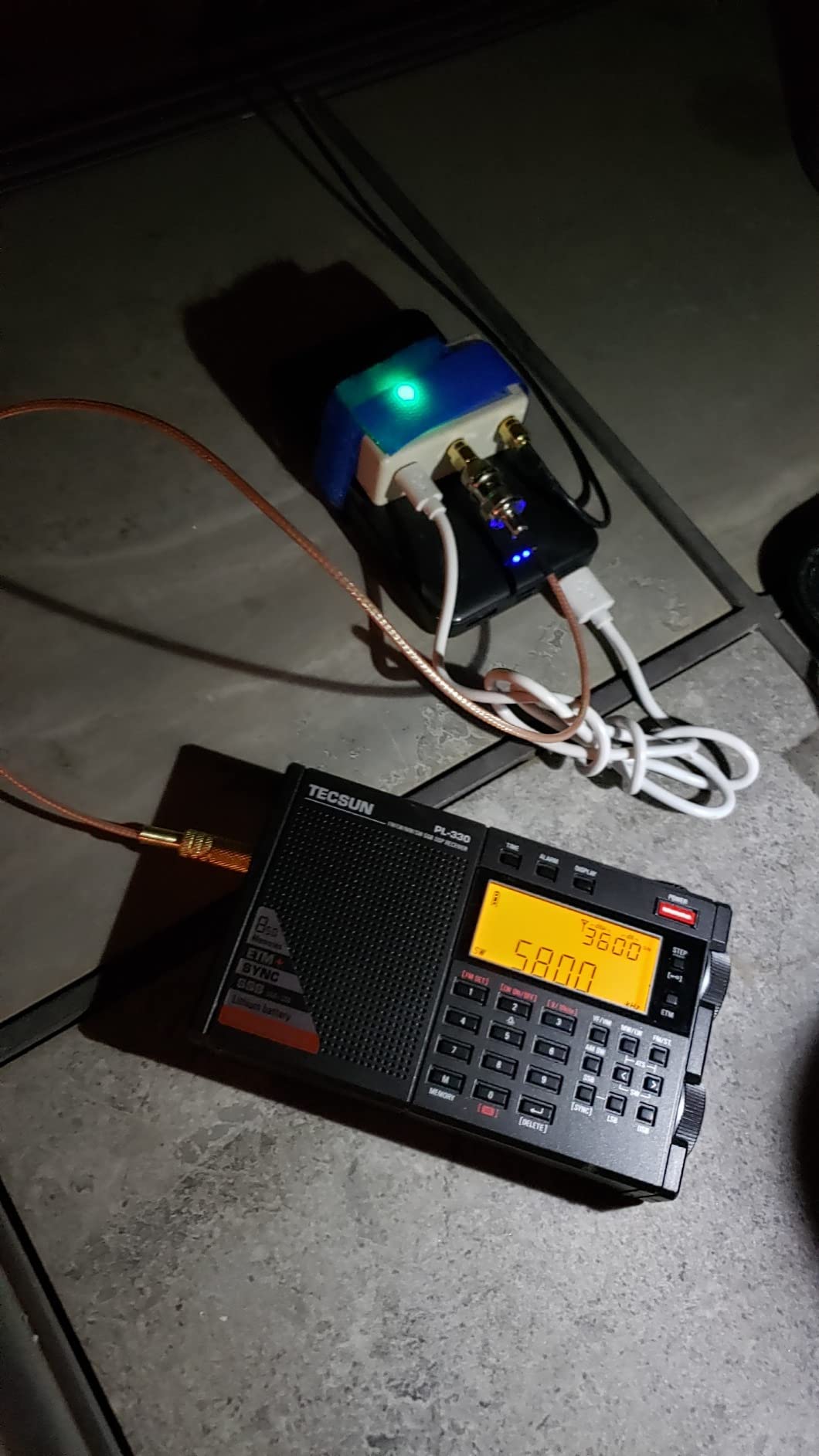
Size is the reason it lands on this list. At 7.4 ounces and 5.5 by 3.5 by 1 inch it slips into a pocket, which makes it the easiest radio here to carry without planning ahead. Owners treat it as the best balance in the shortwave class, citing sensitivity better than cheaper XHDATA sets and SSB at a fraction of the C. Crane cost.
Longwave is the frequency you give up for SSB, and some buyers say they would have traded it the other way. The onboard speaker is rated at 8 ohms and 250 mW, which sounds loud for a unit this small but is still small, so earphones are worth bringing.
Who should buy the Tecsun PL330
It suits travellers, hikers and anyone who wants a full-featured shortwave receiver that does not need a bag of its own. The key lock is useful when the radio lives in a pack, and the 850 presets mean you can store your target frequencies once and forget them.
It is also the sensible middle step for someone moving up from a crank radio who wants SSB without stepping up to the PL880.
Where the Tecsun PL330 falls short
There is no NOAA weather band, no alert function, no hand crank and no solar panel. For an emergency kit, that means it cannot do the single most important job a radio is bought for, and it needs charging more often than an AA-powered set.
There is no kickstand, so it is easy to knock over, the knobs feel light and plasticky, and the button layout needs the manual before it makes sense.
How to Choose an Emergency Shortwave Radio
The wrong radio for your situation is a common and expensive mistake, because most emergency radios are sold on feature counts rather than reception quality. Here is what actually decides whether a radio works for you.
1. Check for a real shortwave band, not a token one. The cheapest crank radios compress the whole 7-19 MHz range onto a single band with a fast-turning knob, so you cannot hold a station. Look for split shortwave bands, a frequency display, or direct frequency entry. If shortwave matters to you, the Kaito KA500, the C. Crane CC Skywave 2 or a Tecsun DSP set are the honest options.
2. Count power paths, then discount the weak ones. Every product here claims solar and hand crank. On small built-in panels these only maintain a charge, they do not restore a dead battery, and a hand crank needs many minutes of turning for meaningful output. Treat AA battery support as a real power path and crank and solar as the last resort. If you want solar to carry real weight, look at a separate panel, and our guide to the best solar chargers for emergency kits covers that side properly.
3. Check the NOAA alert system, not just the channel count. Seven NOAA channels are standard. What varies is whether the radio alerts automatically, whether it keeps monitoring in standby, and whether the PPLEE-style models will sound an alarm while switched off. Also note that NOAA and PEAS alerts are USA and Canada services, so they do nothing for a reader travelling elsewhere.
4. Decide receive-only or two-way. Every radio in this roundup is receive-only. None of them can talk to your family, which means a two-way set is a separate purchase. That is a gap worth planning for rather than discovering on the day.
5. Weigh it against your bag. The C. Crane at 6 ounces and the Tecsun sets at around 7 ounces disappear in a pocket. The Kaito KA500 at 1.3 lb and the PL880 at 520 g will shape what else fits in the bag with them. If the radio is going to be carried, weight matters more than any feature.
6. Look at water resistance honestly. Only the ROCAM carries a stated IPX6 rating, which covers heavy rain and spray. The rest are labelled water resistant with port covers that do not reliably stay shut. For a vehicle or a coastal kit, treat that difference as decisive.
7. Check the battery chemistry against your real risk. The forum consensus on r/preppers favours plain AA cells, because they cost little, are available in every town and hold charge for years. Lithium packs last longer and give better runtime, but a swollen cell that has sat unused is a fire risk. Our preference is an internal lithium pack for daily use plus a compartment of AA cells as the long-term fallback.
8. Read the review volume, not just the rating. A 4.5 star average from a handful of reviews tells you very little. The Raynic at more than 20,000 ratings and the Kaito KA500 at more than 13,000 have enough long-term feedback that recurring problems are well documented, which is what you want to know before buying rather than after.
We also weighed independent testing, owner reports across r/preppers, r/shortwave and r/amateurradio, and the frequency of specific complaints. Radios with clear recurring defects, such as shortwave bands that pick up nothing or solar panels that never charge, were ranked accordingly.
Do You Need a License to Talk on an Emergency Radio?
No, not for anything in this roundup, because every radio on this list is receive-only. The question comes up constantly on forums because emergency kits and walkie-talkies are often bought together, and the licensing rules for the two-way options catch people out.
FRS channels are license-free. The Family Radio Service sits in the 462 to 468 MHz range and requires no application, no fee and no exam. Transmission is limited to 2 watts on the designated channels, and you cannot use a repeater. For family coordination within a neighbourhood during an outage, this is the simplest legal option.
GMRS requires a license. The General Mobile Radio Service uses higher channels with more power, a repeater network and better range. Using GMRS without a license is a violation, and the rules apply to everyone in a group, including a family camping together. The license is an online application with no exam and no fee, but you must have one before you transmit.
Amateur radio requires a licence and an exam. Ham licences unlock the widest range, including the HF bands that overlap shortwave, and that is where a trained operator gets the most out of a global emergency. The exam is real, and the process takes a few months rather than a few minutes.
NOAA weather channels are receive-only. Transmitting on them is not merely unlicensed, it is unlawful. The alert channels are for one-way warnings from the National Weather Service.
The practical advice from experienced forum members is to decide in advance. If your plan is a neighbourhood message board, FRS works with no paperwork. If you want distance and repeaters, get the GMRS licence before you need it. If you want HF, that is a hobby in its own right and the licence is the easy part.
Frequencies to Pre-Tune Before an Emergency
Tuning a radio while the power is out and the sky is full of static is a miserable experience, so the work belongs in advance. The aim is to have the radio find the right things by itself.
Start with NOAA. The National Weather Service runs a seven-channel continuous broadcast system, and only the one covering your region matters. Find your local station before you need it, note the channel, and set the radio to scan or alert mode for that group. On models with a NOAA standby function, leave it there so the radio watches the channel for you.
Next, set the automatic alert mode. On the Raynic, Mesqool and PPLEE models this is a single menu option that turns the unit into a watch station rather than a radio you have to switch on and monitor. On the C. Crane Skywave 2 the weather alert is a dedicated function within the weather band.
Then use each radio’s own scanning to find what reaches you. The C. Crane, Emgykit and Tecsun DSP models can scan a band and store only the frequencies currently carrying a signal, which means the stored list is built from what actually reaches your location. That list is far more useful than any published frequency chart, because reception at 3 to 30 MHz depends almost entirely on your surroundings, the time of day and the season.
Store those results as numbered presets and leave them untouched. If you are near a coast, near an airport or in a valley, the local conditions decide which stations you can hear, and a preset list built in the calm will still work in the storm. Our guide to the best hand-crank emergency radios for disasters covers the alert-setup side for smaller models.
Will a Shortwave Radio Survive an EMP?
Short answer: a radio that runs on AA or AAA batteries has a reasonable chance of working, and a radio with a lithium cell, a solar panel and a USB port is the more exposed design. No consumer radio is hardened against an electromagnetic pulse, and any claim of a shielded or EMP-proof model should be treated with suspicion.
The reason batteries matter is basic physics. A pulse that destroys semiconductors has to get into a device through wiring, long conductors or the power path. A radio sitting on AA cells has no mains input, no USB port in use and no long external runs, so there is very little for energy to travel along. A solar-equipped radio with a lithium battery has more connections, and lithium cells are damaged by the surge that a pulse can push into a charging circuit.
What that means in practice is that the most EMP-resistant approach is also the simplest: keep AA battery radios in your kit, keep lithium radios separate, and do not store a phone charger cable permanently attached. This is the same redundancy thinking that shows up in the 3-3-3 rule, which is about three weeks of water, three months of food and three years of supplies.
It is also worth being honest about shortwave itself. In a domestic power outage, NOAA alerts and local AM and FM usually carry the information that affects your family, because those are the broadcasts the authorities push first. Shortwave adds international news, aviation and maritime traffic, and stations that are reporting on a distant disaster. It is a real addition, but it is an addition, not a replacement for a weather radio. If you want the full picture on that trade-off, our emergency preparedness kit guide for families covers how the radio fits alongside water, light and power.
Build a 3-Radio Redundant Kit
Two cheap radios from different brands beat one expensive radio, and that advice comes up constantly in prepper communities. The logic is that manufacturers share failure modes, so two radios from the same design line can fail the same way at the same time.
Home unit: the Kaito KA500. Leave it powered or on AA batteries in a central room with clear speaker access. Its USB output lets it charge phones, its split shortwave bands let you listen, and its size is fine for a shelf. A NOAA standby setting means it warns you before you think to turn it on.
Go bag unit: the Raynic CR1009Pro or Mesqool. Both are around 16 ounces, run on AAA cells as well as USB, and have bright lights and USB phone charging. The Raynic adds a frequency display and automatic alerting, which is worth more than the analog dial once you are digging through a bag in the dark.
Vehicle unit: the ROCAM. A car is the most exposed place for water, dust and temperature swings, and the ROCAM is the one radio in this roundup with a stated IPX6 rating. Its five power sources mean it can also start a charge from the vehicle’s own USB port.
Then add a fourth, cheap, battery-only receiver such as the C. Crane CC Skywave 2, stored with fresh AAs and no other role. It has no charging electronics, no lithium cell and no complex firmware, so it is the one most likely to simply work on the day you need it. Rotate the batteries in it twice a year, and write the date of the last change on the case so future you knows whether they are fresh.
Frequently Asked Questions
What is the best radio for emergency preparedness?
The Raynic CR1009Pro is the strongest all-round choice, with automatic NOAA alert scanning, six power options including three AAA batteries, a 5000mAh pack that charges a phone, and bright 3W and 2.5W lights. The Kaito KA500 is the better pick if real shortwave reception and plain AA battery operation matter more than a display.
What radio would survive an EMP?
A radio running on AA or AAA batteries has the most straightforward protection, because it has no mains input, no active USB connection and no lithium cell exposed to a charging surge. Keep those in your kit, store lithium-equipped radios separately, and avoid permanently attached charging cables. No consumer radio is genuinely hardened, so treat any shielding claim sceptically.
Is a shortwave radio actually useful in an emergency?
Yes, but as an addition rather than a replacement. NOAA weather alerts and local AM and FM carry the warnings that affect your household, and those are what authorities push first. Shortwave adds international news, aviation and maritime traffic, and stations reporting on a distant disaster, which matters most if you are far from a NOAA transmitter or local radio coverage is thin.
Do I need a license for an FRS or GMRS radio?
FRS channels are license-free, with no application, fee or exam, and are limited to 2 watts on designated channels. GMRS requires a license before you transmit, and every person in the group needs one, even on a family trip. Amateur radio also requires a licence and an exam. Every radio in this roundup is receive-only, so none of these rules apply to them.
What is the 3-3-3 rule for radios?
The 3-3-3 rule is a general preparedness guideline meaning three weeks of water, three months of food and three years of supplies, not a radio-specific standard. Applied to a radio kit, the useful interpretation is redundancy: keep at least three radios in different locations from different manufacturers, and treat batteries as a supply that needs rotating rather than a one-time purchase.
Final Verdict
The best shortwave radio for emergency use depends on which failure you are planning for. If your concern is official weather warnings and keeping a phone alive, the Raynic CR1009Pro is the pick, backed by the largest owner base in this roundup and an alert system that wakes the unit on its own.
If your concern is long-term resilience and actual shortwave listening, the Kaito KA500 gives you split shortwave bands, a long antenna and plain AA battery operation, and it doubles as a USB power bank. For the best reception per dollar, the C. Crane CC Skywave 2 covers the full shortwave range with an external antenna jack, and the Tecsun PL330 adds SSB in a pocketable body for people who want to hear working stations.
Our advice for 2026: buy two radios from different manufacturers rather than one expensive set, store one at home, one in your go bag and one in the vehicle, and set the NOAA alert mode on all of them this weekend. That weekend of setup is worth more than any specification on this list. Our picks are current as of 2026, so check the latest prices and reviews before you buy.