
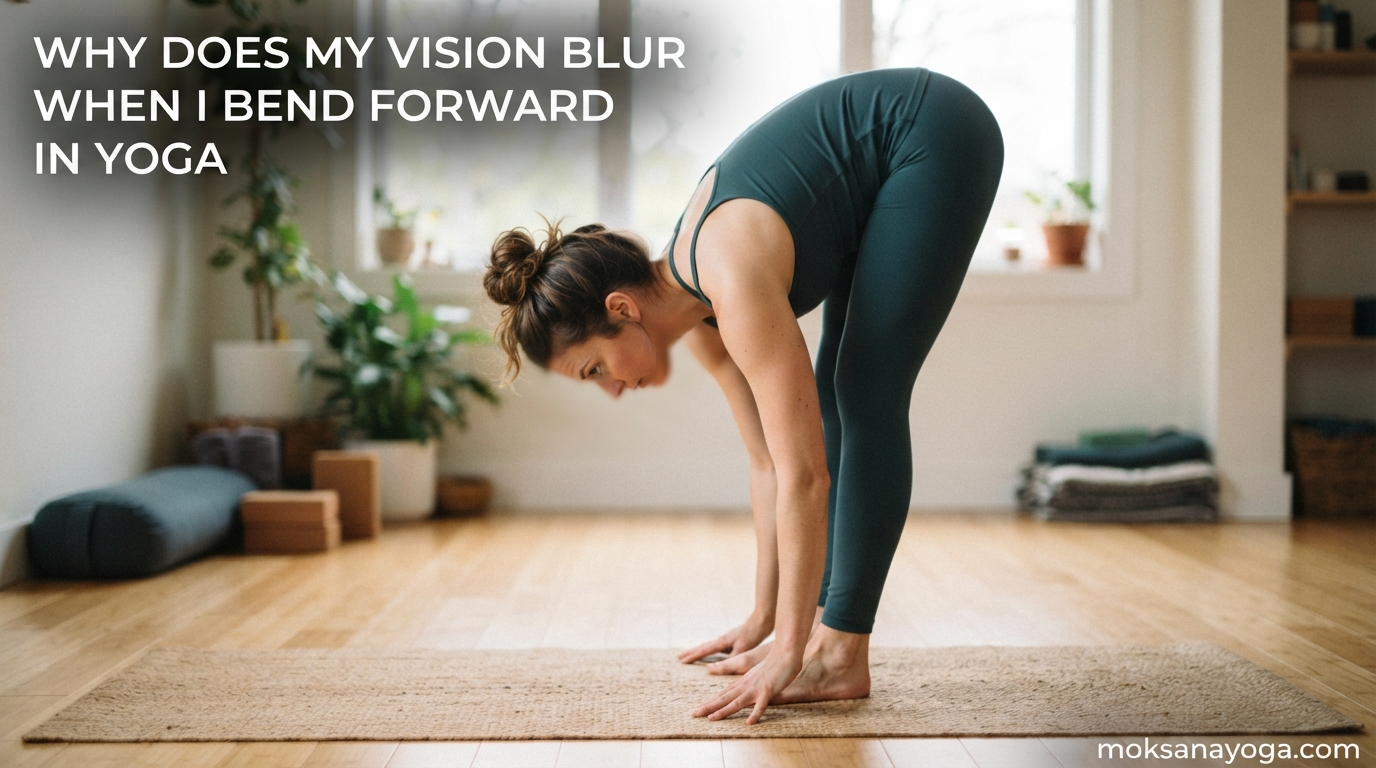
If you have ever stood up from a forward fold and felt the room go dark, fuzzy, or simply disappear for a few seconds, you are not alone. This is one of the most common and unsettling experiences yoga practitioners report, and the question “why does my vision blur when I bend forward in yoga?” comes up constantly in yoga forums and studios. Our team has looked into the physiology, the research, and the real experiences of practitioners to give you a clear, practical answer. In short: vision blur during forward bends is almost always caused by temporary blood pressure shifts and increased pressure in your eyes and head. It is usually harmless, but there are important exceptions you need to know about.
One Reddit user described it perfectly: “Doing forward fold and then slowly going to mountain pose feels like I’m dying every time. I can’t feel my legs, can’t see, can’t hear anything for a few seconds.” That dramatic description captures what many people feel but rarely talk about in class. The good news is that understanding why this happens gives you the tools to prevent it entirely.
This guide covers the three main physiological mechanisms behind vision changes in yoga, the specific poses most likely to trigger them, a step-by-step technique to transition safely, and the warning signs that mean you should talk to a doctor. Whether you are dealing with orthostatic hypotension, increased intraocular pressure, or the valsalva maneuver, we will break down exactly what is happening in your body and what you can do about it.
Table of Contents
Why Does My Vision Blur When I Bend Forward in Yoga? The Short Answer
Your vision blurs when bending forward in yoga because two things happen at once: blood rushes to your head and eyes, increasing pressure, and then when you stand up, blood rapidly drains away faster than your vascular system can compensate. This creates a brief drop in blood flow to your brain and retinas, causing temporary visual disturbances.
Here are the three primary causes, all of which we will explore in detail:
- Orthostatic hypotension — your blood pressure drops temporarily when you change position from bent to upright, reducing blood flow to your brain and eyes for a few seconds.
- Increased intraocular pressure (IOP) — being upside down or in a head-down position physically increases the pressure inside your eyeballs, which can distort vision temporarily.
- The valsalva maneuver — holding your breath or straining during a fold increases pressure in your chest and head, amplifying both of the effects above.
Most practitioners experience the first cause. The second matters most for people with glaucoma or eye conditions. The third is something almost nobody talks about but affects nearly everyone who holds their breath in deep folds.
The Blood Pressure Connection: Orthostatic Hypotension
Orthostatic hypotension is the medical term for the blood pressure drop that happens when you stand up quickly. It is the single most common reason for vision blur in yoga, and understanding it takes the fear out of the experience.
When you bend forward in a fold like Uttanasana (standing forward bend), gravity pulls blood toward your head. Your body does not fight this much because you are folded over. The blood pools in your head, face, and eyes. You might notice your face feels flushed or warm, or that you feel pressure behind your eyes. That is the increased blood volume in your head.
When you stand back up, gravity reverses immediately. All that pooled blood rushes back down toward your legs. For a few seconds, your heart has not yet adjusted, and the blood pressure in your brain drops below the level needed for optimal function. Your retinas, which are extremely sensitive to blood flow changes, respond first. Your vision dims, blurs, goes grey, or even blacks out momentarily.
One forum user explained it well: “Most likely caused by low blood pressure; it takes a few seconds for the vascular system to detect and respond.” Your body does respond, usually within 5 to 15 seconds. Your heart rate increases, your blood vessels constrict, and blood flow to your brain normalizes. The vision returns.
Several factors make orthostatic hypotension worse in yoga. Dehydration is a big one. If you have not drunk enough water before class, your blood volume is lower, making the pressure drop more dramatic. Practicing in a hot room dilates your blood vessels, compounding the effect. Low blood sugar from practicing on an empty stomach also contributes. And simply coming up too fast, especially after holding a fold for a long time, gives your body no time to adjust gradually.
People with naturally low blood pressure are more susceptible to this. If you already run at 90/60 or lower, the additional drop from standing up can be enough to cause noticeable vision changes. This is not dangerous in itself, but it is uncomfortable and worth managing.
Intraocular Pressure: What Happens to Your Eyes
The second mechanism behind vision changes in forward bends is increased intraocular pressure, and this one deserves serious attention. Intraocular pressure (IOP) is the fluid pressure inside your eye. Normal IOP ranges from about 10 to 21 mmHg. When you go upside down or place your head below your heart, that pressure spikes.
Research published by the American Optometric Association found that four common yoga poses significantly increase intraocular pressure: downward dog, plow pose, the standard forward bend, and legs-up-the-wall pose. In the study, IOP increased in every head-down position measured. For healthy eyes, this temporary spike is not a problem. The eye adjusts, and pressure returns to normal within seconds or minutes of coming out of the pose.
However, for people with glaucoma, this matters a great deal. Glaucoma is a condition where elevated eye pressure damages the optic nerve over time. The American Academy of Ophthalmology notes that while glaucoma patients can practice yoga, they should be cautious about head-down positions. A sustained IOP spike from holding plow pose for several minutes could potentially contribute to optic nerve damage in susceptible individuals.
Here is where it helps to understand the difference between a forward fold and a true inversion. In a standing forward bend, your head is below your heart but only moderately so. The IOP increase is modest and brief. In a headstand or fullSupported Shoulderstand, your head is significantly below your heart and you are often staying there for an extended period. The IOP increase is much greater and more sustained. This is why headstands tend to cause more noticeable vision changes than forward folds, and why eye doctors specifically caution glaucoma patients about inversions rather than gentle folds.
For most people without eye conditions, the IOP increase from forward bends is not the main cause of vision blur. Orthostatic hypotension when rising is the bigger factor. But if you notice a feeling of pressure or fullness in your eyes while in the fold itself, before you even stand up, IOP is likely contributing.
The Valsalva Maneuver: The Hidden Trigger
This is the mechanism almost no yoga article talks about, and it may be the most underappreciated factor in yoga-related vision changes. The valsalva maneuver happens when you exhale against a closed airway, creating pressure in your chest and abdomen. You do it unconsciously when straining, and many yogis do it in deep forward folds without realizing it.
Think about what happens when you fold deep. You are stretching intensely. Your body wants to brace. If you are not actively breathing, you may inadvertently hold your breath or partially close your throat. This creates exactly the kind of pressure the valsalva maneuver produces. That pressure transfers directly to your head and eyes, amplifying both the orthostatic hypotension and the IOP effects we already discussed.
The valsalva maneuver also affects your heart rate and blood pressure in a specific pattern. Pressure in the chest compresses the aorta, briefly raising blood pressure. Then, when you release and breathe, blood pressure drops sharply before recovering. If this drop coincides with standing up from a fold, the combined effect can produce a dramatic vision blackout.
This is why yoga teachers constantly cue breathing. It is not just about relaxation. Active, steady breathing during folds prevents the valsalva effect and keeps pressure changes more gradual. If your vision tends to blur in folds, the first thing to check is whether you are holding your breath or straining.
One practical way to tell: if your face is turning red or you feel pressure building in your head while still in the fold, you are probably bearing down. Soften the fold, bend your knees more, and let your breath flow steadily through your nose.
Yoga Poses Most Likely to Cause Vision Changes
Not all poses are equal when it comes to vision effects. Based on the research and practitioner reports, here are the poses most commonly associated with blurred vision, ranked roughly by how often they trigger symptoms.
1. Uttanasana (Standing Forward Bend) — The classic culprit. You are standing, fully folded, often for several breaths. When you rise to Tadasana, the orthostatic shift is sudden and dramatic. Many people report their vision going completely dark for 2 to 5 seconds.
2. Adho Mukha Svanasana (Downward-Facing Dog) — Your head is below your heart in this pose, and if you are holding it for extended periods in a flow sequence, IOP increases and blood pools in your head. Transitions out of down dog into standing poses can trigger dizziness and vision blur.
3. Halasana (Plow Pose) — This is a deep inversion with your head well below your heart and your spine flexed. IOP increases significantly, and the position is often held for a minute or more. Research specifically identifies plow as a high-IOP pose.
4. Sirsasana (Headstand) — The most intense inversion. Your entire body weight is inverted, maximizing blood flow to the head and IOP. Headstand practitioners frequently report blurry vision during and after the pose. For anyone with glaucoma risk, headstands warrant particular caution.
5. Salamba Sarvangasana (Shoulderstand) — Similar to plow in its effects, with the neck strongly flexed adding potential cervical spine compression to the mix. The neck flexion can also reduce blood flow through the vertebral arteries, adding another layer to vision changes.
6. Paschimottanasana (Seated Forward Bend) and Upavistha Konasana (Wide-Legged Seated Fold) — Less likely to cause dramatic vision changes because you are seated, but the head-down position still increases IOP. These tend to be gentler because the transition out is less sudden.
7. Ardha Uttanasana (Halfway Lift) — Often overlooked, but the transition between full forward fold and halfway lift, then back down, can trigger symptoms in sensitive people because of the repeated position changes.
Notice that the common thread is head-below-heart positioning combined with transitions. The more suddenly you change position and the longer you held the fold, the more likely you are to notice vision effects.
How to Prevent Blurry Vision and Dizziness in Forward Bends
Now for the practical part. Vision changes in yoga are preventable with a few targeted adjustments. Our team has compiled the most effective strategies from yoga teachers, physical therapists, and experienced practitioners.
Rise Slowly: The Safe Transition Technique
The single most effective change you can make is to slow your transition out of forward folds. Here is a step-by-step technique that minimizes the blood pressure drop:
Step 1: When you are ready to come out of the fold, take a full breath in while still folded. This signals your nervous system to prepare.
Step 2: Place your hands on your hips and bend your knees slightly. Lead with your chest, not your head. Keep your spine long as you rise halfway.
Step 3: Pause in Ardha Uttanasana (halfway lift) with a flat back for one full breath. This gives your vascular system time to begin adjusting.
Step 4: Slowly stack your spine vertebra by vertebra until you are fully upright. Keep your knees soft.
Step 5: Stand still in Tadasana for two to three breaths before moving to the next pose. Let your vision fully stabilize.
This technique adds maybe ten seconds to your transition. It can completely eliminate vision blur for most people.
Keep Breathing
As we covered with the valsalva maneuver, breath-holding is a hidden trigger. Make your breath audible if you need to. A soft ujjayi breath ensures your airway stays open and prevents the pressure build-up that amplifies vision changes. If you notice yourself straining, back off the depth of the fold. You should always be able to breathe smoothly and steadily.
Modify the Pose
You do not need to fold fully to get the benefits of the pose. Consider these modifications:
- Bend your knees deeply in Uttanasana and Downward Dog. This reduces the intensity of the fold and the head-down angle.
- Use blocks under your hands in standing folds to bring the floor closer and reduce how far you fold.
- Shorten your hold times in inversions. Thirty seconds in plow is enough for most practitioners.
- Replace inversions with alternatives. Legs-up-the-wall at a gentle angle provides many benefits without the full inversion risk.
- Practice Child’s Pose between folds to give your vascular system a neutral-position reset.
Hydrate and Fuel Properly
Dehydration and low blood sugar both worsen orthostatic hypotension. Drink water before class, especially in heated rooms. If you practice first thing in the morning, a small snack with complex carbohydrates and a little protein can stabilize your blood sugar enough to prevent symptoms. Avoid heavy meals right before practice, which can cause their own issues, but a banana or handful of nuts thirty minutes before can make a real difference.
Build Tolerance Gradually
If you are new to yoga or returning after a break, your vascular system needs time to adapt. Start with gentle folds and short holds. Over weeks of regular practice, your body becomes more efficient at regulating blood pressure during position changes, and symptoms typically diminish. Many practitioners who struggled with vision blur early on find it disappears entirely after a few months of consistent practice.
When Blurry Vision Is Not Normal: Warning Signs
Most vision changes in yoga are harmless and resolve within seconds. But certain symptoms warrant medical attention, and it is important to know the difference. Please consult an eye doctor or physician if you experience any of the following.
See a doctor if: your vision takes more than a minute to fully clear after a fold. Normal recovery time is 5 to 15 seconds. Anything beyond 30 seconds is unusual and worth investigating.
See a doctor if: you experience vision changes during or after exercise that persist, recur frequently even with modifications, or happen outside of yoga as well. This could indicate an underlying cardiovascular issue, blood pressure regulation problem, or neurological condition.
See an eye doctor if: you have glaucoma, a family history of glaucoma, high eye pressure, or any existing eye condition. Ask specifically which poses are safe for you. The American Academy of Ophthalmology recommends that glaucoma patients avoid or limit sustained head-down positions. A single IOP measurement during a fold can tell your doctor how much the pose affects you personally.
Seek immediate care if: you experience sudden severe vision loss, vision loss in only one eye, vision changes accompanied by severe headache, chest pain, difficulty speaking, or weakness on one side of the body. These could indicate a stroke, retinal artery occlusion, or other emergency. These are rare, but they require immediate medical attention.
One Reddit user shared a concerning experience: “Attempted a headstand and had blurry vision for a brief period afterward.” While brief blur from a headstand is common, any lingering changes or one-sided symptoms after an inversion should be evaluated promptly.
The bottom line is that brief, bilateral vision changes that clear within seconds during position transitions are almost always benign. Persistent, severe, or one-sided symptoms are not, and they deserve professional evaluation rather than self-diagnosis.
FAQs
What yoga poses should you avoid if you have glaucoma?
If you have glaucoma, the American Optometric Association and the American Academy of Ophthalmology recommend avoiding or limiting sustained head-down positions including headstand (Sirsasana), shoulderstand (Salamba Sarvangasana), plow pose (Halasana), downward-facing dog (Adho Mukha Svanasana), and standing forward fold (Uttanasana). These poses significantly increase intraocular pressure. Talk to your eye doctor about which specific poses are safe for you and how long you can hold them.
How to improve eyesight through yoga?
While yoga cannot reverse refractive errors like nearsightedness, eye yoga practices may help with eye strain and focus. Try palming (rubbing hands together and cupping over closed eyes), focus shifting between near and far objects, and eye rotations in all directions. These practices relax the eye muscles and improve circulation around the eyes. However, they do not replace corrective lenses or medical treatment for eye conditions.
When I workout, my vision gets blurry?
Blurry vision during any workout, not just yoga, is most commonly caused by a temporary drop in blood pressure when changing positions or intensity levels. Other causes include dehydration, low blood sugar, holding your breath during exertion (the valsalva maneuver), and increased intraocular pressure in inverted positions. If it happens regularly, lasts more than a few seconds, or occurs with other symptoms, consult a doctor to rule out underlying cardiovascular or neurological issues.
Should you close your eyes during yoga?
Closing your eyes during yoga can deepen body awareness and relaxation in poses like Child’s Pose, Savasana, and seated meditation. However, closing your eyes during balance poses or transitions increases fall risk and may worsen dizziness if you are already prone to orthostatic hypotension. If you feel lightheaded, keep your eyes open and fix your gaze on a drishti (focal point) to stabilize. Use closed eyes selectively in still, grounded poses.
Conclusion
Understanding why your vision blurs when you bend forward in yoga transforms an alarming experience into a manageable one. The three mechanisms we covered — orthostatic hypotension, increased intraocular pressure, and the valsalva maneuver — are well-understood physiological responses, not signs that something is wrong with you. The vast majority of practitioners who experience this find that rising slowly, breathing steadily, bending their knees, and staying hydrated eliminate the problem entirely.
If vision changes persist despite these adjustments, or if you have an eye condition like glaucoma, talk to your doctor about which poses are right for you. Yoga should feel challenging but not alarming. With the right modifications, you can keep your practice strong, safe, and free of those unsettling moments of darkness. Keep breathing, rise slowly, and trust your body to adjust.