
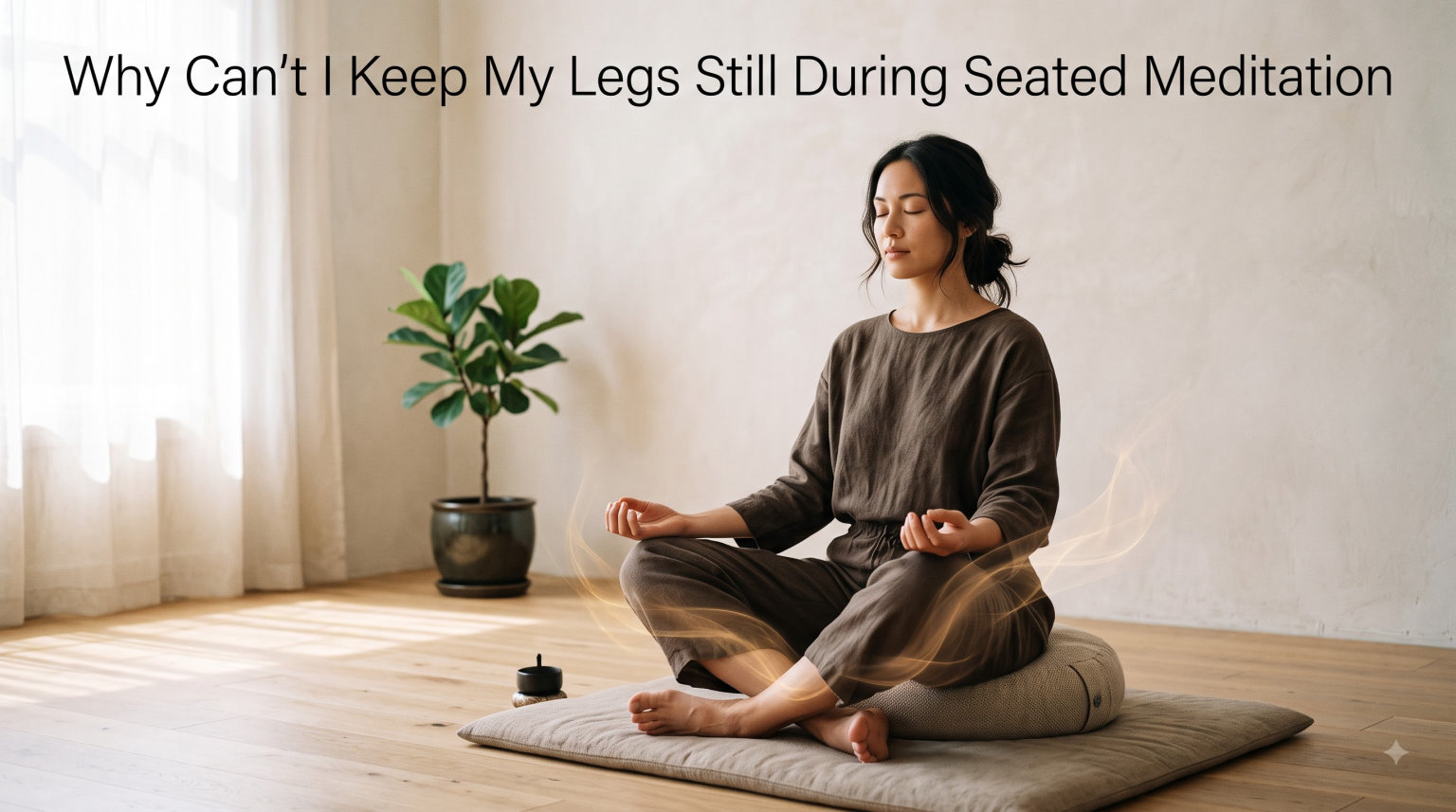
If you are wondering why you can’t keep your legs still during seated meditation, the answer usually comes down to two things: restricted circulation from your sitting position and the fact that meditation makes you notice sensations you would normally ignore. Most meditators experience restless legs, numbness, and pins and needles, especially in the first few months of practice. It is one of the most common frustrations new practitioners bring to forums, teachers, and search engines, and it is completely normal.
When you sit cross-legged for an extended period, your body weight compresses blood vessels and nerves in your legs. At the same time, the focused awareness at the heart of mindfulness practice amplifies every sensation, including the small signals of discomfort you would normally tune out while watching TV or working at a desk. The combination of physical pressure and heightened attention is what makes your legs feel impossible to keep still.
The good news is that this gets much better with the right approach. In this guide, I will walk through the physical causes of leg restlessness during seated meditation, the mindfulness connection that most guides overlook, practical posture adjustments you can make today, and a simple framework for knowing when to move and when to breathe through discomfort. Whether you are new to meditation or have been practicing for years, these strategies will help you sit with greater ease.
Table of Contents
The Awareness Connection: Why Meditation Makes You Notice More
Here is something most meditation guides skip: the reason your legs feel restless during seated meditation is partly that you are getting better at meditating. As your mindfulness deepens, you become more attuned to body sensations that were always there. You simply never noticed them before because your mind was busy with other things.
Think about it this way. Throughout your day, your body constantly sends you signals, an itch on your nose, a slight tension in your shoulders, a minor ache in your lower back. Most of these signals get filtered out by your brain as background noise. When you sit down to meditate, you turn off that filter. Suddenly every sensation arrives at full volume.
This is the paradox that trips up so many practitioners. You might assume that your legs are getting worse during meditation, when in reality your awareness is getting sharper. The circulation changes and nerve pressure were always present when you sat cross-legged to watch a movie or eat dinner on the floor. You just never paid attention to them before.
I remember when this clicked for me. I had been meditating for about six weeks and felt frustrated that my legs seemed more restless than ever. A teacher pointed out that the restlessness was not new, my awareness of it was new. That reframing changed my entire approach. Instead of fighting the sensations, I started observing them as part of the practice.
This does not mean you should ignore genuine discomfort or push through pain. It does mean that some of what you are feeling is the natural result of paying close attention to your body for the first time. As one experienced practitioner on the r/Meditation forum put it, your legs were always falling asleep, you just did not notice until you started sitting still enough to listen.
Physical Causes of Leg Restlessness During Meditation
While heightened awareness explains part of the experience, there are real physical mechanisms at work when your legs go numb or feel restless during seated meditation. Understanding these causes helps you make targeted adjustments rather than just enduring the discomfort.
Restricted Blood Flow
The most common physical cause of leg numbness during meditation is restricted blood flow. When you sit cross-legged, the weight of your upper body presses down through your pelvis onto your legs. This pressure can compress the blood vessels that run through your thighs, knees, and calves, reducing circulation to your lower legs and feet.
The popliteal region, the area behind your knee where major blood vessels and nerves pass through, is particularly vulnerable. If your knee is sharply folded and compressed against the floor or your other leg, blood flow slows down. Within 10 to 20 minutes, this reduced circulation produces the familiar tingling, numbness, and pins-and-needles sensation.
This is why sitting higher on a cushion makes such a difference. When your hips are elevated above your knees, the angle at your knee joint opens up. There is less sharp folding, less compression, and better blood flow throughout your legs.
Nerve Compression
Beyond blood vessels, nerves in your legs can also get compressed during seated meditation. The common peroneal nerve, which runs near the outside of your knee, is one of the most frequently affected. When this nerve is pinched between your knee and the floor, you may feel numbness on the outside of your lower leg or the top of your foot.
Nerve compression tends to come on faster than blood flow restriction. If you feel numbness within the first five minutes of sitting, nerve pressure is likely the culprit. This is a sign that your posture needs adjustment, not something to push through. Persistent nerve compression over long periods can lead to temporary weakness or the feeling that your foot will not cooperate when you stand up.
Hip Inflexibility and the Pelvic Position
Tight hips are one of the biggest hidden causes of leg restlessness during meditation, and most people do not realize the connection. If you spend your days sitting at a desk, driving, or lounging on a couch, your hip flexors are chronically shortened. When you try to sit cross-legged, those tight hips cannot rotate outward enough to let your knees drop comfortably toward the floor.
When your hips are tight, your body compensates in two ways. First, your knees stay high in the air, which means more weight rests on the sensitive areas of your legs. Second, your pelvis tilts backward, which rounds your lower back and shifts your center of gravity in ways that increase pressure on your legs and the sciatic nerve.
The solution is not to force your knees down, which can strain your knee joints. Instead, raising your seat height with a cushion or folded blanket brings the ground to your hips rather than asking your hips to reach the ground. I have seen people go from 15 minutes of miserable sitting to a comfortable 40-minute session simply by adding three inches of cushion height.
Asymmetry Between Legs
Many meditators notice that one leg falls asleep faster than the other or that one side feels more uncomfortable. This asymmetry is completely normal and usually reflects natural differences in flexibility, muscle tension, or the way you habitually fold your legs. Most people have one hip that is tighter than the other from years of crossing the same leg on top.
Try alternating which leg goes on top in half lotus or Burmese position from session to session. Over time, this helps balance out the flexibility and reduces the asymmetry that contributes to uneven numbness.
Posture Adjustments to Keep Your Legs Still
The single most effective change you can make to reduce leg restlessness during seated meditation is adjusting your posture. Most discomfort comes from a few fixable alignment issues, not from some inherent inability to meditate cross-legged.
Raise Your Hips Above Your Knees
This is the golden rule of seated meditation posture. Your hips should always be higher than your knees. When your hips are elevated, your pelvis tilts slightly forward into a neutral position, your lower back maintains its natural curve, and the weight of your body distributes through your sit bones rather than crushing your legs.
If your hips are at the same level as your knees or lower, you are essentially sitting on your own legs. All your upper body weight presses down through the folded legs, and numbness arrives quickly. Most beginners need more cushion height than they expect. A single thin cushion is rarely enough for someone with tight hips.
To find the right height, sit on your cushion and check whether your knees are lower than your hip points. If they are level or higher, add another cushion or fold a blanket underneath until your knees clearly drop below your hips.
Sit on the Front Edge of Your Cushion
Where you sit on your cushion matters as much as how high it is. Instead of plopping down in the center, position yourself on the front third of the cushion. This allows your pelvis to tilt slightly forward and creates a stable tripod: your two sit bones on the cushion and your crossed legs on the floor or mat below.
This forward position is one of the most common tips from experienced meditators on meditation forums. Sitting further forward reduces the backward pelvic tilt that compresses nerves and restricts circulation. It also makes it easier to maintain an upright spine without straining your back muscles.
Find Your Pelvic Neutral
The concept of a pelvic neutral position comes from physiotherapy and applies directly to meditation posture. Your pelvis has a natural position where the curves of your spine stack efficiently and your core muscles can support your upper body with minimal effort. Too far forward and you overarch your lower back. Too far back and you slouch, putting weight on your legs.
To find it, rock your pelvis gently forward and backward a few times. Notice the midpoint where your lower back feels naturally curved, not flattened and not overarched. That is your pelvic neutral. Settle into it and let your sit bones anchor you to the cushion.
Maintain an Upright Spine With Natural Slack
Aim for a spine that is upright but not rigid. One useful image from Zen practice is to keep about 5 to 10 percent slack in your posture. This means you are sitting tall and alert, but not locked into a military attention position that creates tension in your back, shoulders, and neck.
Think of the top of your head being gently lifted toward the ceiling. Let your shoulders drop and relax. Allow your chin to tuck slightly so the back of your neck lengthens. When your spine is well-aligned, your core muscles do the work of holding you upright, and your legs are free to relax rather than brace against the floor.
Engage Your Core Gently
When your deep core muscles are gently engaged, they support your spine and take pressure off your legs. This does not mean sucking in your stomach hard. It means maintaining a light, steady activation in your lower abdomen, as if you were about to receive a gentle poke in the belly.
Many people collapse into their legs because their core is completely disengaged. By activating those muscles even slightly, you transfer the workload from your legs to your torso, where it belongs. This one adjustment alone can extend your comfortable sitting time significantly.
Choosing the Right Seated Position for Your Body
Not every meditation position works for every body. The lotus position looks beautiful in photographs, but it demands a level of hip external rotation that most Western bodies simply do not have. Forcing yourself into a position your body is not ready for is a recipe for knee pain and numbness.
Burmese Position
The Burmese position is the easiest cross-legged posture for most beginners and remains a favorite of long-term practitioners. Both feet rest flat on the floor in front of you, one in front of the other, rather than stacking on your thighs. Your knees ideally touch or come close to the mat on both sides.
Because both feet are flat on the floor and there is no stacking, the Burmese position puts less torque on your knees than lotus variations. It is symmetrical, which helps with even circulation, and it is easier to maintain for longer periods. If you are just starting out, this is the position I recommend trying first.
Quarter and Half Lotus
Quarter lotus is a gentle step up from Burmese. One foot rests on the calf of the opposite leg rather than flat on the floor. Half lotus takes this further by placing one foot on top of the opposite thigh. Both of these positions require more hip flexibility than Burmese but less than full lotus.
Only attempt half lotus if your knees can comfortably reach or nearly reach the floor in Burmese position. If your knee is up in the air, forcing your foot onto your thigh puts dangerous rotational stress on the knee joint. Always let your hip flexibility guide you, not your ego.
Full Lotus
Full lotus, where both feet rest on opposite thighs, is the traditional meditation posture depicted in Buddhist art. It is extremely stable and creates a very grounded base. It also demands exceptional hip flexibility and should only be attempted by practitioners who have spent months or years developing that range of motion.
For most people, full lotus is not necessary for a deep meditation practice. The stability benefits are real, but the risk of knee injury if your hips are not flexible enough is also real. There is no spiritual advantage to sitting in full lotus if it damages your knees.
Seiza: The Kneeling Position
Seiza is a kneeling position where you sit on your heels with a cushion or bench between your legs and the floor. A seiza bench, also called a meditation bench or kneeling bench, angles your pelvis forward and takes all the pressure off your crossed legs entirely.
For meditators who experience persistent leg numbness in cross-legged positions, seiza is often the answer. It keeps your spine upright, your hips above your knees, and your legs in a natural, non-compressed position. Many people who cannot sit cross-legged for 10 minutes can kneel comfortably for an hour on a seiza bench.
Sitting in a Chair
There is no rule that says you must sit on the floor to meditate. A chair is a perfectly valid meditation seat and is often the best choice for people with knee issues, hip problems, or limited flexibility. The key is to sit toward the front of the chair with both feet flat on the floor and your spine upright, not leaning against the backrest.
If your feet do not reach the floor comfortably, place a cushion or folded blanket under them. The same principle applies: hips slightly above or level with knees, spine upright, weight distributed through your sit bones.
Cushions and Support: What Actually Helps
The right equipment can transform your meditation experience. You do not need to spend a fortune, but you do need to think about what your body requires.
The Zafu: Your Most Important Tool
A zafu is a round, firm meditation cushion designed specifically to lift your hips above your knees. Unlike a soft pillow, which compresses under your weight and provides no lift, a zafu is stuffed firmly enough to maintain its shape and height throughout a long sit.
Most zafus are filled with buckwheat hulls or kapok fiber. Buckwheat hulls conform to your body and do not compress over time, making them the better long-term investment. A standard zafu raises your hips by about 4 to 5 inches, which is enough for many people. If you have particularly tight hips, you can stack two zafus or place a folded blanket on top.
The Seiza Bench Alternative
If cross-legged sitting does not work for you regardless of cushion height, a seiza bench is worth serious consideration. These angled wooden benches let you kneel with your weight supported by the bench rather than your heels. Your legs hang relaxed on either side with no compression at all.
Look for a bench with an angled seat, typically 5 to 7 degrees, which encourages the same forward pelvic tilt that a zafu provides. Some benches are adjustable, which is helpful if you are still figuring out your ideal height.
Supporting Your Knees
If your knees do not comfortably reach the floor in cross-legged positions, placing a small cushion, rolled blanket, or yoga bolster under each knee provides crucial support. Without that support, your inner thigh muscles have to work continuously to hold your legs up, which contributes to fatigue and restlessness.
Think of knee support as scaffolding. It is not a permanent fix, but it allows you to sit comfortably while you gradually improve your hip flexibility through yoga and stretching. Over time, as your hips open up, you may find you need less and less support.
Clothing Matters More Than You Think
Tight clothing is an underappreciated contributor to leg numbness during meditation. Jeans, dress pants, and tight leggings restrict circulation at the waist, hips, and thighs. When you fold into a cross-legged position, already tight clothing becomes even tighter around the folded joints and compressed areas.
Wear loose, comfortable pants with an elastic or drawstring waist for meditation. Sweatpants, yoga pants, or dedicated meditation trousers all work well. This small change can add several minutes to your comfortable sitting time, and I have heard from many practitioners on meditation forums that switching out of jeans was the single most effective thing they tried.
The Stoplight Method: When to Move and When to Stay
One of the hardest skills in meditation is knowing when to adjust your posture and when to stay with discomfort. Move too soon and you never build the mental steadiness that meditation develops. Move too late and you risk injury or numbness that lingers long after your session ends.
The stoplight method, drawn from Zen meditation teaching, gives you a simple framework. It uses the metaphor of traffic lights to help you classify what you are feeling and respond appropriately.
Green Light: Breathe Through It
Green light sensations are mild and manageable. A slight ache, gentle tingling, or a subtle urge to shift position. These sensations are normal and do not indicate any problem. This is the discomfort that meditation practice teaches you to observe with curiosity rather than react to immediately.
When you notice a green light sensation, acknowledge it without judgment. Return your attention to your breath or your chosen anchor. Often the sensation will fade on its own within a minute or two as your attention moves elsewhere. This is where real meditation practice happens.
Yellow Light: Prepare to Adjust
Yellow light sensations are increasing in intensity. The numbness is spreading, the ache is deepening, or you feel a building pressure that you cannot ignore. This is your body telling you that an adjustment will be needed soon.
You do not need to move immediately, but you should plan to adjust at the next natural pause in your practice, perhaps at the end of a breathing cycle or when a bell rings. Continuing to push through yellow light discomfort for extended periods builds tolerance, but do not let it escalate to red.
Red Light: Move Now
Red light means sharp pain, electrical zapping sensations, or numbness that is severe enough to worry you. This is your body’s alarm system. Move immediately and without guilt. There is no virtue in injuring yourself during meditation.
Sharp knee pain is always a red light. The knee is a hinge joint, not a rotating joint, and pain there means something is being stressed in a way it should not be. Unfold your legs, stand up slowly, or shift to a different position. Meditation should never cause joint damage.
The Key Distinction: Discomfort vs. Pain
Learning to tell the difference between discomfort and pain is one of the most valuable skills meditation teaches. Discomfort is dull, diffuse, and often shifts or fades when you bring awareness to it. Pain is sharp, specific, and persistent or worsening. Discomfort is something to sit with. Pain is something to respond to.
If you are unsure, err on the side of caution, especially as a beginner. Over time, you will develop a clearer sense of your body’s signals and greater confidence in knowing when to stay and when to move.
Building Sitting Tolerance Over Time
Nobody starts out able to sit comfortably for an hour in cross-legged meditation. Sitting tolerance is built gradually, like strength or endurance. The people you see sitting motionless for long retreats have usually spent years getting there.
Most practitioners find that significant improvement in sitting comfort comes over a period of weeks to a few months of consistent practice. The first two to four weeks are often the hardest, as your body adjusts to the new demands and your mind adjusts to paying attention to it. By the two to three month mark, most people notice a marked improvement.
The best approach is gradual. If you can sit comfortably for 10 minutes today, aim for 12 or 15 minutes next week. Adding small increments allows your muscles, joints, and circulation to adapt without overwhelming them. Trying to jump from 10 minutes to an hour usually results in discouragement and physical strain.
Yoga Stretches That Directly Help
Certain yoga stretches improve the specific flexibility needed for comfortable seated meditation. Focus on poses that open your hips, lengthen your hip flexors, and release tension in your lower back.
Hip openers like pigeon pose, butterfly stretch, and figure-four stretch directly target the external rotation needed for cross-legged sitting. Hip flexor stretches like low lunge and crescent lunge counteract the shortening that comes from hours of desk sitting. A simple routine of 10 to 15 minutes of these stretches after meditation or as a separate practice can dramatically improve your sitting comfort over time.
Consistency Over Duration
When it comes to building tolerance, consistency beats duration every time. Sitting for 15 minutes every day will build your tolerance faster than sitting for an hour once a week. Your body adapts to regular, repeated demands more effectively than to occasional intense ones.
If your legs are particularly restless on a given day, it is fine to sit for a shorter time. A consistent daily practice of 15 comfortable minutes will serve you far better than an inconsistent practice of uncomfortable 45-minute sessions. Meet your body where it is.
FAQs
How do I keep my legs from falling asleep during meditation?
To keep your legs from falling asleep during meditation, raise your hips above your knees using a firm cushion or zafu, sit on the front edge of the cushion to tilt your pelvis forward, and choose a position like Burmese or seiza that puts less pressure on your nerves and blood vessels. Loose clothing and knee supports also help reduce numbness.
Why can’t I sit still during meditation?
You struggle to sit still during meditation because the focused awareness of mindfulness practice amplifies body sensations you normally ignore. Combined with physical factors like restricted circulation, nerve pressure, and tight hips, this heightened sensitivity makes every discomfort feel more intense. As your practice develops and your posture improves, the urge to move decreases.
Is it dangerous if my legs keep falling asleep during meditation?
Occasional leg numbness during meditation is not dangerous and resolves quickly when you change position. However, persistent or severe numbness that lingers after you stand up, or sharp pain in your knees, is a sign that your posture needs adjustment. Never force through sharp pain, as prolonged nerve compression or knee strain can cause temporary weakness or injury.
How long does it take to build meditation sitting tolerance?
Most practitioners notice significant improvement in sitting comfort within 2 to 3 months of consistent daily practice. The first few weeks are typically the hardest. Gradually increasing your sitting time by a few minutes each week, combined with hip-opening stretches, helps your body adapt without strain.
Can I meditate in a chair instead of cross-legged?
Yes, meditating in a chair is a completely valid option and is often the best choice for people with knee or hip issues. Sit toward the front of the chair with both feet flat on the floor, spine upright, and hips level with or slightly above your knees. The quality of your meditation does not depend on sitting on the floor.
Can meditation help with cortisol and blood pressure?
Research suggests that regular meditation practice may help reduce cortisol levels and lower blood pressure over time. The relaxation response activated during meditation counteracts stress hormones and promotes cardiovascular health. These benefits come from consistent practice over weeks and months, not from any single session.
Conclusion
Understanding why you can’t keep your legs still during seated meditation is the first step toward solving it. The restlessness comes from a combination of physical factors, restricted blood flow, nerve compression, tight hips, and poor pelvic alignment, along with the heightened body awareness that meditation practice develops. None of these mean you are doing something wrong.
The most effective changes are often the simplest. Raise your hips above your knees on a firm cushion, sit on the front edge, choose a position that fits your body, and wear loose clothing. Use the stoplight method to distinguish between discomfort you can breathe through and pain that needs a response. Build your tolerance gradually with consistent daily practice, and supplement with hip-opening stretches.
Most importantly, be patient with yourself. Every meditator goes through this phase. With the right posture, the right support, and a little time, you will find that your legs settle, your body steadies, and your practice deepens in ways you did not expect.