
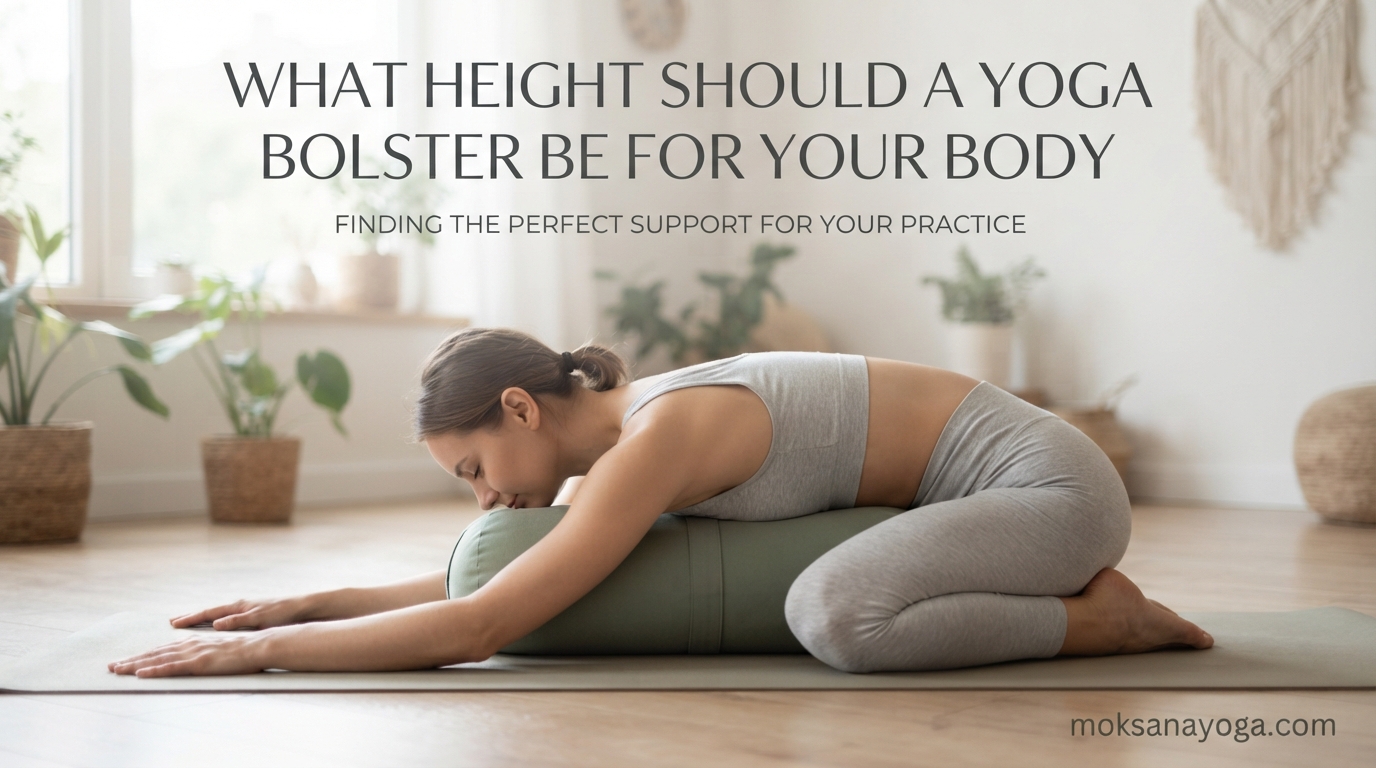
If you have ever settled into Supported Child’s Pose and felt a sharp pinch in your lower back instead of sweet relief, your bolster height might be the culprit. I have seen this firsthand in my own practice and with students over the years. The wrong height turns a restorative pose into a strain, while the right height makes your body feel weightless.
Figuring out what height should a yoga bolster be for your body is not as simple as picking the most popular model. Your height, torso length, body frame, flexibility level, and primary practice style all play a role. Most people buy whatever the studio uses, only to discover it feels completely wrong at home.
This guide breaks down exactly how to match bolster height to your specific body type. I will cover dimension basics, how height affects different poses, specific recommendations by height range, shape interactions, and troubleshooting tips so you never second-guess your prop again.
Table of Contents
Quick-Answer: What Height Should a Yoga Bolster Be for Your Body?
The right yoga bolster height for your body depends primarily on your overall height and torso length. As a general rule, shorter practitioners (under 5’2″) need a bolster that is 4 to 5 inches tall, average-height practitioners (5’2″ to 5’8″) do best with 5 to 6 inches, and taller practitioners (over 5’8″) typically need 6 to 7 inches of height.
Here is a quick reference breakdown:
- Under 5’2″ (petite): Junior or lean bolster, 4-5 inches tall
- 5’2″ to 5’8″ (average): Standard rectangular bolster, 5-6 inches tall
- Over 5’8″ (tall): Standard or round bolster, 6-7 inches tall
- Plus-size or broader frame: Standard or round with firm filling, 6-7 inches tall
- Kids and teens: Junior bolster, 4 inches tall
These ranges give you a starting point, but torso length, flexibility, and intended use all fine-tune the final choice. The sections below walk you through each factor in detail.
Understanding Yoga Bolster Dimensions
Before diving into height recommendations, it helps to understand how bolsters are measured. A bolster has three dimensions: length, width (or diameter for round bolsters), and height (also called thickness). Each dimension affects your practice differently, but height is the one that most directly determines comfort and support.
Length
Length runs from one end of the bolster to the other. Standard bolsters are typically 25 to 28 inches long. This matters most for poses where your spine runs along the bolster, like Supported Fish Pose or Savasana. If the bolster is too short for your torso, your head or hips will hang off the edge, creating tension rather than release.
Pranayama bolsters are shorter, usually around 22 inches, because they are designed for seated breathing exercises rather than reclining poses. The shorter length keeps them compact and lightweight.
Width and Diameter
Width refers to how wide the bolster is from side to side when lying flat. Standard rectangular bolsters are about 12 to 14 inches wide. Round bolsters are measured by diameter instead, typically 6 to 7 inches across. A wider surface area gives you more room to settle, while a narrower bolster is easier to grip and carry.
Width also affects stability. A wider rectangular bolster will not roll away and provides a broader base for reclining poses. A round bolster offers a curved surface that is ideal for backbends but requires more balance in certain positions.
Height (Thickness)
Height is the measurement from the surface the bolster rests on to its top edge. This is the dimension that matters most for body fit. A rectangular bolster has two height options: lying flat (usually about 5 inches) and resting on its side (usually about 6 to 7 inches). Round bolsters have a single height equal to their diameter.
The height determines how much lift your body receives in any given pose. Too much lift and you feel overstretched or unstable. Too little and you bottom out, meaning your body sinks through the bolster until it hits the floor underneath.
Standard Dimensions by Bolster Type
Different bolster types have different height profiles. Here is how they compare:
- Standard Rectangular: 26″ long x 12-14″ wide x 5-6″ tall (6-7″ on side)
- Round/Cylindrical: 26-28″ long x 6-7″ diameter
- Lean/Hybrid: 26″ long x 10-12″ wide x 5″ tall (flat side and curved side)
- Pranayama: 22″ long x 3-4″ wide x 5-6″ tall
- Junior: 22″ long x 7-8″ wide x 4″ tall
These are general ranges. Specific brands vary slightly, so always check the listed dimensions before buying. The height range is the number to pay closest attention to when matching a bolster to your body.
How Bolster Height Affects Your Practice
Bolster height changes how each pose feels in your body. The same bolster can feel perfect in one pose and wrong in another, which is why understanding the relationship between height and specific movements matters so much.
Restorative Poses and Deep Relaxation
In restorative yoga, the goal is complete surrender. Your bolster needs to be tall enough to support your body weight without compressing flat, but not so tall that it creates an aggressive stretch. For Supported Child’s Pose, the bolster height determines how much your hips release and whether your forehead can rest comfortably.
If the bolster is too low, your torso sinks and your chest collapses. If it is too high, your hips feel strained and your breathing becomes shallow. The right height lets your belly soften completely into the bolster while your spine stays long and relaxed.
Backbends and Heart Openers
For heart-opening poses like Supported Fish Pose, bolster height controls the intensity of the backbend. A taller bolster creates a deeper arch in your spine, which can feel wonderful for flexible practitioners but overwhelming for stiff beginners. A lower bolster provides gentle elevation that opens the chest without strain.
This is where body proportions really come into play. A practitioner with a long torso needs a longer bolster to support the full spine, and a taller height to match their natural spinal curve. Someone with a shorter torso may find a standard height creates too much arch.
Seated Poses and Meditation
For seated poses and pranayama, the bolster lifts your hips above your knees to improve pelvic tilt and spinal alignment. The height needs to match your hip flexibility. Tight hips need more height to prevent the lower back from rounding. Flexible practitioners can sit comfortably on a lower surface.
This is also why you will see people sit on the edge of a bolster rather than on top of it. The edge provides a firmer, more stable surface for the sit bones while the bolster body rolls away slightly, creating a natural slope that encourages proper pelvic alignment.
Prenatal Practice
Pregnant practitioners need specific height considerations. A bolster that is too low under the side-lying body does not provide enough support for the belly, while one that is too tall can create uncomfortable pressure. Many prenatal teachers recommend standard rectangular bolsters for their versatility, as they can be stacked, folded over blankets, or used on their side to adjust height as needed.
For prenatal Savasana, the bolster height affects how comfortably you can recline on your side. A medium height of about 5 to 6 inches under the top arm and between the knees tends to work well for most bodies throughout pregnancy.
Height Recommendations by Body Type
This is the section I wish existed when I bought my first bolster. No competitor breaks this down by specific height ranges, so people are left guessing. Here is a detailed guide to choosing bolster height based on your body type and proportions.
Under 5’2″: Petite Frames
If you are under 5’2″, a standard rectangular bolster often feels like sleeping on a log. The height is too much for a shorter torso, creating an over-arched spine in backbends and feeling bulky in forward folds. I am 5’3″ myself and spent months struggling with a standard bolster before switching to a junior size.
For petite frames, I recommend a junior bolster (about 4 inches tall) or a lean bolster (about 5 inches tall with a flat side option). The junior size gives enough support for restorative poses without overwhelming a smaller body. The lean bolster offers flexibility because you can use the flat side for less height or the curved side for more.
A 5’3″ yogi on Reddit asked whether to get a standard or junior bolster, and the consensus from the community was junior for anyone under 5’4″. The shorter length of a junior bolster (22 inches) also fits a shorter torso better, preventing the head or sacrum from hanging off the edge.
Specific recommendations for petite frames:
- Primary choice: Junior bolster at 4 inches tall
- Alternative: Lean bolster at 5 inches tall (flat side down)
- Avoid: Full-size round bolsters (7 inches is too tall for most poses)
- For meditation: Pranayama bolster at 5-6 inches provides good hip lift without bulk
5’2″ to 5’8″: Average Height
If you fall in the average height range, you have the most options. A standard rectangular bolster at 5 to 6 inches tall will work for most poses and body types in this range. This is the size studios typically stock because it fits the widest range of practitioners.
The key decision within this range is whether you prefer the versatility of a rectangular bolster or the curved support of a round one. Rectangular bolsters give you two height options (flat at 5 inches or on the side at 6 to 7 inches), while round bolsters offer a single height that excels at backbends and knee support.
For average-height practitioners, I recommend starting with a standard rectangular bolster. It is the most adaptable choice. You can always add a round bolster later for poses where a curved surface feels better. The rectangular shape also provides more stability for beginners who are still learning prop placement.
Specific recommendations for average height:
- Primary choice: Standard rectangular bolster at 5-6 inches tall
- Backbend focus: Round bolster at 6-7 inches diameter
- Meditation focus: Pranayama bolster at 5-6 inches tall
- Travel or small space: Lean bolster at 5 inches tall
Over 5’8″: Taller Practitioners
Taller practitioners face a different challenge. A standard rectangular bolster at 5 inches can feel too low, especially for backbends and heart openers. Your longer torso and deeper spinal curves need more elevation to achieve the same release as a shorter practitioner.
If you are over 5’8″, a round bolster at 6 to 7 inches diameter or a standard rectangular bolster used on its side at 6 to 7 inches tall will likely serve you better. The extra height fills the space between your body and the floor, preventing the gap that causes tension in the lower back and shoulders.
Length also matters more for taller bodies. Look for bolsters that are 27 to 28 inches long to ensure your head and sacrum are fully supported in reclining poses. A 25-inch bolster may leave your head hanging, which defeats the purpose of restorative practice.
Specific recommendations for taller practitioners:
- Primary choice: Standard rectangular bolster (used on side) at 6-7 inches tall
- Backbend focus: Round bolster at 7 inches diameter, 28 inches long
- Restorative focus: Standard rectangular with extra blanket for height adjustment
- Length preference: Look for 27-28 inch bolsters
Plus-Size and Larger Bodies
For plus-size and larger-framed practitioners, bolster height interacts with both comfort and weight capacity. A bolster that is too soft or too low will compress under body weight, bottoming out and providing no support. The forum discussions I reviewed highlighted this exact problem, with one 250+ pound practitioner noting that standard bolsters collapsed flat during use.
The solution is a bolster with firm filling and adequate height. Buckwheat hull bolsters are ideal because they conform to your body without compressing flat, maintaining their height even under significant weight. Cotton batting bolsters can work too, but look for densely packed options.
A height of 6 to 7 inches works well for most plus-size practitioners. The extra height ensures that even with some compression, the bolster still provides meaningful elevation. A standard rectangular bolster placed on its side or a round bolster both work well.
Specific recommendations for plus-size and larger bodies:
- Primary choice: Round bolster with buckwheat filling at 7 inches diameter
- Alternative: Standard rectangular with dense cotton batting, used on side (6-7 inches)
- Filling preference: Buckwheat hulls for conforming support without bottoming out
- Cover preference: Durable cotton or microfiber with reinforced seams
- Avoid: Foam core bolsters (may compress too much under heavier weight)
Torso Length vs Full Height: Why It Matters
Here is something no competitor talks about: your overall height is not the only measurement that matters. Torso length plays an equally important role in bolster fit. Two people who are both 5’6″ can have very different torso proportions, and that affects which bolster height feels right.
A practitioner with a long torso relative to their legs needs a longer bolster to support the full spine and a slightly taller height to match their natural spinal curvature. Someone with a shorter torso and longer legs may find a standard height creates too much arch in backbends.
To measure your torso for bolster purposes, sit on the floor with your back against a wall. Measure from the floor to the top of your shoulder. This gives you a sense of how much vertical support you need in reclining poses. As a rough guide:
- Torso measurement under 20 inches: Consider junior or lean bolster
- Torso measurement 20-24 inches: Standard rectangular works well
- Torso measurement over 24 inches: Look for taller round or side-placed bolsters
Combine this torso measurement with your overall height to narrow down the perfect bolster. If you are tall with a short torso, the height recommendation shifts downward. If you are average height with a long torso, you may need more length and height than expected.
Kids and Teens
Children and teenagers need smaller props for proper alignment. A full-size standard bolster overwhelms a child’s frame, making poses uncomfortable rather than supportive. Junior bolsters at 4 inches tall and 22 inches long are designed specifically for smaller bodies.
For kids under 4’8″, a junior bolster provides appropriate support without excess bulk. Teenagers who are still growing can transition to a lean bolster or standard rectangular depending on their current height. Following the height ranges above, apply the same logic to teens as adults once they reach about 5 feet tall.
Shape Considerations and How They Affect Height
Bolster shape changes the effective height you experience in each pose. A rectangular bolster and a round bolster might have similar measurements on paper, but they feel completely different in practice because of how the surface interacts with your body.
Rectangular Bolsters
Rectangular bolsters are the most versatile shape because they offer two distinct heights. Lying flat, a standard rectangular bolster is about 5 inches tall. Placed on its side, the same bolster rises to about 6 to 7 inches. This dual-height feature is one reason many practitioners and studios prefer the rectangular shape.
The flat surface also provides stability for reclining poses. Your body does not roll or shift, which is especially helpful for beginners. The firm, even surface distributes weight predictably, making it easier to find comfortable positioning.
Round Bolsters
Round bolsters have a single height equal to their diameter, typically 6 to 7 inches. The curved surface excels at creating gentle backbends and supporting the natural arch of the spine. They are the go-to choice for heart openers, Supported Bridge Pose, and knee support in Savasana.
The height of a round bolster is consistent regardless of how you orient it, which simplifies decision-making. However, the curved surface can feel less stable for reclining poses compared to a flat rectangular bolster. Some practitioners stack a round bolster on a rectangular one for combined height and surface area.
Lean Bolsters
Lean bolsters are a hybrid shape with one flat side and one curved side. This design gives you the best of both worlds: the stability of a rectangular bolster when flat side down, and the curved support of a round bolster when flat side up. The height typically ranges from 4 to 5 inches depending on orientation.
For practitioners who want one bolster that can serve multiple purposes, the lean shape is an excellent choice. It effectively gives you two bolsters in one, adjusting height and surface contour to match the pose.
Pranayama Bolsters
Pranayama bolsters are narrow and relatively short, designed specifically for seated breathing exercises. They are typically 5 to 6 inches tall, 3 to 4 inches wide, and about 22 inches long. The height is tuned for sitting cross-legged with the hips elevated above the knees.
While they are not designed for reclining poses, pranayama bolsters can work well for meditation if you prefer a narrower sitting surface. The compact size makes them easy to store and travel with.
Junior Bolsters
Junior bolsters are scaled-down versions of standard bolsters, measuring about 4 inches tall, 7 to 8 inches wide, and 22 inches long. They are designed for children, petite practitioners, and anyone who finds a standard bolster too bulky.
The lower height of a junior bolster makes it ideal for gentle restorative poses where you want subtle elevation rather than deep support. They also work well as a secondary prop, placed under the wrists or knees for additional cushioning.
Other Factors That Influence Your Choice
Height is the most important dimension, but it is not the only one. Firmness, filling material, cover type, and weight all interact with height to determine how a bolster actually feels under your body.
Firmness
Firmness affects effective height because a soft bolster compresses when you lie on it. A bolster listed as 6 inches tall might effectively provide only 4 inches of support once your body weight presses into it. This is the bottoming-out problem that forum users repeatedly mention.
The community consensus from yoga forums is that a bolster should feel firm but not hard, similar to a well-made sofa cushion. You want enough give to feel comfortable, but not so much that you sink to the floor. When testing firmness, press your hand into the bolster with moderate pressure. If your hand easily reaches the surface underneath, the bolster is too soft.
Filling Materials
The three main filling types each behave differently in terms of height maintenance:
Buckwheat hulls conform to your body shape while maintaining their overall volume. They do not compress flat, which means the bolster keeps its listed height even under significant weight. The trade-off is that buckwheat bolsters are heavier, typically 6 to 8 pounds, and they make a subtle crunching sound when you move.
Cotton batting is the traditional filling for rectangular bolsters. It provides firm, even support but can compress over time. A densely packed cotton bolster maintains its height well for years, while a loosely packed one will flatten. Cotton bolsters are lighter, usually 4 to 6 pounds.
Foam core bolsters use a shaped piece of foam, sometimes wrapped in cotton fiber. They are the lightest option and provide consistent, springy support. However, foam can break down over years of use, gradually reducing effective height. Foam is also more prone to compression under heavier body weight.
Cover Material
The cover does not directly affect height, but it does affect grip and maintenance. Cotton and microfiber covers provide a non-slip surface that keeps the bolster in place. Smooth vinyl covers (like EZ Clean options) are easy to wipe down between uses, which matters for studio settings.
For home practitioners, a removable, washable cotton cover is usually the best choice. It keeps the bolster clean and extends its lifespan. Look for covers with hidden zippers so you can add or remove filling to adjust firmness and effective height over time.
Weight and Portability
If you carry your bolster to a studio, weight matters. A buckwheat bolster at 8 pounds gets heavy in a tote bag over several blocks. Cotton and foam bolsters are lighter and easier to transport. Some practitioners keep a heavy buckwheat bolster at home and a lighter one for travel.
Signs Your Bolster Is the Wrong Height
Sometimes you do not realize a bolster is the wrong height until you know what to look for. Here are the most common signs, drawn from my own experience, student feedback, and forum discussions.
Signs Your Bolster Is Too Tall
If your bolster is too tall for your body, you will likely notice these signs during practice:
- Neck strain or tension in heart-opening poses
- Lower back pinching in Supported Child’s Pose
- Difficulty breathing deeply or feeling breath become shallow
- Sensation of overstretching rather than gentle opening
- Restlessness or inability to settle into the pose
- Head tilting back excessively in reclining positions
If you experience these signs, try a lower bolster or place your current bolster flat instead of on its side. Adding a folded blanket on the floor beside the bolster can also create a more gradual transition for your body.
Signs Your Bolster Is Too Short
A bolster that is too short or flat produces different signals:
- You feel the floor through the bolster (bottoming out)
- Your hips or shoulders do not feel fully supported
- You cannot achieve a sense of weightlessness in restorative poses
- Your lower back rounds instead of staying neutral
- Your knees remain higher than your hips in seated poses
- You constantly feel the need to add blankets or blocks for more height
If you are constantly stacking blankets on your bolster, it is probably too short for your body. Consider upgrading to a taller round bolster or switching to a denser filling that maintains its height better.
When the Height Is Just Right
The right height produces a distinct sensation. You settle into the pose and your body immediately softens. Your breath deepens naturally without effort. You feel fully supported, as if the bolster is an extension of the floor that happens to be shaped exactly for your body.
In restorative poses specifically, the right height triggers a parasympathetic nervous system response. Your heart rate slows, your muscles release tension, and you might even drift toward sleep. If you are not experiencing this level of release, the height may need adjustment.
Common Mistakes to Avoid When Choosing Bolster Height
Avoid these common pitfalls when selecting a bolster based on height:
Buying what the studio uses. Studio bolsters are chosen for versatility across many body types, not for your specific frame. What works in a shared class setting may not work for your home practice.
Ignoring torso length. Overall height is just one factor. If you have a particularly long or short torso, your bolster needs may differ from someone the same height with different proportions.
Choosing based on appearance. A cute cover or attractive shape does not mean a bolster will work for your body. Always check the dimensions, especially height, before purchasing.
Assuming one size fits all poses. You may need different heights for different poses. This is why rectangular bolsters with their dual-height design are so popular. Some practitioners own two bolsters of different heights for this reason.
Overlooking firmness. A soft, tall bolster can end up shorter in practice than a firm, shorter one. Always factor in how much the filling will compress under your body weight.
Forgetting about future needs. If you are pregnant, recovering from an injury, or planning to deepen your practice, your bolster needs may change. Consider whether a versatile option can grow with your practice.
Frequently Asked Questions
What is the standard size for a yoga bolster?
A standard rectangular yoga bolster is typically 26 inches long, 12 to 14 inches wide, and 5 to 6 inches tall. Round bolsters are usually 26 to 28 inches long with a 6 to 7 inch diameter. These dimensions work for most average-height practitioners but may need adjusting for petite or tall bodies.
How do I choose the right yoga bolster height?
Choose your yoga bolster height based on your overall height and torso length. If you are under 5 foot 2, look for a 4 to 5 inch bolster. For 5 foot 2 to 5 foot 8, a standard 5 to 6 inch bolster works well. If you are over 5 foot 8, aim for 6 to 7 inches. Also consider firmness, since soft bolsters compress and effectively lose height under body weight.
What is the best filling for a yoga bolster?
The three main filling options are buckwheat hulls, cotton batting, and foam core. Buckwheat conforms to your body and maintains its height under pressure, making it ideal for larger bodies and restorative use. Cotton batting is lighter and provides firm, even support. Foam core is the lightest option but may compress under heavier weight. Choose based on your body type and portability needs.
Is a round or rectangular bolster better for yoga?
Round bolsters excel at backbends, heart openers, and knee support because their curved surface matches the natural arch of the body. Rectangular bolsters are more versatile because they offer two height options (flat and on-side) and provide a stable surface for reclining poses. Most practitioners benefit from starting with a rectangular bolster for its adaptability.
Can a yoga bolster be too tall for my body?
Yes, a yoga bolster can absolutely be too tall. Signs include neck strain, lower back pinching, shallow breathing, and a feeling of overstretching in poses that should feel restorative. If you are under 5 foot 2 and using a standard or round bolster at 6 to 7 inches, it is likely too tall. Switch to a junior or lean bolster for a better fit.
Why do people sit on the edge of yoga bolsters?
Sitting on the edge of a bolster places the sit bones on a firm, stable surface while the bolster body angles away, creating a natural slope. This position encourages proper pelvic tilt and spinal alignment during seated meditation and pranayama. It is especially helpful for practitioners with tight hips who need elevation without the bulk of sitting on top of the full bolster.
Conclusion
Figuring out what height should a yoga bolster be for your body comes down to understanding your proportions and practice needs. The quick-reference ranges in this guide give you a starting point, but the real test is how your body feels when you settle into a pose. The right height creates instant relaxation. The wrong height creates tension.
Start with the height range that matches your overall stature, factor in your torso length, and pay attention to how different shapes and fillings affect effective height. If your current bolster is not working, the troubleshooting signs above will help you identify whether you need more or less elevation. Your body knows the answer. Trust what you feel in each pose, and adjust from there.