
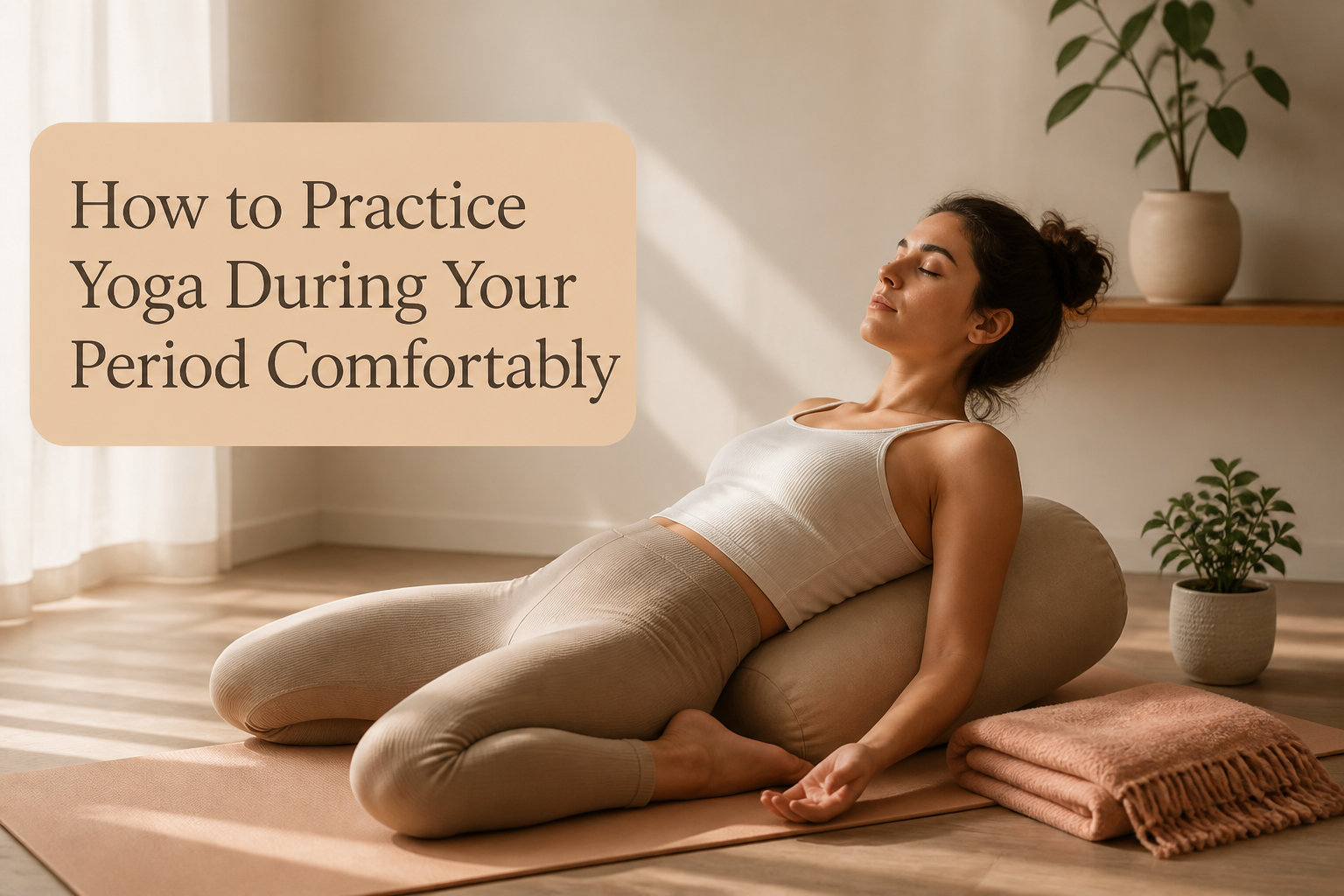
Yes, you can absolutely practice yoga during your period, and for most women it genuinely helps. The key is shifting toward gentle, restorative poses that release pelvic tension, ease lower back pain, and calm your nervous system rather than pushing through your usual vigorous flow. Learning how to practice yoga during your period comfortably comes down to choosing the right poses, modifying where needed, and letting breath lead movement.
If you have ever unrolled your mat on day one of your cycle and wondered whether to practice at all, you are in good company. Cramps, bloating, fatigue, and that heavy ache across the lower back can make even Sun Salutations feel impossible. Our team at Moksana Yoga has guided hundreds of students through exactly this moment, and the answer is almost never to skip your mat entirely.
Instead, think of your period as an invitation to slow down. A 15-to-20-minute sequence of supported forward folds, hip openers, and gentle twists can melt away tension that painkillers barely touch. In this guide, you will learn the science behind why yoga helps, ten specific poses ranked by symptom, what to avoid, a complete 20-minute sequence you can follow on your heaviest days, and how to adapt your practice across the four phases of your menstrual cycle.
Table of Contents
How Yoga Supports Your Body During Menstruation?
Gentle yoga during menstruation works on three levels at once: physical, hormonal, and emotional. On the physical side, slow stretching increases blood flow to the pelvic region, which helps the uterus release cramped muscles instead of gripping tighter. Forward folds and hip openers specifically target the lower back and hip flexors, where period tension tends to accumulate.
On a nervous system level, restorative yoga activates the parasympathetic branch, the rest-and-digest mode that counters the stress response many women feel during their cycle. When you slow your breath and hold supported poses for several minutes, cortisol drops and your body shifts out of survival mode. This is why so many students tell us they sleep better after a gentle period practice than they do on any other night.
Hormonally, research published in the Journal of Bodywork and Movement Therapies suggests that consistent yoga practice may help regulate the endocrine system over time. While a single session will not rebalance your hormones, regular gentle practice across multiple cycles has been linked to reduced severity of cramps, less bloating, and steadier mood.
The emotional piece matters just as much. Many women feel irritable, weepy, or simply drained before and during their period. A quiet, mindful practice gives you a place to process those feelings without judgment. It is less about touching your toes and more about giving yourself permission to rest.
One important note: gentle does not mean lazy. A well-designed period practice is intentionally slow and deeply supported, but it still asks you to be present. The goal is not to avoid movement. The goal is to move in a way that feeds your body rather than depleting it.
It is also worth saying that there is no single right way to practice during your period. Some women feel great flowing through a slow vinyasa on day two. Others want nothing but Child’s Pose for three days straight. Both responses are normal, and a big part of this guide is helping you figure out which version your body is asking for.
Quick Symptom Guide: Which Poses Help What
Before diving into the full pose breakdown, here is a quick map of which poses to reach for based on what hurts. Every body responds differently, but these pairings come from years of student feedback and align with how each pose works mechanically.
For menstrual cramps: Knees-to-Chest (Apanasana), Reclined Bound Angle Pose (Supta Baddha Konasana), and Child’s Pose (Balasana) apply gentle compression and release to the lower abdomen.
For lower back pain: Cat-Cow (Marjaryasana-Bitilasana), Supine Twist (Supta Matsyendrasana), and Child’s Pose decompress the lumbar spine and release tight hip flexors that pull on the back.
For bloating: Seated Forward Bend (Paschimottanasana) and gentle twists like Supine Twist stimulate digestion and encourage trapped gas to move.
For fatigue: Legs Up the Wall (Viparita Karani) and Supported Bridge (Setu Bandhasana) reverse blood flow, reduce swelling in the legs, and recharge energy without requiring effort.
For mood swings and anxiety: Reclined Bound Angle Pose, Corpse Pose (Savasana), and slow pranayama calm the nervous system and create emotional space.
For headaches: Legs Up the Wall with an eye pillow, plus slow alternate nostril breathing, can ease tension headaches that often accompany hormonal shifts.
For insomnia: A short sequence of Child’s Pose, Reclined Bound Angle, and a long Savasana with belly breathing helps many students fall asleep faster and stay asleep longer.
How to Practice Yoga During Your Period Comfortably: 10 Gentle Poses
The following ten poses form the backbone of a period-friendly practice. Each one includes the Sanskrit name, a step-by-step setup, the specific benefit during menstruation, suggested hold time, and modifications using props.
1. Child’s Pose (Balasana)
Balasana is arguably the single most comforting pose during menstruation. It gently compresses the lower abdomen, which can ease cramping, while lengthening the lower back and calming the mind. The name comes from the Sanskrit word bala, meaning child, reflecting the posture of surrender and rest.
How to practice:
Step 1: Kneel on your mat with your big toes touching and knees spread wide.
Step 2: Exhale and fold your torso forward between your thighs, resting your forehead on the mat or a bolster.
Step 3: Stretch your arms forward or relax them alongside your body, palms facing up.
Step 4: Let your belly soften completely and breathe slowly into your lower back.
Hold time: 2 to 5 minutes.
Modification: Place a bolster or stacked pillows lengthwise between your knees and rest your entire torso on it. This takes all pressure off the hips and lower back and is ideal for heavy flow days when you want zero effort.
2. Cat-Cow (Marjaryasana-Bitilasana)
This flowing movement warms up the spine, releases the lower back, and gently massages the abdominal organs. It is perfect as the first movement of your period practice because it asks very little of the body while waking up the spine and breath.
How to practice:
Step 1: Begin on your hands and knees with wrists under shoulders and knees under hips.
Step 2: Inhale, drop your belly, lift your chest and tailbone (Cow).
Step 3: Exhale, round your spine toward the ceiling and draw your navel in (Cat).
Step 4: Continue flowing between the two for 8 to 10 slow breath cycles, moving with your breath rather than forcing the range.
Modification: If your wrists are sensitive, make fists instead of flat palms. If kneeling is uncomfortable, you can do a seated version from a chair, circling the spine gently on each inhale and exhale.
3. Reclined Bound Angle Pose (Supta Baddha Konasana)
This is the queen of restorative period poses. Supta Baddha Konasana opens the hips, releases the inner thighs, and creates a sense of deep grounding that many women describe as instantly soothing for cramps. The Sanskrit name translates to reclined bound angle, and the bound angle refers to the soles of the feet pressing together.
How to practice:
Step 1: Sit on the floor and bring the soles of your feet together, letting your knees fall open.
Step 2: Place pillows or blocks under each thigh for support so your groins can fully relax.
Step 3: Slowly recline backward onto a bolster or stack of pillows running the length of your spine.
Step 4: Rest your arms at your sides with palms up and let your whole body sink into the props.
Hold time: 5 to 10 minutes.
Modification: If you do not have a bolster, fold a blanket into a long rectangle and place it under your spine. The key is full support so your body can let go completely. Many teachers consider this the most important pose in a menstrual sequence.
4. Knees-to-Chest (Apanasana)
Apanasana applies direct, gentle pressure to the lower abdomen, which can relieve cramping almost immediately. It is named for apana, the downward-moving energy in yoga philosophy, which aligns with the natural direction of menstrual flow. Energetically and physically, this pose works with your body rather than against it.
How to practice:
Step 1: Lie on your back.
Step 2: Draw both knees toward your chest and wrap your arms around your shins.
Step 3: Rock gently from side to side to massage the lower back.
Step 4: Breathe deeply and allow your lower belly to soften against your thighs.
Hold time: 1 to 3 minutes.
Modification: If pulling both knees in feels like too much pressure on a heavy day, hold one knee at a time and let the other leg extend long along the floor.
5. Supine Twist (Supta Matsyendrasana)
Gentle spinal twists release the lower back, stimulate digestion to ease bloating, and create space across the sacrum. The key word here is gentle. During your period, keep the twist soft and supported rather than going for maximum rotation.
How to practice:
Step 1: Lie on your back and draw your right knee into your chest.
Step 2: Extend your right arm out to the side and guide your right knee across your body to the left with your left hand.
Step 3: Keep both shoulders grounded and gaze toward your right hand.
Step 4: Hold and breathe, then switch sides.
Hold time: 2 to 3 minutes per side.
Modification: Place a pillow between your knee and the floor so the twist does not pull deeply through the abdomen. During menstruation you want release, not intensity.
6. Legs Up the Wall (Viparita Karani)
This is a mild semi-inversion that is widely considered safe during menstruation, unlike full inversions such as headstand. Viparita Karani drains tired legs, reduces bloating and swelling, and is incredibly restorative for fatigue. Many students say this is the one pose they will always do, even on their worst cycle days.
How to practice:
Step 1: Sit sideways next to a wall with one hip touching it.
Step 2: Swing your legs up the wall as you lie back, bringing your sitting bones close to the base of the wall.
Step 3: Let your arms rest at your sides and close your eyes.
Step 4: Breathe slowly and let your legs be completely passive.
Hold time: 5 to 15 minutes.
Modification: Place a folded blanket under your hips for elevation, or bend your knees slightly if the hamstrings feel strained. Some teachers prefer you skip this pose on the heaviest flow days, so listen to your body and decide what feels right.
7. Supported Bridge Pose (Setu Bandhasana)
A supported bridge opens the front of the body, stretches the hip flexors, and gently stimulates the abdominal region without strain. Using a block under the sacrum turns this into a restorative pose rather than an active backbend, which is exactly what you want during your period.
How to practice:
Step 1: Lie on your back with knees bent and feet flat on the floor, hip-width apart.
Step 2: Press into your feet and lift your hips.
Step 3: Slide a yoga block under your sacrum at a comfortable height.
Step 4: Relax completely onto the block and rest your arms at your sides.
Hold time: 2 to 5 minutes.
Modification: If you do not have a block, a firmly rolled blanket works. Keep the lift low to avoid a strong backbend, which is not ideal during menstruation.
8. Seated Forward Bend (Paschimottanasana)
Forward bends are the cornerstone of traditional menstrual sequences. Paschimottanasana lengthens the spine, calms the nervous system, and gently compresses the abdomen to soothe cramps. The Sanskrit word paschima means west or back of the body, and uttana means intense stretch.
How to practice:
Step 1: Sit with your legs extended straight in front of you.
Step 2: Inhale and lengthen your spine.
Step 3: Exhale and fold forward from the hips, reaching toward your feet or shins.
Step 4: Rest your forehead on a bolster or folded blanket placed across your legs.
Hold time: 3 to 5 minutes.
Modification: Sit on the edge of a folded blanket to tilt your pelvis forward. If your hamstrings are tight, bend your knees slightly. The focus is on the forward release, not on how far you reach.
9. Low Cobra (Bhujangasana)
A gentle low cobra counteracts the tendency to hunch forward when cramps hit. It opens the chest, stimulates the abdominal organs, and relieves lower back tension without the intensity of a full backbend. The Sanskrit name comes from bhujanga, meaning serpent or cobra.
How to practice:
Step 1: Lie face down with your legs extended and palms flat under your shoulders.
Step 2: Press the tops of your feet into the mat.
Step 3: Inhale and lift your chest, using your back muscles more than your arms.
Step 4: Keep your elbows close to your body and your lower body grounded.
Hold time: 3 to 5 breaths, repeated 2 or 3 times.
Modification: Keep the lift small. During your period you want a soft, nourishing backbend rather than a deep spinal extension. If your lower back feels tender, skip this pose entirely and replace it with more Cat-Cow.
10. Corpse Pose (Savasana)
Do not skip this one. Savasana is where the benefits of every other pose integrate. It lowers blood pressure, calms the nervous system completely, and gives your body permission to rest. The name comes from sava, meaning corpse, reflecting total stillness and release.
How to practice:
Step 1: Lie flat on your back.
Step 2: Let your legs fall comfortably apart and your arms relax at your sides, palms facing up.
Step 3: Place a bolster or rolled blanket under your knees to release the lower back.
Step 4: Close your eyes and let your breath find its own natural rhythm.
Hold time: 5 to 10 minutes.
Modification: Drape a folded blanket over your abdomen. The gentle weight feels deeply comforting during menstruation and mirrors the grounding effect of weighted blankets.
Poses to Avoid During Your Period
Just as some poses help, others can make symptoms worse or go against the natural downward flow of menstruation. The general rule is to avoid strong inversions, deep twists, and intense backbends during the heaviest days of your cycle.
Inversions: Headstand, Shoulderstand, and Handstand
Why no headstand during period? Traditional yoga philosophy holds that menstruation is a downward-flowing process called apana, and inversions reverse that flow. From a modern standpoint, inversions during your period can cause feelings of heaviness, increased cramping, or even irregular spotting in some women. While there is no conclusive medical study proving harm, the consensus among experienced teachers is to skip full inversions for the first three days of your cycle.
Deep Twists
Strong seated twists like Ardha Matsyendrasana can compress the abdomen intensely. During menstruation your uterus is already working hard, and deep twisting may increase discomfort or even intensify cramps. Stick to gentle, supine twists that release rather than wring the belly.
Strong Backbends
Full Wheel (Urdhva Dhanurasana) and Bow Pose (Dhanurasana) stretch the abdomen and pelvic region aggressively. On heavy days this can feel aggravating rather than opening. Stick with supported, low backbends like the gentle Bridge Pose described above.
Powerful Core Work
Poses like Boat Pose (Navasana) and plank variations engage the abdominal muscles intensely. Since your uterus is already contracting during your period, adding strong core engagement can increase cramping. Give your belly a break and save the core work for after your cycle ends.
The 7-2-1 Rule for Menstruation
You may have seen the 7-2-1 rule mentioned in period yoga discussions. It is a simple guideline: avoid inversions for the first 7 days if you have a longer cycle, or at minimum the first 2 days of heaviest flow, and always avoid them for at least 1 full day. Different teachers frame it slightly differently, but the spirit is the same. Give your body the first portion of your cycle to flow downward without interference.
What About Hot Yoga?
This is one of the most debated topics on yoga forums. Some practitioners swear by hot yoga during their cycle, saying the heat eases cramps and improves mood. Others report dizziness, heavier bleeding, and lightheadedness, especially on the first two days. There is no medical consensus. If you practice hot yoga, our recommendation is to dial back the intensity, hydrate aggressively, and skip class entirely on your heaviest day. Listen to your body over any tradition.
Breathing Techniques for Period Relief
Breathwork, or pranayama, is one of the most underrated tools for menstrual discomfort. Slow, deliberate breathing activates the parasympathetic nervous system, lowers cortisol, and creates a sense of calm that spreads through the entire pelvic region.
4-6 Count Breathing
This is the simplest and most effective technique for period relief. Inhale through your nose for a count of 4, then exhale through your nose for a count of 6. The longer exhale signals safety to your nervous system and naturally slows your heart rate. Practice this for 5 minutes lying in Savasana or Child’s Pose and you will likely feel cramping begin to ease.
Nadi Shodhana (Alternate Nostril Breathing)
Nadi Shodhana balances the left and right hemispheres of the brain and is excellent for mood swings and anxiety. Close your right nostril with your thumb and inhale through the left. Close the left nostril with your ring finger, release the right, and exhale through the right. Inhale right, close, exhale left. That is one round. Continue for 5 to 10 rounds.
Belly Breathing for Cramps
Place one hand on your lower belly. As you inhale, let your belly rise gently into your hand. As you exhale, let it fall. This diaphragmatic breathing gently massages the uterus and can soften cramping within a few minutes. Combine this with Apanasana (knees-to-chest) for maximum relief.
Bhramari (Humming Bee Breath)
If you are dealing with a tension headache or anxiety during your period, Bhramari can help. Inhale through your nose, then exhale with a soft humming sound, keeping your lips gently closed. The vibration soothes the vagus nerve and the low hum naturally lengthens your exhale. Try 5 to 8 rounds.
A 20-Minute Gentle Yoga Sequence for Your Period
Here is a complete sequence you can follow on any day of your period. It takes about 20 minutes and requires only a mat, one bolster (or two pillows), and optionally a yoga block.
Minutes 0 to 2: Settle into Child’s Pose with your bolster between your knees. Breathe slowly and set an intention to rest.
Minutes 2 to 5: Move through Cat-Cow at your own pace, letting each movement follow a slow breath.
Minutes 5 to 10: Lie back into Reclined Bound Angle Pose with pillows under your thighs and spine. Let everything release.
Minutes 10 to 12: Draw your knees to your chest for Apanasana, rocking gently side to side.
Minutes 12 to 15: Move into a gentle Supine Twist on each side, with a pillow under your top knee.
Minutes 15 to 18: Swing your legs up the wall for Viparita Karani. Close your eyes and practice 4-6 count breathing.
Minutes 18 to 20: Finish in Savasana with a blanket over your belly. Rest completely.
This sequence is intentionally restorative. You should finish feeling more energized than when you started, never depleted. If a pose does not feel right, skip it. Your practice on day one of your period will look different from day four, and that is exactly how it should be.
How Yoga Varies Across Your Cycle Phases
Your menstrual cycle has four distinct phases, and your yoga practice can shift with each one. Thinking in phases helps you stop fighting your body and start working with it.
Menstrual phase (days 1 to 5): This is the time for the poses in this guide. Think restorative, slow, supported, and mostly supine or seated. Inversions and strong vinyasa are off the table for most women.
Follicular phase (days 6 to 14): Energy returns as estrogen rises. This is when you can build back into stronger standing poses, arm balances, and dynamic flows. Your body is primed for effort.
Ovulatory phase (around day 14): Energy and confidence often peak here. Many women feel their strongest and most flexible. This is a great time for challenging poses and longer practices.
Luteal phase (days 15 to 28): Progesterone rises and energy begins to taper. Start slowing down, adding more restorative poses, and preparing your body for the menstrual phase ahead. This is when PMS symptoms often appear, and gentle yoga can help manage them.
Tuning into these phases turns yoga from a static routine into a living practice that changes with you. Our students who track their cycle alongside their practice consistently report fewer severe symptoms and a deeper sense of connection to their bodies.
Props and Support: Making Every Pose Accessible
Props are not a crutch. During your period, they are the difference between a pose that releases tension and one that creates it. Here is a quick checklist of what helps.
Bolster: The single most valuable prop for period yoga. Use it under your spine in Reclined Bound Angle, between your knees in Child’s Pose, and across your legs in seated forward folds.
Blankets: Fold one under your hips in seated poses to tilt your pelvis forward. Drape another over your belly in Savasana for grounding.
Block: Use it under your sacrum in Supported Bridge or under your top knee in Supine Twist.
Eye pillow: Often overlooked but deeply soothing. The gentle weight on your eyes signals your nervous system to rest.
If you do not own yoga props, household items work perfectly. Bed pillows replace bolsters. Rolled towels substitute for blocks. A scarf or belt works as a strap. The point is support, not equipment.
Creating a Comfortable Practice Space
How your space feels matters more than how it looks, especially during your period when sensitivity to temperature, light, and noise is heightened. Warm up the room before you start. Dim the lights. Wear soft, loose clothing that does not press into your belly. Have water nearby.
Many students tell us they practice period yoga in the evening, and the combination of gentle movement plus dim lighting becomes part of their self-care ritual. If you are bleeding heavily, consider practicing in loose clothing or even underwear and a pad rather than restrictive activewear. Comfort is the entire point.
You might also experiment with adding warmth. A heated blanket, a hot water bottle on your lower belly during Savasana, or simply practicing in a warm room can amplify the cramp-relieving effects of every pose.
When to Rest Versus When to Move
This is the question that no single rule can answer, because every cycle is different. As a general guide, the first 24 to 48 hours of bleeding are when most women need the most rest. If you feel exhausted, dizzy, or nauseous, skip the poses and just do breathwork in Savasana.
By day three or four, energy often returns. This is when Cat-Cow, gentle standing forward folds, and even a slow Sun Salutation modified with bent knees can feel restorative. The beauty of yoga is that it meets you wherever you are. Some cycles you will want a 30-minute sequence. Others you will want 5 minutes of breathing. Both count.
If you experience severe pain that does not respond to gentle movement, vomiting, or dizziness that prevents you from standing, these are signs to rest completely and consult a healthcare provider. Yoga is supportive, but it is not a replacement for medical care when something deeper is going on.
What the Research Says About Yoga and Menstrual Health
Several small but meaningful studies support what yoga teachers have observed for generations. A 2017 study in the Journal of Bodywork and Movement Therapies found that women who practiced yoga regularly reported significantly lower menstrual pain compared to a control group. Another study published in the International Journal of Environmental Research and Public Health linked consistent yoga practice with reduced PMS symptoms and improved emotional wellbeing.
Research also suggests that yoga may help with primary dysmenorrhea, the medical term for painful periods without an underlying condition. While the studies are not large enough to prescribe yoga as a standalone treatment, they consistently show that gentle practice is safe and beneficial for most women during menstruation.
Importantly, no peer-reviewed study has shown that moderate, gentle yoga during menstruation is harmful. The caution around inversions comes from tradition and anecdote rather than clinical evidence, though many teachers and students continue to find the guideline useful.
Yoga Philosophy and Traditional Views on Menstruation
Traditional yogic texts, including the Hatha Yoga Pradipika and the writings of B.K.S. Iyengar, recommend that women rest entirely from asana practice during menstruation. Iyengar specifically taught that the first three days of the cycle should be reserved for rest, with only light, supported poses allowed.
Modern yoga has moved toward a more flexible approach. Most contemporary teachers agree that gentle, prop-supported practice is not only acceptable but beneficial. The tension between traditional rest and modern gentle practice is worth knowing about, because you will encounter both perspectives in classes and online.
Our approach at Moksana Yoga falls in the middle. We respect the wisdom of rest, and we also trust women to know their own bodies. If you want to rest fully, rest. If you want to move gently, move. The philosophy that matters most is the one that serves your wellbeing.
FAQs
Is it okay to do yoga on your period?
Yes, it is safe and often beneficial to do yoga during your period. Gentle, restorative poses like Child’s Pose, Reclined Bound Angle, and Legs Up the Wall can relieve cramps, lower back pain, and fatigue. Avoid strong inversions and deep twists, and listen to your body on heavy flow days.
Which yoga pose is best for period cramps?
Knees-to-Chest (Apanasana) and Reclined Bound Angle Pose (Supta Baddha Konasana) are two of the most effective poses for menstrual cramps. Both apply gentle compression or release to the lower abdomen and can ease cramping within a few minutes of slow breathing.
Why should I avoid headstands during my period?
Traditional yoga teaches that menstruation is a downward-flowing process and inversions like headstand reverse that flow. Many women report increased cramping, heaviness, or spotting after inversions. The general recommendation is to skip full inversions for at least the first two days of your cycle.
What is the 7-2-1 rule for menstruation?
The 7-2-1 rule is a yoga guideline that suggests avoiding inversions for the first 7 days of a longer cycle, or at minimum the first 2 days of heaviest flow, and always for at least 1 full day. The rule reminds practitioners to give the body space to menstruate naturally without reversing the flow.
Should I modify yoga poses on my period?
Yes, most poses benefit from modification during menstruation. Use props like bolsters and blankets, reduce hold times, skip deep twists and strong backbends, and choose restorative variations. The goal is support and release, not intensity.
Can I do hot yoga during my period?
There is no medical consensus on hot yoga during menstruation. Some women find the heat relieves cramps, while others experience dizziness and heavier bleeding. If you practice hot yoga, reduce intensity, hydrate well, and consider skipping your heaviest flow day.
Conclusion
Learning how to practice yoga during your period comfortably is less about following rules and more about building a relationship with your own body across each cycle. Some months you will want a full restorative sequence. Others you will need five minutes of belly breathing and nothing else. Both are valid.
The poses in this guide, from Child’s Pose to Legs Up the Wall, give you a toolkit you can return to every cycle. Combine them with slow pranayama, plenty of props, and the willingness to rest when rest is what your body is asking for. That is the heart of practicing yoga during your period, and it is a practice that deepens with every cycle.