
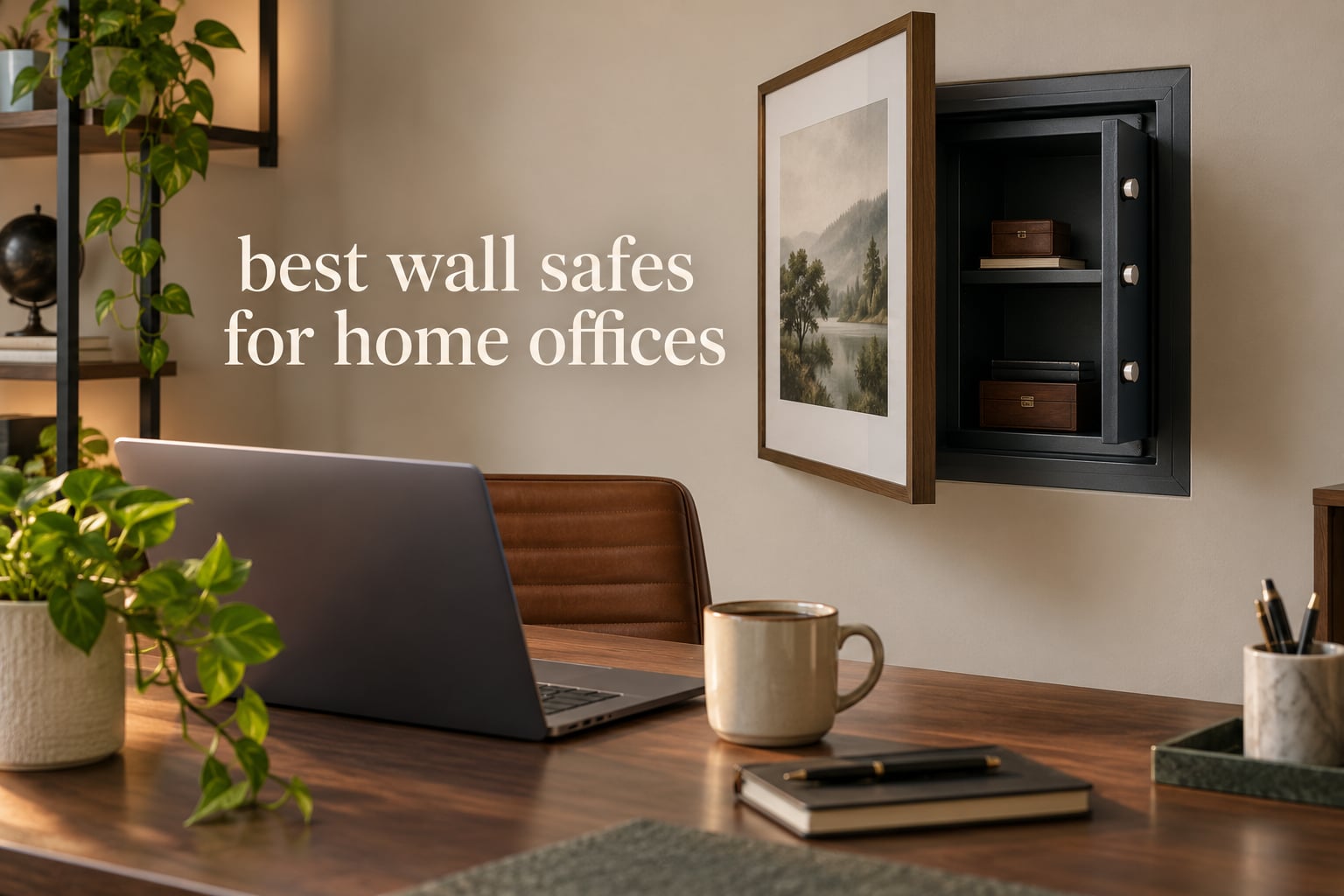
A home office is the most concentrated pile of valuables in most homes. Passports, property deeds, tax records, wills, checkbooks, client contracts under NDA, and sometimes a firearm all end up in the same room, usually in the same desk.
That makes the home office the room where a wall safe earns its keep. A recessed wall safe takes up no floor space, sits flush with the drywall, and disappears behind a framed print or a wall-mounted display. The failure mode is different from a floor safe though: a wall safe lives or dies on whether it physically fits your wall cavity, and most returns and regrets trace back to one measurement nobody took.
We compared 12 in-wall safes built for this job, reading the dimensions, lock hardware, and owner feedback on each. If you want the wider context first, our guides to hidden wall safe storage and fireproof safes for home documents cover the general categories. This one is narrowed to the office, where concealment and document capacity matter more than safe-diving.
Table of Contents
What Is a Wall Safe?
A wall safe is a steel security box recessed into a wall cavity, bolted to the wall studs with lag screws, and finished flush with the wall surface so it can be hidden behind artwork, a mirror, or a mounted television. Unlike a floor safe it cannot be carried off in one grab, but it is limited by your wall depth and usually offers less fire protection and less interior volume than a freestanding safe.
The main formats you will see in this category are:
Between-studs in-wall safe — the standard format here, sized to drop into a 16 inch on-center stud bay.
Spacer-compatible in-wall safe — a between-studs body shipped with a spacer kit so it can also reach 24 inch on-center framing.
Handgun-profile wall safe — a short, shallow body for a pistol and a light, often with a fingerprint reader.
Surface-mounted cabinet safe — bolts to the face of the wall with no cutting, but sacrifices all concealment.
Drywall-overlay hidden safe — a thin box that mounts to the face of the framing and is then covered with a fresh panel of drywall.
One honest note before the picks. Almost every safe in this roundup is described by its maker as burglary resistant or heavy duty, and almost none of them carry an independent UL listing. Treat those words as manufacturer marketing, and look at the steel, the lock, and the anchoring hardware instead. Our thinking on the broader safe market is in the home safe roundup.
Quick Picks: The Best Wall Safes for Home Offices (October 2026)
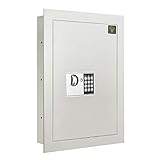
Paragon In-Wall Keypad Safe
- 0.83 cubic feet
- 39 lb steel body
- LED keypad with 2 codes
- alarm lockout
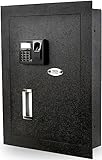
Viking VS-52BLX Biometric Safe
- 500 DPI fingerprint
- 39 lb body
- 20mm deadbolt
- 3 shelves plus LED

Grimtron Spacer Kit Wall Safe
- Fits 16 inch and 24 inch studs
- 2 shelves plus hooks
- silent mode
- USB power port
At a glance, all 12 picks:
Paragon 83-DT5912 — best overall for documents, jewelry, and everyday office valuables with a keypad.
Viking VS-52BLX — best for fast fingerprint access and a genuinely heavy steel body.
Grimtron VT04-WE — best value, and the only one here that bridges 16 inch and 24 inch stud spacing.
Protex PWS-1814E — best for a thick steel body with dual motorized bolts and an auto-opening door.
Nebakne 25.6 inch tall safe — best for a hidden lower tray plus a tall slim body.
GUVELI 17.72 inch compact safe — best for a shorter wall section where a full-height box will not fit.
GIANTEX GT50957-HW — best for holding several handguns alongside documents in a 0.83 cubic foot cavity.
XDeer S008QG — best for a pistol only, with a gas strut and sub-second fingerprint reads.
Tiskgg 29.53 inch tall safe — best for three removable shelves and a false bottom.
XDeer S009 — best biometric option with the largest interior in this group at 0.85 cubic feet.
Homak WS00017001 — best low-cost concealed box for a pistol and small valuables.
LANGGER V LAWS0002 — best for the deepest usable interior, over 5 inches.
All 12 Wall Safes at a Glance
| Product | Specifications | Action |
|---|---|---|
| Paragon In-Wall Keypad Safe |
|
Check Latest Price |
| Viking VS-52BLX Biometric Safe |
|
Check Latest Price |
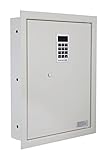 Protex PWS-1814E Keypad Safe Protex PWS-1814E Keypad Safe |
|
Check Latest Price |
 Nebakne 25.6 inch Tall Wall Safe Nebakne 25.6 inch Tall Wall Safe |
|
Check Latest Price |
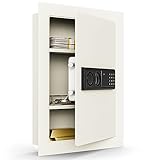 GIANTEX GT50957-HW Wall Safe GIANTEX GT50957-HW Wall Safe |
|
Check Latest Price |
| Grimtron VT04-WE Wall Safe |
|
Check Latest Price |
 GUVELI 17.72 inch Compact Safe GUVELI 17.72 inch Compact Safe |
|
Check Latest Price |
 XDeer S008QG Biometric Safe XDeer S008QG Biometric Safe |
|
Check Latest Price |
 Tiskgg 29.53 inch Tall Wall Safe Tiskgg 29.53 inch Tall Wall Safe |
|
Check Latest Price |
 XDeer S009 Biometric Wall Safe XDeer S009 Biometric Wall Safe |
|
Check Latest Price |
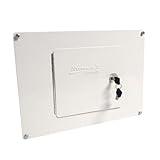 Homak WS00017001 Wall Box Homak WS00017001 Wall Box |
|
Check Latest Price |
 LANGGER V LAWS0002 Biometric Safe LANGGER V LAWS0002 Biometric Safe |
|
Check Latest Price |
1. Paragon 83-DT5912 In-Wall Keypad Safe — Best Overall for Office Documents
Paragon Safes In Wall Safe with Keypad and 2 Manual Override Keys, White
0.83 cubic feet
39 lb alloy steel
16.25 by 4 by 22 inch
LED keypad, 4 AA batteries
Pros
- Fits 16 inch on-center studs with about a quarter inch clearance
- Heavy 39 lb steel body that feels durable
- Two programmable codes plus two override keys
- Alarm locks out after three wrong entries
- Wide front flange hides minor drywall cutting errors
Cons
- Center locking mechanism eats into usable interior space
- Not fireproof
- Keypad beep cannot be disabled
This is the safe we kept coming back to. The Paragon 83-DT5912 is a tall, narrow in-wall body that drops between standard 16 inch on-center studs, and at 0.83 cubic feet it holds a genuinely useful stack of documents rather than a token handful.
Owners consistently describe it as heavy and well built. At 39 pounds it is one of the more substantial bodies in this roundup, and reviewers note that anchor bolts are included in the box, which is more than several competitors manage.
The wide front flange is the detail most people miss until they are holding a drywall saw. It covers a cut that is a quarter inch off, so a small measuring error does not turn into a visible gap around the door.
Two programmable codes run from three to eight digits, and the anti-theft system alarms for 20 seconds after three wrong codes and for five minutes after six. Two manual override keys ship in the box, which matters more than it sounds on an electronic unit. The four AA batteries are rated at four to five months, and the beeping on each keypress cannot be switched off.
What it fits and where it goes
The interior chamber measures 16.25 inches long, 3.8 inches wide, and 20.25 inches tall, against an exterior of 16.25 by 4 by 22 inches. That shape is close to ideal for a document folder stood on end, and it disappears completely behind a tall framed print. The 4 inch depth points at a 2×6 wall, or a 2×4 wall with the drywall face set slightly back.
Who should skip it
Skip it if you are protecting deeds and tax paperwork against fire, since nothing in the listing claims a fire rating. Skip it if silent access matters, because the keypad emits a beep on every press with no mute setting. And know that the center locking mechanism takes up more usable space than buyers expect, which also makes the middle shelf awkward.
2. Viking Security VS-52BLX Biometric Wall Safe — Best for Fast Fingerprint Access
Viking Security Safe VS-52BLX Hidden Wall Biometric Safe
970 cubic inches
39 lb alloy steel
4 by 14 by 19.3 inch
500 DPI sensor, 6 AA batteries
Pros
- Fingerprint reader reads worn and older prints reliably
- Redundant access: fingerprint plus PIN plus two cross keys
- 39 lb body with 5mm door and 20mm motorized deadbolt
- Three fully adjustable shelves plus key hooks and interior LED
- Fingerprint memory survives battery removal
Cons
- Center lock box reduces usable middle depth
- Shelf tabs can bend in shipping
- Included batteries are weak
- Not fireproof
The Viking VS-52BLX is the one in this group with a long ownership history behind it, and owners report multi-year use without problems. At 39 pounds with a 5mm door and a motorized 20mm deadbolt, it is also the most substantial-feeling body here.
What sets it apart is the sensor. The 500 DPI optical reader stores up to 32 fingerprints or one PIN code, and reviewers repeatedly single it out as the most reliable scanner they have used, including with older and worn prints. The scanner memory is retained even if the batteries come out, which removes one of the classic fingerprint lockout worries.
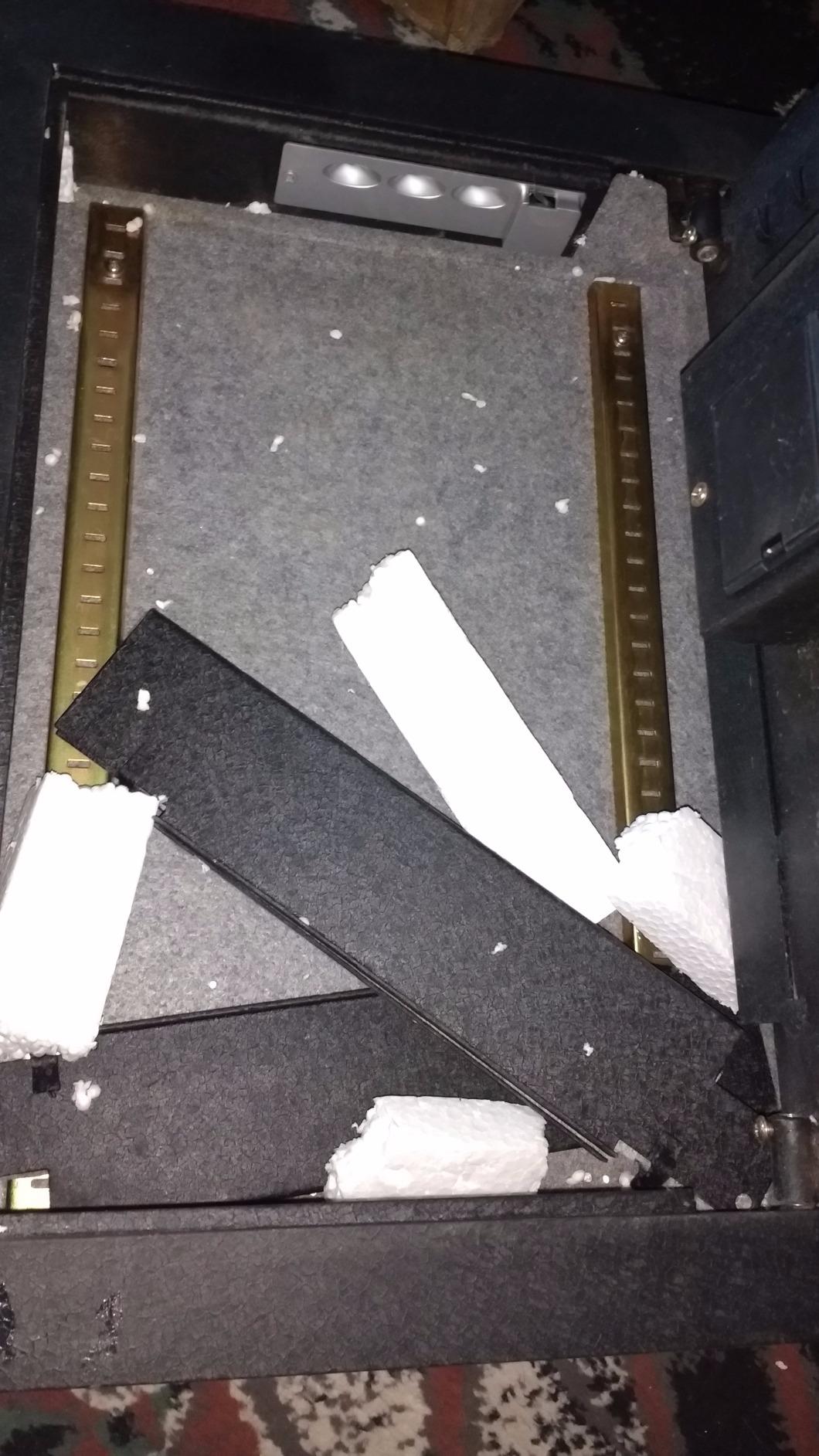
You get four ways in: fingerprint, PIN, and two four-prong cross keys, with two backup keys, four mounting bolts, an Allen wrench, and six AA batteries in the box. The carpeted interior has a built-in LED, three fully adjustable shelves, and key hooks, which is the most considered storage layout of the twelve here.
What it fits and where it goes
Exterior dimensions are 4 inches deep, 14 inches wide, and 19.3 inches tall, with an interior chamber of 14 by 3.5 by 18.5 inches. It mounts directly between 16 inch on-center studs, and owners in 24 inch framing report needing to add extra blocking. Because it can also mount to a floor, it doubles as a small floor safe in a tight closet.
Who should skip it
Skip it if you only want a keypad, because the PIN slot holds a single code. Skip it if you are storing anything that must survive a fire, since it carries no fire rating. Two mechanical details: the lock box sits in the middle of the cavity so the center is shallower, and the adjustable shelves rest on thin tabs that some buyers report bending in transit, so check them before closing the wall.
3. Protex PWS-1814E Burglary Resistant Keypad Wall Safe — Best Heavy Steel Body
Protex Safe Electronic Keypad Wall Safe (PWS-1814E), Burglary Resistant wall safe, digital electronic locking system, velvet interior, automatic door opening, 2 Removable shelves
0.44 cubic feet
28 lb gauge steel
3 by 14 by 18 inch body
18-1/8 by 14-1/8 rough opening
Pros
- Thick steel body with dual motorized bolts that feel genuinely burglary resistant
- Motorized bolts pop the door open after the code is entered
- Velvet interior with an LED light
- Multiple fail-safes across codes and a power pack and physical keys
- Mounts nearly flush
Cons
- Written instructions are sparse and unclear
- Shallow 3 inch interior
- Removable shelves feel flimsy
- Only one user code plus one master code
The Protex PWS-1814E is treated as the sturdiest of the between-the-studs safes here, and the reason is the locking hardware. Two live motorized chrome bolts, each three-quarter inch in diameter, drive into the frame and then pull the door open for you once the code is entered.
At 28 pounds with heavy duty gauge steel it is not the heaviest body in the list, but bolt diameter is the number that separates it from the lighter compact units, and buyers comparing the two usually come back to the Protex for that reason.
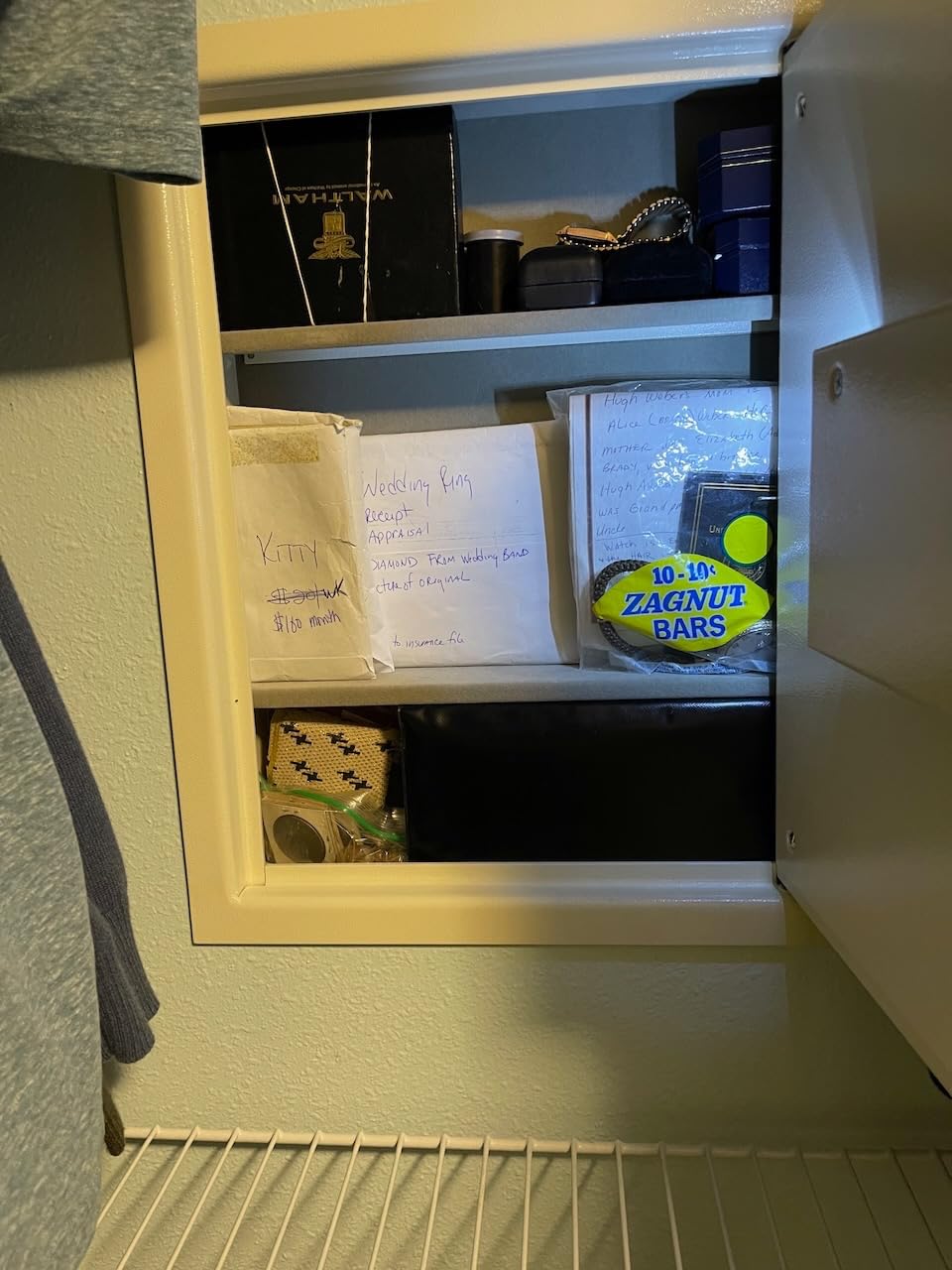
The velvet interior has an LED that illuminates the contents when the door opens, and two removable shelves divide the 0.44 cubic feet. Fail-safe access is unusually thorough: a user code, a master code, an external power pack, and physical keys. Installation difficulty in owner reports almost always traces back to non-standard stud spacing rather than to the safe.
What it fits and where it goes
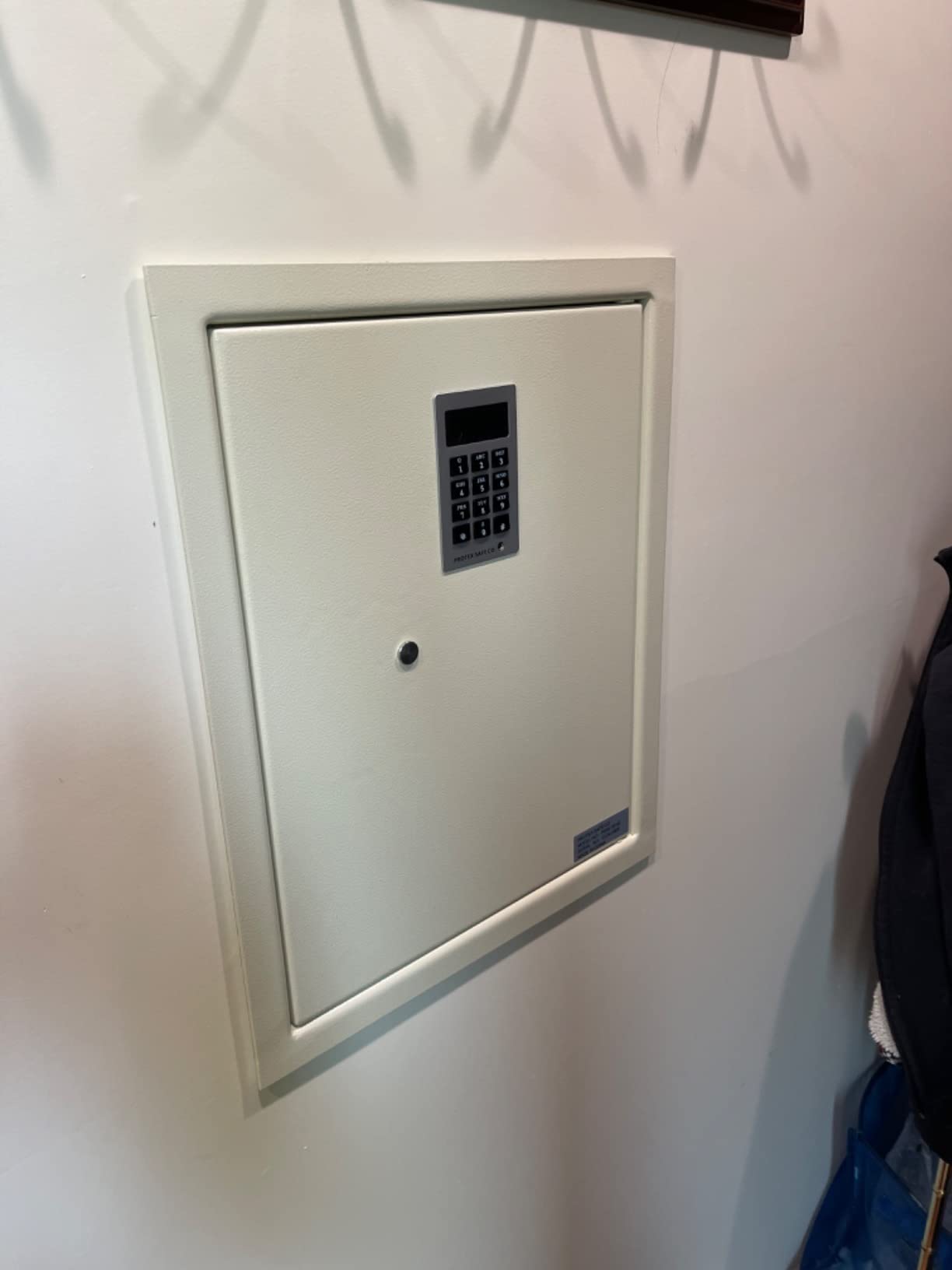
Exterior size is 3 inches deep, 14 inches wide, and 18 inches tall, and the required rough opening is 18-1/8 by 14-1/8 inches at 3-3/4 inches of depth. That opening is wider than the safe’s own body dimension, so you need roughly 18 inches of clear bay. It also protrudes only a quarter to half inch from the finished wall, flatter than most here.
Who should skip it
Skip it if you need to program several family members, because it supports one user code and one master code. Skip it if you are not patient with documentation, since sparse instructions around programming and rough-opening size are the most common complaint, and the removable shelves are repeatedly described as flimsy for the weight of files.
4. Nebakne 25.6 Inch Tall Fireproof Wall Safe — Best for a Hidden Second Compartment
25.6″ Tall Fireproof Wall Safe Between Studs 16″ Centers | Hidden Wall Safe
25.6 inch tall
28.7 lb alloy steel
3.93 inch depth
4cm thick steel door, electronic lock plus keys
Pros
- Tall 25.6 inch body gives more vertical storage than most between-studs units
- 4cm thick steel door with solid bolts resists hand-tool attacks
- Hidden lower compartment adds a second layer
- Digital keypad accepts 3-8 digit codes plus two emergency keys
- Flush mounting disappears behind framed artwork
Cons
- Shallow depth under 4 inches limits storage to flat items
- Fire resistance is not independently verified despite the marketing claim
- Nearly 29 pounds makes solo installation harder
The Nebakne safe is picked for one feature above the others: a hidden lower compartment behind the main cavity. For an office where you want a second layer for a single set of spare keys or a backup drive, that is genuinely useful.
The steel door is listed at 4cm thick with two 2.2cm solid bolts and an all-metal integrated door panel, which is the thickest door claim in this roundup. At 28.7 pounds it is also one of the heavier bodies, and that weight cuts both ways during installation.
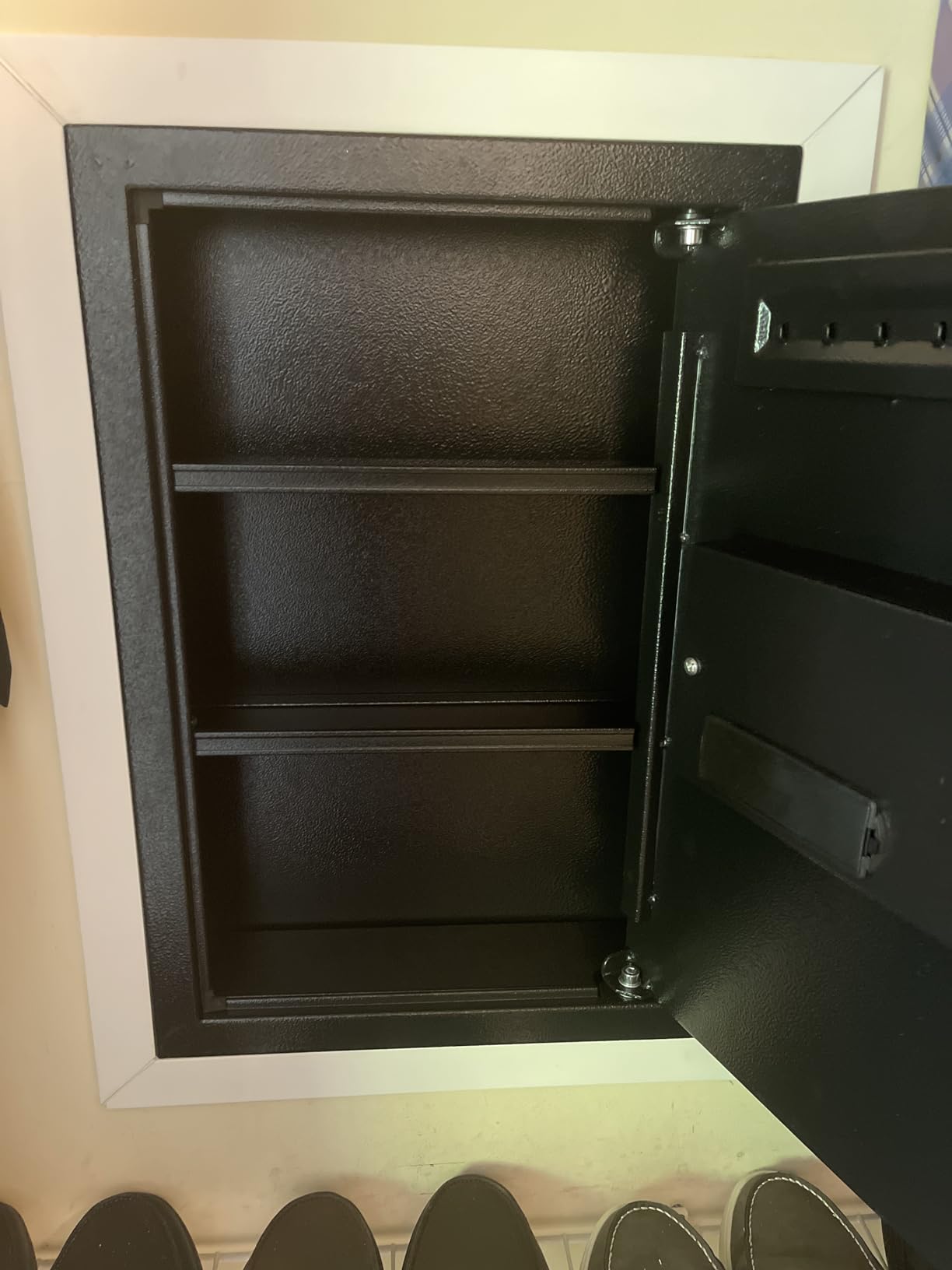
Access is a digital keypad accepting three to eight digit user and master codes, with two emergency keys and a turn knob as backup. A removable interior shelf works alongside the hidden tray, and owners report that it disappears cleanly behind artwork.
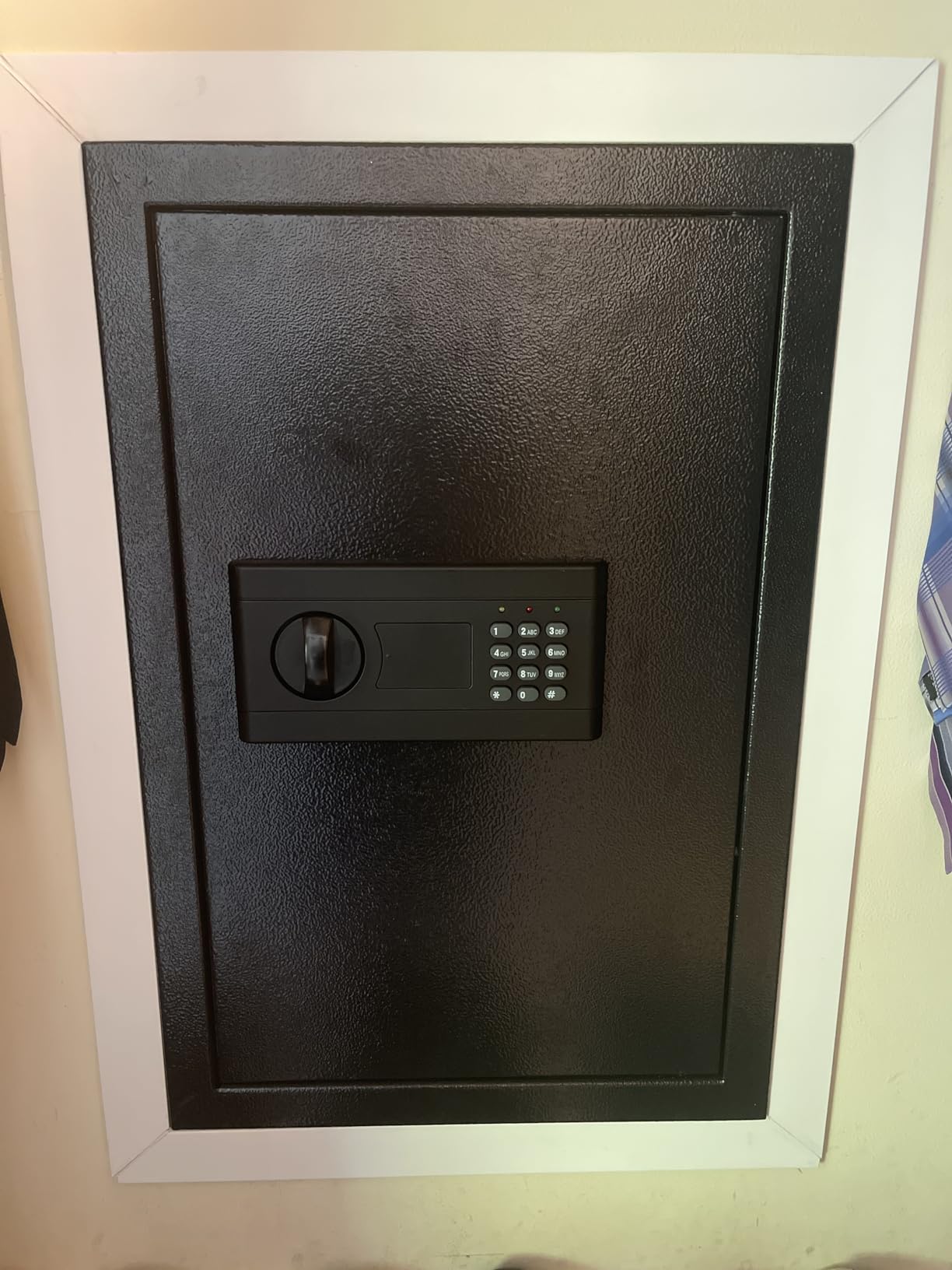
What it fits and where it goes
Exterior dimensions are 25.6 inches tall, 3.93 inches deep, and 14.56 inches wide, designed for a 16 inch on-center stud bay. The height is the selling point, because a stack of full-size document folders stood on end fits in a way a shorter 18 inch body cannot manage. Plan the concealment art to match, since a small picture will leave the door obvious.
Who should skip it
Skip it if fire protection is the goal. The word fireproof appears in the product name, but reviewers report no stated or independently verified fire rating, and forum readers treat an unverified fireproof claim as a red flag here. Also skip it if the wall is shallow, since just under 4 inches of depth holds flat items and documents only.
5. GIANTEX GT50957-HW Electronic Hidden Wall Safe — Best for Multiple Handguns
Giantex Electronic Wall Hidden Safe Security Box, Built-In Wall Electronic Flat Security Safety Cabinet (White)
0.83 cubic feet
31.6 lb alloy steel
22 by 16 by 4-1/7 inch exterior
Keypad plus key, internal battery bay
Pros
- Beefy steel construction with real weight that holds solidly to the studs
- Two ways to open with a programmable keypad or override key
- Fits 16 inch on-center studs and hides flush
- Owners report fitting three to four handguns alongside cash and jewelry
Cons
- Keypad panel feels cheap and is soft rubber
- Lock assembly eats into the middle interior space
- Not fire rated
- Battery compartment is inside the safe
The GIANTEX GT50957-HW is the one in this group that reviewers describe as outperforming its class. At 31.6 pounds it is a solid body, and 0.83 cubic feet of interior is enough for several handguns alongside a stack of documents and a jewelry roll.
Multiple owners note that the panel and hinges look identical to safes costing two or three times as much apart from a front decal, and at a 4.5 rating from 285 reviews that framing is well supported.
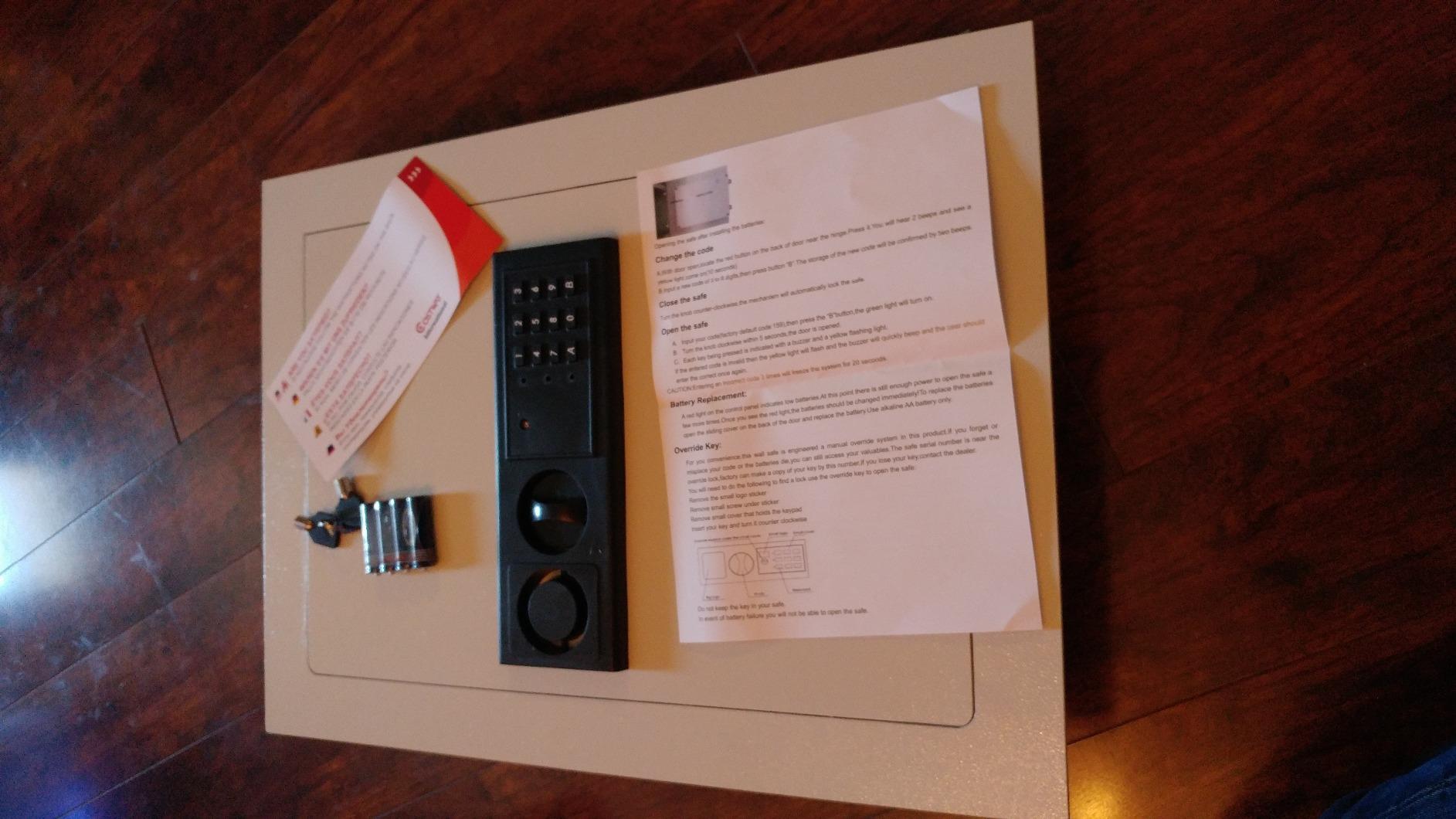
Two ways in: a programmable combination keypad or a physical override key, with a lockout after three incorrect attempts. The exterior is 22 inches tall, 16 inches wide, and 4-1/7 inches deep, with an interior of 19 by 13-4/5 by 3-3/4 inches. The interior is undivided by shelves, which is a benefit if you are laying handguns flat rather than stacking files.
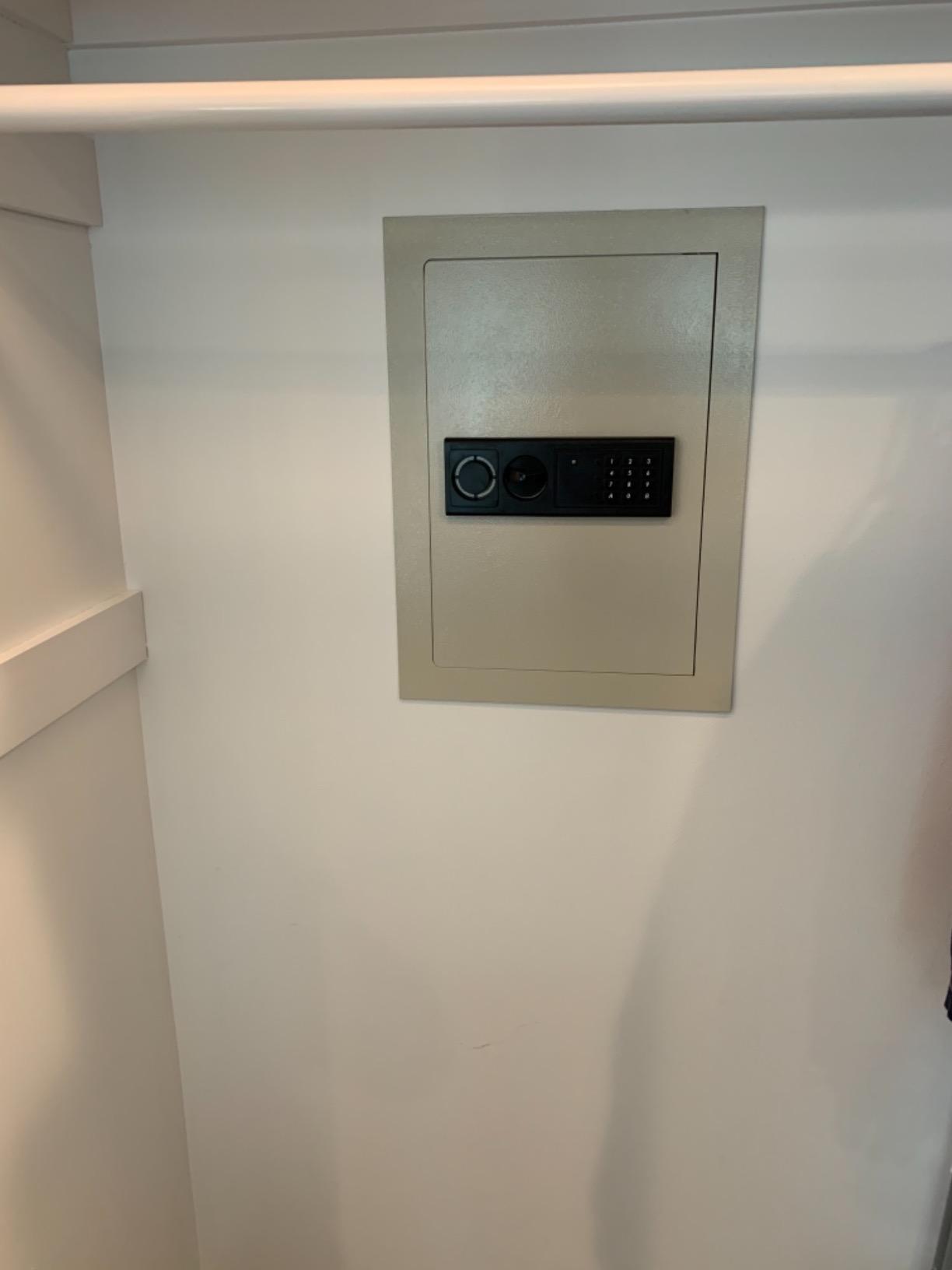
What it fits and where it goes
Because the body is 16 inches wide at the exterior and 13-4/5 inches wide inside, it fills a 16 inch stud bay almost completely, which makes it a poor fit for 24 inch on-center framing without a spacer. Check your stud spacing first. It works well in a walk-in closet or behind a large framed piece, and the 4-1/7 inch depth again points at a 2×6 wall.
Who should skip it
Skip it if the feel of the keypad matters, since it is described as cheap and soft rubber, the most common quality complaint. Skip it for fire-protected documents, as it is not fire rated. One practical note if you go ahead: the battery compartment is inside the safe, so a dead battery means reaching for the backup key, and the access plate screw is metric and awkward to remove.
6. Grimtron VT04-WE Wall Safe With Spacer Kit — Best Value and Fits 24 Inch Studs
Grimtron Electronic Wall Safe Between 16″ & 24″ Studs with Shelves & Hooks
0.76 cubic feet
25.8 lb steel
3.86 by 14.57 by 19.68 inch
Spacer kit for 16 and 24 inch studs
Pros
- Spacer kit allows installation in both 16 inch and 24 inch stud spacing
- Locking mechanism leaves more usable vertical interior space
- Two removable shelves plus adjustable hooks
- Silent mode reduces keypad beeping
- Interior LED and auto-open door
- Responsive customer service
Cons
- Not fireproof
- Included screws strip easily so buy quality lag bolts
- Pegboard hooks cannot be repositioned
- Thin U-shaped steel latch is not very pry resistant
Stud spacing is the number one reason wall safe purchases go wrong, and the Grimtron VT04-WE is the only safe here that solves it outright. It ships with a spacer kit that bridges non-standard spacing, so the same body installs in both 16 inch and 24 inch on-center framing.
At 0.76 cubic feet and 25.8 pounds it leaves more usable vertical interior space than competing designs, because the locking mechanism is positioned so it does not eat the full center column. For documents that matters more than raw volume.
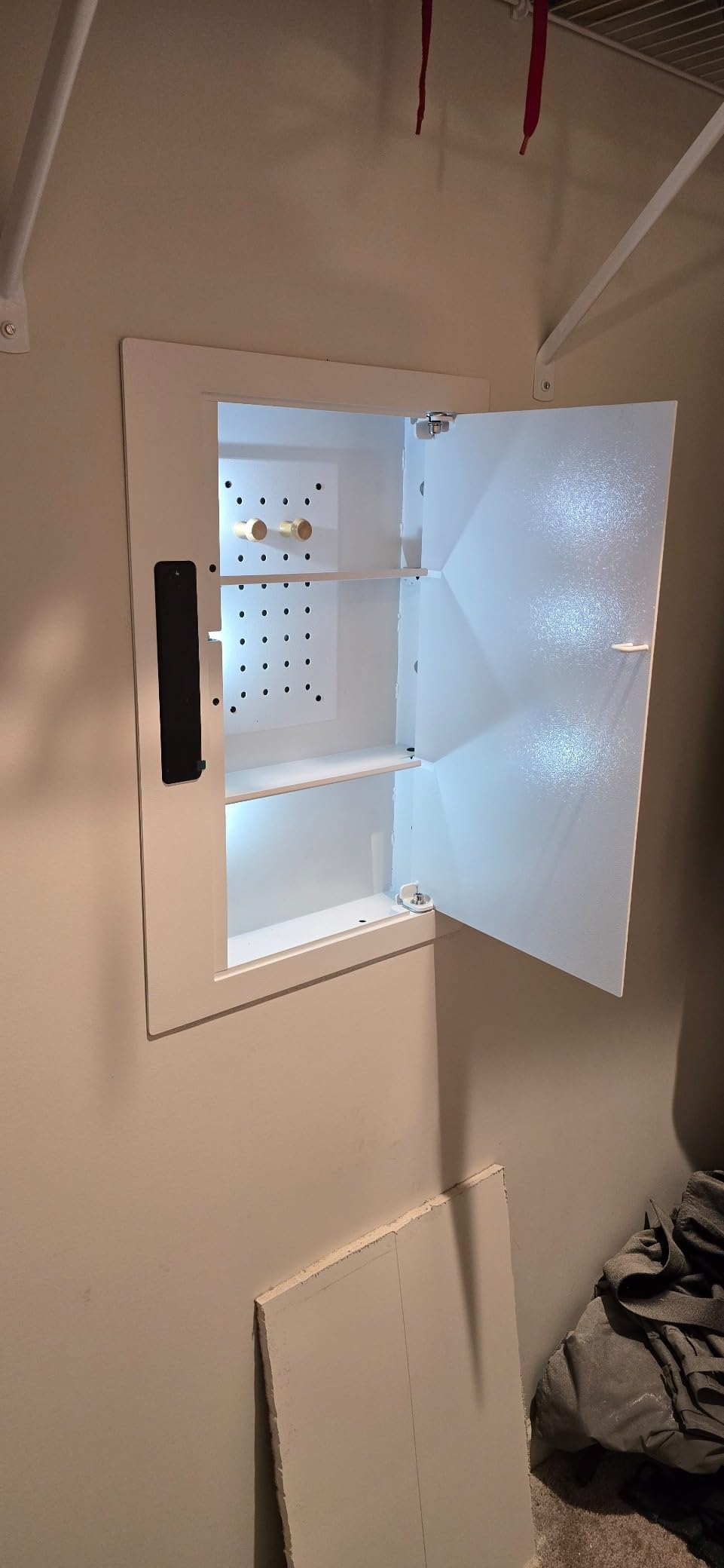
Inside you get two removable shelves and adjustable hooks, a digital keypad with an auto-open door, an interior LED, and a silent mode that turns off the beeping. Two emergency keys and an external USB power port handle depleted batteries. Wall screws and anchors are included, though you may want to replace them.
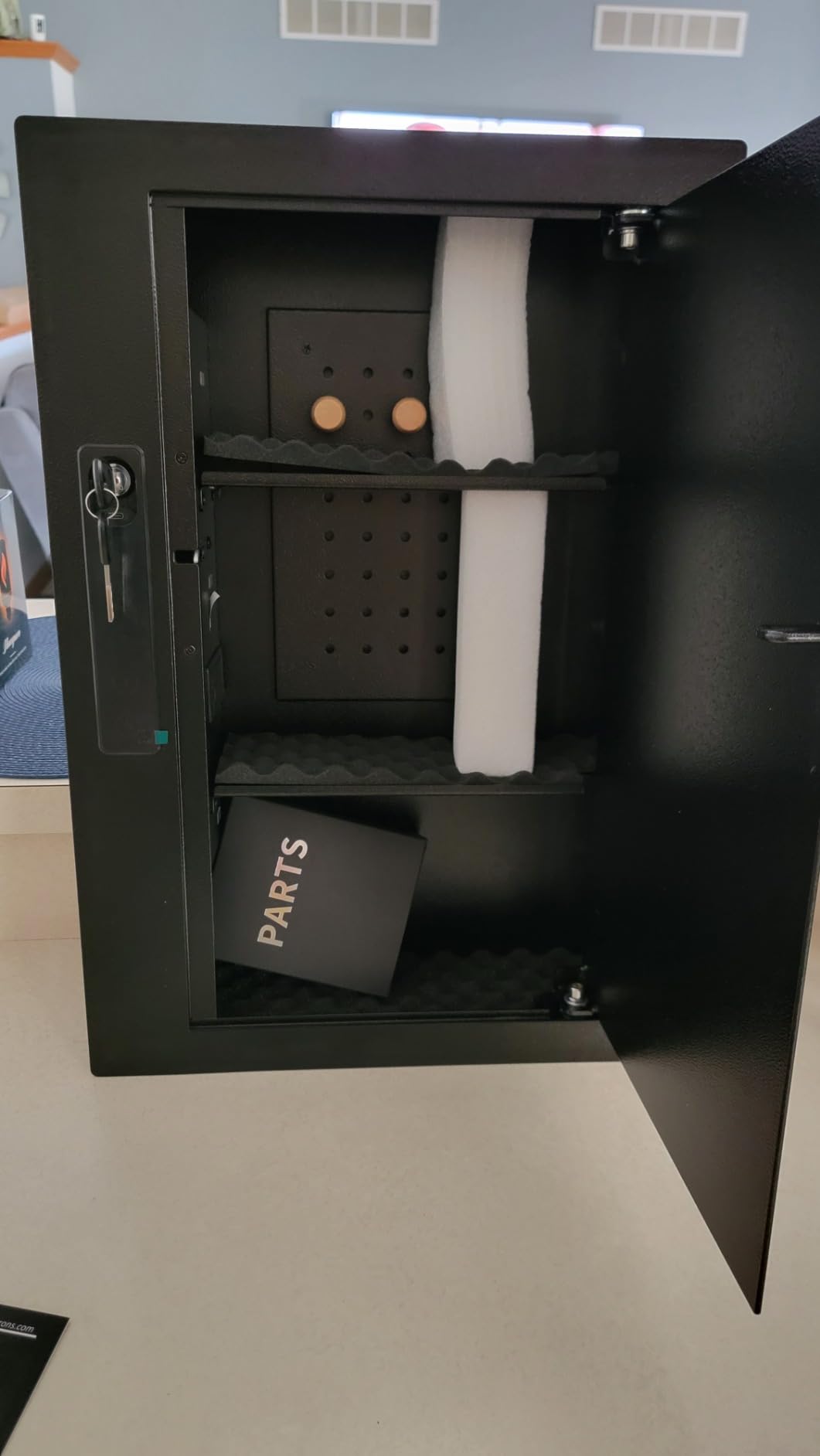
What it fits and where it goes
Exterior dimensions are 3.86 inches deep, 14.57 inches wide, and 19.68 inches tall. The face sits nearly flush, which is what makes the behind-artwork concealment read as a wall rather than a cabinet. Because the body is under 4 inches deep, it is a genuine candidate for a 2×4 wall in a remodel where the drywall face sits slightly back from the stud face.
Who should skip it
Skip it if your threat is a determined attacker with a pry bar, because the most common hardware complaint is the thin U-shaped steel latch on the door. The included screws also strip easily, so buy proper lag bolts rather than trusting the box. And skip it for fire protection, since it is not fireproof.
7. Tiskgg 29.53 Inch Tall Wall Safe — Best for Three Removable Shelves
White 29.53″ Tall Fireproof Wall Safes Between the Studs 16″ Centers
29.53 inch tall
16.33 kg alloy steel
3.93 inch depth
3 removable shelves plus false bottom
Pros
- Tallest body in this group at 29.53 inches for generous vertical storage
- Three removable shelves plus a hidden false-bottom compartment
- Two motorized deadbolts that resist hand and power tool attack
- Flush mount hides cleanly behind framed artwork
- Easy to program with a 4-8 digit combination plus key backup
Cons
- Marketed as fireproof with no stated or independently verified rating
- Very shallow depth of just under 4 inches
- White finish can arrive scuffed or dinged
- Minor gaps around the door
The Tiskgg is the tallest body in this group at 29.53 inches, and that height is what you are buying. Combined with three removable shelves and a hidden false bottom, it turns a shallow between-studs cavity into something closer to a small vertical filing column.
Locking is handled by two motorized deadbolts, and access is a four to eight digit combination with emergency keys and a turning knob as backup. Reviewers call installation easy and describe the safe as solidly made, with one honest framing repeated often: it is meant to deter honest people rather than professionals.
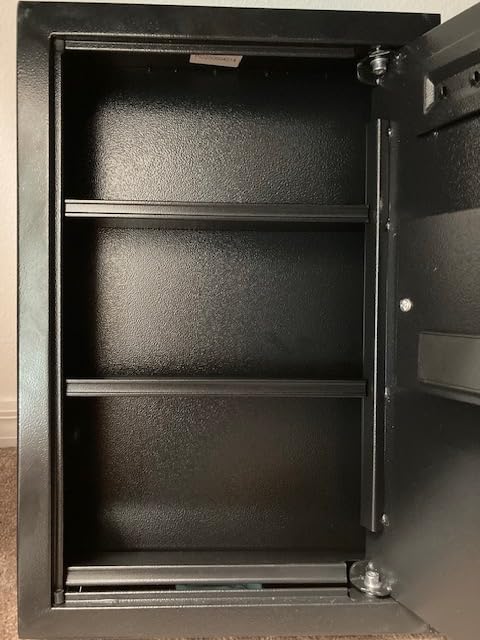
The shelf count is what separates it from shorter competitors. If your office holds binders, a stack of hanging folders, or a jewelry roll that needs separating, that organization is worth more than another fraction of a cubic foot of undifferentiated space.
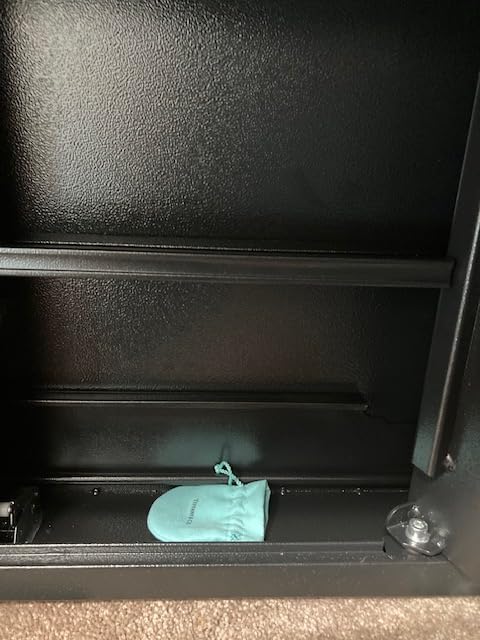
What it fits and where it goes
Exterior dimensions are 29.53 inches tall, 3.93 inches deep, and 14.56 inches wide, fitting between 16 inch on-center studs. At this height you are committing to a full-length concealment: a tall mirror, a large framed print, or a floor-to-ceiling shelving unit, not a modest picture. Confirm the vertical clearance above the floor before you mark the outline.
Who should skip it
Skip it if you need real fire protection. The product is marketed as fireproof but no stated or independently verified rating is provided, and that distinction matters for deeds or a will. Our fireproof document safe guide covers what a real rating looks like. Owners also report the white finish arriving scuffed with minor gaps around the door.
8. XDeer S008QG Biometric Wall Safe With Gas Strut — Best for a Pistol and Nothing More
XDeer Biometric Wall Safe with Gas Strut for Quick Access
0.09 cubic feet
14.09 by 2.44 by 11.42 inch
Fingerprint plus PIN, AAA batteries, gas strut door
Pros
- Fast fingerprint unlocking that lands on the first attempt with practice
- Runs on standard AAA batteries instead of hard-to-find lithium cells
- Four access methods with silent mode and USB emergency power
- Gas strut gives one-handed opening with an interior LED
- Compact format works beside a bed or door and in a closet
Cons
- Interior capacity is realistically a pistol with a light and little else
- Fingerprint sensor can be inconsistent with damp or worn fingers
- Adhesive magazine pouch repeatedly detaches
- Mounting hole spacing is not aligned to 16 inch stud centers
- Battery assembly is fragile and can snap a solder joint
The XDeer S008QG is a handgun safe, not a document safe, and it is worth being blunt about that because the 0.09 cubic foot interior is tiny. What it does well is speed. The biometric module reads in under 0.1 seconds at up to 508 DPI, and owners report the scanner performing well against costlier biometric safes.
A gas strut holds the door open for one-handed access, with an interior LED light, a backlit keypad, and a silent mode. Four ways in: fingerprint, a three to eight digit PIN, two spare keys, and a USB emergency port.
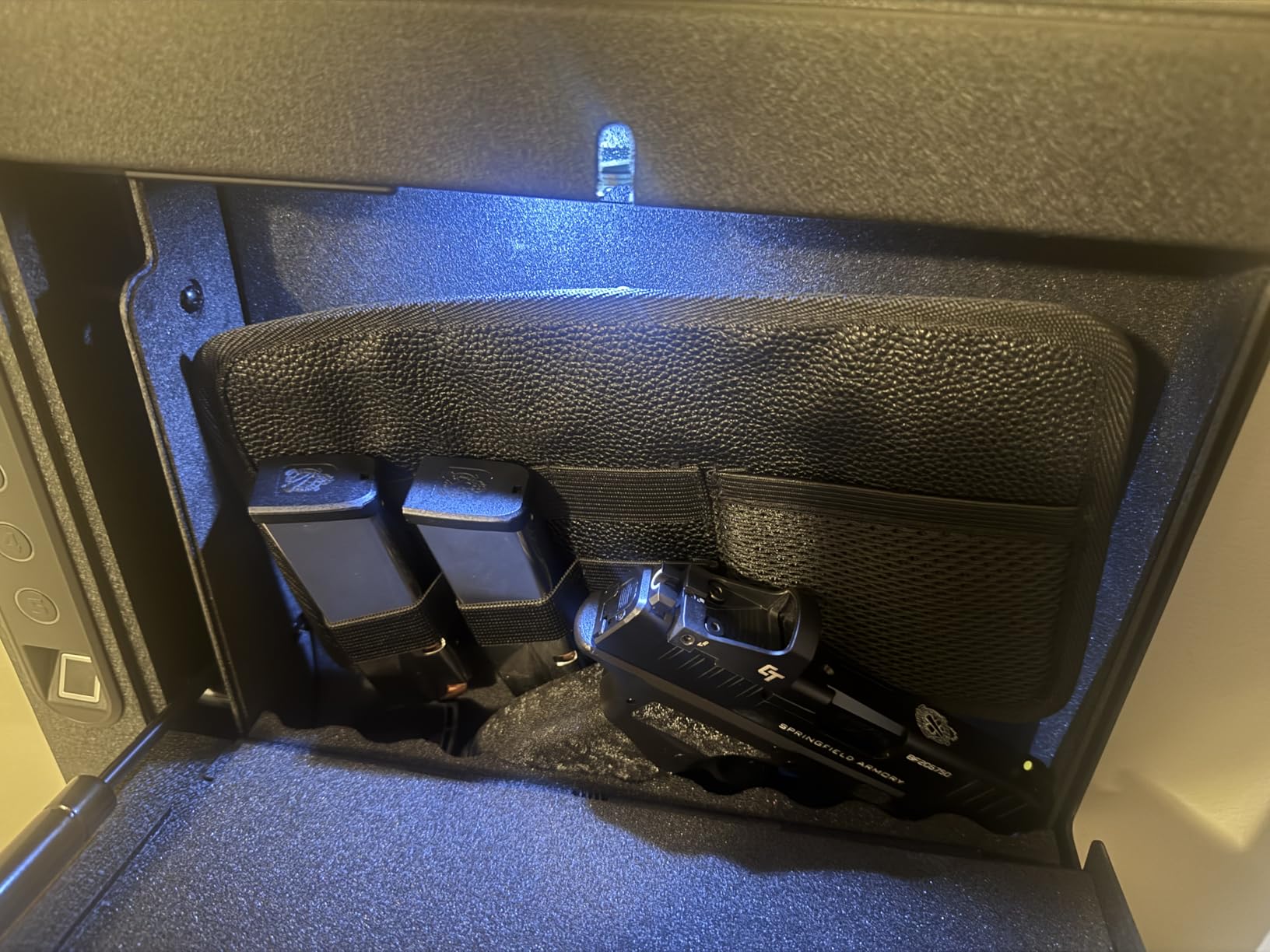
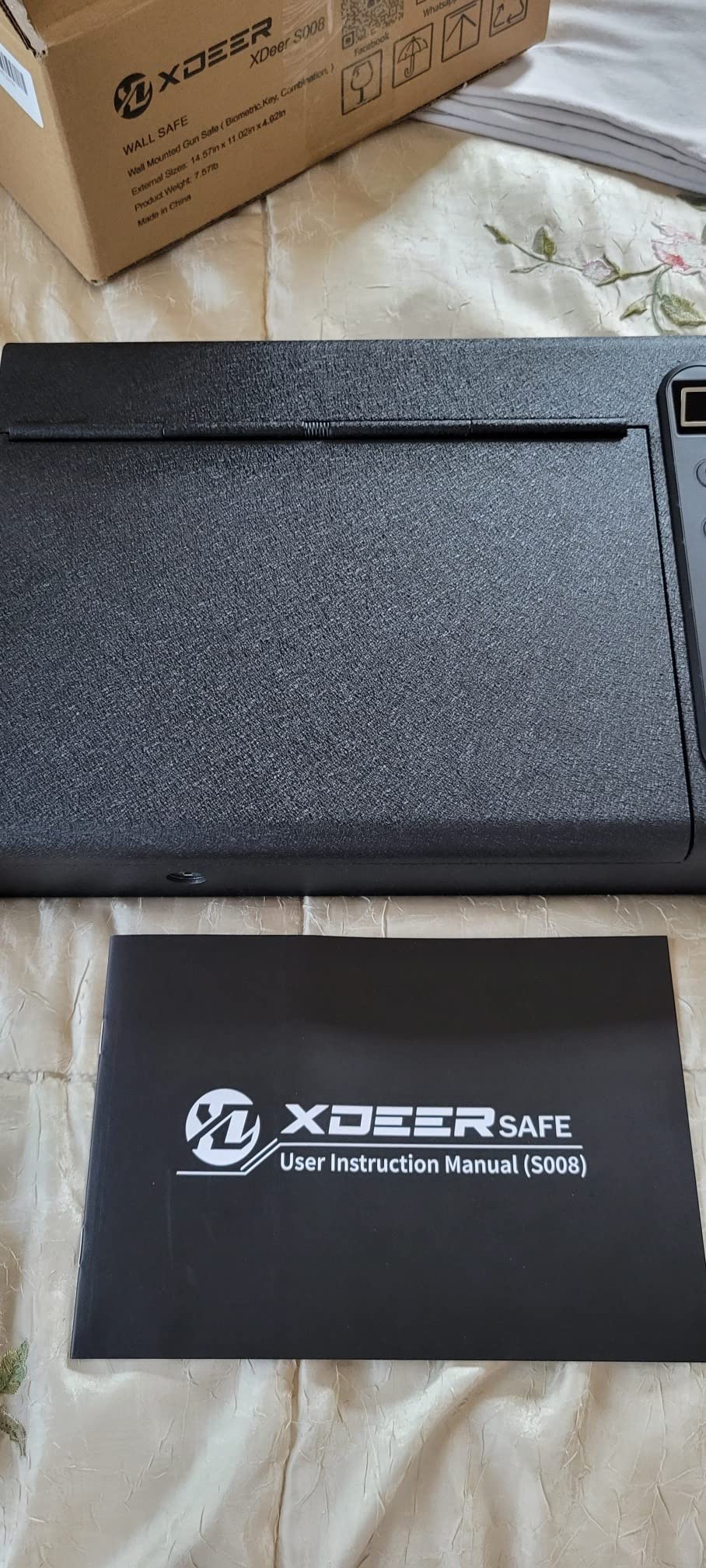
One practical upgrade worth noting: it runs on standard AAA batteries rather than a hard-to-find lithium cell. The box includes the safe, a USB cable, three foot screws, three gaskets, two keys, a manual, and a magazine pocket, an unusually complete list for this category.
What it fits and where it goes
Exterior dimensions are 2.44 inches deep, 14.09 inches wide, and 11.42 inches tall, with an interior listed at 7.09 by 10.24 by 2.17 inches. The 2.44 inch depth makes it one of the few here that can genuinely sit inside a standard 2×4 wall cavity. One critical caveat: the mounting hole spacing is not aligned to 16 inch stud centers, so it does not bolt directly into studs without adapting the fixings.
Who should skip it
Skip it if you plan to store spare magazines inside. Interior volume is the binding constraint, and the supplied adhesive magazine pouch repeatedly detaches from the back panel. Skip it if fingerprints are your only access path, because the sensor is finicky with damp, worn, or cold fingers and the battery assembly can snap a solder joint when removed. Keep the two keys somewhere separate.
9. XDeer S009 Biometric Wall Safe — Best Large-Capacity Biometric Option
XDeer Biometric Wall Safe Between 16″ Studs, Upgraded Hidden Safe
0.85 cubic feet
16.22 by 4.13 by 22.04 inch
Fingerprint plus PIN, 6 anchor bolts, shelves and pegboard
Pros
- Three unlocking methods with fingerprint
- keypad and two emergency keys
- Largest stated capacity in this group at 0.85 cubic feet
- Removable shelves and hanging panels with adjustable hook spacing
- Matte black powder-coated steel resists rust and scratches
- Rounded edges and automatic locking suit homes with children
Cons
- Fingerprint sensor needs a dry clean finger and a 1-2 second hold
- Reinforced steel structure still leaves only shallow usable depth
- Shelves and pegboard must be removed to create open storage space
The XDeer S009 is positioned as the roomier sibling to the smaller biometric wall safes, and at 0.85 cubic feet it is the largest stated capacity in this group. That extra volume is what lets it hold a handgun, a spare magazine, and a document stack in the same cavity rather than choosing one.
Access is triple: a fingerprint scanner, a numeric keypad, and two emergency keys. Owners value the redundancy, particularly for a safe that might hold a firearm, where a single failed scan would matter more.
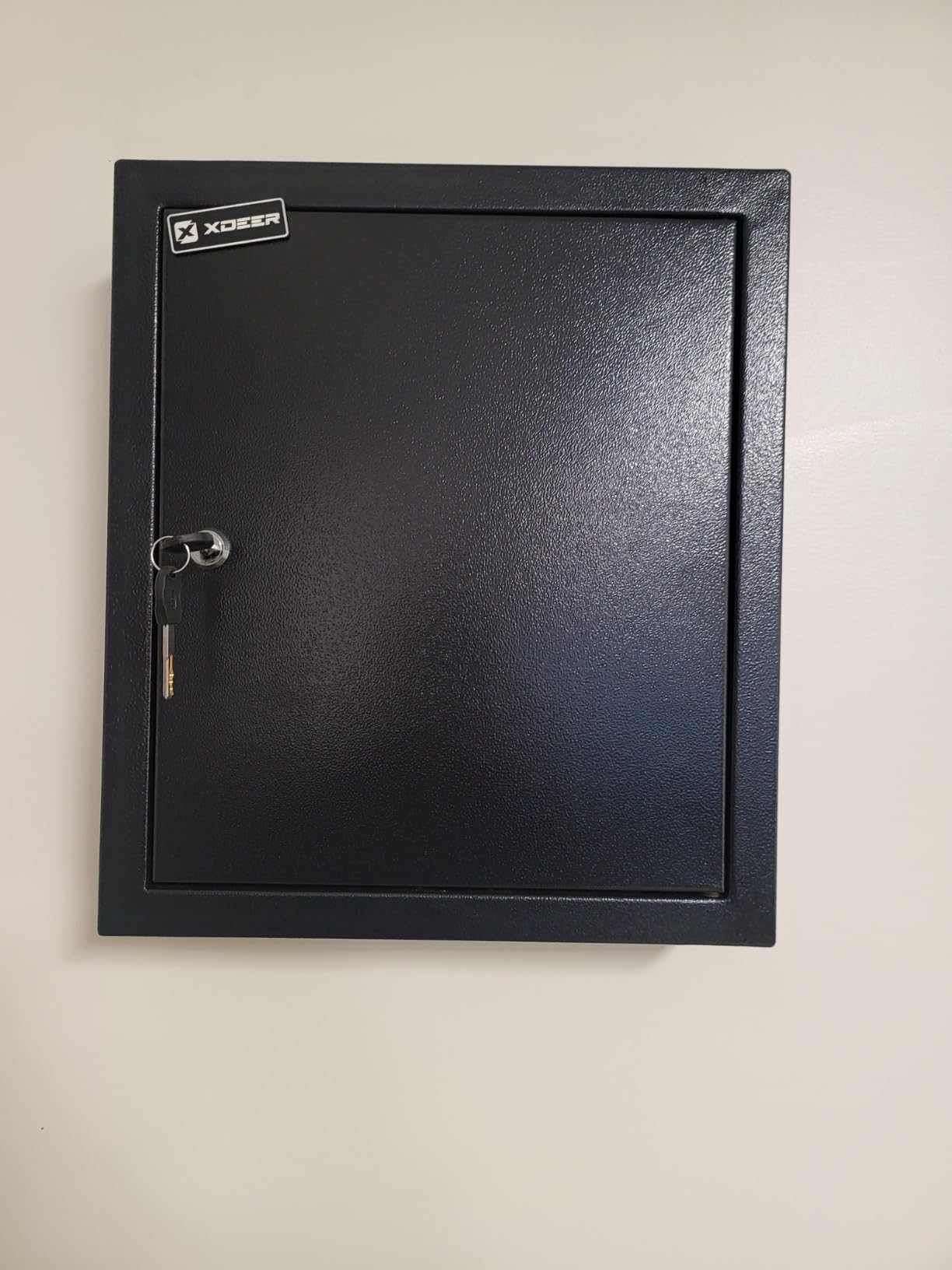
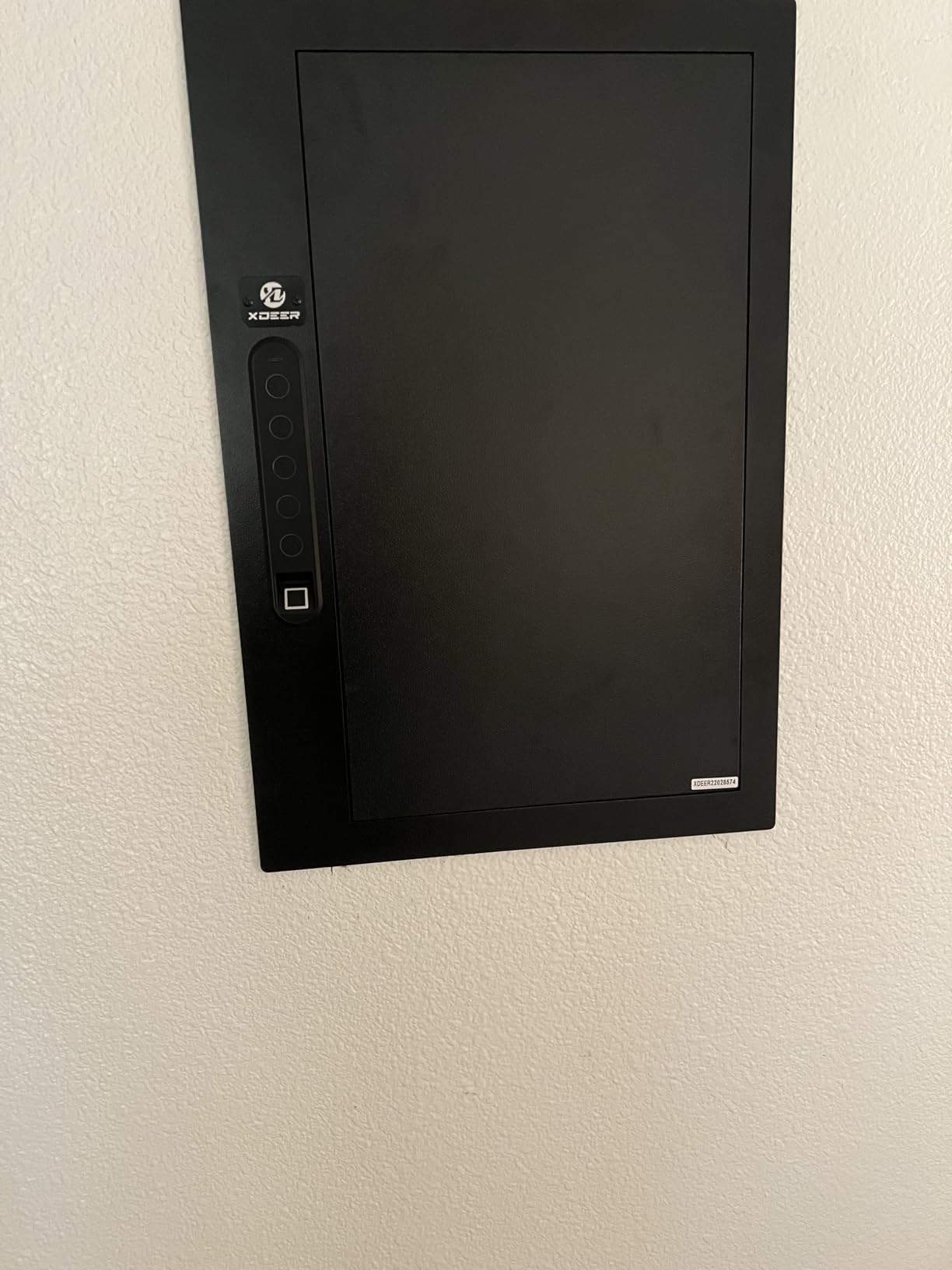
Inside you get removable shelves and hanging panels with adjustable hook spacing, six anchor bolts for fixing to the wall framing, and a matte black powder-coated finish that resists rust and scratches. Rounded edges and automatic locking are the details that matter if there are children in the house.
What it fits and where it goes
This is the safe to pick if you want biometric convenience and document capacity in the same box, and if you want a full-height door a large framed print will hide. At 4.13 inches deep, 16.22 inches wide, and 22.04 inches tall, the width again points at a 16 inch on-center stud bay, and the depth favors a 2×6 wall since there is no spacer kit here.
Who should skip it
Skip it if your fingers run cold or wet. The scanner needs a dry, clean finger held for one to two seconds to read reliably, which is a real constraint for anyone using it in a garage or basement. Skip it if you need a large open cavity, since the reinforced steel still leaves shallow usable depth and the shelves have to come out entirely. Our hidden storage wall safe guide covers deeper alternatives.
10. GUVELI 17.72 Inch Tall Compact Wall Safe — Best for a Short Wall Section
Black 17.72″ Tall Wall Safe Between Studs with Combo Lock & Removable Shelf
17.72 inch tall
10.66 kg steel
17.72 by 4.02 by 14.56 inch
2 motorized deadbolts plus key
Pros
- Compact 17.72 inch profile is the shortest option here for tighter walls
- Two motorized deadbolts resist hand and power tool attacks
- False-bottom hidden compartment adds a second layer
- Powder-coated scratch-resistant black finish
- Programmable 3-8 digit password plus emergency key backup
Cons
- Marketed as fireproof with no stated or independently verified rating
- Shallow depth of about 4 inches limits bulky items
- Lighter build than the larger steel safes in this category
The GUVELI solves a problem the taller units create. At 17.72 inches high it is the most compact body in this roundup, which makes it the pick when your stud bay has a window, a baseboard heater, a plumbing line, or a switch plate in the way of a full-height safe.
Despite the smaller frame it keeps the same security furniture as the bigger models: two motorized deadbolt locks on a 14.56 inch wide steel body, plus a false-bottom compartment for a second layer of concealment.
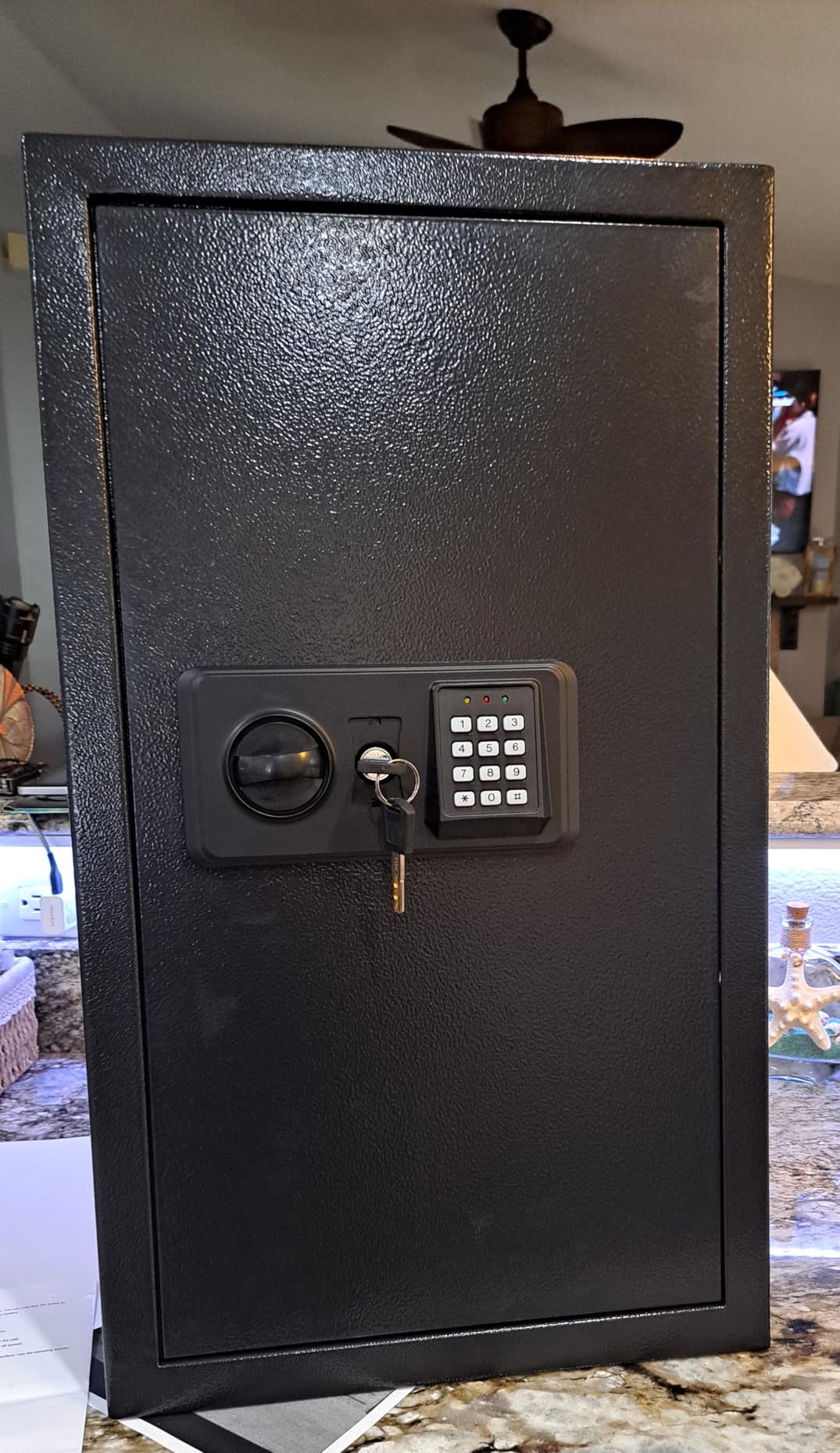
Access is a programmable three to eight digit password with an emergency key for backup, plus a vibration alarm. Buyers call it good value for a small flush-mount unit and report straightforward installation between 16 inch studs, with the honest framing that it deters casual access rather than a determined attack.
The black powder coat is described as scratch resistant, which matters for a face handled every time you open it, and the false-bottom compartment adds a second layer of concealment for a spare key or a backup drive.
What it fits and where it goes
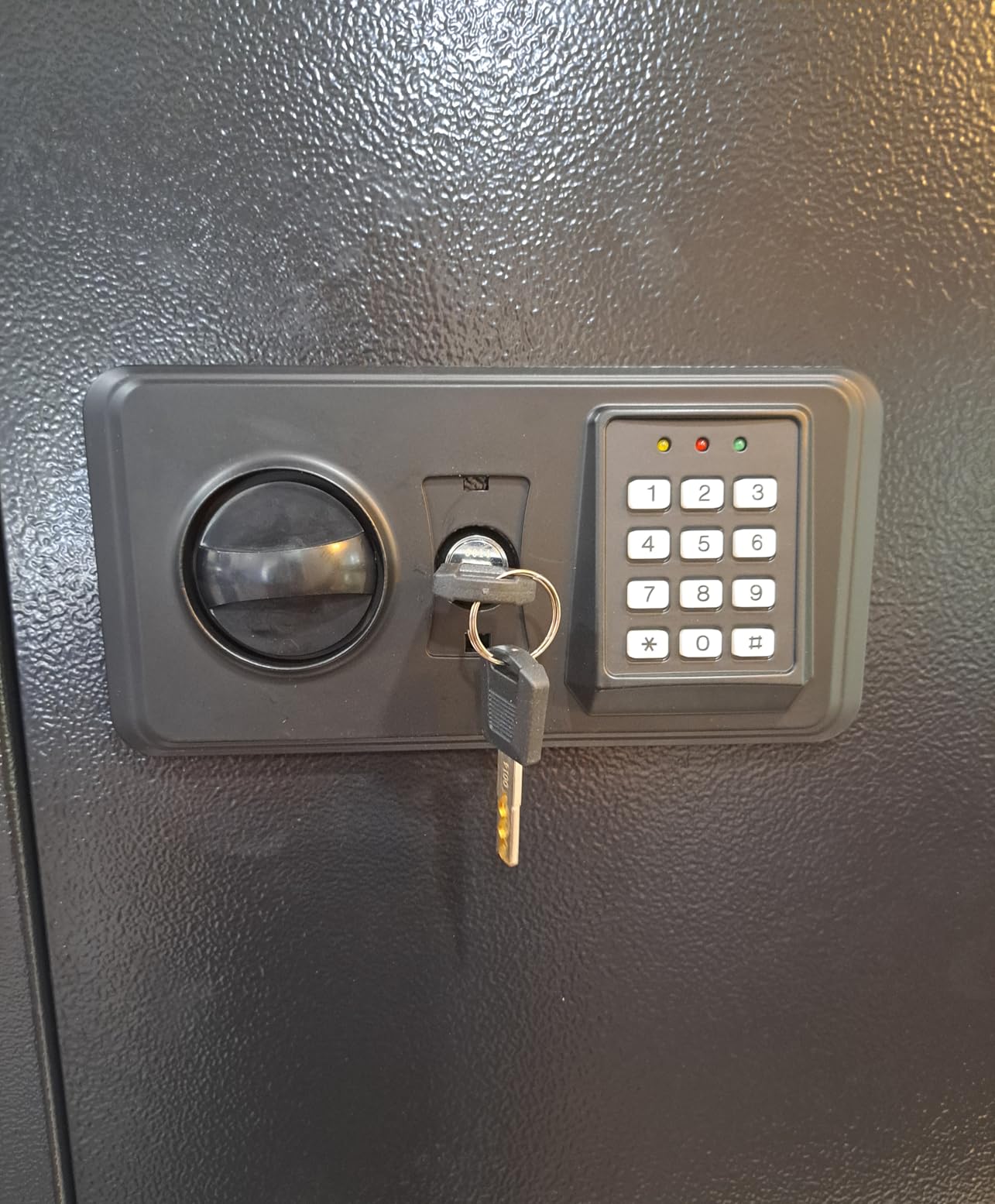
Exterior dimensions are 17.72 inches tall, 4.02 inches deep, and 14.56 inches wide, with a chamber listed at 16 inches wide, 17.7 inches tall, and 4 inches deep. That short, flat profile suits a half-wall, a closet return, or the section of wall above a credenza, and it hides behind a wide-format frame more easily than a portrait one. Plan the concealment art before the cut.
Who should skip it
Skip it if the marketing has convinced you it is fireproof. Buyers specifically question the claim, and no stated or independently verified rating is provided. At 10.66 kg it is also lighter than the larger steel safes here, and that shows in the feel. And skip it if you store anything bulky, since four inches of depth is flat-item storage only.
11. Homak WS00017001 Between The Studs Steel Wall Box — Best Budget Concealed Box
Homak First Watch Between The Studs High Security Steel Wall Safe, White
480 cubic inches
4 lb alloy steel
17.12 by 4 by 11.75 inch
Tubular key lock, water resistant
Pros
- Fits between standard 16 inch on-center studs with a full-length piano hinge
- Tubular locking mechanism resists prying better than cheap flap-style doors
- Discreet after install especially behind a mirror or picture
- Shallow 4 inch body is easy to fit in closets and tight walls
- Holds a pistol
- cash and small valuables with room to spare
Cons
- Door has no protective rim or lip and leaves a pry-bar gap at the frame
- Not a high-security safe and the door material feels soft
- No internal shelf or hooks included
- Only two keys are supplied
The Homak WS00017001 is the simplest thing in this roundup and the one we would describe most honestly. It is a 4 pound steel box with a tubular key lock, sold as a concealment box rather than a security safe, and it carries a 4.6 rating from 657 reviews for exactly that reason.
Buyers treat it as an inexpensive way to remove a pistol, a cash envelope, and a spare set of keys from a nightstand or a desk drawer, and several owners have installed more than one. It is also one of only two products here listed as water resistant.
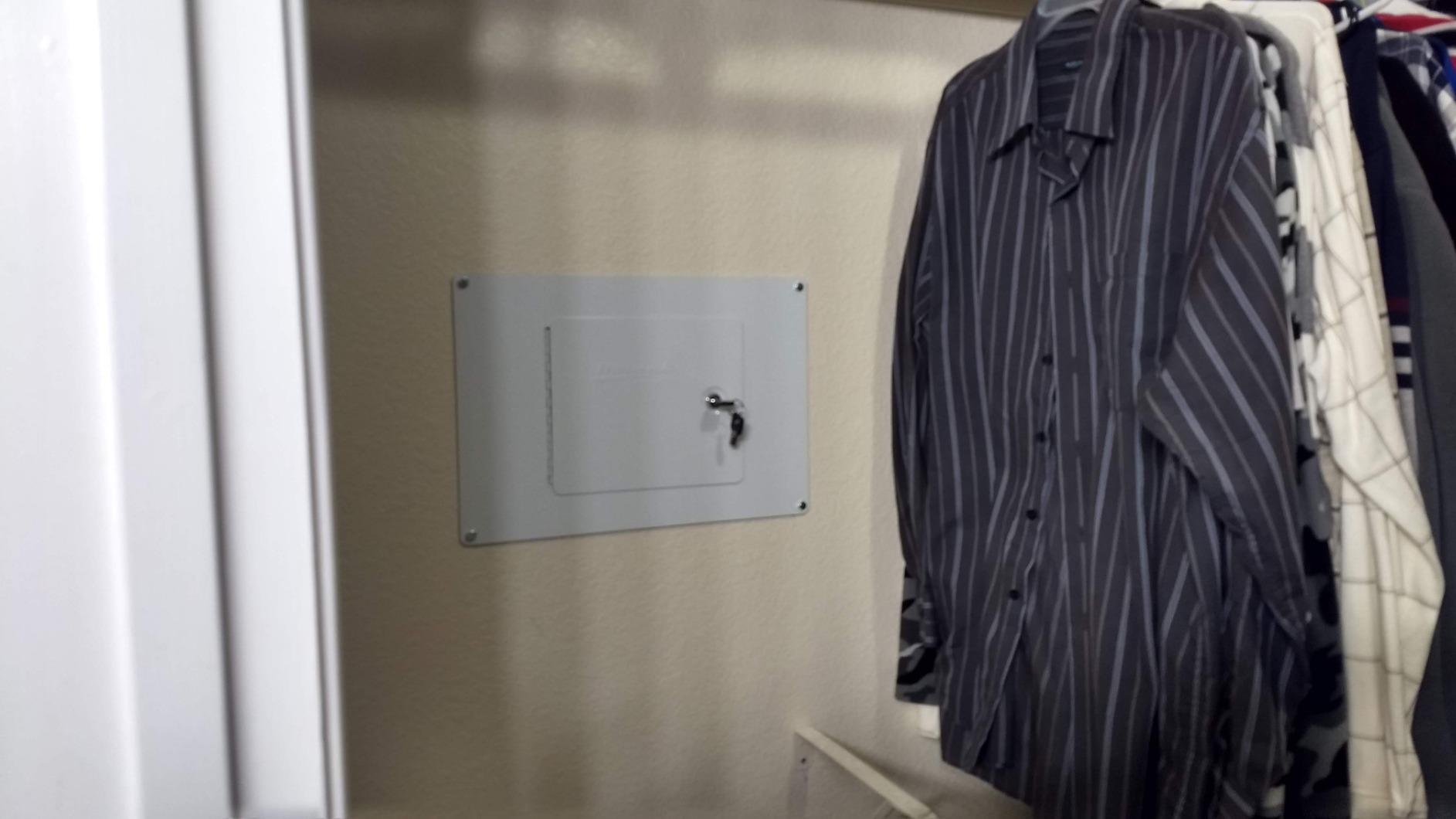
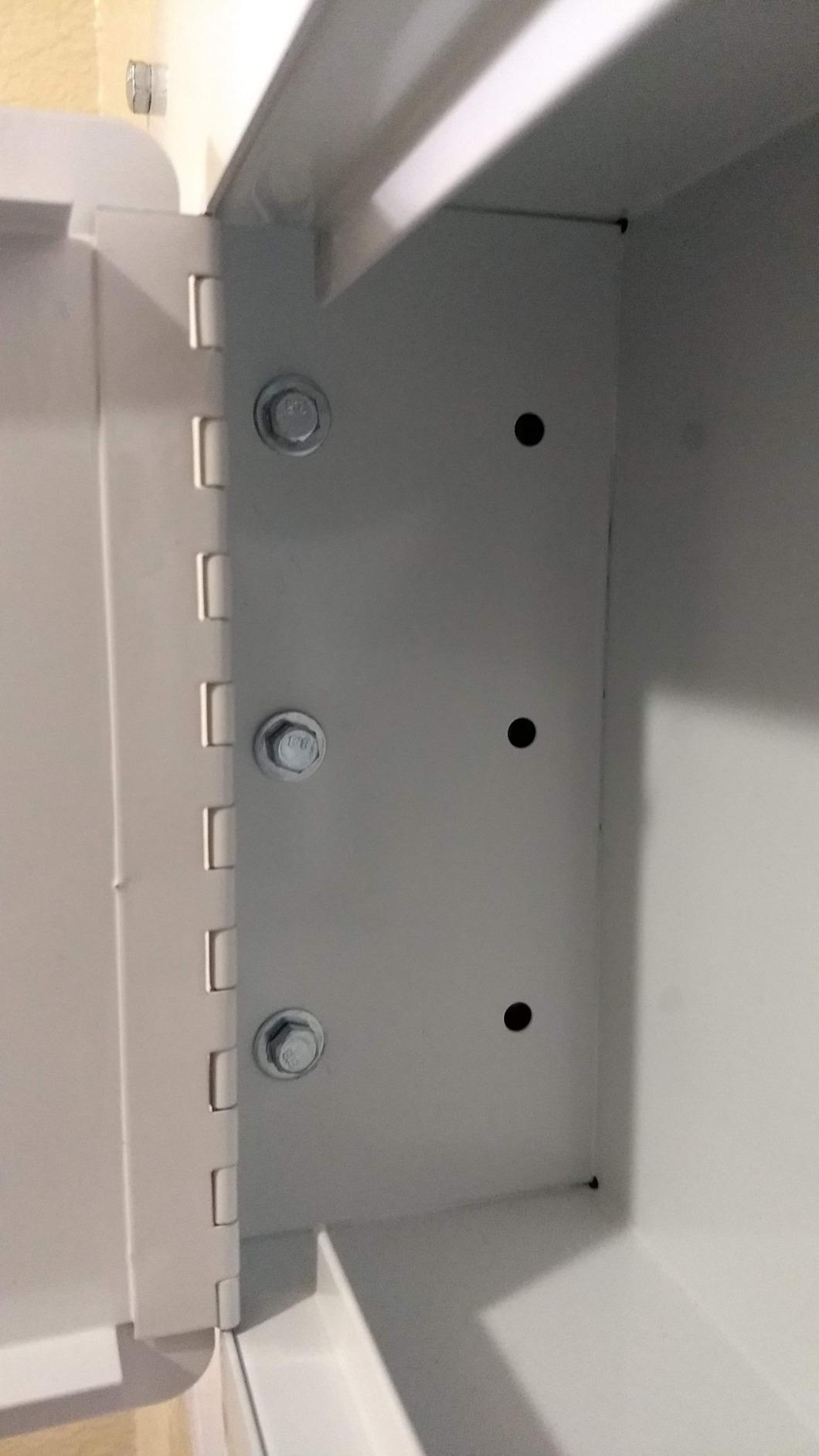
The tubular locking mechanism is a step up from the cheap flap-style doors that dominate the very bottom of this category, and a full-length piano hinge attaches the door to the frame rather than a short stub hinge. The interior is lined with black foam, and dimensions are 4 inches deep, 17.12 inches wide, and 11.75 inches tall, with a 480 cubic inch chamber.
What it fits and where it goes
At 17.12 inches wide it drops into a 16 inch on-center stud bay with room to spare, and at 11.75 inches tall it is short enough to hide behind a standard wide-format frame, a mirror, or a row of books. It is the easiest of the twelve to conceal because there is so little of it, and the 4 inch depth also suits a 2×4 wall.
Who should skip it
Skip it if you need real burglary resistance. The most repeated criticism in the reviews is the missing rim around the door opening, which leaves a pry-bar gap at the frame, and the door material feels softer than expected. This is deterrence and concealment, not resistance. Skip it if you want organized contents, since no shelf or hooks are included and only two keys ship.
12. LANGGER V LAWS0002 Biometric Wall Safe — Best for the Deepest Interior
Langger Biometric Wall Safe Between Studs, Hidden Fingerprint In‑wall Safe
5.12 inch chamber depth
14.63 kg carbon steel
15.1 by 4 by 21.8 inch
100 fingerprints plus PIN
Pros
- Fast fingerprint unlock with PIN and key backup for up to 100 prints
- Deepest interior in the group at over 5 inches for handguns and magazines
- Recessed door with two motorized deadbolts on a carbon steel body
- Silent mode available by turning the beep off
- White finish blends with trim for concealed residential installs
Cons
- Some units arrive with poorly executed spot welds that can fail during install
- Biometric reader is finicky unless the button is held 1-2 seconds
- Deadbolt screws can be overtightened at the factory
- Occasional units arrive dented or with chipped paint
The LANGGER V LAWS0002 is the deepest interior in this group, at just over 5 inches of chamber depth. For a home office that stores a handgun with magazines, or a stack of binders that will not lie flat, that depth is the entire argument.
It also accepts up to 100 fingerprints, more than any other safe here, alongside a PIN code and emergency keys. Two motorized deadbolts drive into a recessed door on a carbon steel body, and silent mode is available by turning the beep off.
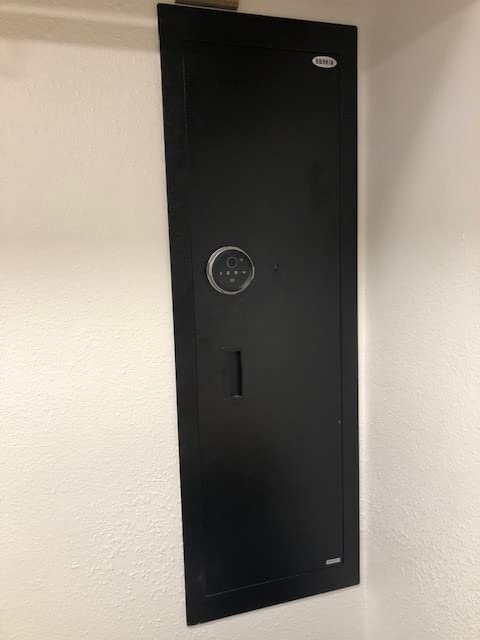
Customer service is repeatedly described as stellar and quick to resolve problems, and the white finish blends with trim, a sensible detail for a residential install where the safe has to disappear rather than announce itself.
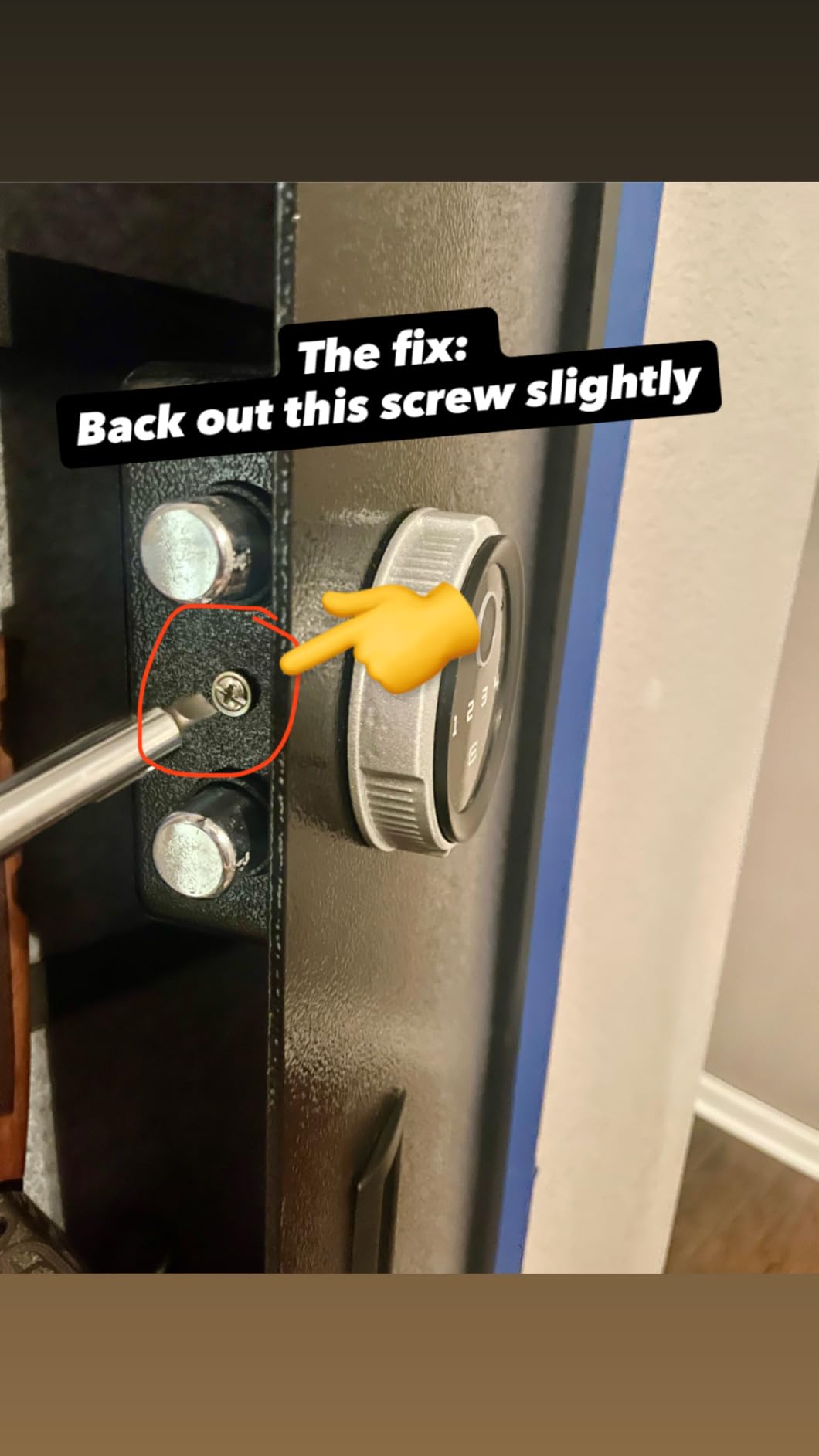
What it fits and where it goes
Exterior dimensions are 4 inches deep, 15.1 inches wide, and 21.8 inches tall, and the required wall opening is listed as 21 by 13-3/4 by 4 inches. The door is right-hinged, so plan which side it swings before you cut next to a desk return, and expect to need a full-length frame to conceal it.
Who should skip it
Skip it if a 5 inch interior is not worth the thicker wall it requires, since it will not suit a standard 2×4 partition without more work. Skip it if quality control worries you, because the complaints on record are manufacturing rather than design: spot welds that can fail during installation, a deadbolt screw tightened tight enough to stop the pins dropping, and units arriving dented or chipped. Inspect it fully before closing the wall.
How to Measure Your Wall Before You Buy
Measure before you order, not after delivery. Every return and most of the regret we found traces to a cavity that was narrower or shallower than the safe, and the whole check takes about ten minutes with a tape measure and a stud finder.
First, find your stud spacing. Studs are almost always 16 inches on center, but 24 inch on-center framing is common in older homes, in garages, and in some multi-family construction. Run a stud finder across the intended wall, or knock along the surface and listen for the solid knock. If you do not find a stud in about 16.25 inches, stop and plan for 24 inch framing.
That is the failure forum readers hit most often: buying a safe rated for 16 inch on-center studs, discovering the studs are at 24 inches, and ending up with a surface-mounted unit and no concealment at all. One of the twelve picks ships with a spacer kit that solves exactly this.
Second, measure the cavity depth. A standard 2×4 stud gives you about 3.5 inches of clear depth, which means a wall safe has to be under about 3.5 inches to sit fully flush, or you accept a door that stands slightly proud. A 2×6 stud gives you about 5.5 inches, which is the reason the deeper safes in this roundup exist.
Third, check the required rough opening, not just the safe’s own dimensions. The Protex needs an 18-1/8 by 14-1/8 inch opening for a 14 inch wide body, which is a detail that can force you to trim a stud or add blocking.
Fourth, look for obstructions. Electrical boxes, plumbing, HVAC returns, and fire blocking in the bay all reduce usable space, and you want to know before the drywall saw comes out.
Fifth, check the door swing. Swinging doors need clearance in front of the safe, and in a home office that is usually where the desk sits. Our home safe roundup covers the floor and cabinet options if swing clearance is impossible.
Understanding UL RSC and Fire Ratings
UL RSC, short for Residential Security Container, is a UL listing that means a safe survived a fixed battery of common-tool attacks under laboratory conditions. Forum readers consistently treat it as the minimum bar worth caring about, and they are right that a listing matters more than a brand name.
None of the twelve safes in this roundup carries a UL RSC listing. That is not a knock on the products; it is a fact about the category. Between-studs safes sold for home use are almost never independently certified, and the language you will read on the listing page is manufacturer copy. Treat heavy duty, high security, and burglary resistant as unverified until you see a certification number.
Fire ratings are the other place marketing runs ahead of the facts. A real fire rating states a duration, such as 30 or 60 minutes, and is certified by UL or ETL. Two of the picks here use the word fireproof in the product name and neither states an independently verified rating, and reviewers raise the same objection in both cases.
Cash is a special case. It will survive temperatures that ruin paper, but the plastic currency notes in circulation today and the ink on them can curl, smear, or fade in a long hot exposure, and the adhesive on some currency is not heat resistant. If you are protecting a large sum, a fire-rated document safe is the better answer. If you are protecting a few hundred in an envelope, a wall safe is fine.
What to do with this information: buy the wall safe for theft resistance and concealment, and buy a separate fire-rated document safe for anything you genuinely cannot afford to lose to a fire. Those are two different jobs and pretending one box does both is how people end up with ruined paperwork.
Which Lock Type Should You Choose?
Choose a mechanical key or combination lock for simplicity, a digital keypad for codes you will not have to remember, and a fingerprint reader for speed. Every option below has a failure mode, and the honest version is that the backup method matters more than the primary one.
Key and tubular locks. No batteries, nothing to fail, and the Homak’s tubular mechanism is a step up from the flap doors at the bottom of the market. The cost is that you need the key, and two keys is not much redundancy.
Digital keypad. Programmable codes, an audible lockout after repeated wrong entries, and no key to lose. The Paragon runs two programmable codes with two override keys, and the Grimtron adds silent mode so the keypad does not beep.
Biometric fingerprint. The fastest option by a wide margin, and the Viking’s 500 DPI sensor is the one reviewers single out as reading worn and older prints consistently. The failure mode is finger condition: damp, dirty, or cold fingers cause rejections, so you always want a PIN or a key behind it.
Battery management. This is where most complaints in this category actually live. A safe whose batteries die with the door shut is a locked box full of your own property. Every electronic pick here should ship with a backup method, and the best ones add a USB emergency power port, which the Grimtron and the XDeer both have.
Battery life ranges from roughly four to five months on four AA cells for the Paragon to the standard AAA cells in the XDeer. Lithium batteries are the wrong choice here for a simple reason: they are the items most often ruined in a safe, and their failure is harder to predict. Our hidden wall safe guide covers more lock options.
Where to Put a Wall Safe in a Home Office
The best spot is the one that is concealed but reachable without rearranging the furniture, and that usually means a low or mid-height wall that sits behind something you already hang. Burglars search obvious locations first and spend under six minutes inside, which is why concealment consistently outperforms raw steel thickness in a real break-in.
Five placements worth considering, in rough order of how well they work:
Behind the credenza or a low bookcase. The safe sits at 3 to 4 feet off the floor, out of the sightline from a doorway, and the furniture hides the door completely. Check that the credenza is not blocking the door swing before you cut.
Inside a built-in cabinet run. The best concealment in any office, because the cabinet face is already a flat panel waiting to be a wall. It does mean the safe only works when the cabinet is open, so keep the access fast.
Behind a wall-mounted display. Works well and looks intentional, but you need the display bracket to land on studs that flank the opening, not across it.
In a closet corner at about waist height. Easy to reach, easy to conceal behind hanging clothes, and the Homak’s 11.75 inch height suits a standard closet stud bay.
Away from the door and the window. Do not put it near an entry point. Everything a person carries in the first thirty seconds of a break-in gets checked, and that includes the wall by the door.
Plan the keypad side too. A keypad that faces the office door means someone can shoulder-surf a code from the hallway, so rotate the install if the swing allows it, and make sure the interior light is not visible from a window after dark.
One caution for renters and condo owners. A flush in-wall safe requires permanent modification of the wall, so check your lease or ask your landlord before cutting. If drilling is not allowed, a surface-mounted cabinet safe keeps the anchoring honest and you simply lose the concealment, which is the single biggest part of what you are paying for.
Installation: DIY Between Studs or Hiring a Pro
Installing a between-studs wall safe is a straightforward weekend job for someone comfortable with a drywall saw. Professional installation is worth it when the wall is load-bearing, when you are cutting into a 24 inch bay, or when the wall is finished in something other than standard drywall.
The sequence, if you are doing it yourself:
Locate the studs and mark the bay with a pencil, checking for wiring and plumbing first.
Use the manufacturer template, or trace the safe body, to outline the opening on the drywall.
Cut the opening with a drywall saw, scoring the face first to keep the paper from tearing.
Slide the body into the cavity and confirm it is plumb and level before you tighten anything.
Anchor to the studs with lag bolts or the supplied lag screws. Drywall anchors are not acceptable in this application.
Check the door swing, the keypad side, and the flange coverage before finishing.
Paint the flange, hang the art, and store the override keys somewhere off-site.
That fifth step is where most installs go wrong. Forum readers are consistent on this: drywall anchors are not acceptable, and the thin screws included with several of these safes will strip. Buy proper lag bolts and drive them into the stud, not the drywall.
Call a pro if the wall is load-bearing, if you are not sure what is inside the bay, or if the wall is plaster, lath, or masonry. A professional also matters for warranty coverage, since some manufacturers specify approved mounting methods. And if a safe is going to hold a firearm, check your local storage requirements before you pick the wall, not after.
For anyone who wants a comparison of the surface-mounted and freestanding options, our floor safe guide covers the cases where a wall is not workable.
What Not to Store in a Wall Safe
A wall safe is a dry, enclosed steel box with a limited interior, and a few common items will be damaged by the environment or by the lockout itself.
Skip lithium batteries, both loose and inside devices. They can vent, and a vented cell in a sealed box is a genuine hazard. The same goes for any battery-powered device you would not want to find swollen and dead.
Skip medication that you or anyone else might need urgently. A lockout during a health event turns a security feature into an emergency.
Skip magnetic media, hard drives, and film. Heat and humidity inside a closed box will degrade them faster than a desk drawer would.
Skip ink cartridges and fountain pen ink. Even a brief temperature swing can ruin a cartridge, and the safe that protects your deeds is not worth a ruined pen.
Be deliberate with cash. High-denomination notes are the target of choice in a targeted burglary, and heat plus time can curl plastic notes. A moderate amount in an envelope is a reasonable use. A large amount belongs in a bank or a proper rated safe, not a between-studs box.
Do store the things that are hardest to replace and hardest to prove you had: passports, deeds, birth certificates, wills, insurance policies, and a spare set of keys. That is exactly what an in-wall safe is good at.
Frequently Asked Questions
What are the best safes for an office?
For a home office, a between-studs in-wall safe is the best fit, because it takes no floor space and disappears behind artwork or a wall-mounted display. Look for 16 inch on-center stud compatibility, a door that mounts nearly flush, and a backup access method alongside whatever electronic lock it uses. The Paragon 83-DT5912 is our overall pick for documents and jewelry, and the Viking VS-52BLX is the pick when speed of fingerprint access matters most.
What is the best brand of wall mounted safe?
Brand names matter far less than certification. The single most useful trust signal in this category is an independent UL or ETL listing, because it tells you the safe was tested against a fixed battery of common tools. Most between-studs wall safes sold for home offices carry no such listing, including every model in our roundup, so read the steel thickness, the bolt diameter, and the anchoring hardware instead of the brand on the label.
What are the disadvantages of wall safes?
The main disadvantages are limited depth, limited capacity, and non-portability. A standard 2×4 wall gives roughly 3.5 inches of cavity, so most between-studs safes are under 4 inches deep and hold flat items only. Almost none carry an independent fire rating, which matters for deeds and tax records. And once drywall is closed, the safe cannot be moved, rekeyed, or removed without opening the wall back up.
What are the best fireproof safes for offices?
For genuinely fire-resistant documents you want a safe with a stated, independently certified fire rating, and you should check the duration, since 30 minutes and 2 hours are very different levels of protection. A wall safe is rarely the right answer for this, because fire insulation eats cavity depth and few in-wall models carry a verified rating. Keep a wall safe for theft and concealment, and a separate fire-rated document safe for irreplaceable paperwork.
Will cash burn in a fireproof safe?
Paper currency survives temperatures that destroy documents, but the plastic notes in circulation today and the adhesive in them are sensitive to sustained heat and can curl, smear, or fade. Cash is also the first thing anyone breaking in targets. For a modest sum in an envelope, a wall safe is fine. For a larger amount, a bank deposit or a properly rated safe is the better call.
Where is the best place to put a wall safe?
Put it low or at mid-height on a wall you already decorate, behind a credenza, a bookcase, a built-in cabinet, or a wall-mounted display. Avoid the wall by the door and the window, since those get checked first. Concealment matters more than steel thickness in a real break-in, because intruders search obvious locations and spend under six minutes inside.
What safes can be mounted between studs?
Any safe whose body is narrower than your stud bay can mount between studs, and standard 16 inch on-center framing fits most between-studs models, which are typically 14 to 16 inches wide. The catch is 24 inch on-center framing, which is common in older homes and needs either a model that ships with a spacer kit or additional blocking. Always confirm stud spacing with a stud finder before you order.
Is it better to bolt a safe to the floor or wall?
A wall safe cannot be carried off in one grab, so it wins on immobility, and its flush finish gives far better concealment than a floor safe. A floor safe wins on capacity, depth, and fire rating, and it can be relocated. For an office full of paperwork, the wall safe is usually the better answer; for a large volume of high-value items, the floor safe wins.
Final Verdict
Start by measuring your wall, because that one step decides more than the brand ever will. If you have 16 inch on-center studs and a cavity under 4 inches deep, the Paragon 83-DT5912 is the pick: 0.83 cubic feet, a 39 pound steel body, two programmable codes, and two override keys, with a wide flange that forgives a slightly crooked cut. That is our best wall safe for home offices overall.
If you want speed and solidity, the Viking VS-52BLX wins on its 500 DPI fingerprint reader and its 39 pound body with a 20mm motorized deadbolt. If your framing is at 24 inches on center, the Grimtron VT04-WE is the only safe in this roundup that fits without rebuilding the bay, and its silent mode and USB power port make it the best value on the list.
Whichever you choose, anchor it into the studs with proper lag bolts, conceal it behind something you already hang, keep at least one backup key off-site, and do not expect a wall safe to survive a fire. For the rest of the safe market, our guides to floor safes and home firearm storage cover the options this article does not.