
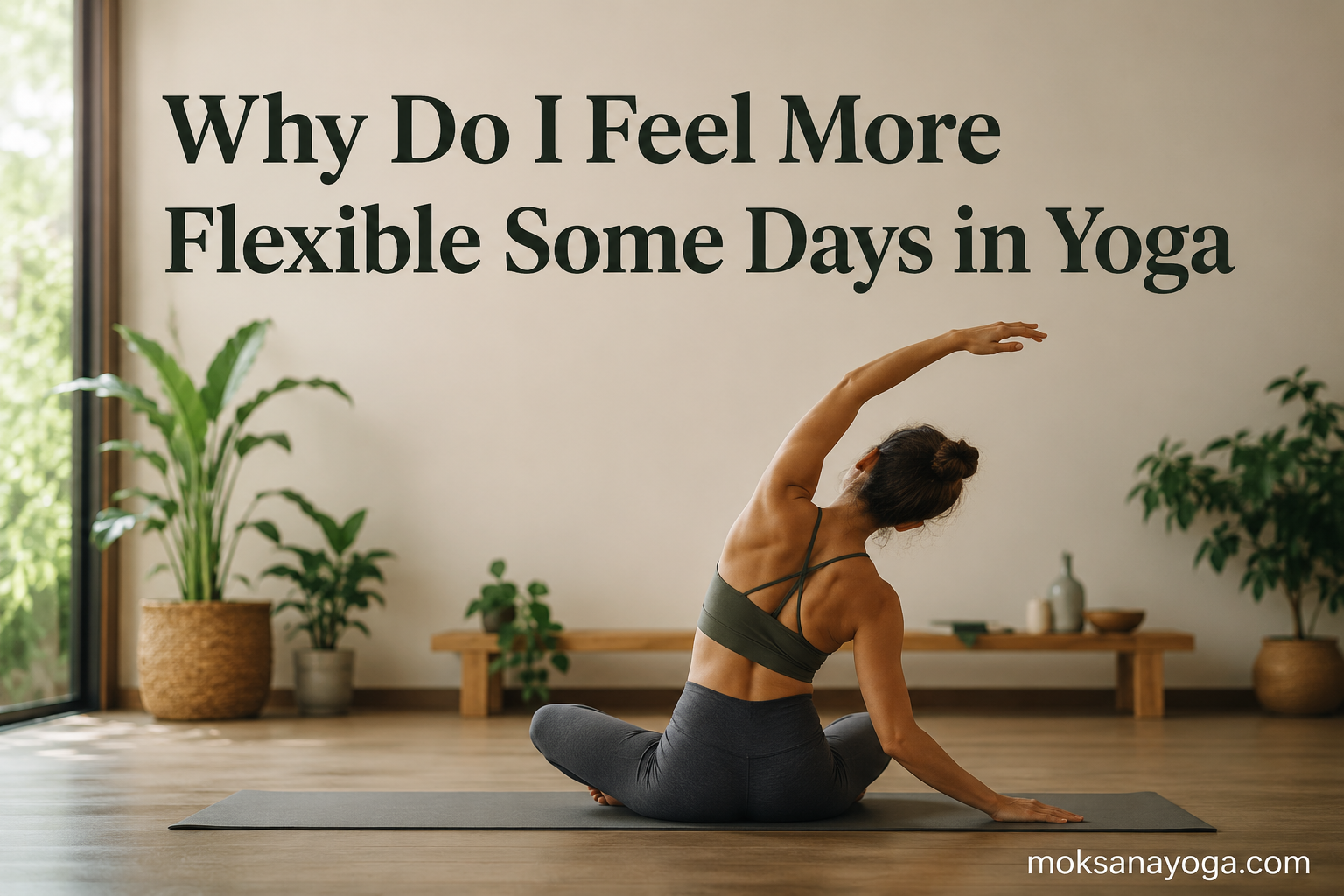
Some days you fold into a deep forward bend like your body was made of warm taffy. The next morning, you can barely touch your shins. If you have been wondering why you feel more flexible some days than others in yoga, you are not alone. This is one of the most common questions in every yoga community, from beginner classes to advanced teacher trainings.
I have practiced yoga for over a decade, and I still have days where my hamstrings feel like they are made of concrete. After talking with hundreds of students, fellow teachers, physical therapists, and digging into the research, I can tell you this: flexibility variation is completely normal. It is not a sign that you are doing something wrong.
Your day-to-day flexibility is controlled by a surprising number of factors. Your nervous system state, how well you slept last night, whether you drank enough water, what you did for exercise yesterday, and even where you are in your hormonal cycle all play a role. Once you understand what is happening inside your body, that frustration starts to melt away.
In this guide, we will break down exactly why your flexibility changes from day to day, what each factor means for your yoga practice, and what you can do to work with your body instead of against it.
Table of Contents
The Short Answer: What Causes Flexibility to Fluctuate
If you want the quick version, here it is. Your flexibility changes from day to day because of these seven key factors:
- Your nervous system state — When you feel safe and relaxed, your nervous system allows deeper stretching. When you are stressed or tense, it tightens everything up to protect you.
- Muscle temperature — Warm muscles stretch further with less resistance. Cold muscles are stiff and resistant to range of motion changes.
- Fascia hydration — Your connective tissue needs water to stay pliable. Even mild dehydration makes your fascia sticky and stiff.
- Sleep quality and recovery — Poor sleep increases muscle tension and reduces your body’s ability to recover, both of which tighten your range of motion.
- Previous day’s activity — A heavy leg day, a long run, or even prolonged sitting yesterday means tighter muscles today.
- Hormonal fluctuations — For women, menstrual cycle phases directly affect joint laxity and muscle tension through hormones like relaxin and estrogen.
- Time of day — Most people are stiffer in the morning and more flexible in the late afternoon or evening due to movement accumulation and body temperature changes.
None of these factors work in isolation. They stack on top of each other, which is why some days everything lines up perfectly and other days nothing does. Let us look at each factor in detail.
Your Nervous System Is the Gatekeeper of Flexibility
If there is one thing I want you to take away from this article, it is this: your nervous system controls your flexibility more than your muscles do.
This surprises a lot of people. We tend to think about stretching as a mechanical process, like pulling taffy or stretching a rubber band. But your muscles are not passive elastic bands. They are controlled by a sophisticated sensory system that constantly monitors tension and decides how far you are allowed to go.
Inside every muscle, you have tiny sensors called muscle spindles. Their job is to detect when a muscle is being stretched too far or too fast. When they sense danger, they trigger what is called the stretch reflex. This is an automatic contraction that stops you from going deeper into a pose. It is your body’s emergency brake system.
Here is where it gets interesting. Your stretch reflex threshold changes based on your mental and emotional state. When your nervous system is in sympathetic mode (fight or flight), your muscle spindles become hypersensitive. They fire off contraction signals at the slightest stretch. This is why you feel tight and stiff when you are stressed, anxious, or rushing to class.
When your nervous system shifts into parasympathetic mode (rest and digest), everything changes. Your muscle spindles relax their vigilance. Your stretch reflex threshold increases. You can suddenly go deeper into poses without any extra warming up. This is why yoga emphasizes breathing so heavily.
Slow, deep breathing directly stimulates your vagus nerve, which activates the parasympathetic nervous system. Every long exhale you take during a yoga class is literally telling your nervous system that it is safe to let go. This is why you often feel much more flexible at the end of a class than at the beginning. Your muscles have not actually gotten longer. Your nervous system has just given you permission to go deeper.
This also explains why the same yoga sequence can feel completely different on different days. If you arrive at your mat already in a parasympathetic state (calm, rested, unhurried), you will feel flexible. If you arrive in a sympathetic state (stressed from work, running late, anxious), the exact same sequence will feel stiff and frustrating.
Why Do I Feel More Flexible Some Days Than Others in Yoga: Muscle Temperature
Muscle temperature plays a massive role in your day-to-day flexibility, and it is one of the most overlooked factors by yoga practitioners.
Your muscles and connective tissues contain a protein called collagen. Collagen behaves a bit like plastic. When it is cold, it is rigid and brittle. When it is warm, it becomes pliable and stretchy. This is not a metaphor. It is actual material science happening inside your body.
When your core body temperature rises by even one or two degrees, your collagen-rich tissues become significantly more extensible. Your muscles offer less passive resistance to stretching. Your tendons and ligaments become more compliant. The overall result is a noticeable increase in range of motion.
This is why a proper warm-up matters so much in yoga. It is also why you feel incredibly stiff in a 6 AM class but loose and open in a 6 PM class. By evening, you have been moving around all day. Your body temperature is higher, your tissues are warmed up, and your nervous system has settled into its rhythm.
On cold mornings, your body temperature is at its lowest after a night of sleep. Your muscles have been still for hours. Your fascia has settled into a shortened, compressed state. Trying to do deep stretches right out of bed is like trying to bend a cold plastic ruler. It is not just uncomfortable. It is also when you are most likely to strain something.
If you practice morning yoga, give your body 10 to 15 minutes of gentle movement before attempting deep stretches. Cat-cow, gentle spinal twists, easy lunges, and joint rotations all raise your core temperature gradually. You will be amazed at the difference this makes.
Fascia Hydration: The Hidden Factor in Your Range of Motion
Fascia is the web of connective tissue that wraps around every muscle, organ, bone, and nerve in your body. Think of it as a full-body wetsuit that holds everything together. When it is healthy, fascia is hydrated, slippery, and glides smoothly as you move.
When fascia becomes dehydrated, it turns sticky and dense. Layers of connective tissue that should slide past each other start to adhere together. This creates what movement specialists call fascial restrictions, and they can dramatically reduce your range of motion without you even realizing it.
Fascia hydration is different from simply drinking water, although water intake is part of it. Fascia gets hydrated through movement. When you move in varied ways, the compression and decompression of tissues acts like a sponge, squeezing out old fluid and drawing in fresh, hydrated fluid. This is why movement variety is so important for maintaining flexibility.
If you sit at a desk for eight hours and then go to a yoga class, your fascia has been compressed in the same position all day. It is dehydrated in the areas that were compressed and overworked in the areas that were strained. Your yoga practice will feel stiff and resistant no matter how good your warm-up is.
Signs that your fascia needs attention include persistent tightness that does not respond to stretching, a feeling of stickiness or resistance when you move, and areas that feel dense or thick under the skin. Foam rolling, self-massage, and varied movement patterns all help rehydrate fascia over time.
Drinking enough water throughout the day also matters. If you are even mildly dehydrated, your fascia loses its fluid content and becomes less pliable. Aim for consistent water intake rather than chugging a bottle right before class.
How Sleep and Recovery Affect Your Yoga Flexibility
No competitor article I have seen covers this topic, which is surprising because it is one of the most powerful factors affecting day-to-day flexibility. Reddit users mention it constantly, but there is no comprehensive resource explaining the connection.
Here is what happens. During deep sleep, your body releases growth hormone, which is essential for tissue repair and muscle recovery. Your muscles rebuild microtears from exercise. Your fascia repairs and rehydrates. Your nervous system processes and releases stress from the day.
When you get poor sleep, all of this gets disrupted. Your cortisol levels stay elevated, which increases muscle tension and promotes fluid retention. Your growth hormone production drops, meaning your tissues do not fully repair from the previous day’s activity. Your nervous system stays in a low-grade sympathetic state, keeping your stretch reflex on high alert.
The result is a body that feels tight, heavy, and resistant on the mat. You might blame your yoga practice or think you are losing flexibility, when really you just did not sleep well the night before.
I have tracked my own sleep and flexibility patterns for years, and the correlation is striking. After a night of 8 hours of quality sleep, my forward fold is noticeably deeper. After a night of 5 hours of broken sleep, I feel like I have lost months of progress. The difference is that dramatic.
Rest days matter just as much. If you practice intense yoga every single day without giving your body time to recover, you accumulate fatigue. Your muscles stay inflamed. Your fascia does not have time to rehydrate. Your nervous system never fully downshifts into parasympathetic mode. Over time, this actually reduces your flexibility rather than improving it.
This is why experienced flexibility trainers recommend 1 to 2 full rest days per week from intense stretching. Your body needs recovery time to integrate the changes you are asking it to make. Stretching every single day at maximum intensity is like lifting weights every single day without rest. It backfires.
Your Hormonal Cycle and Flexibility
If you are a woman, your menstrual cycle has a direct and measurable effect on your flexibility. This is one of the biggest content gaps in the yoga flexibility space. Almost no one talks about it, and it affects half of all practitioners.
Throughout your cycle, levels of estrogen, progesterone, and a hormone called relaxin fluctuate dramatically. These hormones affect your ligaments, joint stability, and muscle tension in ways that can make you feel noticeably more or less flexible on different days.
During the follicular phase (roughly days 1 to 14 of your cycle, starting with the first day of your period), estrogen levels rise. Estrogen tends to increase collagen synthesis and tissue elasticity. Many women report feeling stronger and more flexible during this phase, especially in the days leading up to ovulation.
Around ovulation, relaxin levels peak. Relaxin does exactly what its name suggests. It relaxes ligaments and connective tissue. This is the time in your cycle when you are most likely to feel unusually flexible. Some women find they can achieve deeper stretches and more advanced poses during this window.
During the luteal phase (roughly days 15 to 28), progesterone rises and then falls if pregnancy does not occur. Progesterone can increase water retention, which may make tissues feel puffy and stiff. Many women report feeling tighter and less flexible in the days before their period.
None of this means you should avoid yoga during certain phases. It just means that expecting the same level of flexibility every single day is unrealistic if you have a hormonal cycle. Your body is doing exactly what it is supposed to do. Working with these changes rather than fighting them is the key to a sustainable practice.
If you are pregnant or postpartum, relaxin levels are dramatically elevated, which increases joint laxity significantly. This can make you feel very flexible, but it also means you need to be careful not to overstretch. Your ligaments are more vulnerable to injury during this time.
Time of Day: Morning Yoga vs Evening Yoga Flexibility
Have you ever noticed that your evening yoga practice feels completely different from your morning practice? This is not in your head. There are real physiological reasons why time of day affects your flexibility.
In the morning, your body has been still for 7 to 9 hours. Your intervertebral discs have reabsorbed fluid overnight and are plumped up, which actually reduces spinal flexibility. Your core body temperature is at its lowest point of the day. Your fascia has compressed into whatever sleeping position you held all night.
As the day progresses, your body temperature naturally rises. You accumulate movement, which warms up your tissues and rehydrates your fascia. Your nervous system settles into a more familiar, relaxed rhythm. By late afternoon and early evening, most people are at their most flexible.
This does not mean morning yoga is bad. In fact, practicing in the morning has its own benefits, including setting a positive tone for the day and building consistency. It just means you need to adjust your expectations. A morning practice will naturally feel tighter than an evening practice, and that is perfectly normal.
If you want to improve your morning flexibility, focus on gentle mobility work rather than deep stretching. Save your deepest stretches for later in the day when your body is naturally warmer and more prepared.
How Yesterday’s Workout Affects Today’s Yoga Practice
This is something Reddit users talk about constantly, yet almost no yoga article addresses it systematically. What you did yesterday has a direct impact on how flexible you feel today.
If you did a heavy leg workout yesterday, your hamstrings, quads, and hip flexors are likely carrying microtrauma and inflammation today. This is called delayed onset muscle soreness (DOMS), and it typically peaks 24 to 48 hours after exercise. During this window, affected muscles feel tight, tender, and resistant to stretching.
This does not mean you should avoid yoga after a workout. Gentle, active stretching can actually help with recovery by promoting blood flow and reducing muscle tension. But you should not expect to hit your deepest stretches when your muscles are in repair mode.
The type of activity matters too. Running tends to tighten hamstrings and calves. Weightlifting tightens the muscles you worked most heavily. Prolonged sitting tightens hip flexors and shortens the front of the body. Even standing all day can affect your calf and lower back flexibility.
If you track your workouts alongside your yoga practice, you will start to see patterns. You might find that your flexibility dips the day after a run but rebounds two days later. Or that a rest day before yoga leads to your best flexibility. Once you understand these patterns, you can plan your practice more intelligently.
Genetics, Anatomy, and What You Can Actually Control
Let us be honest about something that most yoga articles avoid. Some of your flexibility is determined by genetics and bone structure, and no amount of stretching will change it.
Your bone shape determines how far you can go in certain poses. If you have deep hip sockets, you will never achieve certain external rotations that come easily to someone with shallow sockets. This is not a flexibility problem. It is a structural reality, and pushing past it can cause joint damage.
Connective tissue elasticity is also partly genetic. Some people are born with naturally more elastic collagen. This is why some people can achieve full splits after a few months of practice while others work for years and never get there. It is not about effort. It is about tissue properties.
What you can control is your relative flexibility. You can improve from wherever your starting point is. You can build consistency in your practice. You can learn to work with your nervous system instead of fighting it. You can prioritize sleep, hydration, and smart recovery. All of these things will help you reach your personal best, even if your personal best looks different from someone else’s.
Understanding your anatomical limitations is actually liberating. Once you stop comparing yourself to the person next to you in class, you can focus on what matters: your own progress, your own body, and your own experience on the mat.
Practical Tips for More Consistent Flexibility in Your Yoga Practice
Now that you understand why your flexibility varies, here are some practical strategies to help you work with your body and build a more consistent, compassionate yoga practice.
1. Warm up properly before deep stretching. Spend at least 10 minutes on gentle, full-body movement before attempting deep poses. Cat-cow, sun salutations at a slow pace, joint circles, and easy lunges all raise your core temperature and prepare your tissues. Never stretch cold, especially in the morning.
2. Use your breath to shift your nervous system. Long, slow exhales (4 to 6 seconds or longer) stimulate your vagus nerve and activate your parasympathetic nervous system. Before you try to go deeper into a pose, take 3 to 5 slow breaths with extended exhales. You will feel your body soften and release.
3. Stay hydrated throughout the day. Fascia hydration depends on consistent water intake, not a single bottle before class. Aim for steady hydration from morning to evening. If you practice hot yoga, you need even more water to replace what you lose through sweat.
4. Prioritize sleep like it is part of your practice. Treat 7 to 9 hours of quality sleep as a non-negotiable part of your flexibility training. Your body does its repair and recovery work during deep sleep. Without it, you are fighting an uphill battle every time you step on the mat.
5. Practice consistently rather than intensely. Fifteen minutes of gentle yoga every day will improve your flexibility more than one intense two-hour session per week. Consistency builds nervous system trust. It keeps your fascia hydrated. It maintains tissue temperature adaptations. The Reddit community echoes this over and over: consistency beats intensity every time.
6. Take rest days seriously. Your body needs recovery time to integrate the changes you are asking it to make. Schedule 1 to 2 full rest days per week from intense stretching. On rest days, gentle walking or restorative yoga is fine, but give your deep stretch tissues time to repair.
7. Track your patterns. Start a simple journal noting how flexible you feel each day along with relevant factors: how you slept, what you did yesterday, where you are in your cycle, what time you practiced. After a few weeks, patterns will emerge. You will learn which factors affect your body most and can adjust your practice accordingly.
8. Stop comparing yourself to others. This might be the hardest tip to follow, but it is the most important. The person next to you in class may have different genetics, different bone structure, years more practice, or simply be at a different point in their recovery cycle. Your only meaningful comparison is to yourself, and even that should be done with compassion.
FAQs
Why am I more flexible some days than others?
Your flexibility fluctuates day to day because of changes in your nervous system state, muscle temperature, fascia hydration, sleep quality, previous day’s activity, hormonal fluctuations, and time of day. When your nervous system is relaxed, your muscles are warm, and your fascia is hydrated, you feel more flexible. When you are stressed, cold, dehydrated, or sleep-deprived, your flexibility decreases.
How long does it take for yoga to make you more flexible?
Most people notice measurable flexibility improvements within 4 to 8 weeks of consistent yoga practice (3 to 5 sessions per week). Significant gains typically appear within 3 to 6 months. However, progress is not linear. You will experience days or weeks where flexibility seems to plateau or even decrease, which is completely normal and reflects the factors discussed in this article.
Does yoga actually make you more flexible?
Yes, yoga does make you more flexible. Regular yoga practice improves flexibility through multiple mechanisms: it trains your nervous system to tolerate deeper stretches, it keeps your fascia hydrated and pliable, it builds active range of motion through controlled movement, and it improves your body awareness so you can safely explore your edge. Research consistently shows that regular yoga practitioners have greater range of motion than non-practitioners.
Are some people naturally more flexible?
Yes, natural flexibility is influenced by genetics, bone structure, connective tissue elasticity, and age. Some people are born with shallower joint sockets, more elastic collagen, or naturally lower muscle tone that makes stretching easier. However, everyone can improve their relative flexibility regardless of their starting point. Your genetic baseline determines your ceiling, but most people never reach their true flexibility potential because of inconsistent practice.
Embracing the Natural Rhythm of Your Body
If you take one thing from this article, let it be this: feeling more flexible some days than others in yoga is completely normal. It is not a sign of failure, regression, or bad practice. It is your body responding to a complex web of physiological factors that change every single day.
Your flexibility is a living, breathing expression of everything happening in your body and mind. How you slept, what you ate, how you moved yesterday, how stressed you feel today, where you are in your cycle, what time it is, and even the temperature of the room all contribute to how open your body feels on the mat.
Instead of fighting this variation, learn to work with it. Some days your body wants to go deep. Other days it wants to rest. Both are valid. Both are productive. The most flexible thing you can do as a yoga practitioner is to meet your body where it is, every single day, without judgment.
Show up consistently. Breathe deeply. Warm up properly. Stay hydrated. Sleep well. And trust that your body knows what it is doing, even on the days when it feels like you have never done yoga before. Understanding why you feel more flexible some days than others in yoga is the first step toward building a practice that lasts a lifetime.