
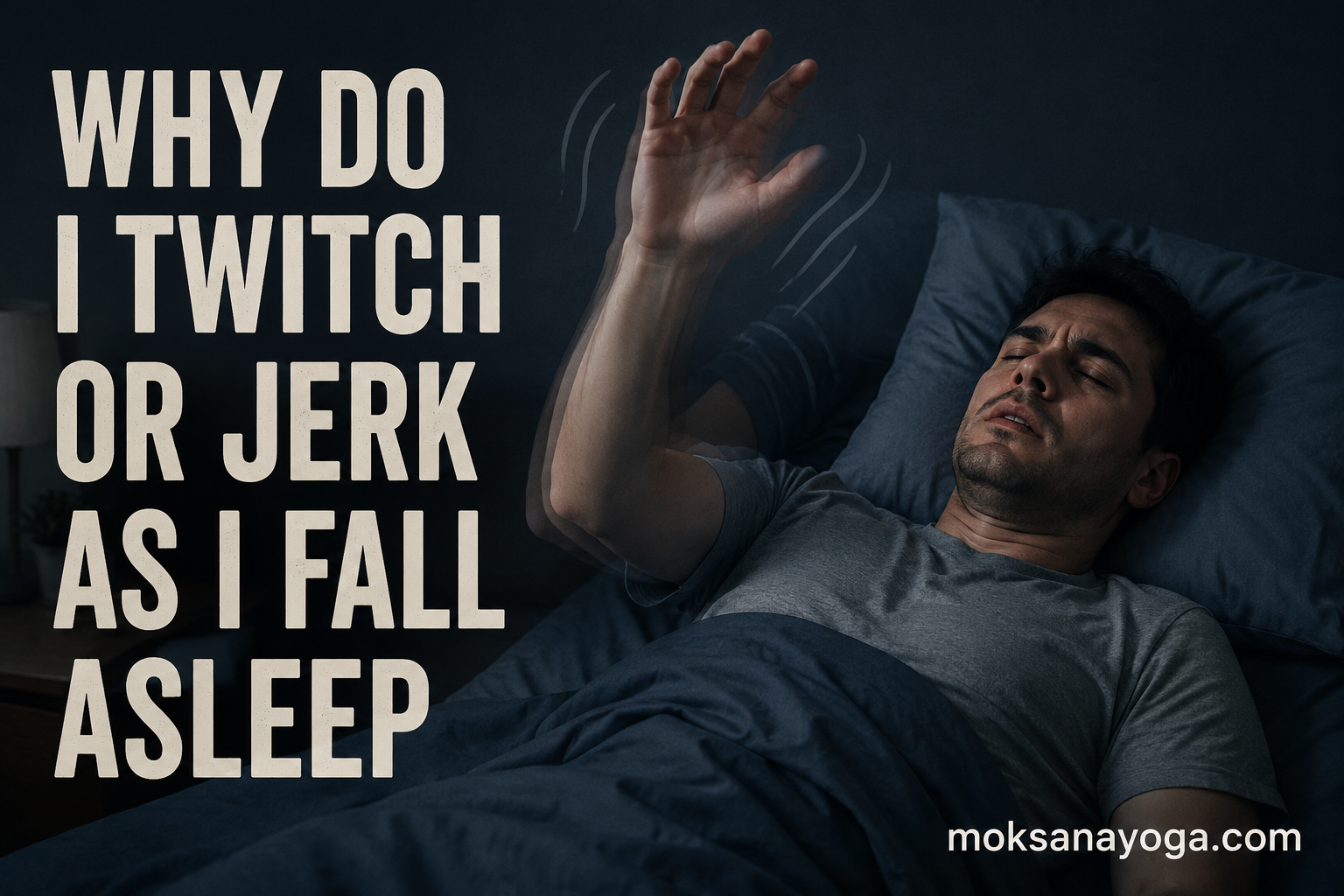
You are drifting off to sleep, finally relaxing after a long day, when suddenly your entire body jolts you wide awake. Your heart races. Maybe you felt like you were falling off a cliff, or maybe your leg just kicked the sheets on its own. If this sounds familiar, you are far from alone. Up to 70% of people experience this exact phenomenon at some point in their lives.
The experience is called a hypnic jerk, and it is one of the most common sleep-related phenomena humans experience. If you have been wondering why do I twitch or jerk as I fall asleep, the short answer is that your nervous system is going through a transition from wakefulness to sleep, and sometimes that handoff does not go smoothly. A brief misfire between nerves triggers a sudden muscle contraction that startles you awake.
Our team at Moksana Yoga has spent years working with students who struggle with sleep, anxiety, and the frustrating cycle of nighttime twitching. We have seen firsthand how understanding what is happening in your body can transform fear into relief. Once you know these jerks are normal and learn a few practical strategies, bedtime stops feeling like a battleground.
In this guide, we will walk you through exactly what hypnic jerks are, why they happen, what they feel like, and how to reduce their frequency. We will also share yoga and mind-body practices that no other sleep resource talks about, because calming your nervous system is one of the most effective ways to calm those nighttime jolts.
Table of Contents
Key Takeaways
Before we get into the details, here are the most important things to know about why you twitch or jerk as you fall asleep:
- A hypnic jerk (also called a hypnagogic jerk or sleep start) is a sudden, involuntary muscle twitch that happens as you transition from wakefulness to sleep.
- Up to 70% of people experience hypnic jerks at some point, making them completely normal and harmless in the vast majority of cases.
- Common triggers include sleep deprivation, caffeine, stress, anxiety, vigorous evening exercise, and irregular sleep schedules.
- Hypnic jerks are not seizures, they are not related to heart problems, and they cannot kill you.
- Most people can reduce hypnic jerks through better sleep hygiene, stress management, and mind-body practices like yoga and meditation.
- See a doctor only if jerks are frequent enough to cause insomnia, if they happen during the day, or if they are accompanied by other concerning symptoms.
Now let us explore each of these points in depth so you can understand exactly what is happening in your body and what you can do about it.
What Is a Hypnic Jerk (Sleep Start)?
A hypnic jerk is a brief, sudden, involuntary contraction of one or more muscles that occurs just as you are falling asleep. The term comes from the Greek word “hypnos” meaning sleep, and these jerks are also known as hypnagogic jerks, sleep starts, or night starts. In medical terminology, they fall under the broader category of sleep myoclonus, which refers to any quick, involuntary muscle movement during sleep onset.
Unlike the twitches you might get during REM sleep, which are tied to dreaming, hypnic jerks happen specifically during the transition from wakefulness to Stage 1 NREM sleep. This is the lightest stage of sleep, the brief window where your brain is just beginning to power down. Most people pass through this stage so quickly that they never notice it, but a hypnic jerk can jolt you right back to full wakefulness in a fraction of a second.
What makes hypnic jerks so startling is not usually the physical movement itself. It is the sensation that often accompanies it. Many people describe a vivid feeling of falling, a flash of light, a loud banging sound, or even a brief hypnagogic hallucination. These sensory experiences are part of what makes the jerk feel so dramatic and alarming, even though the actual muscle contraction is harmless.
Hypnic jerks can affect any part of the body, but they most commonly involve the legs, arms, or the whole body at once. Some people experience them as a small finger twitch, while others feel like their entire body just jumped a foot off the mattress. Both are normal variations of the same phenomenon.
Why Does Your Body Twitch as You Fall Asleep? The Science Explained
To understand why your body twitches as you fall asleep, it helps to picture what is happening in your brain during the sleep transition. When you are awake, your brain is in active mode, with nerves constantly firing to keep your muscles engaged and your body ready to respond. As you fall asleep, your nervous system needs to shift into a completely different mode where your muscles relax and your brain waves slow down.
This handoff does not always happen smoothly. As your brain begins to transition from wakefulness to sleep, the reticular formation, a network of nerves in your brainstem, starts to power down your muscle tone. At the same time, your brain waves shift from fast beta waves to slower alpha waves and then to theta waves characteristic of Stage 1 sleep. On an EEG, which measures brain electrical activity, you can sometimes see specific patterns called vertex sharp waves during this transition.
Sometimes during this shift, the nerves that control muscle movement misfire. Think of it like a car shifting gears, where occasionally the engine revs unexpectedly before settling into the new gear. Your brain sends a signal to your muscles to contract, even though no contraction was needed. The result is a sudden, brief twitch that can affect part or all of your body.
One popular theory suggests this misfire happens because your brain misinterprets the relaxation of your muscles as falling. As your body lets go of tension and your muscles go limp, your brain might briefly think you are in freefall and trigger a startle reflex to catch yourself. This would explain why the falling sensation is so commonly associated with hypnic jerks.
Another theory points to the evolutionary origin of this reflex. Some researchers believe hypnic jerks are a remnant from our primate ancestors, who slept in trees. A sudden relaxation of muscles could be dangerous if you were perched on a branch, so the brain developed a quick-startle mechanism to prevent falls. Whether or not this theory is correct, it is a fascinating way to think about why your body might be hardwired to jolt you awake as your muscles let go.
What Causes Hypnic Jerks? 7 Common Triggers
While hypnic jerks can happen to anyone at any time, certain factors make them much more likely. If you are experiencing frequent or intense sleep starts, one or more of these triggers is probably involved.
1. Sleep Deprivation and Sleep Debt
This is the number one cause of hypnic jerks. When you are sleep-deprived, your body is under physical stress, and your nervous system is more likely to misfire during the sleep transition. The more exhausted you are, the harder and faster your brain tries to plunge into deep sleep, which increases the chance of a turbulent transition. Many Reddit users in sleep forums report that their hypnic jerks become constant after a single night of insomnia, creating a vicious cycle where jerks prevent sleep and sleep deprivation causes more jerks.
2. Caffeine and Stimulants
Caffeine is a central nervous system stimulant that keeps your brain in a state of heightened alertness. If you consume caffeine in the afternoon or evening, those stimulant effects can still be active when you try to fall asleep hours later. Your nervous system is partially wired when it should be winding down, making muscle misfires more likely. Nicotine has a similar effect, as does any stimulant medication taken too close to bedtime.
3. Stress and Anxiety
One of the strongest patterns our team has observed, both in yoga students and in forum discussions, is the link between stress, anxiety, and hypnic jerks. When you are anxious, your body produces elevated levels of cortisol and adrenaline, keeping your nervous system in fight-or-flight mode. Your muscles stay tense, and when they finally try to relax at bedtime, the contrast is jarring. Users on Reddit frequently connect their hypnic jerks to CPTSD, generalized anxiety, and periods of high stress at work or in relationships.
4. Vigorous Evening Exercise
Exercise is excellent for sleep, but timing matters. If you do intense physical activity within two to three hours of bedtime, your body temperature is elevated, your heart rate is still elevated, and your nervous system is revved up. This makes the transition to sleep more abrupt and increases the likelihood of muscle misfires. Gentle stretching or yoga is fine, but save the high-intensity workouts for earlier in the day.
5. Alcohol Before Bed
Many people think alcohol helps them sleep because it makes them feel drowsy. In reality, alcohol disrupts sleep architecture and can intensify hypnic jerks. Alcohol alters the normal progression through sleep stages and can cause your body to skip the gentle transition into Stage 1 sleep, making the kind of abrupt shift that triggers jerks more likely.
6. Irregular Sleep Schedule
Your body operates on a circadian rhythm, an internal clock that regulates when you feel sleepy and when you feel alert. If your bedtime shifts dramatically from day to day, your body never knows when to start the wind-down process. This confusion can make the sleep transition rougher and more prone to hypnic jerks. Shift workers and people who travel across time zones frequently report this issue.
7. Certain Medications
Some medications, particularly certain antidepressants like SSRIs, have been linked to increased hypnic jerks. A 2023 study published in the National Library of Medicine examined the connection between hypnic jerks, major depressive disorder, and antidepressant use, finding that these medications can intensify the phenomenon in some patients. If you started a new medication and noticed an increase in sleep jerks, talk to your doctor about whether there might be a connection.
What Does a Hypnic Jerk Feel Like?
Hypnic jerks are highly variable, and the way they feel can differ dramatically from person to person and even from night to night. Understanding the range of experiences can help you identify whether what you are feeling is indeed a hypnic jerk.
The most classic description is a sudden jolt or electric shock sensation that snaps you from the edge of sleep back to full alertness. Many people describe it as feeling like they were falling and their body suddenly tried to catch itself. This falling sensation is often accompanied by a vivid mental image, such as tripping on a stair, slipping off a ledge, or missing a step on a staircase.
Some people experience the jerk as a single sharp movement in one limb. Your leg might suddenly kick out, your arm might jerk upward, or your hand might twitch. These localized jerks are usually less dramatic than full-body jolts but can still be startling, especially if they happen repeatedly.
Sensory experiences often accompany the physical jerk. Some people report seeing a flash of light behind their eyelids, hearing a loud bang or snapping sound, or feeling a brief tingling or buzzing sensation. These are called hypnagogic hallucinations, and they are a normal part of the experience, not a sign of any problem.
After the jerk, you may notice your heart is racing. This is simply your body’s natural startle response, the same surge of adrenaline you would feel if someone startled you while awake. Your heart rate should return to normal within a minute or two. Taking a few slow, deep breaths can help calm this response more quickly.
For some people, hypnic jerks happen just once or twice a year. For others, they happen every night, sometimes multiple times in a row before sleep finally arrives. The frequency can vary based on stress levels, sleep quality, and the triggers we discussed earlier.
Are Hypnic Jerks Normal and Harmless?
Yes, hypnic jerks are completely normal and harmless in the vast majority of cases. They are a recognized physiological phenomenon, not a disease or disorder. The fact that up to 70% of people experience them at least occasionally should be reassuring on its own.
Hypnic jerks are not a sign of any underlying health problem. They are not seizures, they are not related to your heart, and they cannot harm you. The muscle contraction itself is brief and painless, and the startle response that follows is just your body’s normal reaction to an unexpected stimulus.
Can you die from a hypnic jerk? Absolutely not. There is zero recorded evidence of anyone dying from a sleep start. The only rare risk is physical injury if a particularly violent jerk causes you to hit something, but even this is extremely uncommon.
The real problem with hypnic jerks is not physical danger but sleep disruption. If they happen frequently enough, they can delay sleep onset, contribute to insomnia, and create anxiety about going to bed. This is the cycle worth addressing, and we will cover practical strategies for breaking it later in this article.
Hypnic jerks become a concern only when they are extremely frequent (every night, multiple times), when they are intense enough to cause injury, or when they are accompanied by other symptoms like daytime muscle jerks, confusion, or loss of consciousness. In those cases, it is worth speaking with a doctor to rule out other conditions.
Hypnic Jerks vs. Other Sleep Twitches and Conditions
One of the most common questions people have is whether their nighttime twitching might actually be something else. Several other conditions can cause muscle movements during sleep or at sleep onset, and knowing the difference can help you understand what you are experiencing.
Restless Legs Syndrome (RLS)
Restless Legs Syndrome is an irresistible urge to move your legs, usually accompanied by uncomfortable sensations like crawling, creeping, or itching. RLS typically occurs in the evening or when lying down, but it is a continuous urge to move, not a sudden jolt. If you feel like you cannot keep your legs still for minutes at a time rather than a single sudden jerk, RLS may be the culprit.
Periodic Limb Movement Disorder (PLMS)
PLMS involves repetitive, rhythmic leg movements that occur during sleep rather than at sleep onset. Unlike hypnic jerks, which happen once and startle you awake, PLMS movements happen every 20 to 40 seconds throughout the night. You may not even be aware of them unless a partner notices. PLMS is often diagnosed during a sleep study.
Sleep Myoclonus
Sleep myoclonus is the broader medical category that includes hypnic jerks. While hypnic jerks are a specific type of sleep myoclonus that happens at sleep onset, other forms of sleep myoclonus can occur during different sleep stages. The distinction matters mostly to medical professionals, but if your doctor mentions sleep myoclonus, they are talking about the same family of phenomena.
Nocturnal Seizures
This is the one people worry about most. Nocturnal seizures are seizure activity that occurs during sleep, and they can involve muscle jerking. However, seizures are typically accompanied by other signs such as loss of consciousness, tongue biting, confusion upon waking, and they produce specific abnormal electrical patterns on an EEG. Hypnic jerks produce none of these. A hypnic jerk is not a mild seizure, and having hypnic jerks does not mean you are developing epilepsy.
Sleep Apnea Connection
One connection that is rarely discussed by authoritative sources but comes up frequently in forums is the link between sleep apnea and hypnic jerks. Some users report that their body jerks coincide with breathing pauses. When your airway partially obstructs as your throat muscles relax during sleep onset, your brain may trigger a brief arousal to reopen the airway, and this arousal can manifest as a jerk. If you snore loudly, wake up gasping, or feel exhausted despite sleeping, consider whether sleep apnea might be contributing to your nighttime jerks.
Yoga, Meditation, and Mind-Body Practices to Calm Hypnic Jerks
This is where Moksana Yoga brings something unique to the conversation. No major sleep resource on the SERP discusses yoga and mind-body practices as a tool for reducing hypnic jerks, yet these practices directly address the root cause: an overstimulated nervous system.
Hypnic jerks are fundamentally a nervous system issue. They happen because your body is struggling to transition from sympathetic activation (fight or flight) to parasympathetic activation (rest and digest). Yoga, breathwork, and meditation are some of the most effective tools for training this transition.
Yoga Nidra for Sleep Onset
Yoga Nidra, or yogic sleep, is a guided relaxation practice that systematically moves your awareness through your body, releasing tension from each muscle group. It mimics the exact process your nervous system needs to go through at sleep onset, making it a perfect antidote to hypnic jerks. Practicing Yoga Nidra for 10 to 20 minutes before bed trains your body to relax muscle by muscle, reducing the abrupt relaxation that can trigger misfires. Many of our students report that regular Yoga Nidra practice dramatically reduces or eliminates their nighttime jerks within a few weeks.
Pranayama (Breathwork) to Calm the Nervous System
Specific breathing techniques can shift your nervous system into parasympathetic mode before you even close your eyes. The most effective for sleep onset is Nadi Shodhana (alternate nostril breathing), which balances the two hemispheres of the brain and has been shown to reduce heart rate and blood pressure. Five to ten minutes of slow alternate nostril breathing in bed signals to your nervous system that it is safe to let go.
Another powerful technique is the 4-7-8 breath: inhale for 4 counts, hold for 7, exhale for 8. The long exhale activates the vagus nerve, which is your body’s main parasympathetic pathway. This creates the kind of gradual, controlled relaxation that prevents the abrupt muscle release associated with hypnic jerks.
Restorative Yoga Poses Before Bed
Gentle restorative poses help release physical tension from your body before you get into bed, so there is less work for your nervous system to do at the moment of sleep transition. Legs-Up-The-Wall pose (Viparita Karani) for 5 to 10 minutes is particularly effective because it gently lowers your heart rate and signals relaxation. Supported Child’s Pose and Savasana with a bolster are also excellent choices.
Mindfulness Meditation for Sleep Anxiety
If anxiety about hypnic jerks is part of your problem, mindfulness meditation can break the cycle. When you fear going to bed because you expect to jerk awake, that fear itself keeps your nervous system on high alert, making jerks more likely. A simple body scan meditation, where you move your attention slowly from your feet to your head without judgment, teaches your nervous system that relaxation is safe. Over time, this reduces both the anxiety and the jerks themselves.
How to Reduce or Prevent Hypnic Jerks
Beyond yoga and meditation, here are the most effective lifestyle changes you can make to reduce the frequency and intensity of hypnic jerks. Our team recommends tackling these one at a time rather than all at once, so you can identify which factors matter most for your body.
1. Prioritize consistent, adequate sleep. Aim for 7 to 9 hours per night, and go to bed at the same time every day, even on weekends. This is the single most effective change you can make. Reducing sleep debt calms your nervous system and smooths out the sleep transition.
2. Cut off caffeine by early afternoon. Caffeine has a half-life of about 5 to 6 hours, meaning that a 3 PM coffee is still halfway active in your system at 9 PM. If you are sensitive to caffeine, switch to decaf or herbal tea after noon.
3. Create a wind-down routine. Spend the last hour before bed doing calm, screen-free activities. Read a book, do gentle stretching, take a warm bath, or practice the breathing techniques we described above. This signals to your nervous system that it is time to shift gears.
4. Reduce blue light exposure. Screens emit blue light that suppresses melatonin production. Use blue light filters on your devices after sunset, or better yet, put screens away an hour before bed. If you must use screens, keep the brightness low.
5. Time your exercise wisely. Get plenty of physical activity during the day, as exercise improves sleep quality. But avoid intense workouts within 2 to 3 hours of bedtime. Gentle yoga or stretching is fine and beneficial.
6. Limit alcohol and avoid nicotine. Both substances disrupt your sleep architecture and can intensify hypnic jerks. If you drink, do so in moderation and not right before bed.
7. Consider your magnesium intake. While no single vitamin or mineral deficiency has been definitively proven to cause hypnic jerks, magnesium plays a key role in muscle relaxation and nervous system regulation. Some people find that magnesium supplements or magnesium-rich foods like leafy greens, nuts, and seeds help reduce nighttime twitching. Talk to your doctor before starting any supplement.
8. Optimize your sleep environment. Keep your bedroom cool (around 65 degrees Fahrenheit), dark, and quiet. A comfortable mattress and pillows reduce physical tension, giving your nervous system less work to do at the moment of relaxation.
When to See a Doctor About Sleep Twitching
For the vast majority of people, hypnic jerks require no medical attention at all. They are a normal part of how your body transitions to sleep. However, there are a few situations where consulting a healthcare provider makes sense.
Talk to a doctor if your hypnic jerks happen multiple times every single night and actively prevent you from falling asleep, leading to chronic insomnia. This pattern can create a feedback loop where sleep deprivation makes the jerks worse, and the jerks make sleep deprivation worse.
Seek medical advice if you experience muscle jerks during the daytime while awake, if jerks are accompanied by loss of consciousness, confusion, tongue biting, or unusual sensations, or if a partner tells you that you stop breathing during sleep. These could indicate a different condition that warrants evaluation.
A sleep specialist can perform a sleep study to determine whether your symptoms are hypnic jerks or something else, such as periodic limb movement disorder, sleep apnea, or nocturnal seizures. Knowing what you are dealing with is the first step toward effective treatment.
FAQs
Is a hypnic jerk a mild seizure?
No, a hypnic jerk is not a seizure. Hypnic jerks are benign, involuntary muscle twitches that occur as you transition from wakefulness to sleep. Unlike seizures, they are brief, isolated events with no abnormal brain electrical activity, no loss of consciousness, and no need for medical treatment.
What deficiency causes hypnic jerk?
No single deficiency is definitively proven to cause hypnic jerks. However, some research and clinical observations suggest that low magnesium levels may contribute, since magnesium helps muscles relax and calms the nervous system. B vitamin deficiencies have also been mentioned in connection with nerve function, though more research is needed.
Is hypnic jerk related to heart?
No, hypnic jerks are not related to heart problems. They originate in the nervous system, specifically during the brain’s transition from wakefulness to sleep. You may notice a temporary heart rate spike after a jerk, but that is simply your body’s normal startle response, not a cardiac issue.
What can be mistaken for hypnic jerks?
Several conditions can mimic hypnic jerks, including Restless Legs Syndrome (RLS), Periodic Limb Movement Disorder (PLMS), sleep myoclonus, fasciculations, nocturnal seizures, night terrors, and sleep apnea-related arousals. Key differences include timing, frequency, whether movements occur at sleep onset or during sleep, and whether other symptoms accompany the jerks.
Is it normal to twitch a lot when falling asleep?
Yes, twitching when falling asleep is completely normal. Up to 70% of people experience hypnic jerks at some point. Occasional jerks are harmless, but if they happen every night and prevent you from sleeping, it may indicate sleep deprivation, high stress, or another underlying factor worth discussing with a doctor.
Should I worry about hypnic jerks?
In most cases, no. Hypnic jerks are a normal part of falling asleep and are not dangerous. See a doctor only if jerks are frequent enough to cause insomnia, if they happen during the day, if they cause injury, or if they come with other symptoms like confusion or loss of consciousness.
Can a hypnic jerk wake you up?
Yes, a hypnic jerk can wake you up, especially if the muscle contraction is strong or accompanied by a vivid falling sensation. Smaller twitches may go unnoticed, but a full-body jolt often startles you back to full wakefulness. This is why hypnic jerks can be frustrating when they happen repeatedly.
Can you die from hypnic jerks?
No, hypnic jerks are harmless and not life-threatening. They are a normal physiological phenomenon that occurs during the sleep transition. Serious injury from a hypnic jerk is extremely rare, and there is no recorded case of death from a sleep start.
Conclusion
Understanding why you twitch or jerk as you fall asleep can transform a frightening nighttime experience into something you barely think about. Hypnic jerks are a normal, harmless part of how your nervous system transitions from wakefulness to sleep, and up to 70% of people experience them at some point in their lives.
The key to reducing hypnic jerks is supporting your nervous system through that transition. Prioritize consistent, adequate sleep. Cut back on evening caffeine and stimulants. Manage stress through breathwork, meditation, or yoga. And consider adding practices like Yoga Nidra or pranayama to your bedtime routine, as these directly train your body to relax gradually rather than abruptly.
If you find yourself wondering why do I twitch or jerk as I fall asleep night after night, remember that the answer is almost always simple: your nervous system needs a little help winding down. With the right combination of sleep hygiene and mind-body practices, most people see a significant reduction in hypnic jerks within a few weeks. And if your symptoms are severe enough to disrupt your life, a conversation with a sleep specialist can help you identify whether something else might be going on.
Sleep should be a time of rest and restoration, not anxiety and jolting awake. We hope this guide has given you both the understanding and the practical tools you need to sleep more peacefully tonight.