
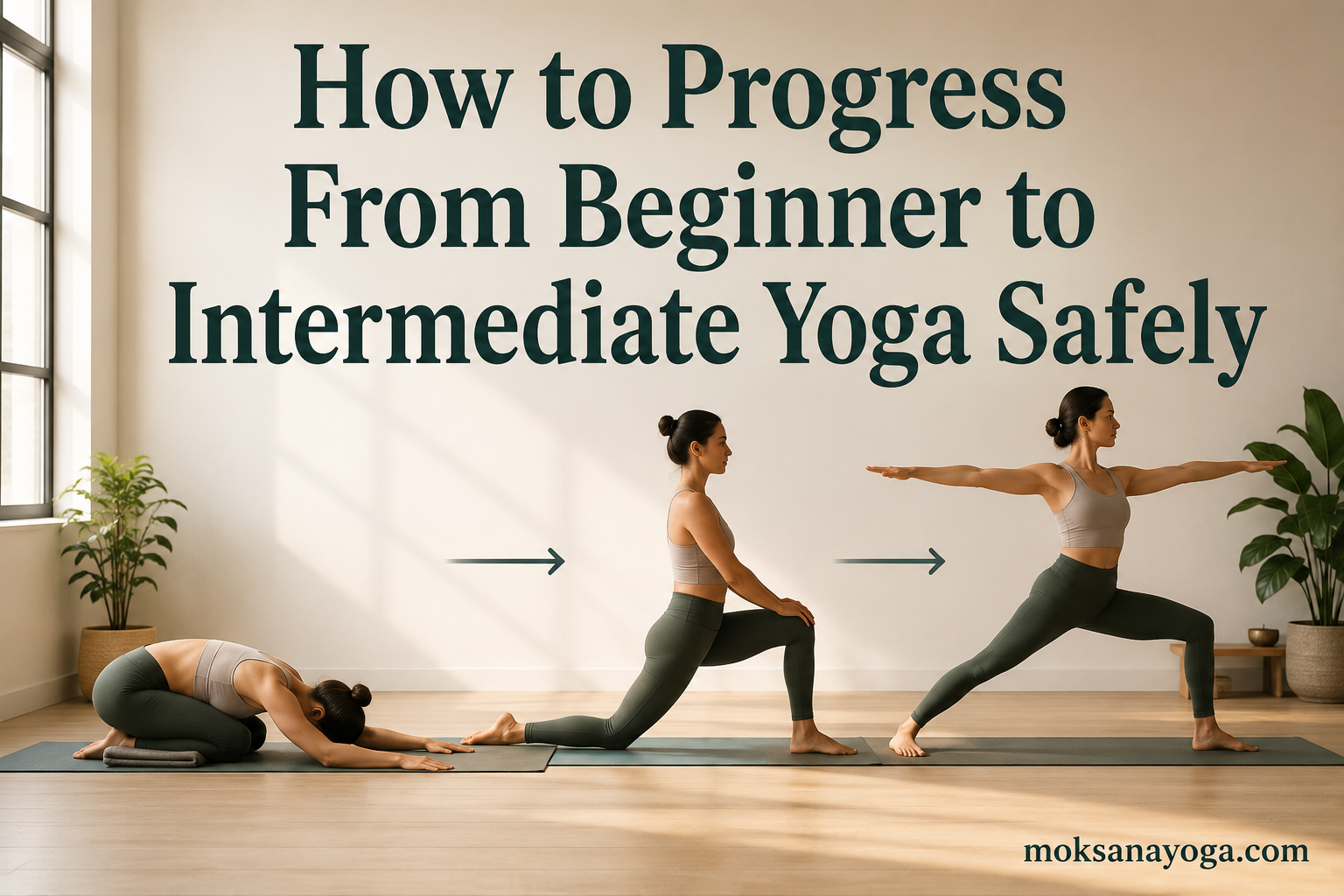
You have been going to beginner yoga classes for months now. You know your Downward Dog from your Warrior I, and you can hold a plank without shaking (too much). Now you are wondering when and how to take that next step without hurting yourself.
Learning how to progress from beginner to intermediate yoga safely is one of the most common questions I hear from students. The transition can feel exciting and intimidating at the same time. Move too fast and you risk injury. Move too slow and you risk boredom and stagnation.
In this guide, I will walk you through exactly what separates a beginner from an intermediate practitioner, realistic timelines, readiness benchmarks, foundational poses to master first, and a structured plan you can follow. I have spent years teaching yoga and helping students navigate this exact transition, and I want to share what actually works.
Whether you practice at home, in a studio, or a mix of both, this guide gives you a clear path forward. Let’s get into it.
Table of Contents
Understanding the Difference: Beginner vs Intermediate Yoga
The line between beginner and intermediate yoga is not as clear-cut as many people think. There is no official certification or test you pass to “graduate” to the next level. Instead, the transition happens gradually as your body, breath, and awareness develop together.
Here is how I break down the differences:
Beginner yoga focuses on learning foundational poses, basic alignment, and getting comfortable with moving your body in new ways. You are building the neural pathways that make poses feel natural. Your teacher cues every transition, and you rely heavily on visual demonstrations to follow along. Most beginner classes move at a slower pace with longer holds in each pose.
Intermediate yoga assumes you already know the basic poses and can perform them with reasonable alignment without constant cueing. The pace picks up. Poses are linked more fluidly through vinyasa transitions. You start encountering arm balances, deeper backbends, and more complex sequencing. Breath coordination becomes expected rather than taught.
Advanced yoga involves demanding poses like full inversions, deep twists, and intricate arm balances. But here is the thing most people miss: advanced practitioners often say the real advancement is in subtlety, not spectacle. The depth of breath awareness, mental focus, and body intelligence matters more than whether you can press into a handstand.
One key distinction I always emphasize: intermediate does not mean you never use props or take modifications. In fact, intermediate practitioners often have enough body awareness to know exactly when and how to use a block, strap, or blanket. Using props is a sign of intelligence, not weakness.
How Long Does It Take to Become Intermediate in Yoga?
Most practitioners need 6 to 18 months of consistent practice to reach an intermediate level. This is the consensus among experienced teachers and matches what I have seen across hundreds of students.
Several factors influence where you fall on that timeline:
- Practice frequency: Someone practicing 4 to 5 times per week will progress faster than someone practicing once weekly. However, consistency beats intensity. Two quality sessions per week every week for a year will serve you better than five sessions per week for a month followed by a long break.
- Prior movement background: If you come from a dance, gymnastics, martial arts, or weightlifting background, you may find certain elements of yoga click faster. Your body already understands body awareness, core engagement, and controlled movement.
- Quality of instruction: Working with an experienced teacher who gives hands-on adjustments and personalized feedback accelerates your progress significantly compared to only following along with generic online videos.
- Body type and natural flexibility: Some bodies adapt to certain poses quickly while others take longer. This does not make one person “better” at yoga. It simply means your path is your own.
- Age and recovery capacity: Younger practitioners may bounce back faster from intense sessions, while older practitioners often bring patience and consistency that leads to more sustainable progress.
Reddit users on r/yoga frequently discuss this timeline. One common theme: most regular practitioners report feeling truly comfortable in intermediate classes after about 1 to 2 years of consistent practice. The 6-month mark is when many start dabbling in intermediate content, but full confidence usually takes longer.
I want to be honest here. Yoga progress is non-linear. You will have breakthroughs where poses suddenly click, and you will have plateaus where nothing seems to change for weeks. Both are normal. The timeline above is a guide, not a deadline.
Signs You Are Ready for Intermediate Yoga
Wondering if you are ready to move up? Here are the physical and mental benchmarks I look for in students before recommending they transition to intermediate classes.
Physical Readiness Markers
These are the concrete physical signs that your body is prepared for intermediate-level demands:
- You can hold foundational poses for 5 to 8 breaths without losing alignment or needing to come out early. This includes Downward Dog, Warrior I and II, Triangle, and plank pose.
- You understand basic alignment independently. When a teacher says “square your hips” or “engage your core,” you know what that feels like in your body without needing a visual demonstration.
- You can complete 3 to 5 rounds of Sun Salutation A with breath-to-movement coordination, meaning you inhale or exhale with each transition rather than moving randomly.
- Your wrists and shoulders can bear weight comfortably. Intermediate poses like plank-to-chaturanga transitions and early arm balances place significant load on these joints.
- You have baseline core stability. You can hold a forearm plank for at least 30 seconds with proper form, and your lower back does not sag during weight-bearing poses.
- You can feel the difference between sensation and pain. This might be the most important physical marker. Intermediate poses will push you into new ranges. Knowing when to back off is a skill that keeps you safe.
Mental and Awareness Markers
Physical readiness is only half the equation. Mental readiness matters just as much when determining if you can safely advance your practice:
- You stay focused on your breath for most of a 60-minute class rather than constantly watching the clock or comparing yourself to neighbors.
- You can modify without feeling embarrassed. If a pose does not work for your body, you happily grab a block or take child’s pose without feeling like you failed.
- You listen to your body’s signals. Some days you feel strong and go for the challenge. Other days you feel tired and dial it back. Both choices feel equally valid to you.
- You are curious about the “why” behind poses rather than just going through the motions. You start asking questions about alignment, anatomy, and breathwork.
- You have let go of comparing your practice to others. This one takes time, and it is something even advanced practitioners work on. But a baseline acceptance that your journey is yours signals maturity.
If you can check off most of these markers, you are in a strong position to start introducing intermediate elements. If several of these still feel out of reach, that is completely fine. More time at the beginner level builds a stronger foundation.
Foundational Poses to Master Before Advancing
Before you start layering in intermediate poses, certain foundational poses need to be rock-solid. These are the building blocks that intermediate sequences assume you already know. If any of these feel shaky, spend more time here first.
The Non-Negotiable Foundation Poses
1. Mountain Pose (Tadasana) — This looks like just standing, but it is the template for all standing poses. You should feel your weight evenly distributed across both feet, your legs engaged, spine long, and shoulders relaxed. Every alignment principle in yoga traces back to Mountain Pose.
2. Downward-Facing Dog (Adho Mukha Svanasana) — The most frequently practiced pose in vinyasa-style yoga. You should be able to hold this for 5 to 8 breaths with your spine long, hands shoulder-width apart, and heels reaching toward the floor (touching is not required). Your teacher should not need to remind you to press through your knuckles or relax your neck.
3. Warrior I and Warrior II (Virabhadrasana I and II) — These build leg strength, hip flexibility, and upper body awareness. You should know the difference between the two poses and be able to set up either one from memory. Your front knee should track over your ankle, and your hips should be reasonably squared or open depending on the variation.
4. Triangle Pose (Trikonasana) — This pose teaches side-body length, hip opening, and spinal rotation. It also reveals asymmetries between your two sides. You should be able to set up with a long stance, maintain a straight front leg, and reach both directions (down and up) without collapsing.
5. Plank Pose and Chaturanga Transition — This is where many practitioners get stuck or injured. You need solid plank alignment first: shoulders over wrists, body in one line, core engaged. Only then should you work on lowering halfway (chaturanga) with control. If your shoulders dip below your elbows or your lower back sags, you are not ready to add this transition to flow sequences.
6. Child’s Pose (Balasana) — Not because it is hard, but because you should feel completely comfortable taking it at any point during practice. Intermediate practitioners use child’s pose freely and without shame.
7. Tree Pose (Vrksasana) — A foundational balancing pose. You should be able to hold tree pose for 5 to 8 breaths on each side without falling out repeatedly. Your standing leg should be strong, and your foot placement should be secure (avoid pressing directly on the knee joint).
8. Seated Forward Fold (Paschimottanasana) — This teaches patience and honest self-assessment. You should be able to fold forward with a long spine rather than rounding aggressively. Reaching your toes is not the goal. Feeling a stretch in your hamstrings while breathing calmly is.
How to Know These Poses Are Solid
Here is my simple test: Can you move through these poses in a slow, un-cued sequence on your own at home? If you can practice Sun Salutation A and a basic standing sequence without a video guiding you, your foundation is strong enough to start building on.
If you still rely heavily on following along with a teacher for every transition, give yourself more time. There is no rush. A strong foundation prevents 90 percent of the injuries I see in intermediate students who advanced too quickly.
How to Progress From Beginner to Intermediate Yoga Safely
Now we get to the heart of it. You know the levels, you have a sense of the timeline, and you have confirmed your foundation is solid. Here is exactly how to make the transition safely.
Principle 1: Progressive Overload, Yoga-Style
In weightlifting, you gradually increase weight or reps over time. In yoga, the principle is similar but the variables are different. You progress by:
- Holding poses longer (from 3 breaths to 5 to 8)
- Adding more challenging variations of poses you already know
- Linking poses more fluidly with less rest between them
- Introducing one new pose or transition per week, not ten at once
The key is introducing one new challenge at a time. If you try to learn crow pose, warrior III, and a new pranayama technique all in the same week, your body and mind get overwhelmed. Pick one thing. Work with it for a week or two. Then add the next.
Principle 2: Breath Comes First
If you cannot breathe smoothly in a pose, you are not ready for that pose. This is a hard rule. Breath is your built-in intensity gauge. When your breath becomes ragged, short, or held, your nervous system is telling you that you have crossed the edge of your capacity.
Before adding intermediate poses, develop a consistent Ujjayi breath practice. This slightly constricted, oceanic-sounding breath builds heat, focuses the mind, and gives you a constant feedback signal. If your Ujjayi breath falls apart during a challenging pose, modify or come out of it.
Principle 3: Introduce Intermediate Poses Gradually
Here are the first intermediate poses I recommend introducing, roughly in this order:
Phase 1 (Weeks 1-4): Half Moon Pose (Ardha Chandrasana) with a block, Warrior III with hands on hips or at the wall, extended plank holds, and bridge pose with shoulder engagement. These build the single-leg balance and core stability needed for harder poses.
Phase 2 (Weeks 5-8): Crow pose (Bakasana) with a pillow or block under your forehead for safety, Camel Pose (Ustrasana) with hands on lower back, Dolphin Pose to build shoulder strength for future inversions, and Boat Pose (Navasana) for core work.
Notice that even these “intermediate” poses have built-in modifications. You are not jumping straight into the full expression. You are building toward it.
Principle 4: Practice Frequency for Progression
To progress from beginner to intermediate, aim for 3 to 5 sessions per week. These do not all need to be 60-minute studio classes. A 25-minute home practice counts. Here is what a balanced week looks like:
- 2 to 3 guided classes (mix of beginner and eventually mixed-level classes)
- 1 to 2 shorter home practices (20 to 30 minutes focusing on specific poses or sequences)
- 1 restorative or yin session for recovery
- 1 full rest day
Rest days are not optional. Your body builds strength and flexibility during recovery, not during practice. Skipping rest days is one of the fastest paths to injury and burnout.
Principle 5: Find the Right Teacher and Class
When you start attending mixed-level or intermediate classes, arrive 5 minutes early and introduce yourself to the teacher. Tell them you are transitioning from beginner to intermediate. A good teacher will give you specific modifications and keep an eye on your alignment.
Do not feel pressured to do everything the class does. If the teacher calls crow pose and you are working on it, try it. If it is your first time seeing it, watch. Ask questions after class. Skipping poses is completely acceptable and expected in mixed-level classes.
An 8-Week Progression Framework
Here is a simple framework to guide your first 8 weeks of intermediate-level practice:
Weeks 1-2: Consolidate and observe. Attend mixed-level classes but stick to beginner variations of everything. Watch what intermediate students do differently. Notice which poses intrigue you and which intimidate you.
Weeks 3-4: Add one challenge. Pick one intermediate pose from the Phase 1 list above. Work on it at home for 5 to 10 minutes after your regular practice. Use props, walls, and modifications liberally.
Weeks 5-6: Add a second challenge. Introduce a second pose from the list. Start exploring Ujjayi breath if you have not already. Try to maintain it throughout a full Sun Salutation sequence.
Weeks 7-8: Integrate. Start attempting intermediate variations during class when they are offered. Accept that you will wobble, fall, and look awkward. Every intermediate practitioner has been there.
Common Challenges When Advancing Your Practice
Progression is rarely smooth. Here are the most common challenges I see students face during this transition, along with practical ways to work through them.
The Plateau Problem
Unlike weightlifting where you can track weights and reps, yoga progress is subjective and non-linear. This drives people crazy, especially those coming from measurable fitness backgrounds. A Reddit user on r/yoga put it perfectly when they asked how to “progress” in yoga when there are no clear metrics to track.
Here is my advice: track qualitative markers instead. Notice if your breath stays calmer during challenging sequences. Pay attention to whether your mind wanders less during meditation. Observe if you recover faster from intense sessions. These subtle shifts indicate real progress even when poses do not look dramatically different.
Plateaus are not failures. They are consolidation phases where your nervous system integrates what you have learned. Trust the process.
Imposter Syndrome in Intermediate Classes
This is more common than anyone admits. You walk into an intermediate class and suddenly everyone around you seems to flow effortlessly while you struggle with the warm-up sequence. You feel like a fraud.
First, most of those people feel the same way about someone else in the room. Second, every single intermediate practitioner was once exactly where you are. Third, nobody is watching you. They are all focused on their own breath and alignment.
If imposter syndrome hits hard, try this: remind yourself that showing up is the practice. The poses are tools, not the goal. If you breathe, move with intention, and respect your body’s limits, you are doing intermediate yoga regardless of how the poses look.
Frustration When Progress Slows
After the initial rapid gains of the first few months, progress naturally slows. This is normal and expected, but it feels discouraging. Your flexibility seems stuck. Your balance has not improved in weeks. A pose you almost had last month feels further away today.
When this happens, shift your focus. Instead of chasing a specific pose, work on a different element of practice. Spend two weeks focusing on breathwork. Try a different style of yoga. Take a workshop on alignment or anatomy. Sometimes stepping away from the pose you are obsessed with creates the space for a breakthrough.
Forum users on Do Yoga With Me’s community consistently report that their biggest jumps in ability came after periods of letting go of expectations. The body responds to consistent, stress-free practice better than it does to forced, frustrated effort.
Comparing Yourself to Others
Social media has made this worse. Instagram is full of beautifully photographed poses in stunning locations that make you feel inadequate about your wobbly Warrior III. Remember that those images represent someone’s best moment, often after years of practice, shot from the most flattering angle.
Your practice is between you and your mat. The person next to you in class does not affect your breath, your alignment, or your growth. Comparing your Day 100 to someone else’s Day 1,000 is not a fair comparison.
Warning Signs to Stop and Rest
Safety is the core of this guide. Knowing when to stop is just as important as knowing when to push forward. Here are specific warning signs that mean you should back off or end your practice immediately:
- Sharp, stabbing pain anywhere in the body. This is different from the dull ache of stretching or the burn of muscle fatigue. Sharp pain means stop, now.
- Joint pain, especially in wrists, shoulders, lower back, or knees. These are the most commonly injured areas in yoga. Never push through joint pain.
- Dizziness or lightheadedness. This can indicate breath-holding, low blood sugar, or blood pressure changes. Come to a seated position and breathe.
- Numbness or tingling in your hands or feet. This suggests nerve compression, often from holding a pose too long or with poor alignment.
- Shaking that goes beyond mild muscle fatigue. Some trembling is normal in challenging poses. Violent shaking means your muscles have reached their limit.
- Inability to maintain steady breath. If you cannot breathe smoothly, you have gone past your edge. Back off until your breath returns to normal.
If you experience any of these, do not “push through.” Yoga is not about enduring pain. The philosophy of ahimsa (non-harming) applies to how you treat your own body. Rest, modify, and live to practice another day.
FAQs
How long does it take to become intermediate in yoga?
Most practitioners need 6 to 18 months of consistent practice (3 to 5 times per week) to reach an intermediate level. Factors like prior movement experience, quality of instruction, and natural flexibility can speed up or slow down this timeline. Consistency matters more than intensity.
What are the signs you are ready for intermediate yoga?
Key readiness signs include holding foundational poses for 5 to 8 breaths with good alignment, performing Sun Salutations with breath-to-movement coordination, understanding alignment cues independently, and having enough body awareness to distinguish between productive sensation and harmful pain.
How do you avoid injury when progressing in yoga?
Avoid injury by introducing one new pose or challenge per week (not many at once), maintaining steady breath throughout practice, using props and modifications freely, taking regular rest days, and stopping immediately if you feel sharp pain, joint discomfort, dizziness, or numbness.
What poses should a beginner know before moving to intermediate?
Master Mountain Pose, Downward Dog, Warrior I and II, Triangle Pose, Plank and Chaturanga transition, Child’s Pose, Tree Pose, and Seated Forward Fold first. You should be able to perform these independently without constant cueing before advancing.
How often should I practice yoga to progress?
Aim for 3 to 5 sessions per week. This can include 2 to 3 guided classes, 1 to 2 shorter home practices of 20 to 30 minutes, 1 restorative session, and 1 full rest day. Consistency over months matters far more than intense daily practice.
Can yoga help with nerve damage or specific medical conditions?
Gentle yoga may help manage symptoms of certain conditions, but if you have nerve damage, scoliosis, endometriosis, or any medical condition, consult your healthcare provider before practicing. A qualified yoga therapist can design a safe, personalized approach. Never force poses with pre-existing conditions.
Conclusion
Learning how to progress from beginner to intermediate yoga safely comes down to three things: a solid foundation, gradual progression, and honest self-awareness. Master your foundational poses. Add intermediate challenges one at a time. Listen to your breath and body above all else.
The journey from beginner to intermediate is not a race. It is a personal process that unfolds differently for everyone. Some poses will come easily. Others will take months or years. Both experiences are valid parts of the practice.
Show up consistently. Breathe through the challenges. Rest when your body asks for it. That is how you progress safely and sustainably. Your intermediate practice is waiting for you, and you will get there exactly when you are ready.