
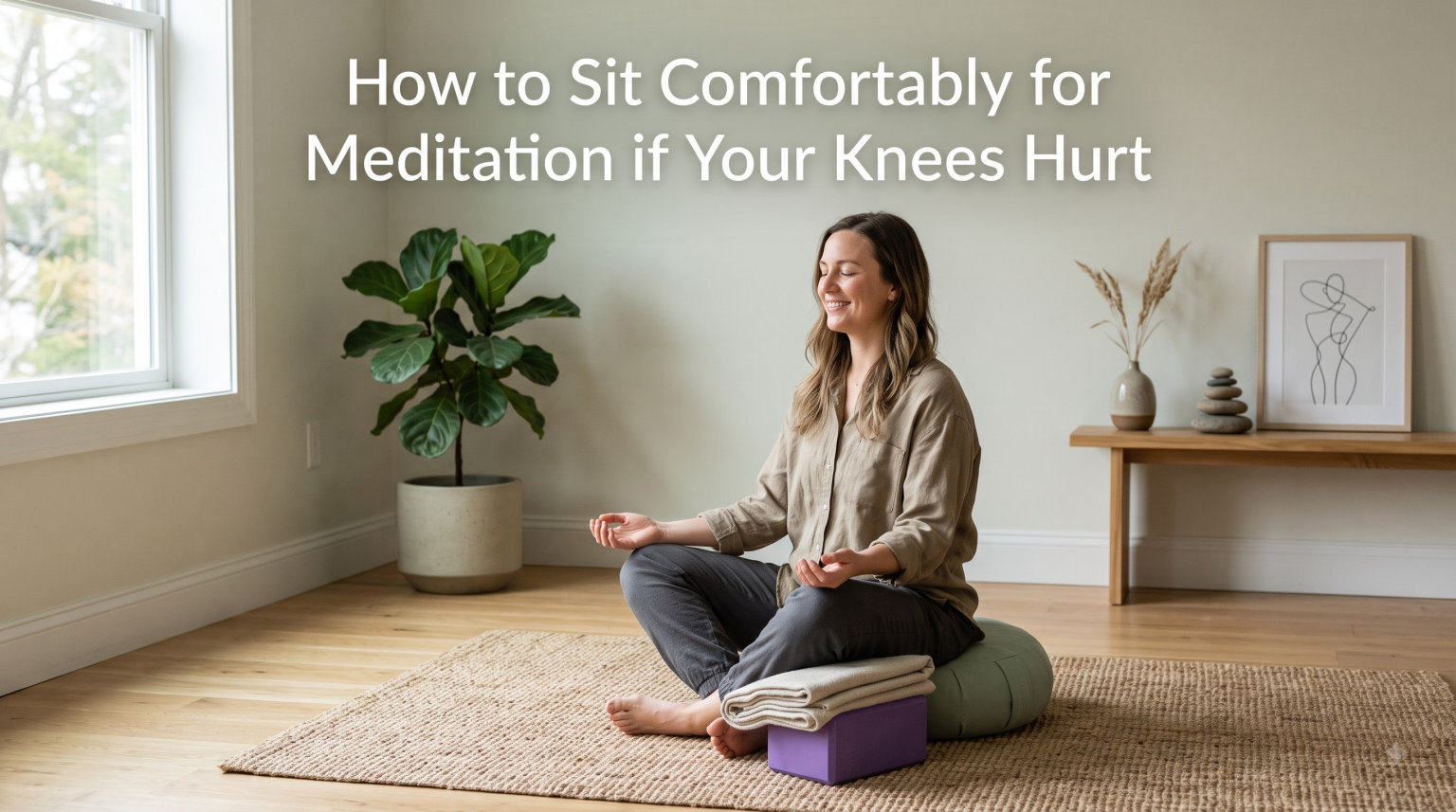
If you have ever shifted uncomfortably on your cushion, wondering whether meditation is supposed to hurt this much, you are not alone. Knee pain during meditation is one of the most common reasons people abandon their practice entirely. I have worked with dozens of students over the years who felt they had to choose between their knees and their mindfulness routine.
The good news is that you do not have to force yourself into a painful lotus position to meditate effectively. Learning how to sit comfortably for meditation if your knees hurt comes down to a few key adjustments: elevating your hips above your knees, choosing the right posture for your body, and using props strategically.
In this guide, we will walk through why knee pain happens, seven specific positions you can try today, the golden rule of hip elevation, stretches that address the root cause, and quick fixes for when pain strikes mid-session. Whether you are a beginner or a long-time practitioner, these strategies will help you build a sustainable, pain-free practice.
Table of Contents
Why Knee Pain Happens During Meditation?
Knee pain during meditation almost always comes down to one issue: your hips cannot rotate far enough to let your knees drop comfortably. When your hips lack flexibility, your knee joint picks up the slack. That joint is a hinge, not a rotating socket, so twisting forces it was never designed to handle create strain, pinching, and sharp pain.
Half-lotus and full-lotus positions are the worst offenders. These postures require significant external hip rotation, and when the hips cannot deliver, the torque transfers directly to the knee meniscus and ligaments. Many meditators on forums like r/Meditation describe badly hurting both knees by pushing into lotus before their body was ready.
Tight hip flexors from sitting in chairs all day compound the problem. If you spend eight hours at a desk, your hip flexors shorten, your glutes weaken, and your external rotators tighten. Then you ask your body to sit cross-legged on the floor for 30 minutes and wonder why your knees scream.
Another factor is knees floating above the ground when you sit cross-legged. When your knees hover in the air with no support, gravity pulls them downward, straining the inner knee ligaments over time. This is why cushion height matters so much, and we will cover that in detail shortly.
How to Sit Comfortably for Meditation if Your Knees Hurt: 7 Positions to Try
Here are seven positions that protect your knees while keeping you alert and grounded. Try each one and notice how your body responds. There is no single correct way to meditate, only the way that works for your unique anatomy.
1. Sit in a Chair
Chair sitting is the most underrated meditation posture. Many practitioners feel they are cheating by using a chair, but traditional teachers across multiple lineages have always permitted it. The Buddha himself outlined sitting, standing, walking, and lying down as valid mindfulness postures.
Choose a chair with a flat seat and a straight back. Plant both feet flat on the floor, hip-width apart, with your knees directly over your ankles. If your feet do not reach the floor, place a folded blanket or block under them so your knees stay at a 90-degree angle.
Sit forward enough that your lower back is supported but not slouched against the backrest. You can place a small cushion behind your lumbar spine for gentle support. This position removes all rotational stress from your knees while keeping your spine naturally upright.
One Reddit user who badly hurt both knees from floor sitting wrote that switching to a chair saved their practice entirely. If you have acute knee pain or a recent injury, start here without guilt.
2. Use a Meditation Bench (Seiza)
A meditation bench, also called a seiza bench, lets you kneel while taking all weight off your knee joints. The bench spans across your calves, and you rest your seat on the angled top. This angle tilts your pelvis slightly forward, stacking your spine effortlessly.
Because your legs are tucked underneath you rather than crossed, there is zero rotational torque on the knees. Many people with chronic knee issues find this the most comfortable floor-level option available. Place a zabuton or folded blanket under your shins and ankles for extra cushioning.
Make sure the bench has a slight forward angle, typically 5 to 10 degrees. A flat bench can compress your lower back. Angled benches encourage the natural curve of your lumbar spine, which prevents slouching.
3. Easy Pose with Elevated Hips
Easy pose, or Sukhasana, is a simple cross-legged position where both shins rest comfortably in front of you. The key modification for knee pain is elevation. Stack one or two firm cushions, a zafu, or folded blankets until your hips sit at least three to four inches above your knees.
When your hips are high enough, your knees naturally drop toward the floor without strain. If your knees still float, place small cushions or rolled towels underneath each knee for support. This removes the gravitational pull that stresses your inner knee ligaments.
This position works well for people with mild knee stiffness who still want a floor-based practice. Start with five to ten minutes and gradually increase as your hips open over time.
4. Burmese Position with Support
The Burmese position is similar to easy pose but both feet rest flat on the floor in front of you, one in front of the other, rather than tucked under the opposite thigh. This reduces the external rotation demand on your hips, which means less torque on your knees.
Many experienced teachers consider Burmese the most sustainable cross-legged posture for Western bodies. It offers the grounded feeling of floor sitting without the extreme flexibility requirements of lotus positions.
As with easy pose, elevate your hips with a zafu or cushion stack. Place a zabuton or soft mat under your ankles to prevent pressure points. If you feel any pinching in your knees, add more height under your seat.
5. Kneeling with Cushion Between Knees
If you do not have a meditation bench, you can kneel and place a firm cushion or rolled blanket between your calves and thighs. This creates a similar effect to the seiza bench by supporting your weight and reducing knee compression.
The cushion should be thick enough that your buttocks rest fully on it rather than hovering above your heels. If you feel pressure on your kneecaps against the floor, add a padded mat underneath. Forum users consistently warn that kneeling without any prop is brutal on the knees.
This position is sometimes called Virasana or Hero Pose in yoga traditions. It can deeply stretch the thigh muscles, which indirectly helps knee health, but never push through sharp pain. Gentle pressure is productive; sharp pain is a warning signal.
6. Standing Meditation
Standing meditation is a legitimate practice with deep roots in Qigong, Tai Chi, and Zen traditions. It completely eliminates knee torque while building leg strength and postural awareness over time.
Stand with your feet shoulder-width apart and your knees softly bent, never locked. Let your arms hang naturally or rest your hands lightly on your lower abdomen. Imagine a string pulling the crown of your head upward while your tailbone descends gently.
Standing is particularly useful if you have been sitting all day and your knees feel stiff. It also builds the leg and core strength that supports better seated posture long term.
7. Lying Down (Savasana)
For severe knee pain or fatigue days, lying down offers complete joint relief. Lie on your back with your arms at your sides, palms facing up. Place a bolster or rolled blanket under your knees to maintain a slight bend, which takes pressure off your lower back and keeps your knee joints neutral.
The main challenge with lying down is staying alert. It is easy to drift into sleep, which some teachers view as a different practice than meditation. To counter this, keep your eyes slightly open and soft, or try a body scan technique that keeps your mind actively engaged.
That said, if knee pain is preventing you from meditating at all, lying down is far better than skipping your practice entirely. You can always rotate between positions as your body needs.
The Golden Rule: Hips Above Knees
If you remember only one thing from this guide, let it be this: your hips should always be higher than your knees when you sit cross-legged. This single principle solves more knee pain issues than any other adjustment.
When your hips sit above your knees, your pelvis tilts forward slightly, your spine stacks naturally, and the weight of your legs distributes through your hips rather than torquing your knees. When your hips are level with or below your knees, gravity pulls your knees down, straining ligaments and compressing the joint.
To check your alignment, sit on your cushion and look down. You should see a clear downward slope from your hip crease to your knee. If your thighs are parallel to the floor or sloping upward, you need more height.
The fix is simple: add cushions, blankets, or yoga blocks until the angle is right. A firm zafu is ideal because it maintains its shape under your weight. Soft cushions compress too much and lose the elevation you need over the course of a session.
Pre-Meditation Stretches for Hip and Knee Prep
Stretching before meditation addresses the root cause of most knee pain: tight hips. When your hips can rotate freely, your knees stop compensating. Here are five stretches that experienced meditators and yoga teachers recommend most often.
Butterfly Stretch: Sit with the soles of your feet together and your knees dropped out to the sides. Gently press your knees toward the floor with your elbows or hands. Hold for two minutes while breathing deeply. This opens your inner thighs and external hip rotators.
Pigeon Pose: From a tabletop position, bring one shin forward at an angle and extend the other leg behind you. Lower your hips toward the floor. This deeply stretches the piriformis and gluteal muscles that control hip rotation. Hold for one minute per side.
Fire Log Pose: Sit cross-legged and stack your shins horizontally, one on top of the other, with ankles resting opposite knees. This is intense, so sit on a cushion to reduce the stretch depth. It targets the outer hip rotators directly.
Low Lunge: Step one foot forward into a lunge and lower your back knee to the floor. Press your hips forward gently to stretch the hip flexor of your back leg. Tight hip flexors are a major hidden cause of knee pain. Hold for one minute per side.
Reclined Figure Four: Lie on your back, cross one ankle over the opposite thigh, and thread your hands behind the hamstring of the bottom leg. Gently pull toward your chest. This releases glute tension without weight-bearing on your knees.
Do these stretches daily, ideally before you sit. Even five minutes makes a measurable difference over a few weeks. Many practitioners report that consistent hip stretching eliminates knee pain more effectively than any cushion adjustment alone.
Quick Posture Adjustments for Immediate Relief
Sometimes pain strikes mid-session and you need a fast fix. Here are adjustments you can make without getting up or breaking your focus.
Add height immediately. Slide an extra folded blanket under your cushion. Even one inch of additional elevation can shift the angle enough to relieve knee torque.
Support floating knees. If one or both knees hover off the floor, tuck a small cushion, rolled sock, or folded towel underneath. The support removes gravitational strain instantly.
Uncross and recross. If you always sit with the right leg in front, switch. Asymmetry can create uneven strain, and simply reversing your leg position often relieves a pinching sensation.
Move your feet forward. Instead of tucking your feet close to your body, let them rest further out in front of you. This reduces the flexion angle at your knee joint.
Lean against a wall. Sit with your back against a wall for partial support. This reduces the muscular effort required to stay upright, which indirectly relaxes the muscles pulling on your knee joints.
None of these adjustments are shortcuts or cheats. They are intelligent adaptations that experienced meditators use constantly. Your practice should serve your wellbeing, not punish your body.
When to Seek Medical Advice
Most meditation-related knee pain is mechanical, meaning it comes from poor alignment or inflexibility and resolves with the adjustments above. However, some types of knee pain signal a deeper issue that needs professional attention.
See a doctor or physical therapist if you experience sharp pain that persists after you stand up, swelling around the knee joint, clicking or locking sensations that cause pain, or numbness that does not resolve within a few minutes of changing position. These could indicate meniscus damage, ligament strain, or nerve compression that needs targeted treatment.
A physical therapist who understands meditation or yoga practice can assess your specific movement patterns and give you personalized corrections. This investment pays off for decades of comfortable sitting ahead.
FAQs
Which sitting position is best for knee pain?
Sitting in a chair with both feet flat on the floor is the best position for knee pain because it eliminates all rotational stress on the knee joints. If you prefer floor sitting, use a meditation bench in seiza position or sit cross-legged on a high zafu with your hips elevated well above your knees.
How do I sit in meditation without pain?
To meditate without pain, follow these steps: elevate your hips at least three inches above your knees using a firm cushion, support any floating knees with small rolled towels, choose a posture that matches your current flexibility level, and stretch your hips for five minutes before each session. Never force your body into a position that causes sharp pain.
Can meditation cure knee pain?
Meditation itself does not cure structural knee problems, but it can reduce the perception of pain and lower inflammation through stress reduction. The posture adjustments and hip stretches that accompany a good meditation practice often resolve mechanical knee pain over time. For persistent or sharp pain, consult a physical therapist.
Is sitting cross-legged bad for your knees?
Sitting cross-legged is not inherently bad for your knees, but it becomes harmful when your hips lack the flexibility to support the position. If your knees float above the floor or you feel pinching inside the joint, you need more hip elevation or a different posture. Over time, gentle stretching makes cross-legged sitting safer and more comfortable.
Should I use a meditation bench if my knees hurt?
Yes, a meditation bench is one of the best solutions for knee pain because it allows you to kneel in seiza position without any rotational torque on your knee joints. Look for a bench with a slight forward angle of 5 to 10 degrees and use a padded mat underneath your shins for comfort.
What chakra is associated with knee pain?
In some traditional energy systems, the knees are associated with the root and sacral chakras, which relate to grounding, flexibility, and the ability to move forward in life. While this perspective offers emotional insight, physical knee pain during meditation should always be addressed through posture, cushion height, and stretching first.
Conclusion
Knee pain does not have to end your meditation practice. The key principles are simple: keep your hips above your knees, use props generously, choose a posture that fits your body, and stretch regularly to open your hips. Whether you sit in a chair, kneel on a bench, or lie down with a bolster under your knees, what matters is showing up consistently.
Learning how to sit comfortably for meditation if your knees hurt is a gradual process. Start with the most supportive position you can find, then experiment as your flexibility improves. Treat your body with patience rather than pushing through sharp pain, and your practice will deepen naturally over the months and years ahead.
Your meditation practice should leave you feeling more connected to your body, not at war with it. With these strategies, you can build a sustainable routine that supports both your knees and your mind for the long run.