
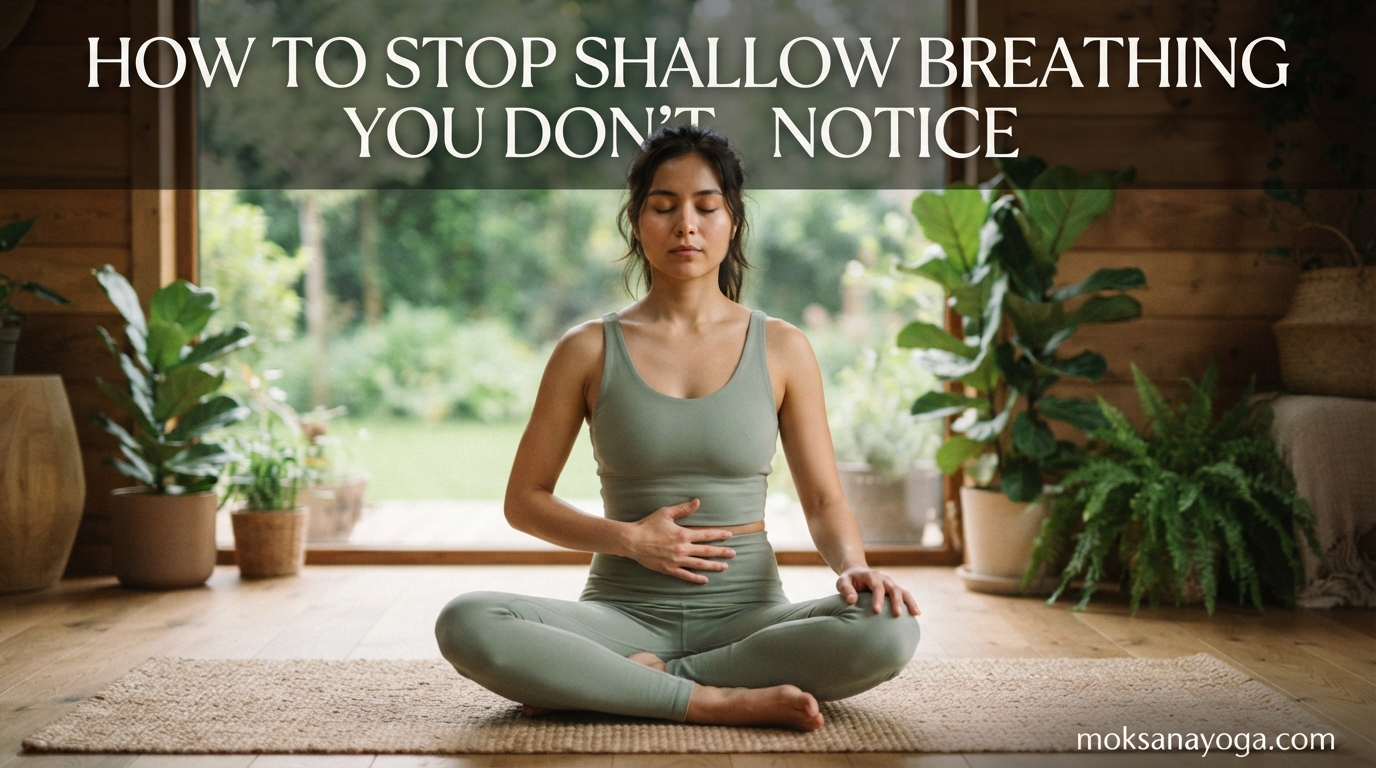
Take a breath right now. Go ahead — I’ll wait. Did your chest rise, or did your belly expand? If your shoulders lifted and your stomach stayed flat, you just caught yourself doing what millions of people do all day without realizing it. Learning how to stop shallow breathing you don’t notice you’re doing starts with exactly this kind of moment — the sudden awareness that your breath has been hiding in plain sight.
I remember the first time a yoga teacher placed her hand on my belly during savasana and said, “Breathe into here.” I had no idea what she meant. After 30-plus years of breathing, I discovered I had been taking tiny chest-level breaths around the clock. A Reddit user in r/Mindfulness described this perfectly: “Until a couple of months ago I never noticed it, but I hardly take in any air when breathing. The breaths I take are tiny all the time.”
That discovery is jarring but liberating. Once you see it, you cannot unsee it. And the good news is that habitual shallow breathing is completely reversible with the right techniques and a bit of daily practice.
Quick self-check — do any of these sound familiar?
- You catch yourself holding your breath while reading emails or scrolling your phone
- Your shoulders feel tense and raised most of the day
- You sigh frequently without realizing it
- You feel like you cannot get a full, satisfying deep breath
- Your chest moves when you breathe, but your belly barely moves
- You feel tired even after a full night of sleep
If you nodded along to two or more of those, this guide is for you. We are going to cover what shallow breathing actually is, why it hides below your awareness, and the specific breathing techniques — including yoga and pranayama exercises — that will help you retrain your breath for good.
Table of Contents
What Is Shallow Breathing?
Shallow breathing is breathing that draws air only into the upper chest, using the intercostal muscles and neck muscles rather than the diaphragm. Each breath is quick and small, filling only a fraction of your lung capacity. The medical term for rapid, shallow breathing is tachypnea, though habitual shallow breathing in daily life is more accurately described as chronic thoracic breathing — relying on the chest instead of the belly.
Contrast this with eupnea, which is the natural, relaxed breathing pattern your body defaults to when you are calm and at rest. Eupnea engages the diaphragm fully. The belly expands on the inhale and gently retracts on the exhale. The chest stays relatively still. This is how your body is designed to breathe.
The problem is that modern life pulls us out of that natural pattern. Hours of sitting, chronic stress, and constant screen time train the body to default to shallow chest breathing instead. Over time, this becomes your new normal — so normal that you stop noticing it entirely.
Why You Don’t Notice You’re Shallow Breathing
Here is the part no competitor talks about clearly: why shallow breathing becomes invisible. The answer comes down to three things — habituation, the stress response, and something called email apnea.
Habituation is the main culprit. Breathing is an autonomic function. Your brainstem manages it around the clock without requiring conscious input. When your breathing pattern shifts from deep diaphragmatic breaths to shallow chest breaths, your nervous system simply accepts the new pattern as baseline. There is no alarm bell. No notification. Your body adapts, and the shallow pattern drops below your conscious awareness.
This is why so many people are stunned when a yoga teacher, a therapist, or a partner points it out. A user in r/Anxiety wrote: “I was stunned to realize that I’ve been exclusively shallow breathing, in kind of a panic like way, for so long that it’s actually difficult to break the habit.” That shock of recognition is incredibly common.
Email apnea makes it worse. Former Apple executive Linda Stone coined the term “email apnea” after observing that around 80% of people temporarily hold their breath or breathe shallowly when checking email or scrolling on screens. The cognitive load and anticipation trigger a mild fight-or-flight response. Your breathing becomes shallow and irregular without any conscious decision. If you spend hours each day on a phone or computer, you are racking up hours of shallow breathing without knowing it.
The mind-body disconnection deepens the pattern. Most of us live in our heads. We think, plan, worry, and analyze — all while ignoring physical sensations. The body breathes shallowly, the mind does not notice, and the gap between the two grows wider. Yoga and mindfulness practices are so effective for shallow breathing precisely because they close that gap. They rebuild the connection between mind and body so you can actually feel what your breath is doing.
Common Causes of Unconscious Shallow Breathing
Shallow breathing does not happen in a vacuum. It is almost always a response to something — and usually several things at once. Understanding the cause is the first step to changing the pattern.
Chronic Stress and the Fight-or-Flight Response
When your brain perceives a threat, real or imagined, it activates the sympathetic nervous system. Your heart rate increases, your muscles tense, and your breathing speeds up and moves into your chest. This fight-or-flight response is designed for short bursts — outrunning danger, then returning to calm.
The trouble is that modern life keeps the threat dial turned up constantly. Work deadlines, financial pressure, family responsibilities, news cycles, and social media all register as low-level threats. Your body responds with shallow, rapid chest breathing that never fully settles back down. Over weeks and months, this becomes your default pattern.
Poor Posture and Muscle Tension
Try this experiment: slouch forward, round your shoulders, and drop your head toward your chest. Now try to take a deep belly breath. You will find it is nearly impossible. When your posture is collapsed, your diaphragm gets compressed and cannot descend fully. Your body compensates by shifting breathing to the upper chest and neck muscles.
Hours of sitting at a desk, looking down at a phone, or driving in a car train the body into postural patterns that physically restrict deep breathing. Tight psoas muscles, rounded shoulders, and forward head posture all contribute. The muscles involved — the scalenes, sternocleidomastoid, and intercostal muscles — become chronically tight, locking the shallow breathing pattern in place.
Sedentary Lifestyle
Physical activity demands deeper breathing. When you move your body — walk, run, practice yoga, climb stairs — your lungs are forced to expand and your diaphragm is forced to work. A sedentary lifestyle removes this natural stimulation. The diaphragm gets lazy, the lungs get accustomed to partial filling, and shallow breathing becomes the path of least resistance.
Anxiety and the Breathing Feedback Loop
Anxiety and shallow breathing create a vicious cycle. Anxiety triggers shallow chest breathing, and shallow chest breathing sends signals to the brain that amplify anxiety. The reduced carbon dioxide tolerance from chronic shallow breathing can make you feel lightheaded, tingling, or short of breath — which then triggers more anxiety.
Users in anxiety forums frequently describe this loop. They feel like they cannot get a satisfying breath, which causes panic, which makes the breathing worse. Breaking the cycle requires interrupting it with conscious breathing techniques — which is exactly what we will cover next.
How Shallow Breathing Affects Your Body and Mind
The effects of chronic shallow breathing go far beyond feeling a bit winded. When your body only gets partial breaths all day, every system is affected.
Your nervous system stays on high alert. Shallow chest breathing activates the sympathetic nervous system and keeps it there. Your body never fully shifts into the parasympathetic rest-and-digest state. This means chronically elevated cortisol, elevated heart rate, and reduced immune function. The vagus nerve, which controls parasympathetic activity, gets under-stimulated because it responds best to slow, deep diaphragmatic breathing.
Your muscles stay tense. Shallow breathing keeps the neck, shoulder, and chest muscles constantly engaged. These muscles were never designed to handle breathing full-time — that is the diaphragm’s job. The result is chronic neck and shoulder tension, tension headaches, and jaw tightness.
Your energy drops. It sounds counterintuitive, but shallow breathing reduces energy even though it takes in less oxygen. The real issue is carbon dioxide balance. Shallow, rapid breathing can lead to mild hypocapnia — too little carbon dioxide in the blood — which makes you feel lightheaded, fatigued, and mentally foggy.
Your sleep suffers. Shallow breathing patterns carry into the night. If your body is stuck in sympathetic dominance, falling asleep and staying asleep becomes harder. Shallow nighttime breathing is also connected to snoring and mild sleep apnea patterns.
Your anxiety increases. The brain interprets shallow chest breathing as a signal that something is wrong. After all, this is how you breathe when you are scared. So your brain looks around for the threat, finds everyday worries to fixate on, and the anxiety cycle deepens.
How to Stop Shallow Breathing: Step-by-Step Techniques
This is the section you came for. Below are four proven techniques to retrain your breathing. Start with one. Practice it daily for a week. Then add another. You do not need to do all of them at once.
1. Diaphragmatic Breathing (Belly Breathing)
This is the foundation. Every other technique builds on this. The goal is simple: retrain your body to use the diaphragm as the primary breathing muscle instead of the chest.
Step 1: Lie on your back with your knees bent and your feet flat on the floor. This position removes postural resistance and makes it easier to feel your breath.
Step 2: Place one hand on your chest and the other on your belly, just below your rib cage.
Step 3: Breathe in slowly through your nose for a count of four. Focus on making the hand on your belly rise while the hand on your chest stays still.
Step 4: Exhale slowly through your nose for a count of six. Feel your belly hand fall gently.
Step 5: Repeat for 5 to 10 minutes. Do this once or twice daily.
If your belly hand is not moving at first, do not force it. Just keep practicing. The diaphragm is a muscle, and it needs time to wake up after years of underuse. Within a few days, you will start to feel the belly expansion naturally.
2. The 4-7-8 Breathing Technique
Developed by Dr. Andrew Weil, the 4-7-8 technique is one of the most effective tools for quickly shifting the nervous system out of stress mode. It is especially useful before sleep, during moments of anxiety, or any time you catch yourself shallow breathing.
Step 1: Sit or lie down comfortably. Place the tip of your tongue against the ridge of tissue just behind your upper front teeth.
Step 2: Exhale completely through your mouth, making a soft whoosh sound.
Step 3: Close your mouth and inhale quietly through your nose to a count of four.
Step 4: Hold your breath for a count of seven.
Step 5: Exhale completely through your mouth to a count of eight, making the whoosh sound again.
Step 6: That is one cycle. Repeat for four cycles to start. Build up to eight cycles as you get comfortable.
The extended exhale is the key. A longer exhale than inhale signals the parasympathetic nervous system to activate, slowing your heart rate and calming your mind. Dr. Weil calls this technique a natural tranquilizer for the nervous system.
3. Box Breathing
Box breathing is used by Navy SEALs, first responders, and meditation practitioners alike. It is simple, portable, and effective for regaining control when you feel anxious or scattered.
Step 1: Sit up straight and exhale all the air from your lungs.
Step 2: Inhale through your nose for a count of four.
Step 3: Hold your breath for a count of four.
Step 4: Exhale through your nose for a count of four.
Step 5: Hold empty for a count of four.
Step 6: Repeat for 4 to 8 cycles.
The equal counts create a sense of balance and rhythm. It is like a reset button for your nervous system. I use it before difficult conversations and during travel — any time stress tries to hijack my breath.
4. Quick Exercises You Can Do Anywhere
You do not always have time for a 10-minute breathing session. These micro-practices fit into a busy day and help break the shallow breathing pattern before it takes hold.
The three-breath reset: Before opening your email, starting a meeting, or picking up your phone, take three slow belly breaths. Four-count inhale, six-count exhale. This takes under 30 seconds and interrupts email apnea before it starts.
The sighing release: Inhale deeply through your nose, take one more sip of air at the top, then exhale with a long audible sigh through your mouth. Do this three times. It releases built-up tension in the chest and resets your breathing rhythm.
The posture check breath: Roll your shoulders back and down. Lift the crown of your head. Now take three slow nasal breaths, feeling your belly expand. This combines posture correction with breath awareness — doubly effective for desk workers.
The transition breath: Every time you transition between activities — standing up from your desk, getting in the car, walking through your front door — take one conscious belly breath. These small pauses accumulate throughout the day and keep shallow breathing from settling back in.
Yoga and Pranayama: Ancient Tools for Shallow Breathing
Yoga offers something medical articles and wellness apps rarely do: thousands of years of refined breath practice. In the yoga tradition, breath work is called pranayama — the regulation and expansion of vital energy through the breath. These practices go beyond simple deep breathing. They train the body to breathe fully, consciously, and with control.
At Moksana Yoga, we see students transform their breathing patterns in a matter of weeks through consistent pranayama practice. The beauty of these techniques is that they address shallow breathing from multiple angles — mechanical, neurological, and energetic.
Dirga Pranayama (Three-Part Breath)
This is the foundational breath practice in yoga and the perfect starting point for anyone retraining shallow breathing. Dirga pranayama teaches you to fill the lungs completely in three stages, maximizing lung capacity and re-engaging the diaphragm.
Step 1: Sit comfortably or lie down. Rest one hand on your belly and the other on your chest.
Step 2: Inhale slowly through your nose, first filling your belly so the lower hand rises.
Step 3: Continue inhaling, expanding your lower ribs and mid-chest.
Step 4: Finish the inhale by filling your upper chest so the upper hand rises slightly.
Step 5: Exhale in reverse — empty the upper chest first, then the rib cage, then the belly.
Practice for 5 minutes daily. This technique retrains the full range of breathing motion that shallow breathing has eliminated.
Nadi Shodhana (Alternate Nostril Breathing)
Nadi shodhana balances the nervous system, calms the mind, and trains slow controlled nasal breathing. It is one of the most effective pranayama practices for anxiety-driven shallow breathing.
Step 1: Sit comfortably. Raise your right hand and rest your index and middle fingers between your eyebrows.
Step 2: Close your right nostril with your thumb. Inhale slowly through your left nostril for a count of four.
Step 3: Close your left nostril with your ring finger. Release your thumb and exhale through your right nostril for a count of four.
Step 4: Inhale through your right nostril for four. Close it with your thumb. Release the ring finger and exhale through your left nostril for four.
Step 5: That is one cycle. Repeat for 5 to 10 cycles.
Ujjayi Pranayama (Ocean Breath)
Ujjayi breath creates a soft ocean-like sound in the back of the throat. It is used throughout yoga asana practice to maintain breath awareness and build internal heat. For shallow breathers, ujjayi is powerful because the audible sound gives your mind something to track — making it much harder to lose awareness of your breath.
Step 1: Inhale through your nose. As you exhale through your nose, slightly constrict the back of your throat as if you are fogging a mirror with your mouth closed.
Step 2: You should hear a gentle whispering or ocean sound on both the inhale and exhale.
Step 3: Maintain this breath for 5 to 10 breaths, or use it throughout a yoga practice.
The combination of nasal breathing, gentle constriction, and audible feedback makes ujjayi one of the most effective practices for breaking unconscious shallow breathing patterns during daily movement.
How Long Does It Take to Retrain Your Breathing?
This is one of the most common questions, and no competitor gives a clear answer. From my experience and from working with yoga students, here is a realistic timeline.
Days 1 to 3: You will become more aware of your breathing throughout the day. This awareness can feel overwhelming — you might notice how often you shallow breathe and feel frustrated. This phase is normal and actually a sign of progress. Awareness always comes before change.
Week 1 to 2: With daily practice of diaphragmatic breathing or Dirga pranayama for 5 to 10 minutes, your diaphragm starts to wake up. You will notice moments during the day when you naturally breathe deeper without trying.
Weeks 3 to 6: The new breathing pattern starts to take hold. You will catch yourself shallow breathing less often. Your neck and shoulder tension may begin to ease. Your sleep may improve. This is when the nervous system begins to re-regulate.
Months 2 to 3: Deep diaphragmatic breathing becomes your new default. You still catch yourself shallow breathing during high-stress moments, but you recover faster. Most students report feeling like a completely different person by this point.
The key is consistency. Five minutes of daily practice will transform your breathing far more quickly than one 60-minute session per week. Your nervous system learns through repetition.
When to See a Doctor
Shallow breathing from stress, posture, and habit is extremely common and fully addressable with the techniques in this guide. However, sometimes shallow breathing signals an underlying medical issue that requires professional attention.
Seek medical care if you experience any of the following:
- Sudden onset of shortness of breath that does not improve with breathing techniques
- Chest pain or pressure along with breathing difficulty
- Shallow breathing accompanied by dizziness, confusion, or bluish lips or fingers
- Persistent shortness of breath that worsens over days or weeks
- Shallow breathing that wakes you from sleep
- Any breathing difficulty associated with a known heart or lung condition
Underlying causes of shallow breathing can include asthma, COPD, heart conditions, pulmonary embolism, anxiety disorders, metabolic conditions, and neurological issues. If you are unsure whether your shallow breathing is stress-related or medical, see a doctor. Breathing techniques are safe and beneficial either way — but ruling out serious conditions brings peace of mind.
Frequently Asked Questions
How to train yourself to stop shallow breathing?
Practice diaphragmatic breathing daily for 5 to 10 minutes: lie down, place one hand on your belly, and breathe through your nose so your belly rises on the inhale and falls on the exhale. Add awareness check-ins throughout the day where you pause and notice your breath. Over 2 to 6 weeks of consistent practice, your body will re-learn to default to deeper belly breathing instead of shallow chest breathing.
Why do I subconsciously breathe shallow?
Your breathing is controlled by the autonomic nervous system, so once shallow breathing becomes a habit, it drops below conscious awareness. Chronic stress keeps your sympathetic nervous system activated, which naturally shifts breathing to the upper chest. Poor posture compresses the diaphragm, forcing chest breathing. And screen time triggers email apnea, where you unconsciously hold or shallow your breath. Your body simply adapts to the new pattern without telling you.
How to remedy shallow breathing?
To remedy shallow breathing: practice diaphragmatic or belly breathing for 5 to 10 minutes daily, try the 4-7-8 technique before sleep or during anxiety, do yoga and pranayama exercises like Dirga pranayama and alternate nostril breathing, improve your posture to give your diaphragm room to move, take regular movement breaks if you sit at a desk, and set hourly reminders to check in with your breath. Consistency matters more than duration.
What is the 4 7 8 rule for breathing?
The 4-7-8 breathing technique involves inhaling through your nose for 4 counts, holding your breath for 7 counts, and exhaling through your mouth for 8 counts. Developed by Dr. Andrew Weil, it activates the parasympathetic nervous system through the extended exhale, which slows your heart rate and calms the mind. Repeat for 4 cycles to start, building up to 8 cycles. It works best before sleep, during anxiety, or any time you catch yourself shallow breathing.
Conclusion
Learning how to stop shallow breathing you don’t notice you’re doing is one of the most impactful changes you can make for your energy, your anxiety levels, and your overall wellbeing. The first step is always awareness — that moment of catching yourself and thinking, “Oh, I was barely breathing.” From there, daily practice of diaphragmatic breathing, the 4-7-8 technique, or a simple pranayama exercise will retrain your body to breathe the way it was designed to.
Start small. Five minutes today is better than an hour someday. Pick one technique from this guide, practice it tomorrow morning, and notice what shifts. Your breath has been with you since the moment you were born — and it is never too late to learn how to do it well.