
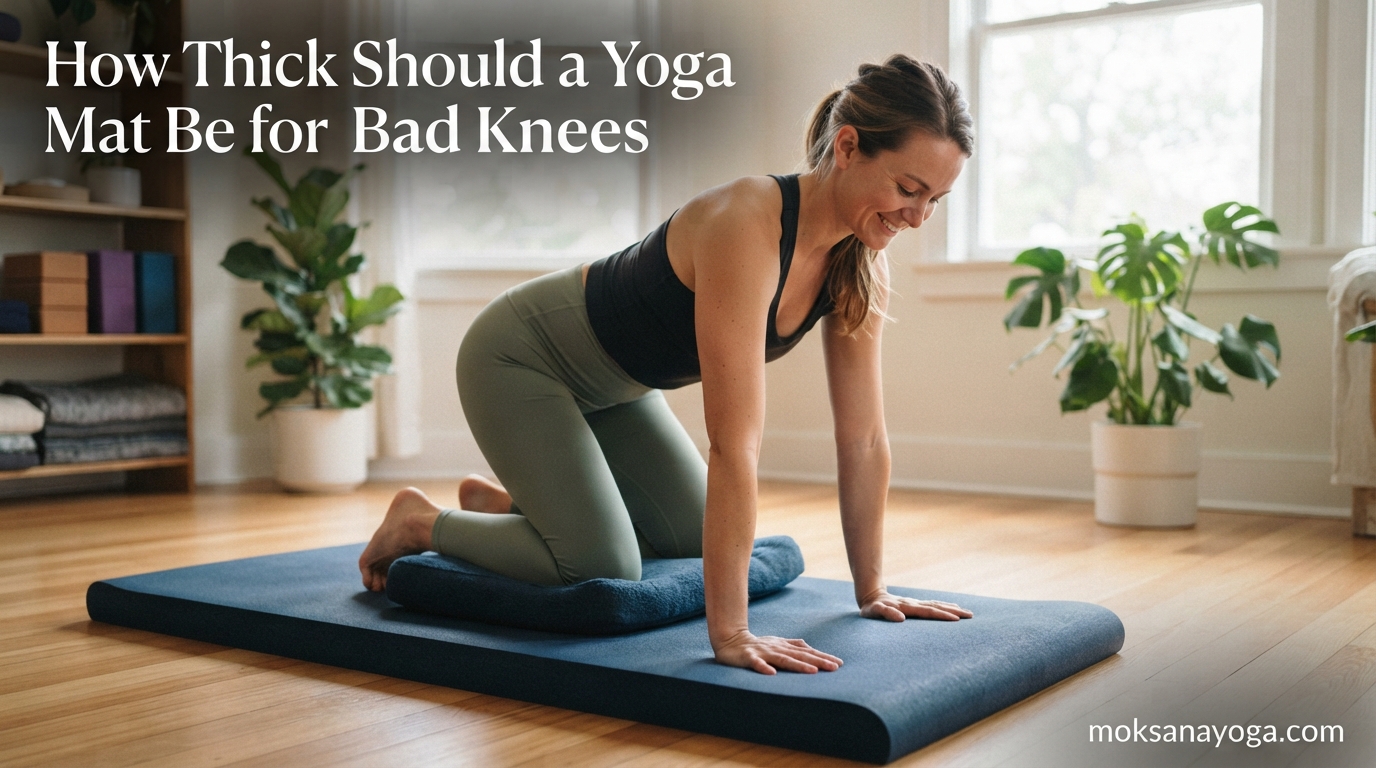
For bad knees, a yoga mat thickness of 5mm to 6mm in a high-density material is ideal. That range absorbs impact during kneeling poses while staying stable enough for standing balance work. Go thicker than 8mm and you trade cushion for wobbly ankles. Go thinner than 4mm and your patella presses straight into the floor.
In this guide I walk through exactly why that 5-6mm window works, how density changes the equation, and what to do if your current mat still leaves you wincing in tabletop. If you have ever wondered how thick should a yoga mat be for bad knees, the short answer is above and the long answer is everything that follows.
Table of Contents
Quick Answer: Yoga Mat Thickness for Bad Knees
Here is the breakdown we recommend after testing mats across hard floors, carpet, and studio surfaces:
- 5mm to 6mm high-density — Best overall for bad knees. Cushions without bottoming out.
- 6mm to 8mm medium-density — Good for restorative or yin yoga where you hold seated postures longer.
- 4mm to 5mm very high-density natural rubber — Works if your mat has strong compression resistance, like a Liforme or Manduka PRO.
- 4mm mat plus a separate knee pad — Best of both worlds for flow classes. Stability for standing, padding where you need it.
- Avoid 10mm+ foam mats — They feel soft at first but compress flat under body weight, offering no real protection.
Can you do yoga if you have bad knees? Absolutely. The right mat thickness plus a few pose modifications lets most people practice without pain.
Why Your Knees Need Extra Support on a Yoga Mat
Your kneecap, or patella, sits directly against whatever surface you are on. There is very little fat or muscle between the bone and the floor. When you kneel in tabletop, low lunge, or camel pose, your body weight concentrates on a small contact point. That is point load, and it is why even carpeted floors feel brutal on sensitive joints.
A yoga mat works as a shock-absorbing buffer. It distributes that concentrated load across a wider area so the patella is not taking the full hit. But here is the catch most people miss: thickness alone does not guarantee protection. A 10mm foam mat that compresses flat under your weight gives you almost nothing. This is called bottoming out, and it is the number one reason thick mats still leave knees aching.
That is why density matters as much as, if not more than, raw thickness. I will break that down further below.
The Full Thickness Spectrum: 1mm to 15mm
Yoga mats range from ultra-thin travel mats to padded slabs that feel like mini mattresses. Here is how each thickness zone performs for sensitive knees.
1mm to 3mm (Travel and Studio Mats)
These mats exist for portability, not comfort. They weigh almost nothing and roll up small enough to stuff in a suitcase. For bad knees, they are useless on their own. Yogis who travel often layer a thin mat over a hotel towel or blanket for basic cushioning. If you only have a thin mat, a folded blanket under the knee is your best friend.
4mm to 5mm (Standard Studio Thickness)
This is the most common range you will find in studios and gyms. A 4mm to 5mm mat made from high-density natural rubber can work well for bad knees because the material resists compression. Cheaper 5mm PVC or TPE mats at this thickness tend to bottom out quickly. If your knees hurt on a standard studio mat, density is likely the culprit, not thickness.
6mm to 8mm (Thick Comfort Mats)
For bad knees, this is the sweet spot for restorative, yin, and gentle yoga. You get noticeable cushion for seated and kneeling poses. The trade-off is balance: standing one-leg poses like tree or warrior III feel less grounded on 8mm of foam. Our team found that 6mm hits a nice middle ground, adding comfort without throwing off stability too badly.
10mm to 15mm (Extra Thick and Pilates Mats)
These feel amazing for seated meditation and supine poses. For active yoga, they are a problem. Wrists sink in, ankles wobble, and transitions feel sluggish. Most 10mm+ mats are low-density foam, meaning they bottom out anyway under concentrated knee pressure. You end up with the worst of both worlds: instability and no real joint protection.
Quick mm to inches reference: 4mm is about 1/6 inch, 5mm is roughly 3/16 inch, 6mm is about 1/4 inch, and 8mm is roughly 5/16 inch.
Density vs Thickness: The Real Secret to Knee Comfort
This is where most guides lose people, so I will keep it simple. Thickness is how tall the mat is. Density is how tightly packed the material is, which determines how much it resists being squished. A 5mm high-density natural rubber mat can protect your knees better than a 10mm low-density foam mat because the rubber pushes back instead of collapsing flat.
Think of it like a running shoe. A marshmallow-soft insole feels great for two minutes, then your foot bottoms out and every step hurts. A firm, responsive sole absorbs impact and bounces back. Yoga mats work the same way. You want compression resistance, not just softness.
Materials ranked by density and knee protection:
- Natural rubber — Highest density, best rebound, excellent for bad knees even at 4-5mm.
- High-density PVC — Good durability, moderate compression resistance. Manduka PRO is the classic example.
- TPE (thermoplastic elastomer) — Lightweight and affordable but lower density. Compresses faster under body weight.
- Cork and rubber composite — Firm with good grip. Best for hot yoga where sweat is a factor.
- NBR foam — Very soft, very low density. Feels thick but bottoms out instantly. Avoid for bad knees.
The Bottom-Out Test
Want to know if your current mat is actually protecting your knees? Try this simple test at home.
Step 1: Place your mat on a hard floor, not carpet.
Step 2: Kneel down and shift your weight onto one knee, the way you would in a low lunge.
Step 3: Can you feel the hard floor through the mat? If yes, your mat is bottoming out. It does not matter how thick it is. The material lacks the density to support your body weight on a concentrated point.
Step 4: Try the same test with a folded blanket under the mat. If the pain disappears, your issue is compression, not thickness. You need either a denser mat or a knee pad, not a thicker foam one.
I have watched students show up with 15mm foam mats convinced they bought the thickest option available. Nine times out of ten, they bottom out in tabletop within the first five minutes. Density wins every time.
How Body Weight Changes the Equation
Almost no guides cover this, and it matters more than people realize. Your body weight directly affects how a mat compresses. A 120-pound person and a 220-pound person will experience the same 6mm mat very differently.
If you are on the lighter side, under 140 pounds, a 5mm high-density mat will feel plush and supportive. You may even find 4mm comfortable. If you are over 180 pounds, that same mat may compress too far under your knees during kneeling poses. In that case, either move to 6mm of high-density material or add a knee pad for targeted cushioning.
This is why physical therapists often recommend the Manduka PRO for larger bodies with bony knees. It is only about 5mm thick but made from dense closed-cell PVC that refuses to bottom out, even under significant pressure.
Floor Type Matters More Than You Think
The surface under your mat changes everything. The same 5mm mat feels completely different on hardwood versus concrete versus carpet.
- Hardwood or laminate — Slight give. A 5-6mm high-density mat handles this well.
- Tile or concrete — Zero give. This is where knees suffer most. Consider 6mm plus a knee pad for kneeling sequences.
- Carpet — Already provides some cushion. A thinner 4-5mm mat can work because the carpet adds a layer of compression underneath.
- Studio sprung floors — Built to absorb impact. Standard 4-5mm mats feel fine here, which is why studio mats seem inadequate when you take them home.
If your knees hurt at home but felt fine in a studio, the floor is half the problem.
Choosing Thickness by Yoga Style
Different styles stress your knees in different ways. Here is how to match thickness to what you actually practice.
Vinyasa and power flow: You move quickly between standing and floor poses. Go with 5mm high-density. Thicker mats slow transitions and make standing balance poses unstable.
Yin and restorative: Long holds in seated and reclined poses. Here 6-8mm shines because you are not doing much standing balance work.
Hatha and Iyengar: A mix of held poses with alignment focus. A 5-6mm mat with a knee pad on standby covers every scenario.
Hot yoga: Sweat changes grip dramatically. A thinner 4-5mm mat with a moisture-activated grip surface (natural rubber or cork) is safer than a thick mat that turns slick when wet.
Prenatal and gentle yoga: Comfort is priority one. 6mm plus a blanket or bolster for kneeling poses.
Pose Modifications for Sensitive Knees
Even with the perfect mat, certain poses hit the knee hard. Here are modifications our team uses regularly that take pressure off without sacrificing the practice.
Tabletop and Cat-Cow
Place a folded blanket under the knees, or use a knee pad. Make sure your hands are directly under your shoulders so your arms take weight, not your kneecaps.
Low Lunge (Anjaneyasana)
The back knee takes the brunt here. Pad it with a blanket, or lift the back heel and come onto the ball of the foot to take the knee off the floor entirely. This changes the pose slightly but protects the joint.
Camel Pose (Ustrasana)
Double-fold your mat under the knees, or place a blanket on top. If your knees still hurt, tuck your toes under so you are on the balls of your feet rather than the tops of your feet and shins.
Hero Pose (Virasana)
This pose is notoriously hard on knees. Sit on a bolster or block to lift your hips, which reduces the angle of knee flexion. If it still hurts, skip it. There is no medal for grinding through knee pain.
Pigeon Pose
Place a folded blanket under the front hip and thigh. This supports the knee at an awkward angle and prevents it from torquing. The front shin can also come more parallel to the front of the mat to reduce knee rotation.
Thick Mat vs Knee Pad: Which Is Better?
This question comes up constantly on yoga forums, and the community consensus is clear. A standard 4-5mm high-density mat plus a separate knee pad beats a thick mat almost every time. Here is why.
A knee pad gives you targeted padding exactly where you need it, only during the poses that require it. When you stand up, the pad goes away and you are back on a stable surface. A thick mat, on the other hand, is thick everywhere. You get cushion for your knees but you also get wobbly ankles in tree pose and sinking wrists in downward dog.
Many yoga practitioners on Reddit report using gardening knee pads, folded blankets, or even a second mat section as a budget workaround. Physical therapists frequently recommend this layered approach over buying the thickest mat available.
Common Mistakes That Make Bad Knees Worse
The number one mistake people make is buying a thick, soft, low-density mat thinking more cushion equals more protection. It does not. Soft foam compresses flat under body weight, leaving your knee pressing into the floor anyway. You spent money on thickness that disappears the moment you kneel on it.
Other common missteps:
- Doubling up two cheap mats — Feels better at first, but both compress together and you still bottom out. Better to invest in one dense mat.
- Ignoring alignment — If your knee tracks inward or outward of your foot in lunges, no mat thickness will save you. Alignment drives joint strain.
- Practicing on tile or concrete without extra padding — Even a great mat cannot fully compensate for a floor with zero give.
- Pushing through pain — Knee pain is a signal, not a challenge. Modify or rest.
How to Measure Your Yoga Mat Thickness Accurately
Manufacturers round numbers and marketing copy stretches the truth. If you want to know what you actually have, measure it yourself.
Press a ruler or caliper gently against the mat surface. Do not compress it. Measure at the center of the mat, not the edges, because edges can curl or flare. If you do not have calipers, stack a few coins (a US quarter is about 1.75mm thick) and compare. Five quarters stacked is roughly 8.75mm.
This matters because a mat sold as 6mm may actually measure 5mm, and that 1mm difference is noticeable on sensitive knees.
FAQs
Is a thicker yoga mat better for bad knees?
Not necessarily. A thicker mat only helps if it is also high-density. A 10mm foam mat compresses flat under body weight and offers little real protection. A 5-6mm high-density natural rubber mat absorbs impact without bottoming out, making it better for bad knees than a thicker but softer mat.
What thickness yoga mat is best for knees?
For most people with bad knees, 5mm to 6mm in a high-density material is the sweet spot. If you practice restorative or yin yoga, 6-8mm works well. For heavier bodies or practice on concrete, consider adding a knee pad to a 5-6mm mat rather than going thicker.
Can you do yoga if you have bad knees?
Yes. With the right mat thickness, proper alignment, and pose modifications like padding under the knees in tabletop and low lunge, most people with knee pain can practice yoga comfortably. Avoid deep flexion poses like hero pose if they cause pain, and always modify rather than push through discomfort.
Why do my knees still hurt even on a thick yoga mat?
Your mat is likely bottoming out. Soft, low-density foam compresses flat under your body weight, so your kneecap still presses into the hard floor. You need a denser material like natural rubber or high-density PVC, not necessarily more thickness. Try the bottom-out test described above to check.
Should I use a knee pad or a thicker mat?
A standard 4-5mm high-density mat plus a separate knee pad is usually better than one thick mat. The knee pad gives targeted cushioning for kneeling poses while keeping the mat stable for standing balance work. Many yoga teachers and physical therapists recommend this layered approach.
What is the best yoga mat material for bad knees?
Natural rubber offers the highest density and best compression resistance, making it the top choice for knee protection even at 4-5mm. High-density PVC, like the Manduka PRO, is also excellent. Avoid NBR foam, which is very soft and compresses flat instantly under body weight.
Finding Your Perfect Mat Thickness
So, how thick should a yoga mat be for bad knees? Start with 5mm to 6mm of high-density material, adjust based on your body weight and floor type, and add a knee pad for poses that need extra cushion. Density matters more than thickness, so prioritize natural rubber or high-density PVC over soft foam no matter how many millimeters it claims.
Run the bottom-out test on your current mat first. If it fails, you do not necessarily need a new mat. You might just need a knee pad and a folded blanket. The best setup is the one that lets you kneel into tabletop without wincing and stand in tree without wobbling.