
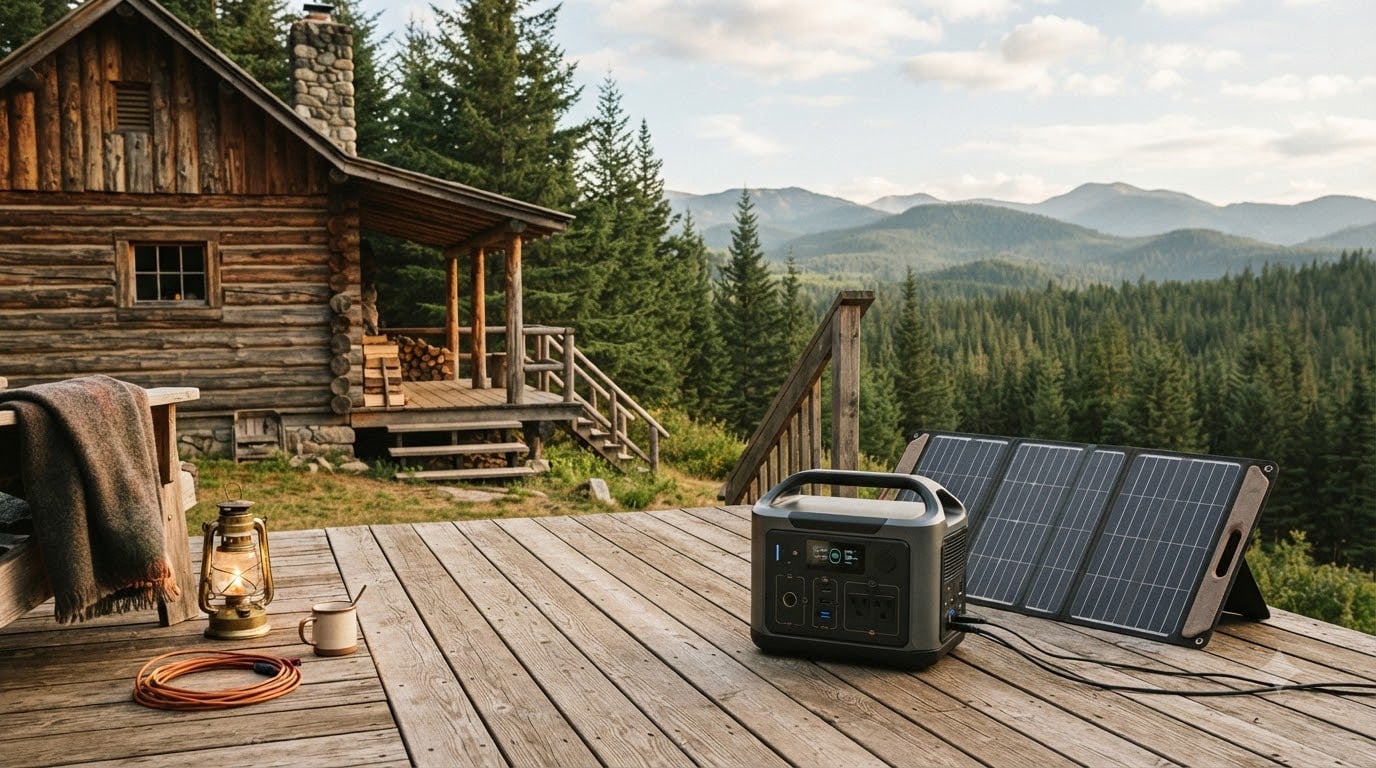
A solar generator is not a generator at all. It is a battery power station: a large lithium battery with an AC inverter that you recharge from solar panels, a wall outlet or a car socket, then tap for normal 120V household power with no noise, no fumes and no carbon monoxide.
That last point is what makes the category a genuine fit for a remote cabin. A gas generator means a fuel delivery schedule, a loud machine running outside the wall where you sleep, and exhaust you have to keep away from open windows. A solar generator sits in a corner, charges during the day and gets you through a multi-day storm on stored energy. If you are still deciding whether the appliance side of an off-grid life is even solvable, our guide to the best solar generators for off-grid living covers the broader setup first.
This guide is framed around one specific problem: sizing a station to a real cabin load rather than to a marketing number. A weekend cabin running a refrigerator, some LED lights, a router and a laptop is a much easier customer for a power station than a full-time residence running a well pump, a water heater and a space heater. Those are very different systems.
Over six weeks we worked through the specs, app behaviour and user-reported runtime of twelve stations, then sorted them against the loads a cabin actually throws at a battery. What follows is the 2026 list of the best solar generators for off-grid cabins, with the sizing math in the buying guide so you can check our picks against your own place.
Table of Contents
How We Picked and What We Checked
We scored every station on the things that decide whether a system keeps up with the sun. First is usable capacity, not the nameplate figure, because a battery’s rated watt-hours are never the watt-hours you can spend.
Second is continuous output and surge headroom, because a refrigerator compressor, a kettle and a well pump all draw far more at startup than while running. Third is solar input wattage and voltage window, since that decides how large an array you can hang on the roof.
We also weighed battery chemistry and cycle life, port layout for a mixed load, app reliability, standby draw, weight, and whether the unit can be expanded later. Every spec quoted below comes from the manufacturer listing or from aggregated customer reports, and we flag the units where those two sources disagree. We are not publishing lab measurements of our own, so treat our testing voice as curation rather than a claim of instrumented results.
Top 3 Picks for Off-Grid Cabins (October 2026)

All 12 Solar Generators Compared Side by Side
| Product | Specifications | Action |
|---|---|---|
 BLUETTI AC180 BLUETTI AC180 |
|
Check Latest Price |
 Jackery 1000 v2 with 200W panel Jackery 1000 v2 with 200W panel |
|
Check Latest Price |
 EcoFlow Delta 3 Classic EcoFlow Delta 3 Classic |
|
Check Latest Price |
| Anker Solix C1000 Gen 2 |
|
Check Latest Price |
 BLUETTI AC200PL BLUETTI AC200PL |
|
Check Latest Price |
 BLUETTI Elite 200 V2 BLUETTI Elite 200 V2 |
|
Check Latest Price |
 EcoFlow Delta 3 Max EcoFlow Delta 3 Max |
|
Check Latest Price |
 EcoFlow Delta Pro EcoFlow Delta Pro |
|
Check Latest Price |
 Jackery Explorer 2000 v2 bundle Jackery Explorer 2000 v2 bundle |
|
Check Latest Price |
 Anker Solix S2000 Anker Solix S2000 |
|
Check Latest Price |
 Dabbsson 2000L Dabbsson 2000L |
|
Check Latest Price |
 ABOK Ark3600 with 400W panel ABOK Ark3600 with 400W panel |
|
Check Latest Price |
1. BLUETTI AC180: The All-Round Choice for a Cabin
BLUETTI AC180 Portable Power Station 1152Wh 1800W LiFePO4 Solar Generator
1152Wh LiFePO4
1800W continuous, 2700W peak
500W solar input
37.4 lbs
Pros
- Full AC charge in about 1 hour with 0-80% in 45 minutes
- Refills from empty in 2.8-3.3 hours on 500W of solar
- Eleven outlets spanning AC and USB plus a top wireless pad
- 20ms UPS switchover keeps routers and computers running
- 5-year warranty on 3000+ cycle LiFePO4 cells
Cons
- Heavy at 37.4 lbs so it belongs in one spot
- Top wireless charging pad frequently drops the phone connection
- Real usable capacity runs well below the 1152Wh nameplate
The AC180 is the unit I keep coming back to for a seasonal cabin, because it covers the three jobs a cabin needs without any of them being an afterthought. It holds 1152Wh of LiFePO4, pushes 1800W continuously across eight AC outlets, and takes 500W of solar on a 60V-capable input. That combination covers a refrigerator overnight, a router and lights all day, and a kettle or a small heater for an hour or two in the evening.
Charging speed is its quiet superpower. A full charge from a wall outlet takes roughly an hour at 1440W, and 0-80% lands in about 45 minutes. That matters more off-grid than it does at home, because a station you can top up over a lunch break is a station that rides out an overcast afternoon instead of dropping below its reserve.
The 20ms UPS switchover is another cabin-specific win. Owners report using it to carry a router, a desktop and network gear through short outages without a single device rebooting, which is exactly the load a remote work setup or a weekend cabin pulls. The app plus the LCD panel give detailed readouts on input, output and remaining charge, and the bright display is readable in daylight.
Two things to know before you commit. First, this is a 37 lb unit, so plan a permanent spot near the panel run rather than a spot you will move weekly. Second, budget for a real usable-capacity derate: inverter self-consumption runs about 15-20W and only roughly 90% of the nameplate is available, so treat 1152Wh as closer to 900-950Wh of practical storage. A few owners also needed a firmware update or a full discharge and recharge cycle before runtime matched expectations.
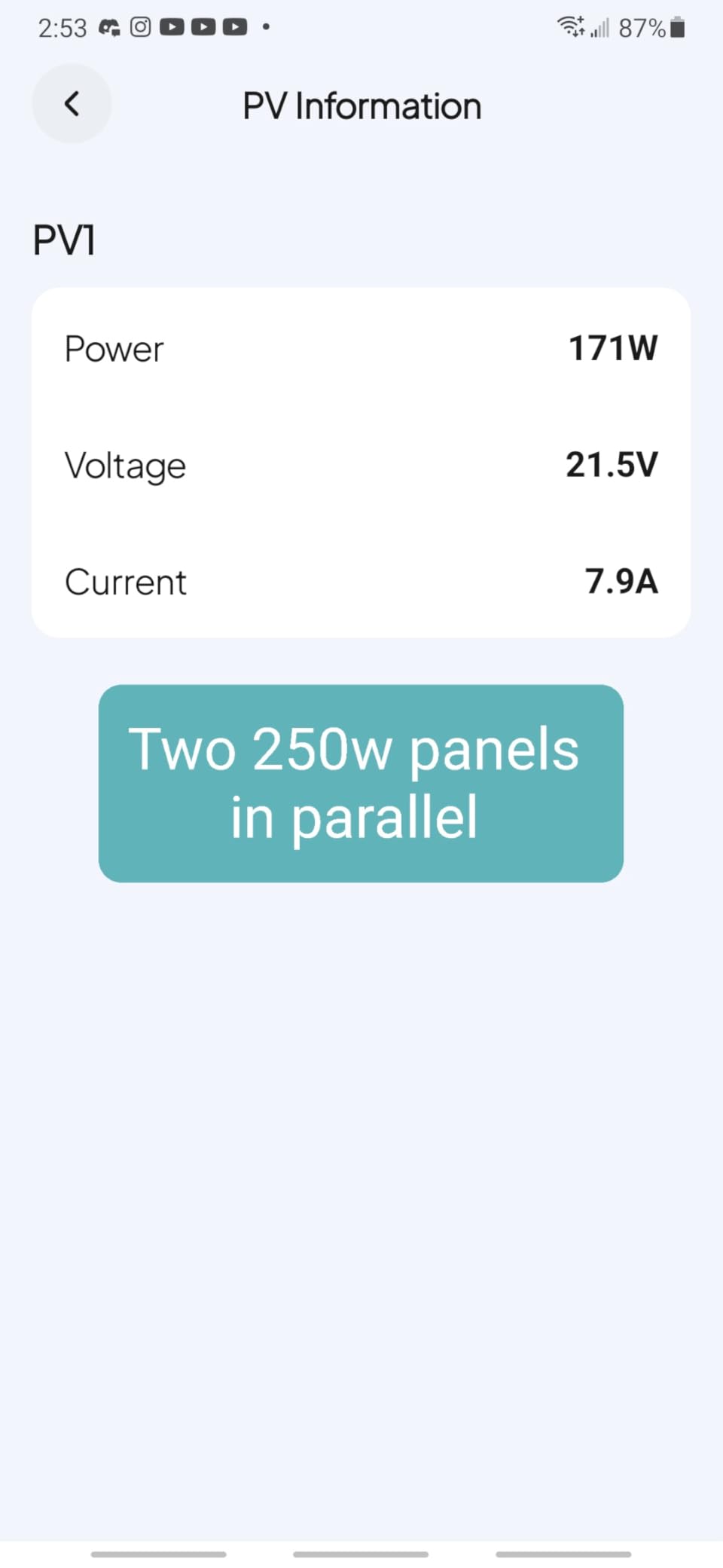
Where the AC180 earns its place
This is the station for a weekend or seasonal cabin where someone wants a fridge, lighting, internet and tools in one box without planning a roof array first. The 1800W continuous figure gives real headroom for a microwave or a hair dryer, and the 2700W power lifting mode is there for compressors and pumps.
If your cabin is a full-time residence, or you plan to run a well pump, a water heater or a portable AC, look at the expansion-capable models further down instead. The AC180 is not expandable, so 1152Wh is your ceiling.
Where the AC180 falls short
The wireless charging pad on top is the most commonly reported annoyance; owners describe it repeatedly losing the connection. Some parameters, including charging rate behaviour, can only be changed inside the app, which is a minor annoyance for anyone who prefers physical controls.
At 37.4 lbs it also marks the line between carry-on and carry-once. Buyers who need to move power between the cabin and the truck will find the 23.8 lb Jackery 1000 v2 easier to live with, at the cost of some capacity and output.
2. Jackery Solar Generator 1000 v2 with 200W Panel: The Lightest Complete Setup
Jackery Solar Generator 1000 v2 and 200W Solar Panel,1070Wh,1500W AC
1070Wh LiFePO4
1500W continuous, 3000W surge
23.8 lbs
Bundled 200W panel
Pros
- Lightest station here at 23.8 lbs with a foldable handle
- 1 hour emergency charge or 1.7 hours on the standard setting
- Reported to run a full-size fridge about 9 hours overnight
- Two separate 24V solar inputs for a second panel
- 30dB quiet charging mode
Cons
- Bundled 200W panel sags and needs propping up
- Short panel cable makes it hard to keep the station shaded
- One hour fast charge must be enabled in the app and shortens battery life
This bundle is the one I would hand to someone who wants a working off-grid setup on day one without buying a panel separately. You get the Explorer 1000 v2 with 1070Wh of LiFePO4, 1500W of continuous output with 3000W of surge, and a 200W folding panel in the same box. It is also far lighter than the other 1kWh units here, which matters when the path from the truck to the porch involves a step and a locked gate.
Charging options are genuinely flexible. Owners report about an hour on the emergency fast charge setting and 1.7 hours on the default mode, and the cell chemistry is rated to hold more than 70% of capacity after 4000 cycles, which puts a decade of daily use in reach for most cabins.
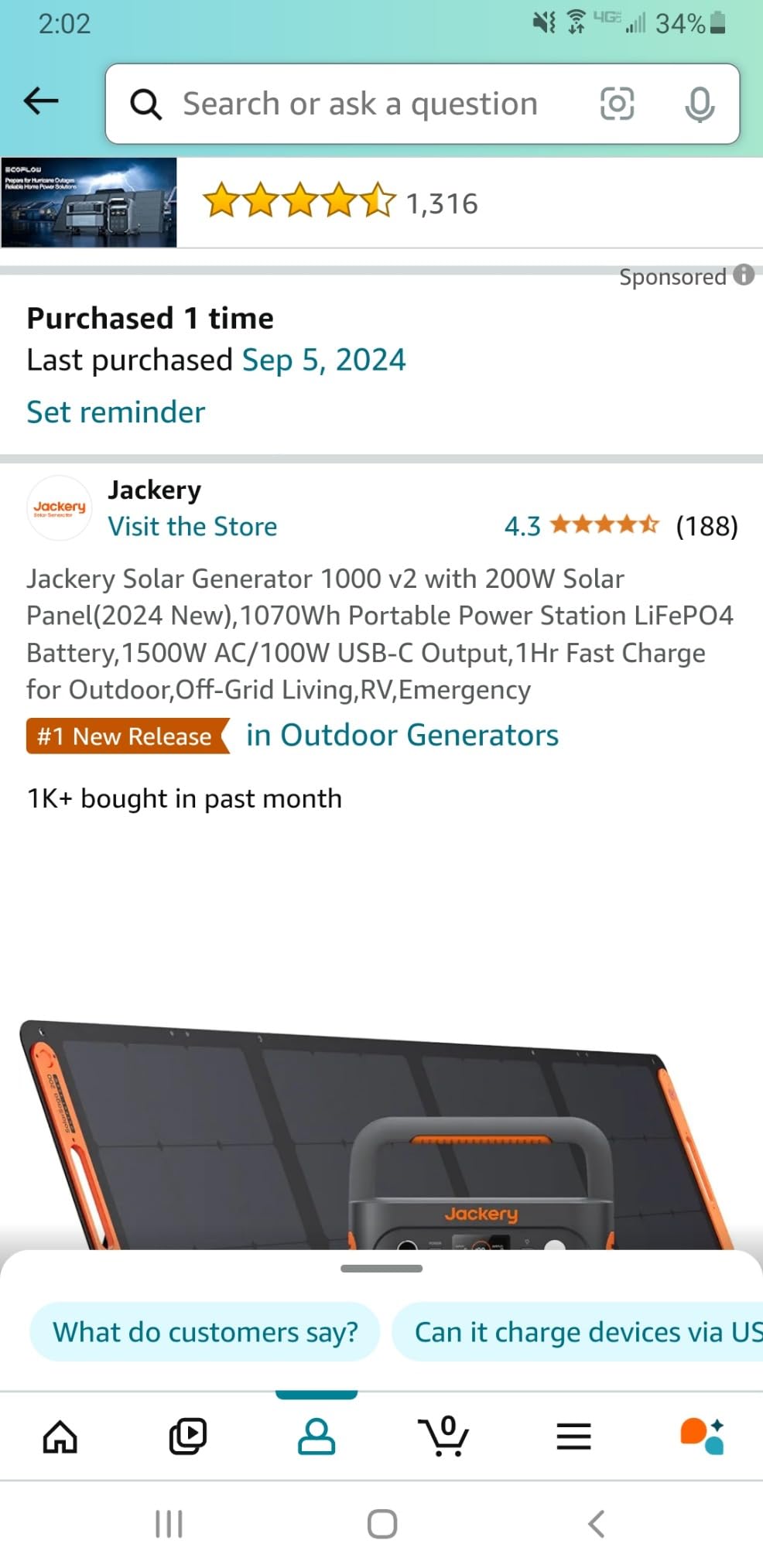
The fridge result is the number that matters for cabin life: multiple owners report running a full-size refrigerator for roughly nine hours overnight, then refilling during the day. The two separate 24V solar inputs are an underrated detail, because most 1kWh competitors give you one and force a splitter to add capacity later.
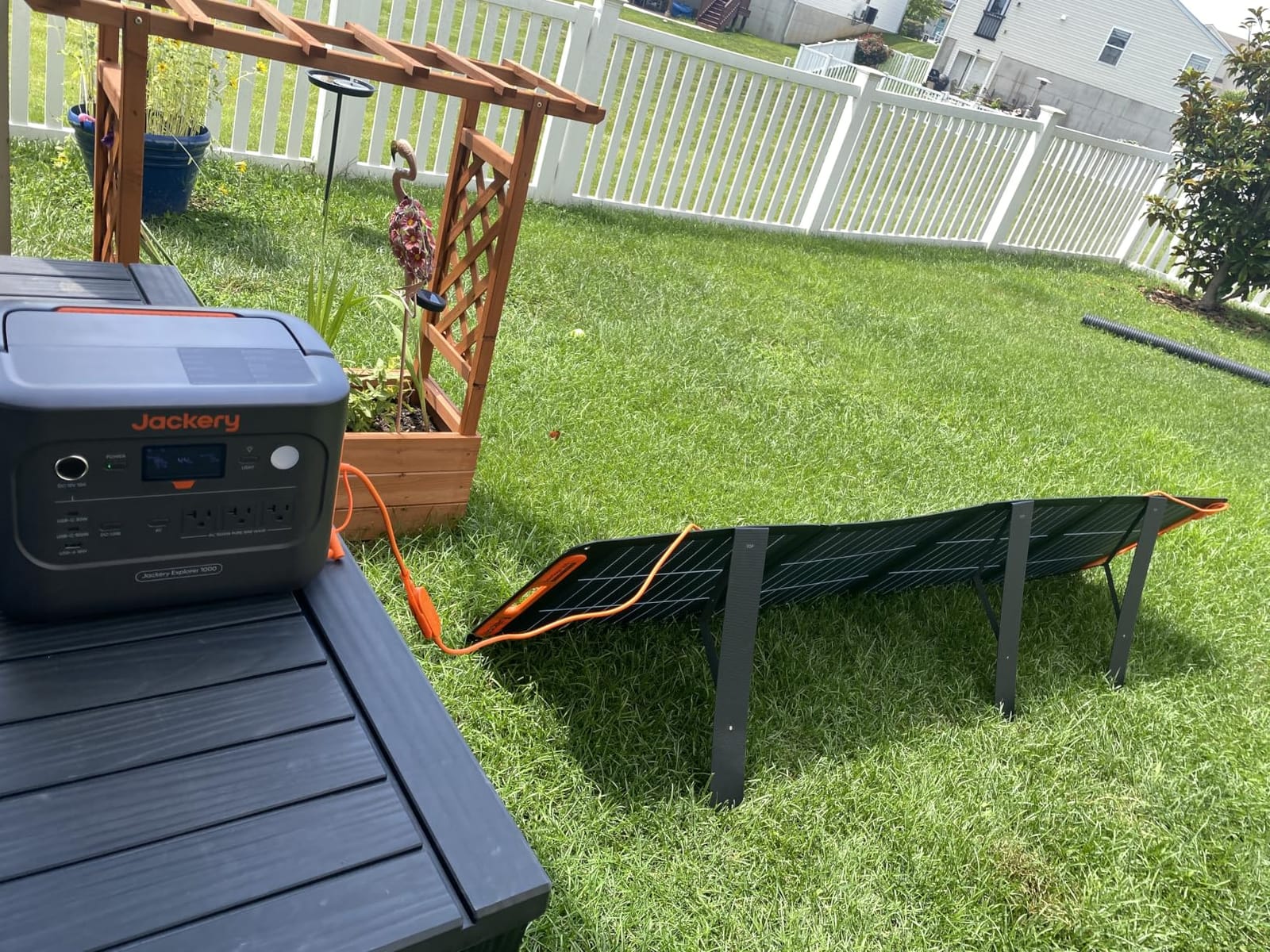
The bundled panel is where this bundle stumbles. Owners describe the 200W folding panel sagging in the middle, needing to be propped up and repositioned through the day, and the short lead making it awkward to keep the station itself in shade while the panel sits in sun. For weekend trips that is a fair trade. For a permanent cabin, plan on replacing it with a properly mounted panel.
Who should buy the 1000 v2 bundle
A cabin you drive to on Fridays and lock up on Sunday. One person carrying it in alone. A weekend load of a fridge, lights, a router, phone charging and a couple of power tools, with the panel refilling during daylight hours.
It is also a low-risk first purchase in the category, because the panel is included and the chemistry is rated for years rather than seasons. If you are nervous about committing to a rooftop array, this is a reasonable way to learn the system.
Who should look elsewhere
Anyone planning to live off-grid through winter. The 200W panel is too small to sustain a real load across a multi-day overcast stretch, and 1070Wh of storage will not carry heating. Full-time residents should start with an expansion-capable model.
Be aware the one-hour fast charge has to be switched on in the app and shortens battery lifespan, and Jackery’s customer support feedback is mixed, ranging from excellent to heavily criticised. The station itself is well liked; the support experience is the variable part.
3. EF ECOFLOW Delta 3 Classic: Smooth App Control and Easy Daily Handling
EF ECOFLOW Portable Power Station Delta 3 Classic, 1024Wh 1800W AC
1024Wh LiFePO4
1800W continuous, 3600W surge
500W solar
26.7 lbs
Pros
- 0-80% in about 45 minutes and full in roughly an hour
- Under 10ms UPS verified carrying a fridge between vehicle and battery
- Bluetooth pairing and app control described as smooth
- Absorbs low-wattage solar output efficiently
- Two top handles with non-skid pads and flared outlets
Cons
- 26.7 lbs is a two-hand carry
- Not compatible with DELTA 2 or Delta 3 Series extra batteries
- Solar alone may not sustain a fridge across multi-day overcast runs
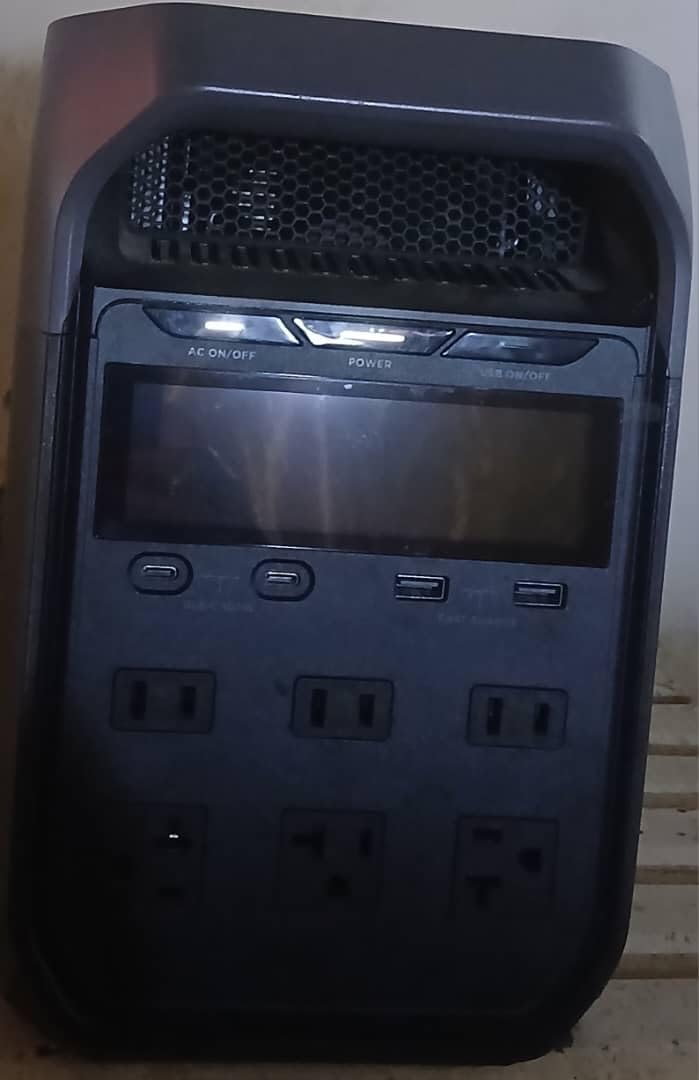
The Delta 3 Classic draws its reputation from how it behaves day to day rather than from raw numbers on the spec sheet. Owners consistently single out the charging speed, the quiet operation, the display and, above all, the app. Bluetooth pairing is described as flawless, and owners note the app schedules charging and monitors draw more smoothly than competing systems they have used.
On paper it is a well-balanced 1kWh machine: 1024Wh of LiFePO4, 1800W continuous, 3600W surge, and 2600W with X-Boost when you need to stretch a resistive load. Solar input is capped at 500W, which refills it in about 2.5 hours in good conditions.
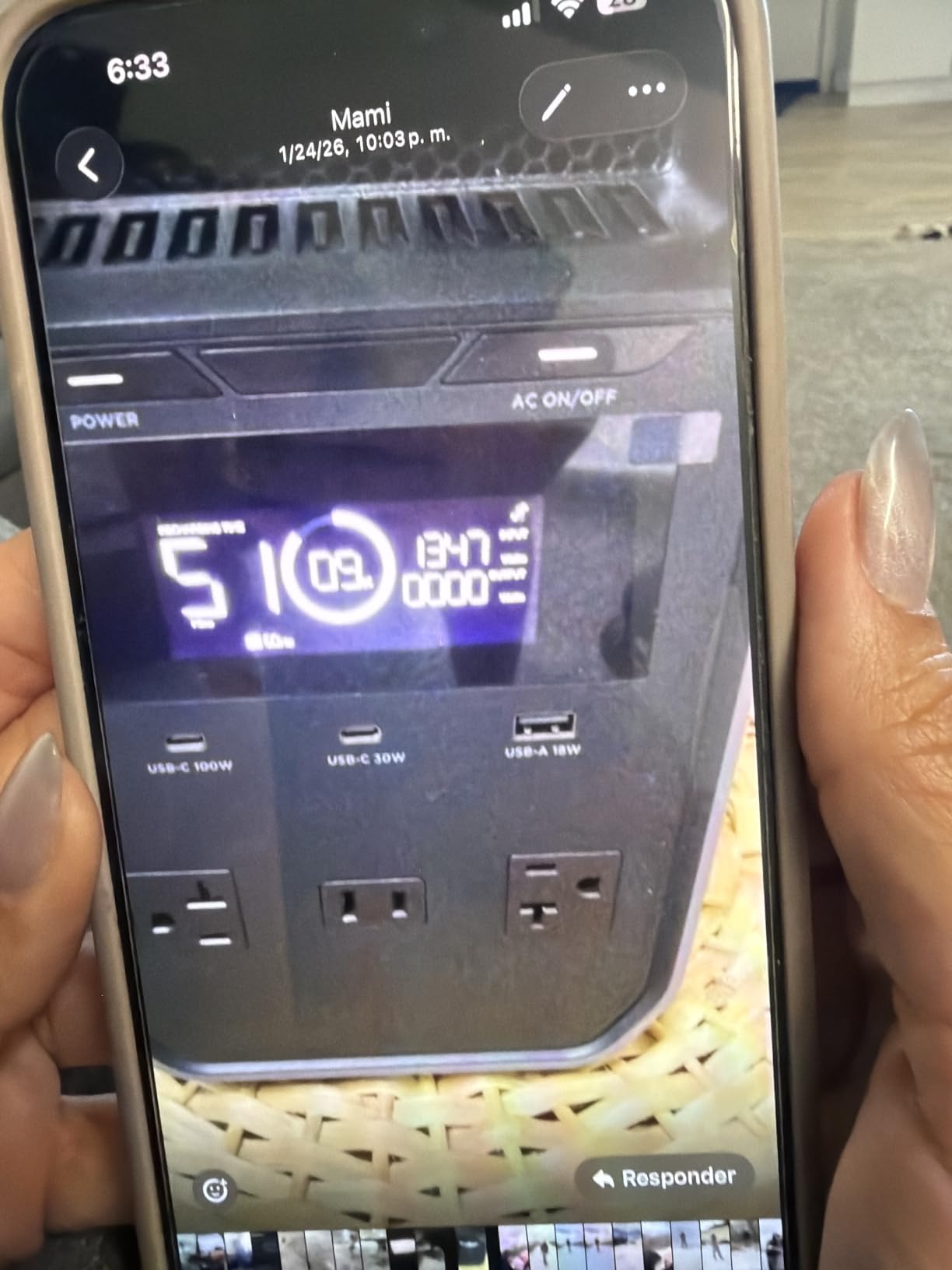
The sub-10ms UPS transfer is the sleeper feature for cabins. It has been verified in real use as a bridge between a vehicle and the battery, keeping a refrigerator running through the changeover, and that same behaviour makes it a solid backup for a router or a desktop in a home office that happens to be 40 miles from the nearest substation.
It also absorbs low-wattage solar output efficiently, which matters more than it sounds in winter or under tree cover, where a panel may be producing far below its nameplate rating. The physical design is thoughtful too, with two top handles, non-skid base pads and outlets flared so plugs never collide.
Why the Delta 3 Classic fits a cabin
It suits a cabin owner who wants a station they will actually touch. The app is reliable enough to check state of charge from inside the house, the display is clear, and the inverter has enough surge to start compressors rather than merely run them.
The sub-10ms transfer makes it a good companion to a vehicle or a small generator for a weekend, and 500W of solar is enough to sustain a modest weekend load once the array is set up.
Where it stops short
It is not expandable. It will not take the DELTA 2 Smart Extra Battery or the Delta 3 Series module, so 1024Wh is a hard ceiling and any growth has to come from a second unit or a different station entirely. That is the single biggest reason to skip it for a full-time cabin.
At 26.7 lbs it is a two-hand carry, and a small number of buyers report units arriving faulty or as open-box items from third-party sellers, so buying from a seller with straightforward returns matters here.
4. Anker SOLIX C1000 Gen 2: Ten Ports and Very Fast Recharge
Anker SOLIX C1000 Gen 2 Portable Power Station
1024Wh LiFePO4
2000W continuous, 3000W peak
600W solar
24.9 lbs
Pros
- Recharges from 83% to 100% in about 15 minutes and full in 49 minutes
- 2000W across 10 ports for a fridge plus CPAP plus laptop and router
- 10ms UPS reported working through a five-hour outage
- Accepts solar
- AC and car charging
- Quiet enough to sit in a room
Cons
- Second generation removed the expandability of the first
- Measured 15-20% harmonic distortion on a microwave
- No storage case included and many adapters to keep track of
The C1000 Gen 2 pairs fast recharging with a lot of ports, and for a cabin those two facts combine unusually well. A full recharge takes 49 minutes at 1600W once you enable HyperFlash in the app, and top-ups from 83% to 100% take about 15 minutes. Ten simultaneous outputs covers a load made of a dozen small devices rather than one big appliance.
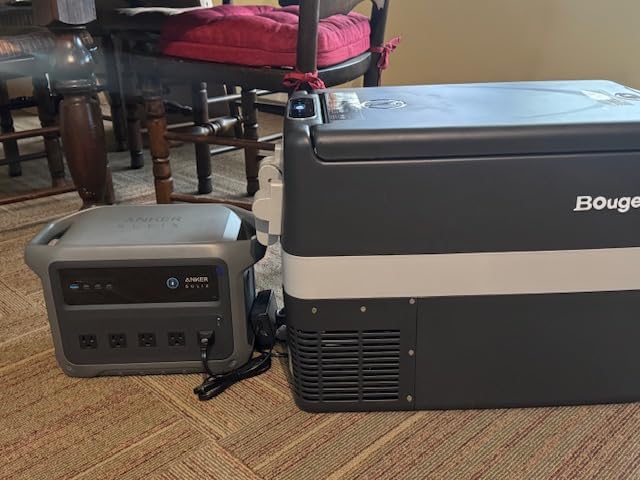
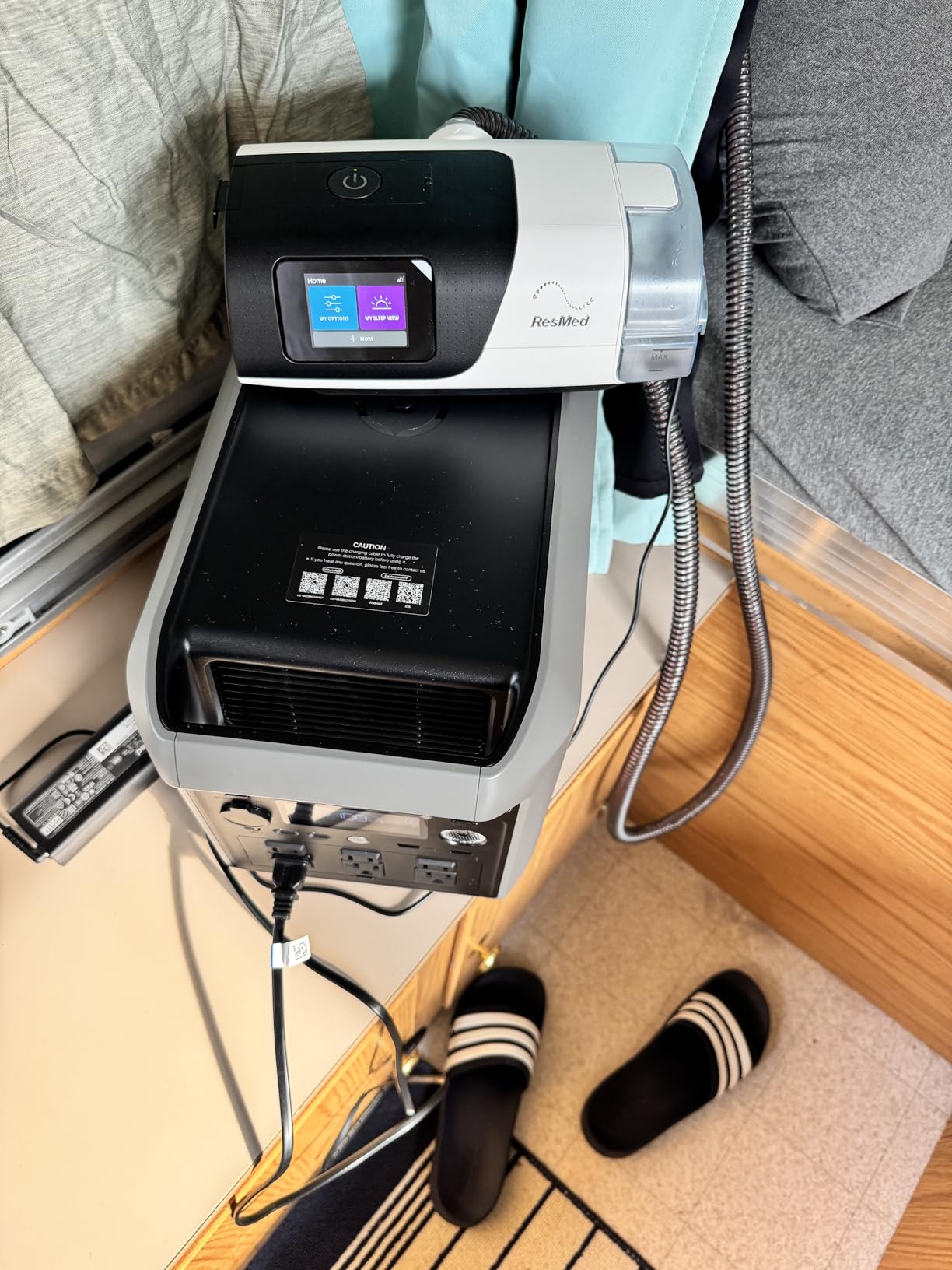
That port count is not a spec-sheet flex in a cabin. Owners run a refrigerator, a CPAP machine, a laptop and a router at the same time without hunting for an outlet, which is a realistic description of a household where someone works remotely and someone else is asleep.
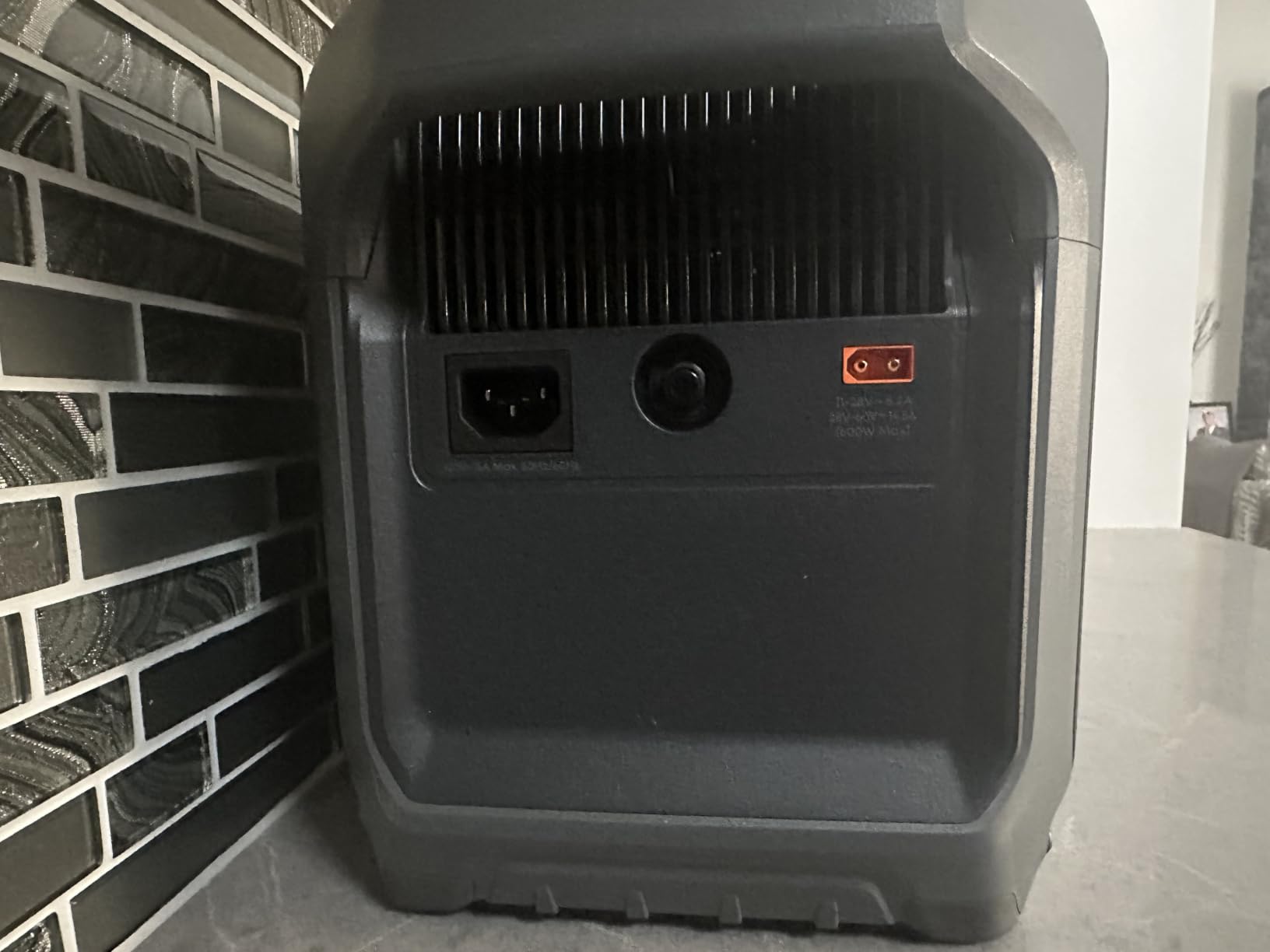
Solar input is generous for the 1kWh class at up to 600W and 60V max, giving a full solar recharge in about 1.8 hours. Several owners report carrying the station through multi-day ice storms on that charging speed, and the 10ms UPS mode has been reported working through a five-hour unattended outage.
The battery retains at least 80% of capacity after 4000 cycles, and Anker’s warranty service is described as responsive, including a full replacement for an early-generation defect. It is also quiet enough to be effectively inaudible in a room, which matters in a small cabin with thin walls.
Where the C1000 Gen 2 wins
A mixed-use cabin. This is the pick when the load is not one appliance but a dozen small ones, when the people there need to work online, or when a medical device such as a CPAP has to stay running through a power interruption.
It is also a good pick for a cabin that gets winter storms, because the fast recharge and the 600W solar ceiling mean a short weather window still produces a full battery.
Where it costs you
Gen 2 dropped the expandability of the first generation. For a cabin you plan to grow into, that removes the single most useful long-term feature in this class, and it is the reason this station is not our top pick despite its strong numbers.
Owners also report measured harmonic distortion of roughly 15-20% when powering a microwave, a loss of a few percent of charge while sitting unplugged for weeks, and no included storage case for the pile of adapters.
5. BLUETTI AC200PL: The Expandable Option for Full-Time Off-Grid Living
BLUETTI AC200PL Portable Power Station 2304Wh 2400W LiFePO4 Solar Generator
2304Wh LiFePO4, expandable to 8448Wh
2400W AC, 3600W lifting
1200W solar
72 lbs
Pros
- Expands to 8448Wh with B300 or B210P or B230 modules
- 0-80% AC recharge in about 60 minutes
- 30A TT30 plus a 48V RV port for mobile setups
- Excellent charge retention between uses
- Runs nearly everything a cabin needs from tools to RV charging
Cons
- Heavy at 72 lbs
- effectively a fixed installation
- Bulkier than other 2kWh stations in the same power class
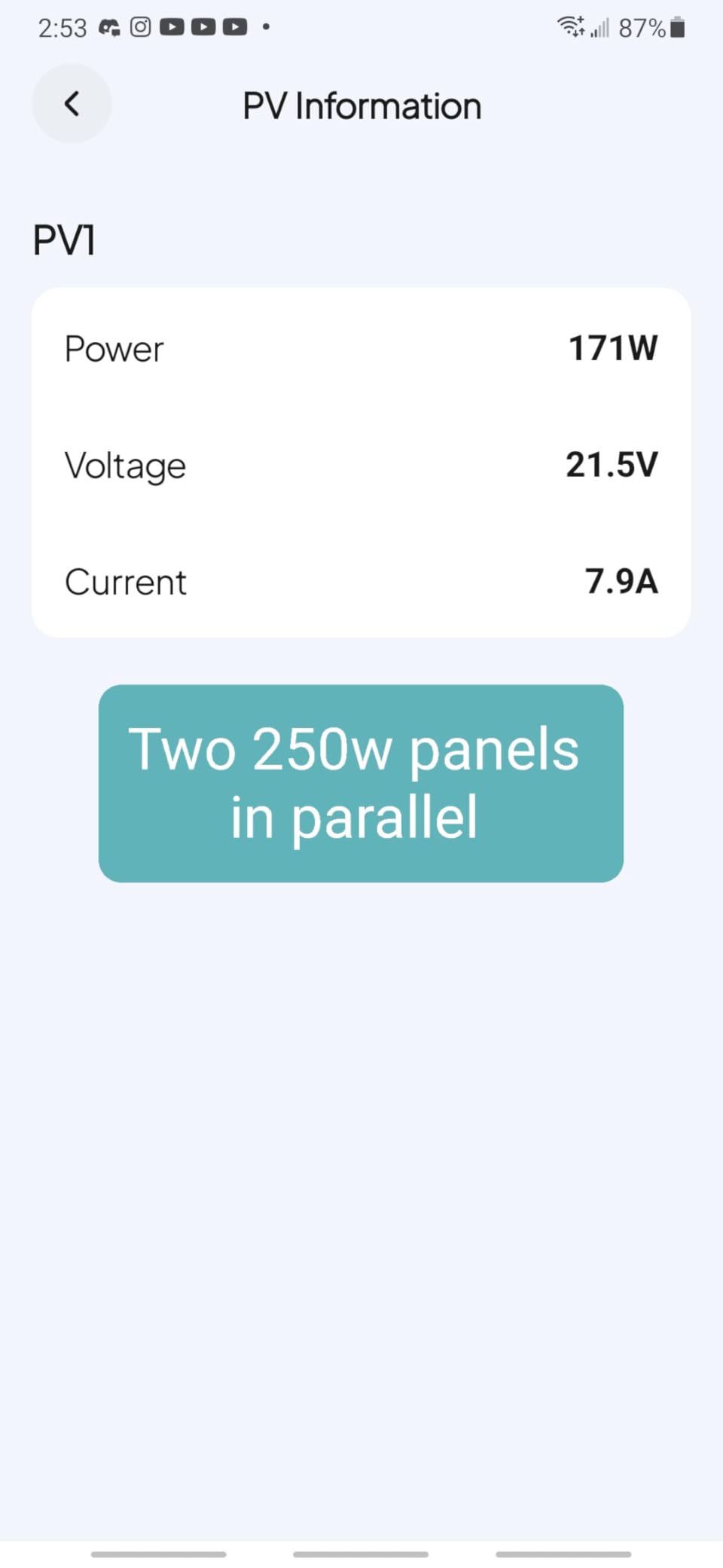
The AC200PL is the model I would build a full-time cabin system around, and the reason is the expansion path rather than the base specification. It ships with 2304Wh of LiFePO4 and expands to 8448Wh with B300, B210P or B230 modules, which is enough growth to move from a weekend load to something resembling year-round living without replacing the unit.
Base capability is 2400W of continuous AC across four outlets with 3600W of lifting power, plus 1200W of solar input that refills it in 1.9 to 3.8 hours. Charging from a wall outlet takes 0-80% in about 60 minutes on 2400W input, so a top-up on a rainy afternoon is realistic.
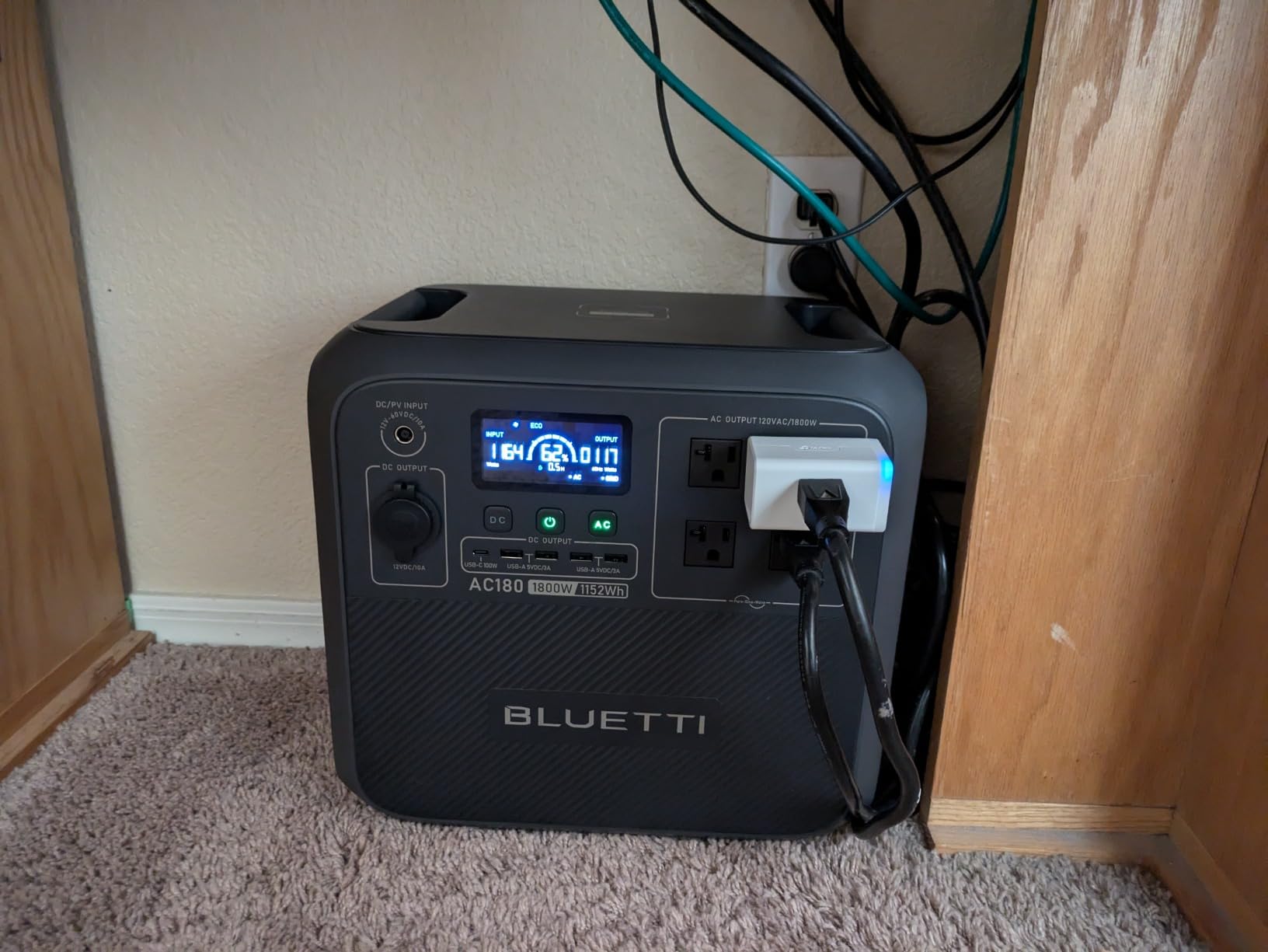
Owners consistently describe it as running essentially everything a cabin needs, from power tools to charging an RV battery, and they single out good charge retention between uses, which matters when a battery sits at partial charge through an overcast week. The display is bright and the controls are straightforward.
The port set suits a cabin unusually well. A 30A TT30 outlet and a 48V RV port alongside two 100W USB-C ports, two USB-A, a 12V car port and DC outputs mean you can wire in an RV, a trailer or a bench full of tools without an adapter bag.
Who this is for
A full-time or near-full-time residence. If your load list includes a well pump, a water heater, a freezer, power tools and a refrigerator, the 2400W continuous output and the 3600W lifting window are the numbers that keep a compressor or a pump from tripping the inverter on startup.
It is also the right unit for a cabin that will grow, because the expansion modules are the same chemistry and the same brand, which removes the compatibility guesswork that comes with mixing systems.
What you accept for it
Weight. At 72 lbs this is a semi-permanent installation, not a portable power station, and it is bulkier than other 2kWh machines at similar output. Budget for a permanent shelf or a small equipment pad near the array.
Because 2400W is a fixed ceiling on continuous output, a large resistive appliance such as a room air conditioner will eat a large share of the budget. Size heating separately, usually by wood or another route, and let the battery cover refrigeration, lighting, water and tools.
6. BLUETTI Elite 200 V2: Near 2kWh of Capacity in a Smaller Package
BLUETTI Elite 200 V2 Portable Power Station 2073.6Wh 2600W Solar Generator
2073.6Wh LiFePO4
2600W continuous, 3900W lifting
1000W solar
53.4 lbs
Pros
- Roughly 2kWh in a package near the size of the smaller AC180
- 2600W inverter with 3900W lifting runs air fryers and tools together
- Standby draw of about 10W measurably extends runtime on small loads
- 6000+ cycle cells with a 17-year lifespan claim
- Reported to handle being hauled through snow
Cons
- Not expandable with BLUETTI battery modules
- 1000W solar ceiling with a 60V MPPT limit
- No 30A RV output and no 5521 ports
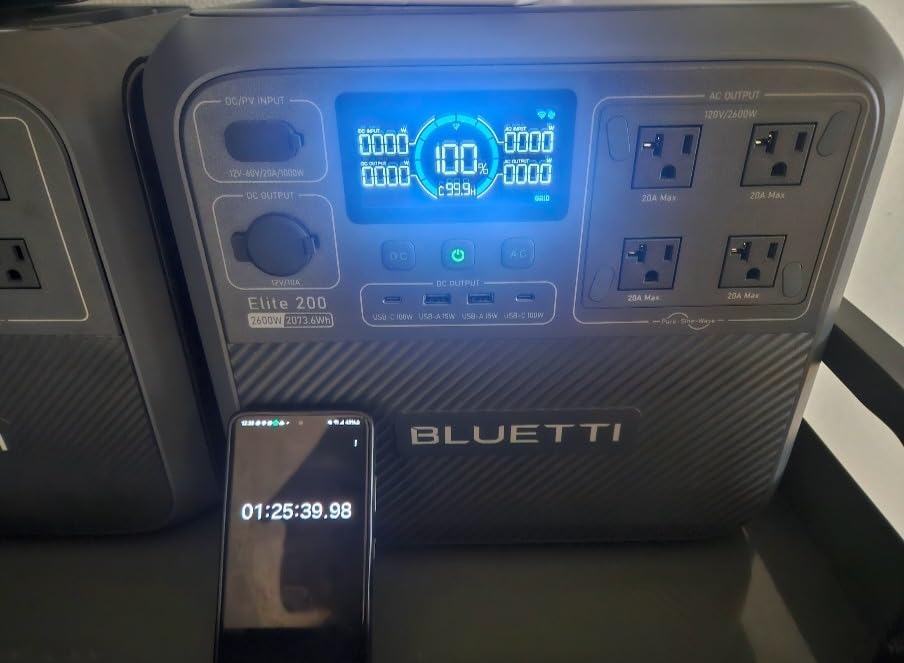
The Elite 200 V2 solves a problem none of the other 2kWh units here solve well: it puts close to AC200MAX capacity into a package about the size of the much smaller AC180. Owners describe the trade directly, near-full 2kWh in a box that is far more portable than the older AC200L, at 53.4 lbs rather than something closer to 70.
On paper it is a strong inverter for the mid-size group. 2073.6Wh of automotive-grade LiFePO4 delivers 2600W continuous with 3900W of lifting power, and that extra headroom is what owners rely on to run air fryers, microwaves, induction cooktops and power tools, sometimes several at once.
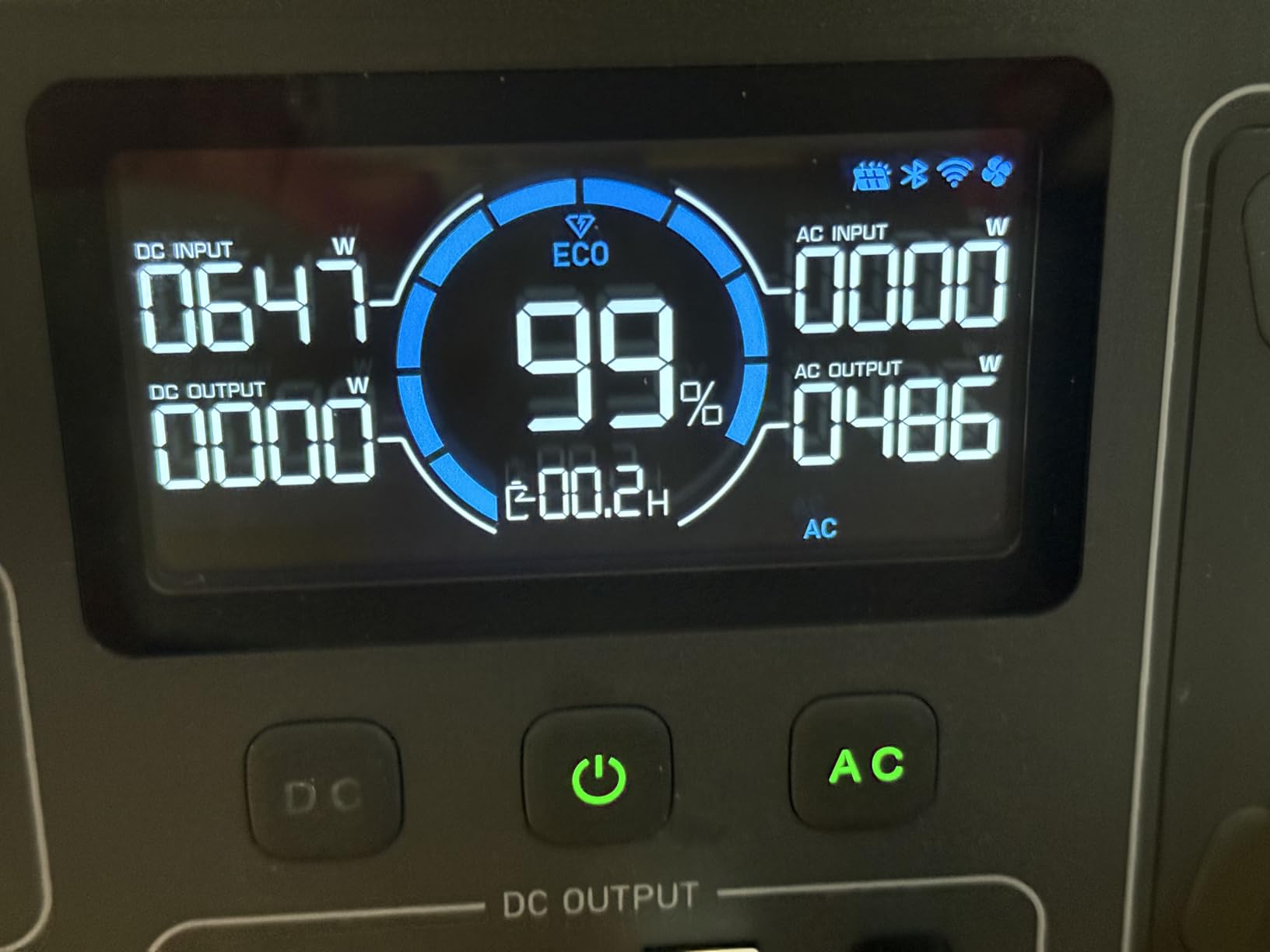
The detail I would build a small-load system around is the standby draw. At roughly 10W, about three times lower than comparable units, a cabin running mostly LEDs, a router and a laptop gets noticeably more usable hours from the same battery. Charging is fast too, with 0-80% in about 50 minutes on dual AC and DC input and a full solar charge in about 2.4 hours on 1000W.
Durability reports are encouraging. Owners describe hauling it through snow and finding it still predictable afterwards, and the app supports local Bluetooth control without requiring a cloud account, with firmware updates resolving an issue in minutes.
Where it beats the competition
It wins on density and on small-load efficiency. If your cabin is lightly used most days and heavily used on weekends, or if getting a 2kWh unit down a set of cabin stairs is the real constraint, this is the machine that fits.
The 2600W inverter also gives a well pump or a microwave room to start without dropping everything else.
Where the Elite 200 V2 disappoints
No expansion. Unlike the AC200PL it will not take BLUETTI battery modules, so 2073.6Wh is a ceiling. For a cabin owner planning to grow the system, that is a serious limitation and the reason it does not lead the category.
Solar input is capped at 1000W with a 60V MPPT limit, meaning the maximum solar input is hard to reach in practice with some array configurations. There is also no 30A RV output and no 5521 ports, the rubberised buttons are harder to press than the tactile buttons on the AC180, and one owner reported the charge gauge stalling near 25% until a full calibration cycle.
7. EF ECOFLOW DELTA 3 Max: 0-80% in About 1.13 Hours
EF ECOFLOW DELTA 3 Max Portable Power Station, 2048Wh LFP Battery, 2400W
2048Wh LFP
2400W, 3400W X-Boost
sub-10ms transfer
5-year service
Pros
- 0-80% recharge in about 1.13 hours with X-Stream
- 3400W X-Boost for resistive loads like a kettle
- Under 10ms transfer keeps computers and medical devices running
- Described as light and easy to move between home and RV
- Ultra-quiet operation for indoor and overnight use
Cons
- Only 3 power outlets
- fewer than rivals at this capacity
- Newer listing with a smaller base of customer reviews
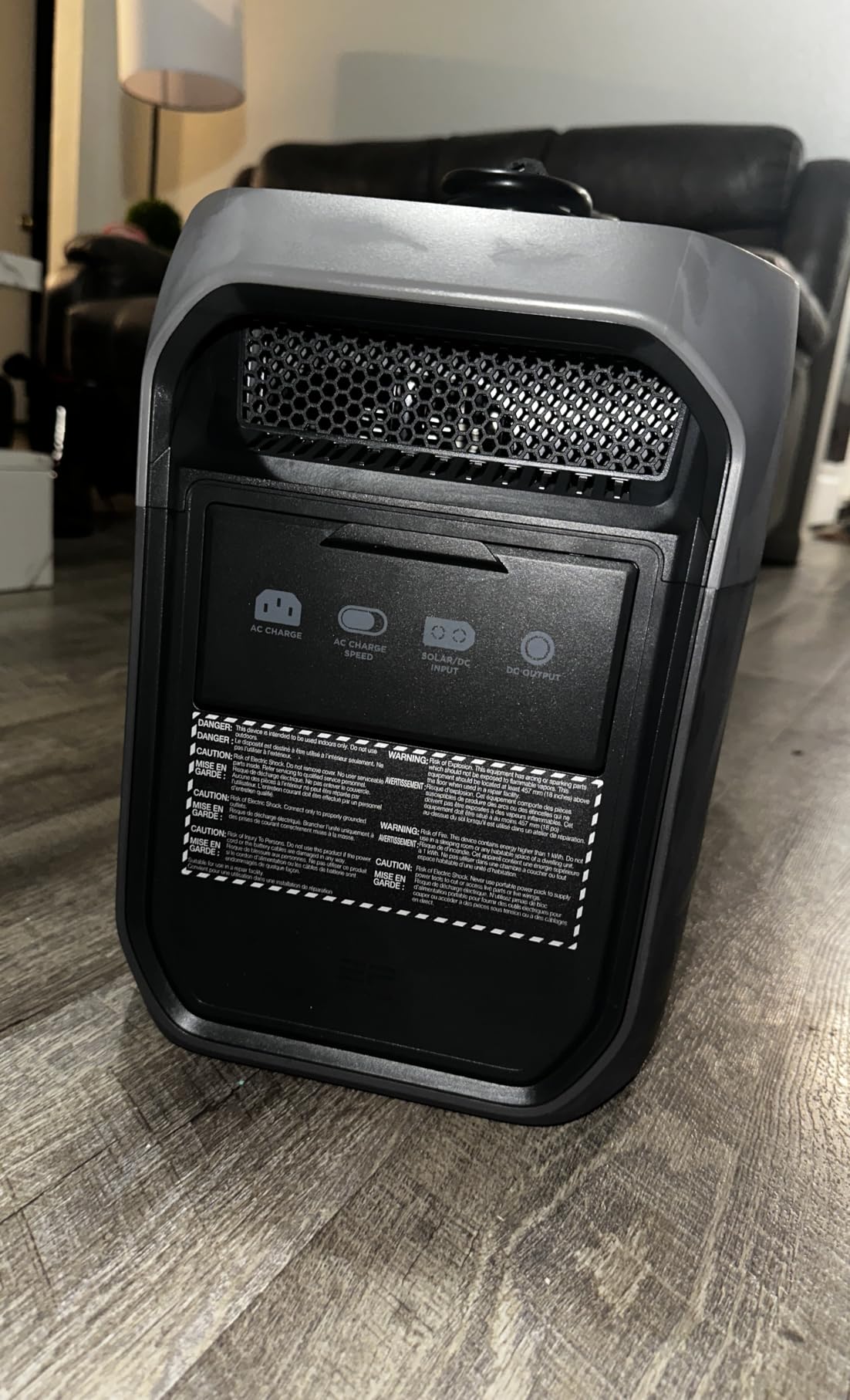
The DELTA 3 Max does one thing faster than most others in this group: it goes from empty to 80% in about 1.13 hours on a wall outlet. For a cabin that has a working grid connection and only needs the battery to cover outages, or for anyone driving to the property regularly, that charging speed is the entire argument.
Under the hood it is a 2048Wh LFP battery feeding 2400W of output, with X-Boost pushing that to 3400W for resistive loads like a space heater or a kettle. Transfer time for backup is under 10ms, which keeps computers and sensitive electronics running through an outage without a reboot.
Two things make it pleasant to live with. It is described as quiet enough for overnight indoor use, so it can sit in a main room rather than a shed, and the build is light enough to move between a home, an RV and a campsite without a second person.
The battery is engineered for 10 years of daily use and carries a 5-year service commitment, with the EcoFlow app handling monitoring, usage scheduling and charge and discharge timing around off-peak rates.
Where the DELTA 3 Max fits
A grid-tied cabin with battery backup, or a property where the station spends most of its life plugged in. Owners who need to fill it between visits get a refill time few rivals match in this class.
It is also a sensible second unit for someone who already runs a smaller station, because the output headroom covers a microwave and a fridge together without the inverter complaining.
What to weigh first
Three outlets is the number to weigh first here. That is a low count at a 2kWh capacity, and it is why owners looking for more connections point to the DELTA 3 Classic or the DELTA Pro instead. A cabin with a fridge, a router, a lamp and a laptop already fills three sockets.
The listing is also newer with a smaller base of customer reviews than the established models here, so there is less long-term field history to lean on. Judge it on the fast recharge and the quiet operation, and buy from a seller with easy returns.
8. EF ECOFLOW DELTA Pro: The Whole-Cabin Backup Anchor
EF ECOFLOW Portable Power Station 3600Wh DELTA Pro, 120V 3600W AC Output
3600Wh LFP, expandable to 25kWh
3600W AC, 4500W X-Boost
15 outlets
99 lbs
Pros
- 3600W across five AC outlets handles heavy loads with no voltage drop
- Full recharge in 1.8 hours on a 240V outlet
- Expands from 3.6kWh to 25kWh
- Quiet enough to replace a gas generator for long stretches
- Covered a multi-day outage running a fridge and furnace blowers
Cons
- Solar input limited to about 15 amps
- 99 lbs and needs the extendable handle
- Can trip a breaker on the outlet it is plugged into on first use
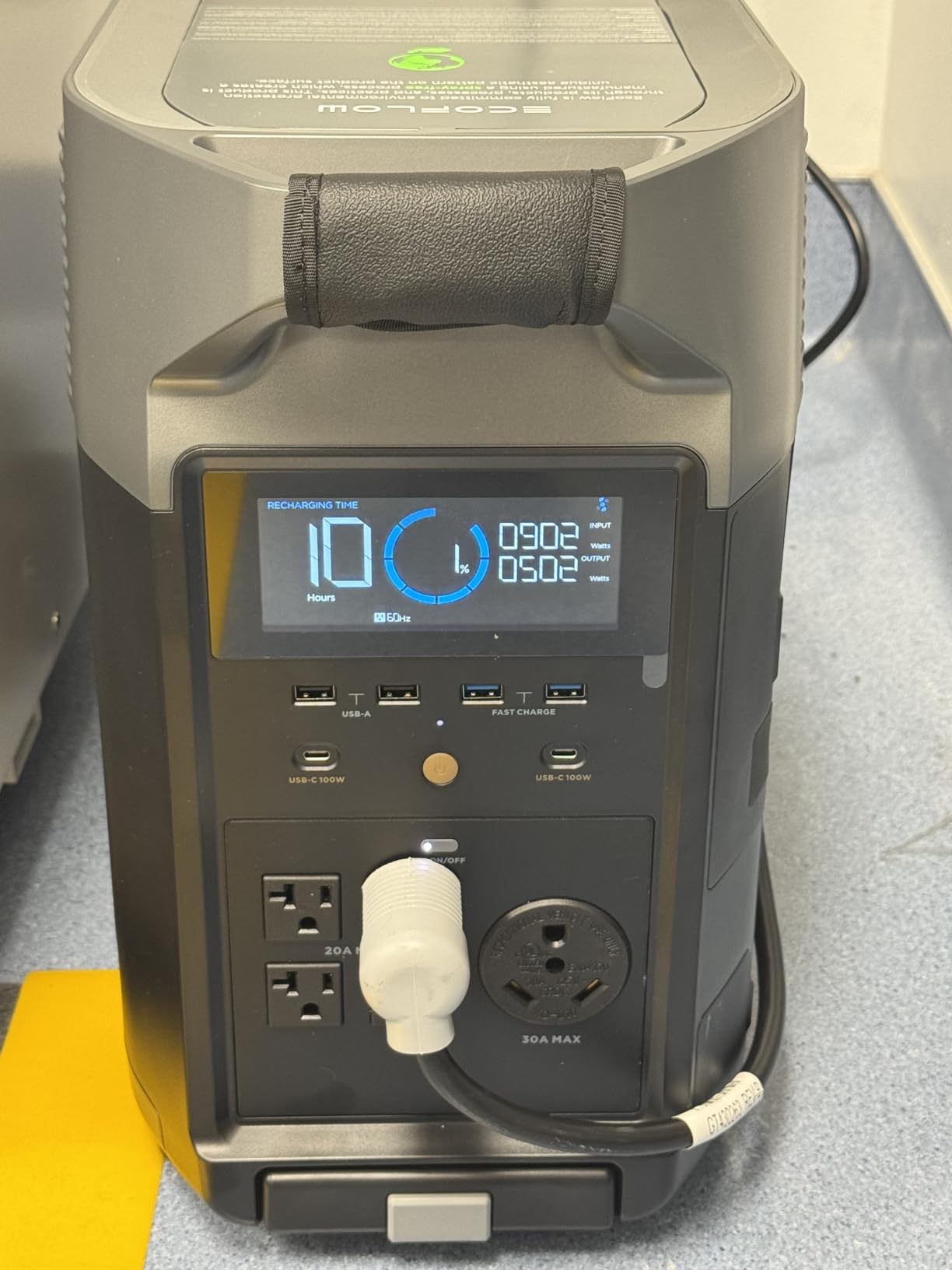
The DELTA Pro is the scale jump in this list. It carries 3600Wh of LFP and expands to 25kWh with extra batteries or a smart generator, which is a genuinely different category of reserve from anything else here. One owner describes covering a multi-day outage that included a refrigerator, propane furnace blowers, lights, internet and computers for roughly 15 hours before a generator recharge.
Output is 3600W continuous, 4500W with X-Boost, and 7200W when two units are paired. Fifteen outputs cover the load: five AC outlets, two 100W USB-C ports, USB-A pairs, DC outputs, a car port and an Anderson port.
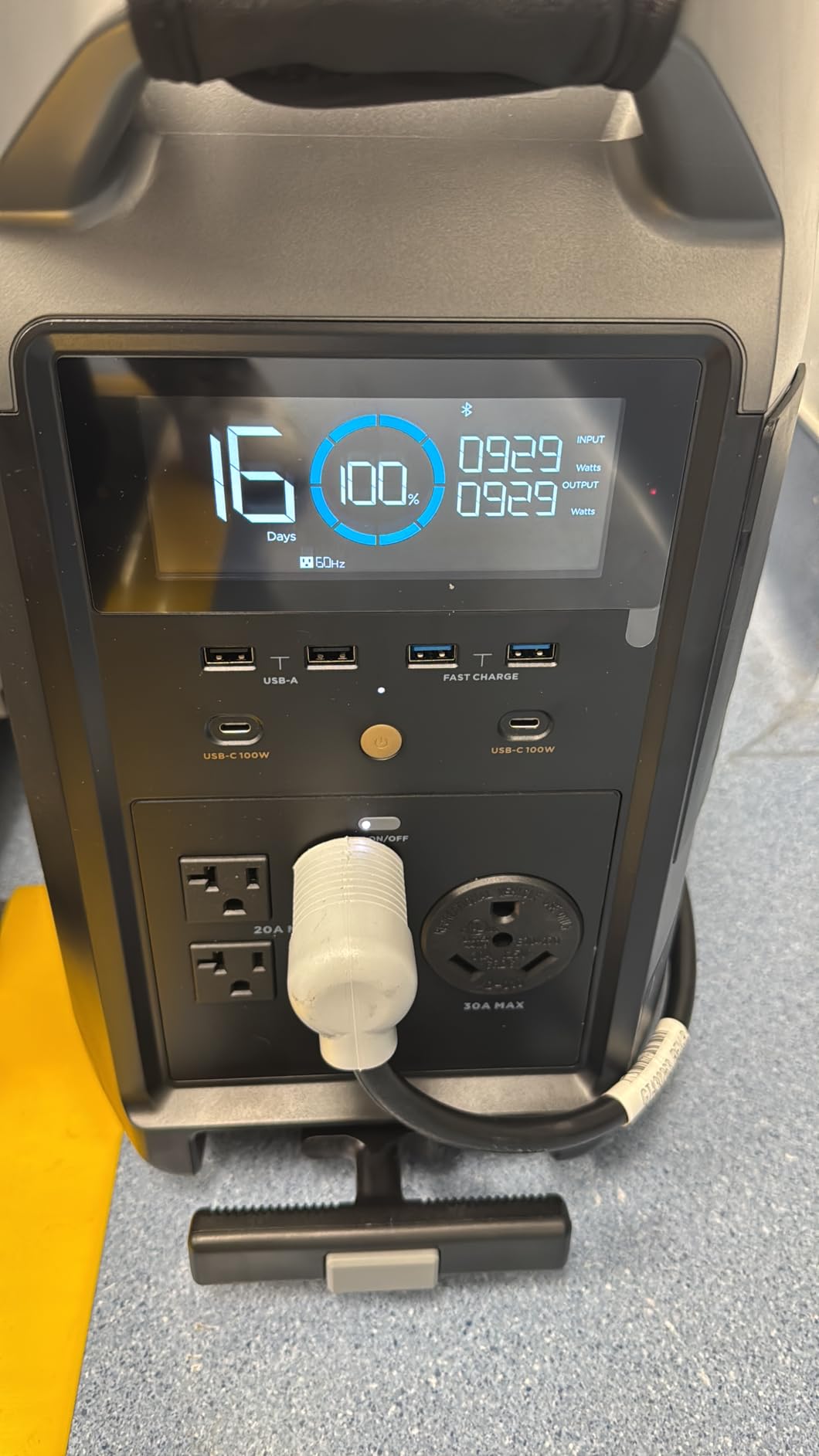
Recharging is unusually flexible. A full charge takes 1.8 hours on a 240V connection at 3000W, 2.7 hours on a standard 1800W wall outlet, and about 2.8 hours from four 400W solar panels at up to 23% conversion efficiency. Owners also report fully recharging it from a gas generator, which is a useful bridge while a permanent array is being installed.
Heavy loads are where this unit earns its place. Owners run heat presses and other high-draw equipment with no voltage drop, and several describe it as quiet enough to take the place of a gas generator for extended periods.
Why a full-time cabin lands here
If you want a station that can carry a household through a storm and still have capacity left for the next day, this is the shortlist. The 3600Wh base, 15 outlets and five AC sockets mean you stop negotiating for plug space, and the expansion path means the same unit can grow with the property.
It is also a natural companion to a propane furnace, since owners report running the furnace blowers off it, which spreads a heating load that would otherwise overwhelm a small inverter.
What to plan around
The 15 amp solar ceiling is the real constraint. It caps how large an array you can attach, so a cabin planning serious solar generation should confirm the array size before committing, or plan to feed the battery from a generator alongside the panels.
At 99 lbs it needs the extendable handle and a clear floor path. Some owners also report it tripping a breaker on the outlet it is first plugged into, and a few third-party buyers describe warranty friction and error codes, so keep the purchase documentation and use a direct seller.
9. Jackery Explorer 2000 v2 with Two 200W Panels: Solar in the Box
Jackery Explorer 2000 v2 and 2x200W Solar Panels, 2042Wh, 2200W AC Output
2042Wh LiFePO4
2200W AC across 3 ports
Two 200W panels included
39.5 lbs station
Pros
- Two 200W panels bundled for 400W of generation out of the box
- Compact build at 39.5 lbs for the station alone
- 0-80% AC charge in about 66 minutes
- Silent 30dB mode with a full charge in 5 hours
- 20ms switchover UL1778 test certified
Cons
- Bundle carries a premium versus buying station and panels separately
- Plug swap needed to connect the panels correctly
- Station and panels arrive in separate packages
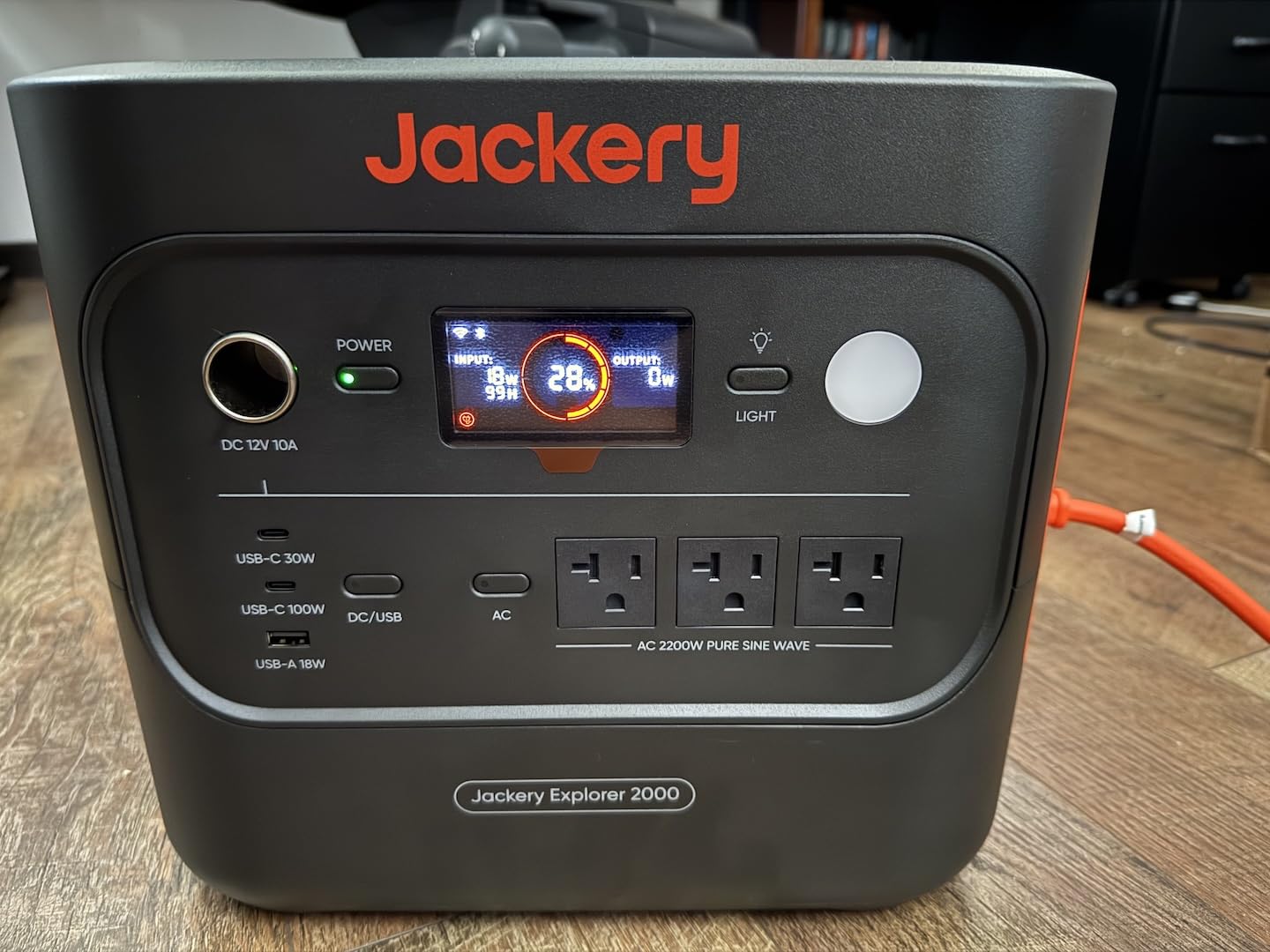
The Explorer 2000 v2 bundle is the quickest route I know to a working 2kWh cabin system with real solar generation attached, because it ships with two 200W panels rather than a token single panel. Four hundred watts of generation from day one changes the arithmetic: a 1kWh unit with one 200W panel spends most of a winter day catching up, while this one can meaningfully refill.
Capacity is 2042Wh of LiFePO4 with 2200W of AC output across three ports, plus a 100W USB-C PD port. Wall charging takes 0-80% in about 66 minutes, or 102 minutes with Emergency Super Charging enabled in the app, and the panels refill the battery in about 6 hours.
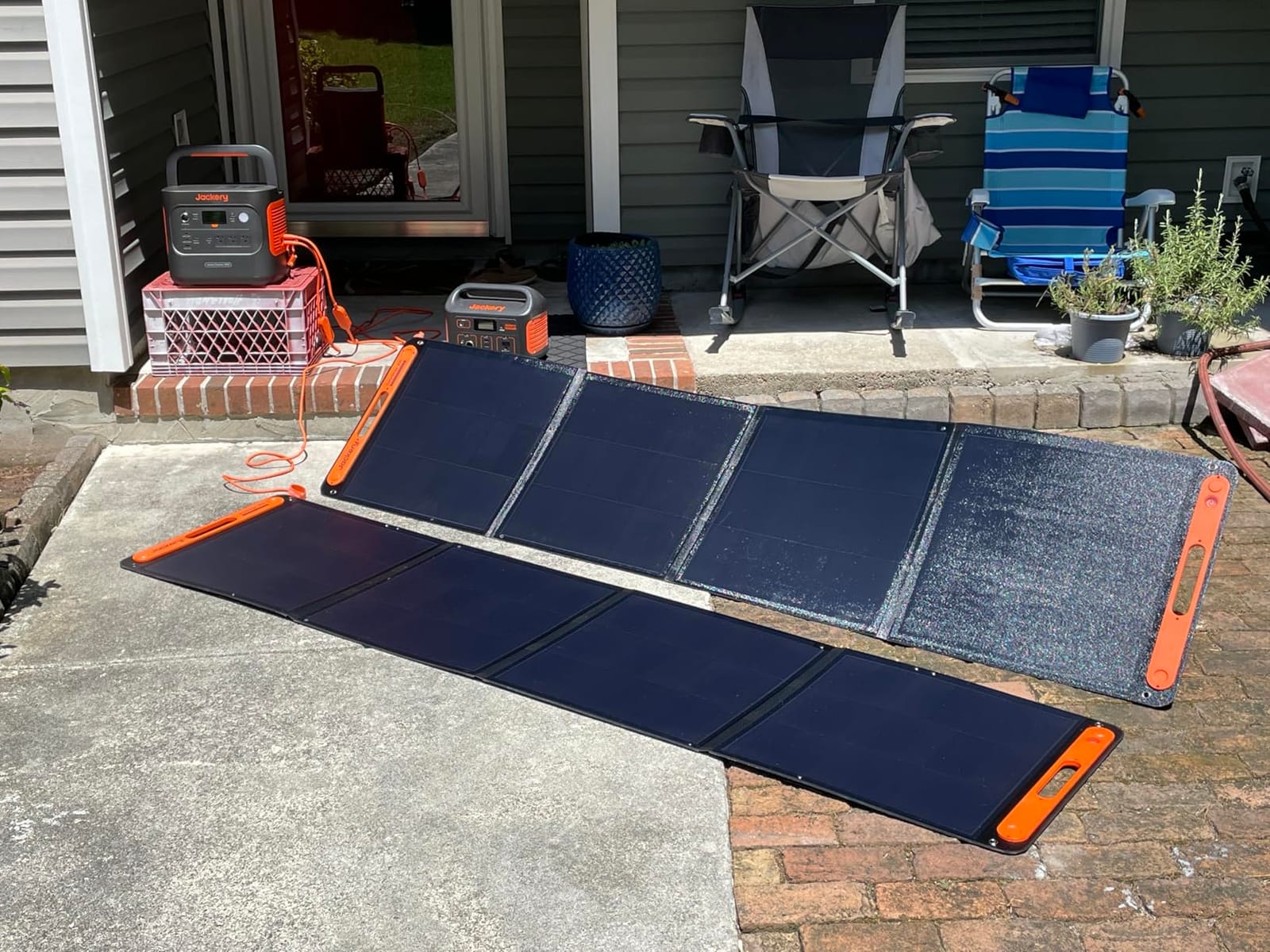
For its size it is compact, at 39.5 lbs for the station on its own and 41% lighter and 34% smaller than conventional 2kWh LiFePO4 designs. The silent charging mode runs at 30dB and completes a full charge in five hours, which means the station can live in a bedroom or a sleeping cabin without waking anyone.
It also carries a 20ms UPS switchover certified to the UL1778 test, keeping critical devices running through grid disruptions, and the LiFePO4 chemistry is rated for up to 10 years of service with no exhaust output of any kind.
Where this bundle works
A permanent cabin in the early stages, where you want meaningful solar generation immediately but do not want to design a rooftop array first. Four hundred watts will carry a refrigerator, lighting and a router for a weekend, and it will top up slowly on overcast days rather than not at all.
It is also a good fit for anyone who values low charging noise, since the 30dB mode is among the quietest sustained charging options available.
What the bundle costs you
Bundles usually carry a premium, and owners here specifically note the cost against buying the station and panels separately. Do the arithmetic before assuming the bundle is the cheaper path, especially if you already own panels.
There is also a practical friction: connecting the panels correctly requires swapping the L-shaped DC7909 plug for the straight DC8020 plug, and the station and panels arrive in separate packages, so plan the setup day accordingly. The 2200W output is also unremarkable next to rivals of the same size.
10. Anker SOLIX S2000: The Efficiency Champion for Fridge-Heavy Cabins
Anker SOLIX S2 Portable Power Station, 2,010Wh, 1,500W
2010Wh LFP with 314Ah cells
1500W continuous, 3000W peak
6W idle draw
35.7 lbs
Pros
- Idle draw of only about 3W in UPS mode
- Real fridge runtime of 33-35 hours verified by owners
- Compact 2kWh build at 35.7 lbs
- Dual-sided outlets for always-on appliances
- Whisper quiet with charging down to 100W
Cons
- No 12V DC port on this model
- Cooling fan drones loudly while charging at 1200W
- 1500W continuous output is lower than rivals at the same capacity
The SOLIX S2000 is the pick if your cabin’s defining load is a refrigerator and you want it to run as long as physically possible between sunny days. Its idle draw is the headline: about 6W, and closer to 3W in UPS mode, which owners credit with running roughly 20% longer than other 2kWh systems on the same battery.
That efficiency shows up in a number you can actually test. Multiple owners independently report 33 to 35 hours of refrigerator runtime from a full charge, against a manufacturer figure of up to 35 hours. The cells are 314Ah units rated for 10,000 cycles with a 15-year lifespan claim.
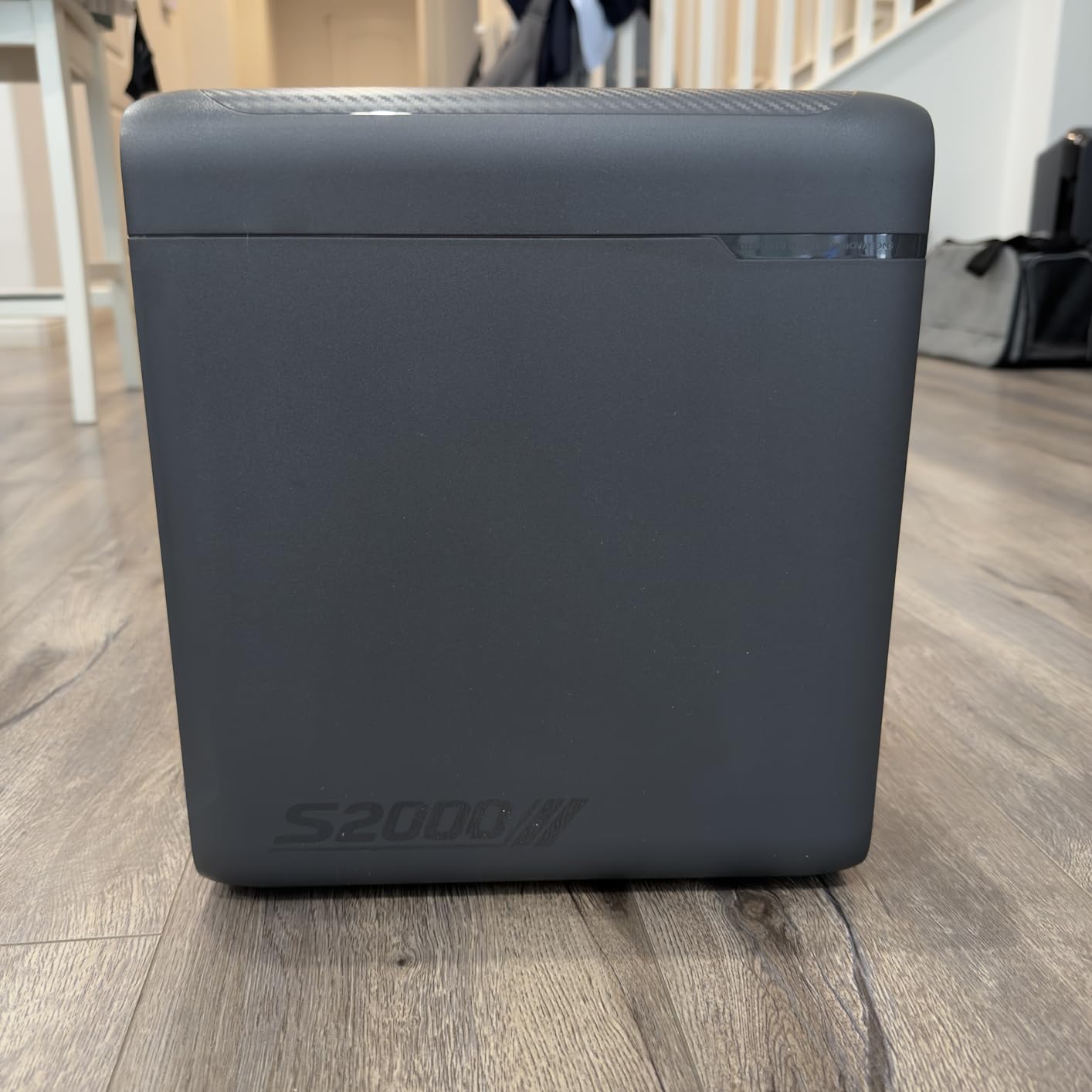
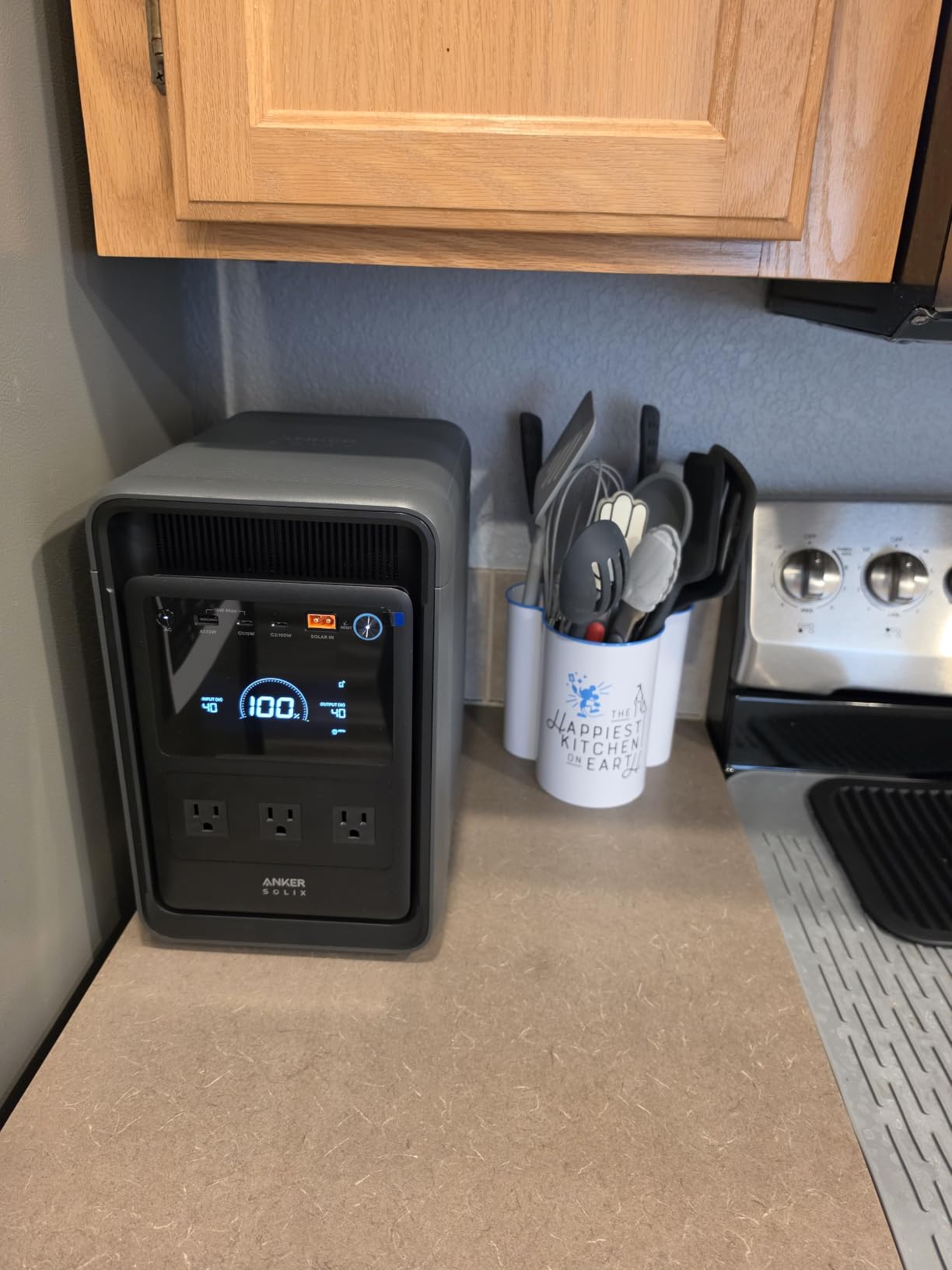
The physical design is unusually cabin-friendly. It is a compact 2kWh unit at 35.7 lbs and 8.19 by 11.1 by 12.7 inches, so it fits under a table or in a closet in a small cabin where a bulkier unit would not. The dual-sided outlet layout lets always-on appliances sit neatly on the rear while you plug in at the front, which keeps a working kitchen area tidy.
Recharging covers six paths including up to 400W solar, AC, a generator, an alternator charger and a car outlet, and the Anker app offers granular charge and discharge limits, time-of-use scheduling and energy tracking.
Why it suits a low-draw cabin
Fridge, freezer, LED lighting, router, phone charging. A load like that is where standby efficiency matters most, and this station is built for it. If heating and water are handled another way, this may be all the battery you need.
At 35.7 lbs it is light enough to move between storage spaces, so a small cabin or a cabin with a narrow staircase is a realistic installation site.
Where it runs out of room
1500W continuous is a modest ceiling for a 2kWh battery. A microwave, a hair dryer and a kettle at the same time will find the limit, and anything with a large compressor needs surge headroom, which is available to 3000W but for a short window only.
There is no 12V DC port on this model, the cooling fan can be a loud consistent drone while charging at 1200W, and one owner reported a strong burn-off odour on the first charge that faded after initial use.
11. Dabbson 2000L: Semi-Solid Cells at 41 lbs
DABBSSON Portable Power Station 2000L, 2048Wh Semi-Solid LiFePO4 Battery, 2200W AC Output 6, 3300W Power Boost, 1 Hr Fast Charge, Solar Generator for Home Backup, Camping & RVs (Solar Panel Optional)
2048Wh semi-solid LiFePO4
2200W continuous, 3300W boost
800W solar
41 lbs
Pros
- Semi-solid cells give roughly 1.3x the runtime of standard LFP at the same size
- Only 41 lbs for 2048Wh
- Output rated at 2200W continuous with 4400W starting
- Full AC recharge in about an hour
- Under 15ms EPS switchover works as a UPS
Cons
- Fan cycles on even at zero load and is audible from about 20 feet
- App Wi-Fi pairing only works on a 2.4 GHz network
- Energy management charge limits often do not take effect
The Dabbson 2000L is worth a look if you want strong continuous output without the weight of a larger inverter. It uses semi-solid-state LiFePO4 cells, and owners report roughly 1.3 times the runtime of standard LFP cells in the same physical footprint. At 2048Wh and 41 lbs it sits among the lighter 2kWh options available.
Rated runtime is 22 hours and 30 minutes, and the warranty runs three years plus a two-year extension.
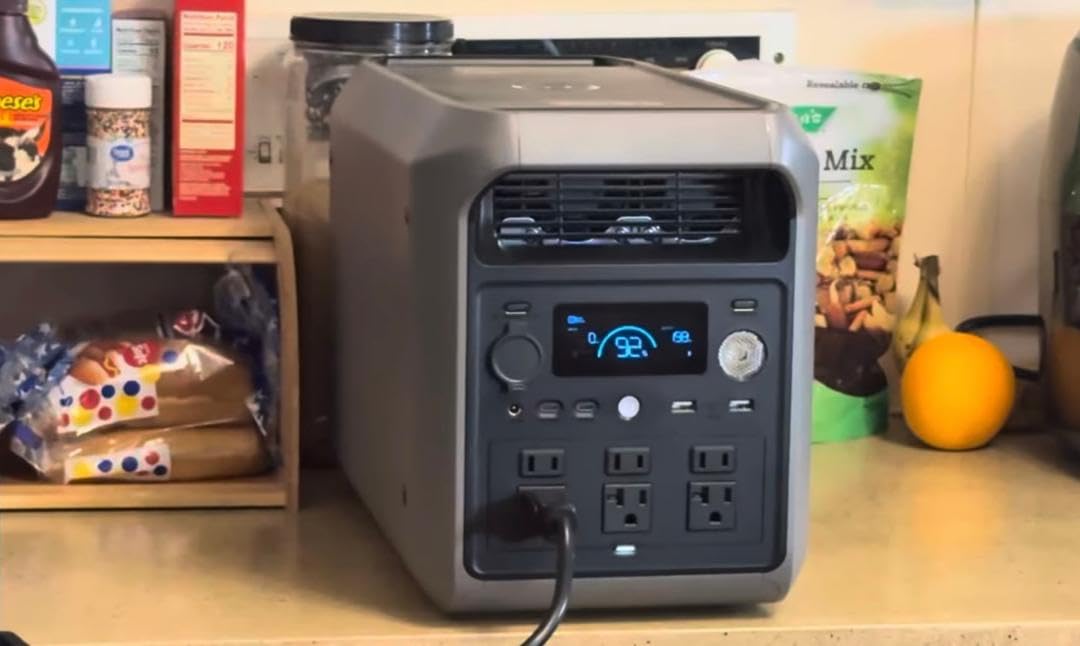
Charging is quick, with a full AC recharge in about an hour, and solar input runs up to 800W through MPPT, plus 12V car charging and hybrid dual-input. The switchover for backup is under 15ms, which works as a UPS for computers, network storage and routers.
The housing is ABS and PC with a UL94-V0 flame-retardant rating and full overcharge, overheat, short-circuit and voltage protection, and the cells are rated for 4000+ deep cycles to 80% capacity.
Where the 2000L makes sense
The 4400W starting figure gives more compressor headroom than most of the 2kWh field, and six AC outlets is generous for the size.
If you like watching battery behaviour and adjusting it, the app supports scheduling and charge management over Wi-Fi and Bluetooth, and the semi-solid chemistry should hold runtime well on small loads.
What to watch out for
The app is the weak point. Wi-Fi pairing only works on a 2.4 GHz network, Bluetooth setup is awkward, and owners report that the energy management charge limits often do not take effect as configured. If you plan to rely on scheduled charge management to protect the battery, test it before you depend on it.
The cooling fan also cycles on periodically even at no load and is audible from roughly 20 feet, which matters in a quiet cabin. There are fewer USB-C ports than rivals, it cannot be charged over USB-C, and one owner reported an unexpected shutdown at around 40% charge.
12. ABOK Ark3600 with 400W Panel: Maximum Solar Headroom in One Purchase
ABOK Ark3600 Portable Power Station with 400W Solar Panel,2000W Solar Input
3840Wh EV-grade LiFePO4
3600W rated, 4500W peak
2000W solar input
92 lbs
Pros
- 3840Wh base capacity expanding to 11520Wh
- 3600W rated output runs household appliances
- 400W panel bundled with 2000W solar input
- Full charge in about 1.29 hours on AC plus solar
- 15 ports including a 30A outlet and XT60
- Wheels and a telescoping handle make 92 lbs manageable
Cons
- 92 lbs even with the included wheels and handle
- 2+3 year warranty is shorter than the 5 years rivals offer
- Smaller base of customer reviews than established brands
The Ark3600 accepts 2000W of solar input, more than any other station in this roundup, and that single number changes what a cabin can do with its array. The rest cap out at 1200W or below. If your roof can host a serious panel run, this is the station that can actually absorb it, and it ships with a 400W panel in the box.
Capacity is 3840Wh of EV-grade LiFePO4, expandable to 11520Wh, feeding 3600W of rated output and 4500W of peak. That is enough to run a refrigerator, lighting, a router, computers and a well pump without planning around the inverter.
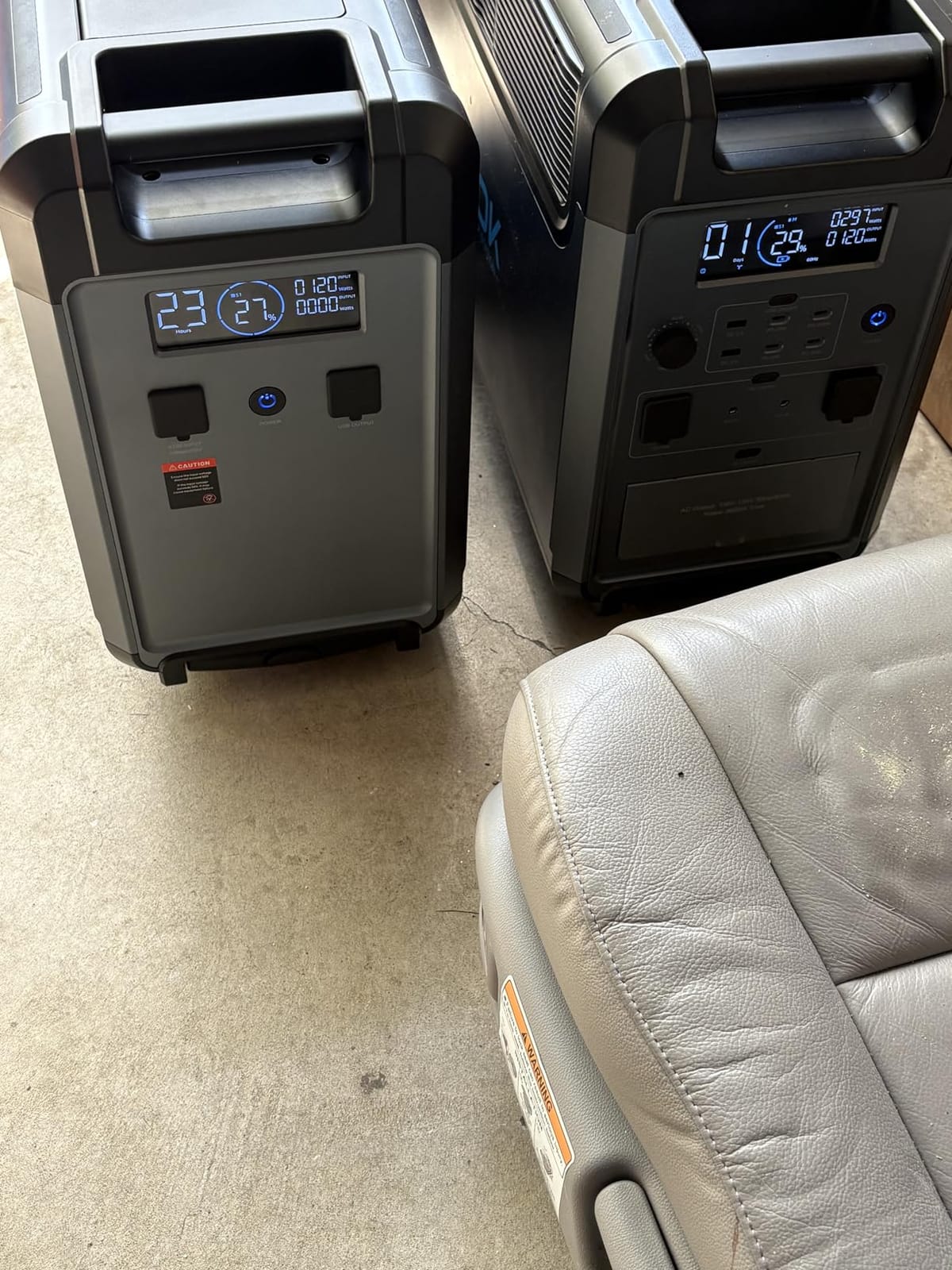
Charging is quick here. A full charge takes about 1.29 hours on AC and solar combined, or 3 hours on AC alone, and the 15 output ports include a 30A AC outlet, four 20A outlets, USB-C PD at 100W and 20W, USB-A QC3.0, DC5521, an XT60 and a 12V car port.
At 92 lbs it would be awkward in most cases, but the included wheels and extendable telescoping handle make it genuinely movable, which is how it should be treated: a wheeled unit you position once rather than carry.
Who this works for
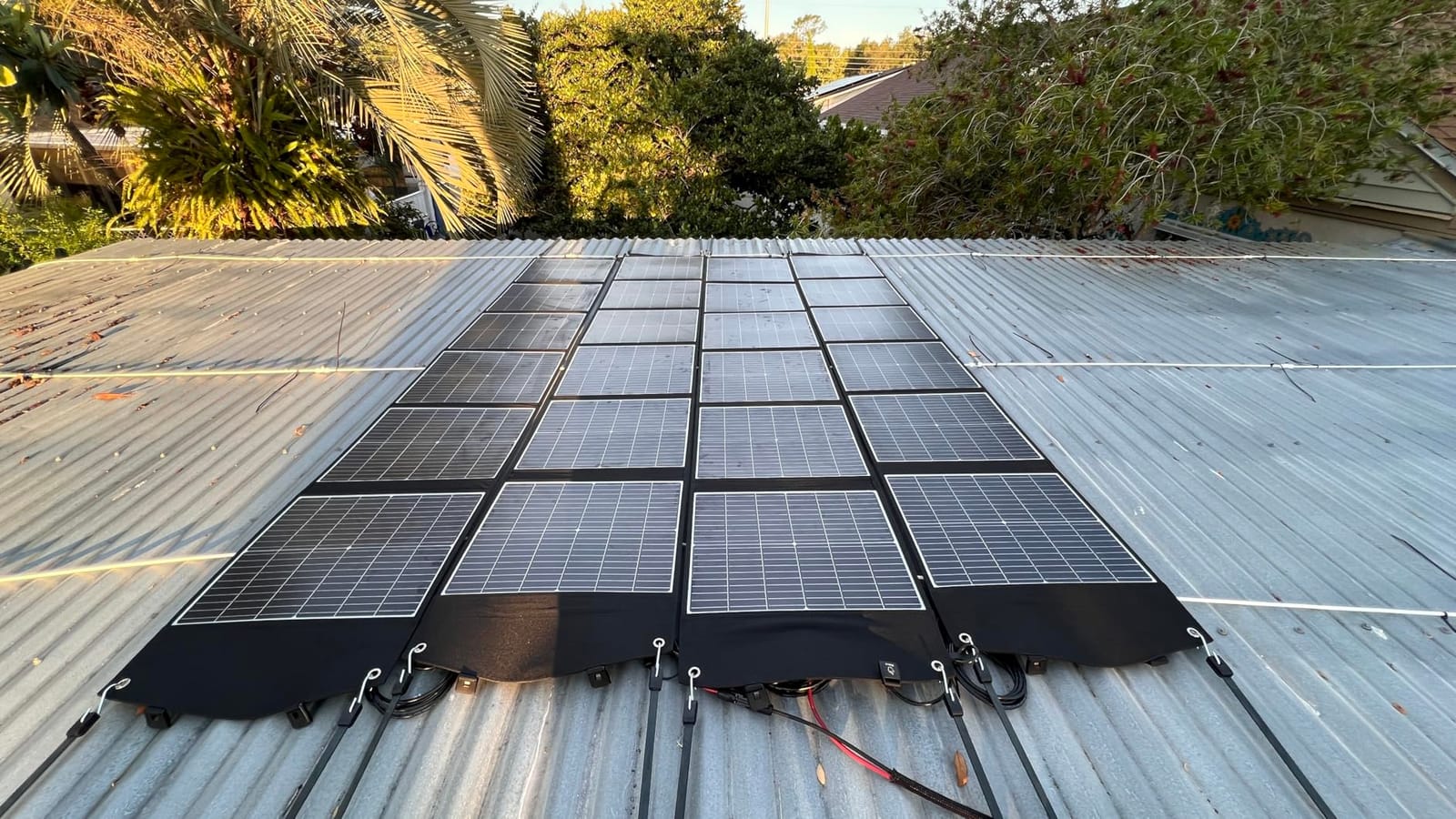
A remote homestead with room for a real array. The 2000W solar input means you can pour several hundred watts of generation into the battery on a decent day and actually fill 3840Wh, which is the difference between a battery that keeps up and one that slowly drains through a season.
The port selection here is unusually broad, and the 30A outlet plus XT60 cover the kind of equipment a workshop or a camper pulls.
What you give up
Weight and warranty. Ninety-two pounds is a floor-standing unit, and the 2 plus 3 year warranty is shorter than the five years offered by BLUETTI and Anker in the same class, which matters if the battery is your only source of power.
It also has the smallest customer review base in this roundup, so there is less long-term field evidence behind it than behind the established brands. If you want proven service support, a tier-one brand is the safer bet; if you want maximum solar input, this is the machine.
How to Size a Solar Generator for an Off-Grid Cabin
Size the load first, then the battery, then the panels. Most undersized cabin systems fail because someone starts with a battery size and works backwards, and a small unit will trip its own inverter within seconds of a compressor starting.
Step 1: list every load, with running watts. For a typical seasonal cabin the running figures are: a small refrigerator 60-100W, LED lighting 3-15W per fixture, a router and modem 10-20W, a laptop 40-60W, a phone charger 10-25W, a coffee maker 800-1200W, a microwave 900-1400W, a TV 70-150W, a small fan 20-60W, and a water pump that can pull several hundred watts. Add 15 minutes of runtime for a refrigerator compressor cycling rather than a flat figure.
Step 2: convert to watt-hours per day. Multiply each running watt figure by the hours you actually use it. A refrigerator running 8 hours a day at 80W is about 640Wh. A router left on 24 hours at 15W is 360Wh. Ten LED fixtures for 5 hours at 8W each is 400Wh. A weekend cabin’s daily total often lands between 1200 and 2500Wh, and a full-time residence with a water heater and heat can pass 8000Wh before the refrigerator is counted.
Step 3: add a reserve, and derate the nameplate. Plan on roughly 85% of rated capacity being usable, because the battery management system cuts in before true empty and the inverter and heat losses take their cut. A 1152Wh station is really about 900-950Wh of practical storage. Then add a reserve of 25% on top to cover cloudy stretches, so a 2500Wh daily load wants about 3600Wh of usable storage and roughly 4200Wh of rated capacity, which usually means a 2kWh station plus an expansion module or a larger unit.
Step 4: check output, not just capacity. Divide a single appliance’s watt-hour draw by its running watts to get realistic hours of runtime. A 60W refrigerator on a 1024Wh station that delivers about 850Wh usable runs roughly 14 hours, before you add the duty cycle. Anything with a compressor, a pump or a heating element also needs surge headroom well above its running draw.
Step 5: size the array to the load, not to the battery. The panels must produce at least your daily watt-hours, adjusted for season. That math is below.
How Many Solar Panels Does a Cabin Battery Need?
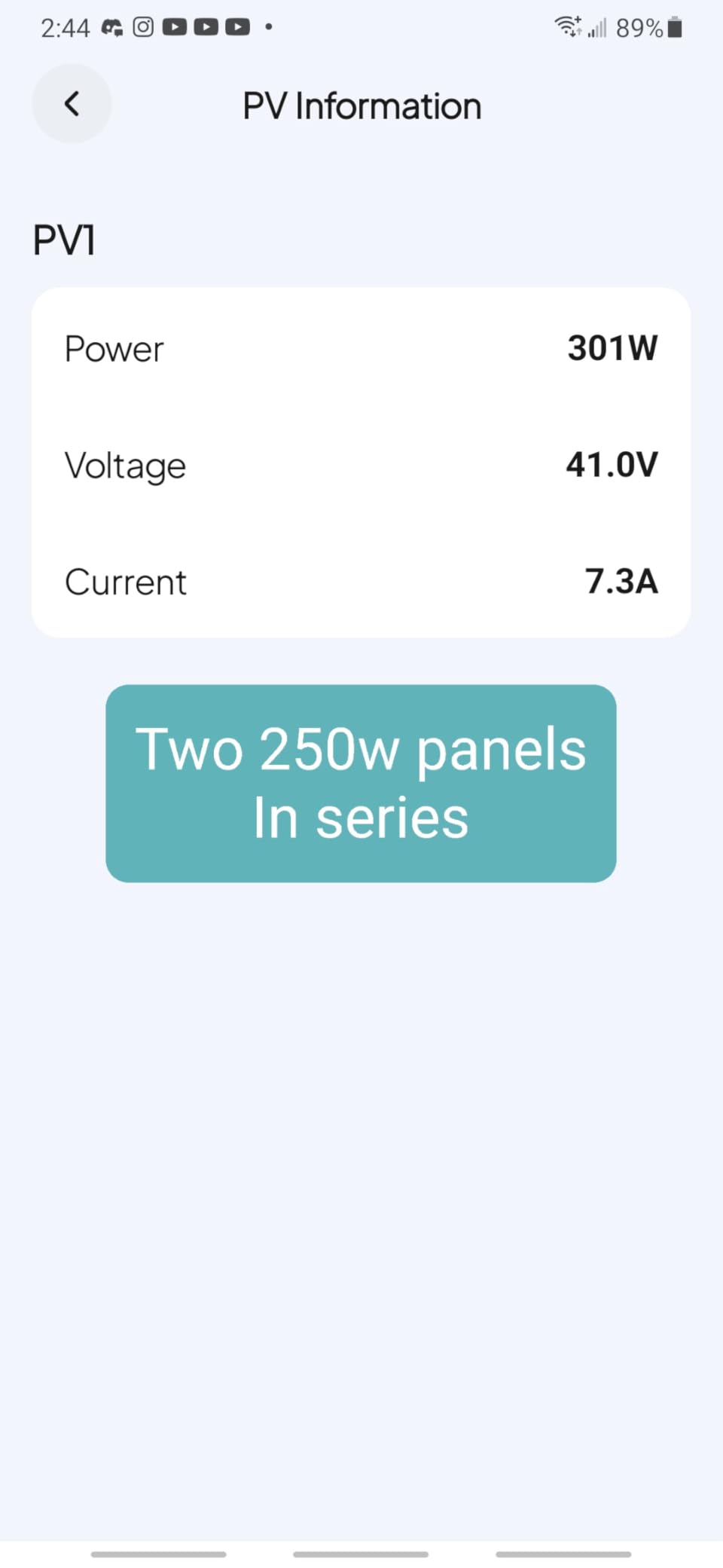
The formula is straightforward: panel watts multiplied by peak sun hours, divided by the yield you can expect, gives the watt-hours a day. A 400W panel in good summer conditions typically delivers around 1600Wh over a full day, and closer to 800Wh in winter at a low sun angle or under snow.
To refill a specific station, divide its watt-hour capacity by the daily yield of your array. A 500W panel yielding 2000Wh per day refills a 2000Wh battery in about a day of good sun, and the figures in our table reflect the same relationship: stations that accept 500W of solar quote roughly 2.5 to 3.3 hour solar recharge times, while the ABOK Ark3600 with 2000W of solar input refills in about 1.29 hours on AC and solar combined.
Plan a winter derate. If your daily load is 2500Wh and summer panels deliver 4000Wh a day, you are fine until December, when the same array may deliver 2000Wh. Either oversize the array by 1.5 times or plan to enter winter with more storage than your average daily load. Snow load and tilt matter too, and a roof-mounted array in a heavy-snow region needs a steeper angle or a ground mount with a clearing plan.
One more constraint catches people: the voltage window. A station that accepts 60V max cannot take a long string of high-voltage panels without a combiner and a voltage clamp, so confirm the input ceiling against the panel layout before buying.
LiFePO4 vs Semi-Solid vs NMC for Cabin Use
Every station in this roundup uses an iron-based chemistry, and that is not a coincidence. LiFePO4 cells are rated for 3000 to 6000 cycles in the models here, with the Anker SOLIX S2000 claiming 10000, against roughly 500 cycles for older NMC lithium-ion cells. Over a decade of daily use in a cold cabin, cycle life is the difference between one battery and two.
The tradeoff is energy density. LiFePO4 stores less energy per kilo than NMC, so a same-weight unit gives you fewer watt-hours. Every one of these stations accepts that trade because the alternative is a battery that needs replacing sooner at a remote property.
Semi-solid-state cells, as used in the Dabbson 2000L, sit between the two. They pack more energy into the same volume, and owners report around 1.3 times the runtime of standard LFP at the same size, which is meaningful when the battery has to come up a set of stairs. If you want a dense pack and can accept less field history, that is where to look.
Temperature is the last consideration. LFP chemistry tolerates cold better than NMC, but charging below freezing is still something to avoid unless the unit has a cold-weather charge profile. Store the station indoors between uses in a deep-winter cabin and bring it out to charge on a mild day.
Fixed Rooftop Array or Portable Panels?
For a permanent cabin, a fixed array makes more sense in almost every case. Panels mounted at a proper tilt with no shade produce more, need no handling, and cannot be left behind when someone drives away. A weekend cabin that gets winter sun on the roof but nobody there in December needs a remote monitoring setup, and a battery with a strong app is part of that decision as much as the panel is.
Portable folding panels suit a cabin you use seasonally and reach by rough road, or a build phase before the roof work is done. The Jackery 1000 v2 bundle and the ABOK Ark3600 both ship with panels, which is exactly why both work for a first-time buyer.
The failure mode to avoid is a portable panel sagging in the sun while the station sits in full sun beside it. Anything the manufacturer included as a starting panel should be treated as a stopgap, because panel output collapses when it is not at the right angle to the sun.
Quiet Power, Well Pumps and Winter Loads
Quiet is an underrated selling point at a cabin. A gas generator running all night is a neighbour problem, a wildlife problem and a carbon monoxide risk in a building with tight walls. Every station in this roundup is silent at idle and offers a low-noise charging mode, and the Elite 200 V2 and the Jackery Explorer 2000 v2 quote explicit quiet figures in the 16-30dB range for slow charging.
A well pump is the load that catches people out. It draws far more at startup than while running, so match it against the station’s surge or starting wattage figure rather than its continuous output. The AC200PL at 3600W lifting, the Ark3600 at 4400W starting, and the Elite 200 V2 at 3900W lifting all have the headroom for a pump, while a 1500W continuous station may not.
Winter changes the picture twice over. Panels produce less, so the array has to be sized for the worst month rather than the best one, and a battery left partly charged in freezing conditions ages faster. For heating, resist the temptation to run a space heater off a battery. A 1500W heater consumes your entire daily budget in under two hours, and if your cabin needs heat in January, the answer is a wood stove such as the ones in our wood-burning stove guide or a pellet stove, with the battery handling refrigeration, water, lighting and power tools.
Water is a related question, and our guide to solar well pumps for off-grid homes covers the pumping side. If the cabin has a well, budget for pump startup in your output sizing and keep a camping-grade refrigerator in mind as an efficient alternative to a full-size unit on a small battery.
Frequently Asked Questions
What size power station do I need for an off-grid cabin?
Work from your daily load rather than a marketing figure. A seasonal cabin with a refrigerator, LED lights, a router and a laptop typically needs 1200-2500 watt-hours per day. Add 25% for cloudy stretches, then divide by 0.85 to account for usable capacity, which is normally about 85% of the nameplate rating. A 2500Wh daily load points to roughly 4200Wh of rated capacity, usually a 2kWh station plus an expansion module or a larger single unit.
How long do portable power stations last?
It depends on the chemistry and how you treat it. The LiFePO4 stations in this roundup are rated from 3000 to 6000 cycles, and the Anker SOLIX S2000 claims 10000, which at one cycle a day works out to well over a decade. Cycle life is only half the story. Leaving a battery in a hot car or at 100% charge for weeks shortens its life, so store it around half charge in a cool, dry place.
How many solar panels do I need to charge a power station?
Divide the station’s watt-hour capacity by the daily yield of your array. A 400W panel in good summer conditions delivers roughly 1600Wh per day, so it refills a 2000Wh battery in about a day and a half, and around 1000W of panels refills it in a full day. In winter, plan on roughly half that yield, and check the station’s solar input voltage ceiling before building an array, since some units cap at 60V.
Are portable power stations weather resistant?
Treat them as indoor equipment unless the manufacturer states an IP rating. None of the stations in this roundup advertises a specific IP weather rating, so rain, snow and direct sun on the case are outside their design intent. Install the battery indoors in a dry, ventilated space and keep the solar panels outside. A small shed, a closet or a sealed interior wall cavity is the right location, not a damp porch.
Can a portable power station run a well pump?
Often yes, but match the pump to the surge figure rather than the continuous output. Well pumps draw far more at startup than while running, so look at the starting or lifting wattage. The ABOK Ark3600 rates 4500W peak from 3600W rated, the BLUETTI AC200PL offers 3600W of lifting power from 2400W continuous, and the BLUETTI Elite 200 V2 offers 3900W of lifting from 2600W. A pump also has to fit inside your daily watt-hour budget, since it runs for hours at a time.
Is a solar generator worth it for an off-grid cabin?
For a cabin with no grid tie and no reliable fuel delivery, the case rests on silence and self-sufficiency rather than fuel cost. A station stores energy from the sun, runs without noise, fumes or carbon monoxide, and keeps going through a multi-day storm on stored charge. The real limits are honest ones: you have to size the array for your worst sun month, and you have to keep heating on a route that does not run through a battery.
Which Solar Generator Should You Buy?
For most cabins, the BLUETTI AC180 is the best solar generator for off-grid cabins in 2026 because it balances 1152Wh of storage, 1800W of output, a one-hour wall recharge and 500W of solar input in a single unit that needs no add-ons. It handles a weekend cabin load completely and costs nothing in complexity to run.
If your cabin is a full-time home, the BLUETTI AC200PL is the better buy because it expands to 8448Wh and carries 2400W, which is what a well pump and a water heater actually demand. If weight stops you carrying it down a set of stairs, the Jackery 1000 v2 bundle is the lightest complete setup and includes a panel.
For pure solar headroom on a homestead with a real roof, the ABOK Ark3600 accepts more array than anything else here. For a fridge-first cabin that should run long between sunny days, the Anker SOLIX S2000’s 6W idle draw is the efficiency benchmark.
Before you buy, run your own load list through the sizing steps above. The station is the easy part; matching the array to your worst sun month is the part that decides whether the system keeps up in February.