
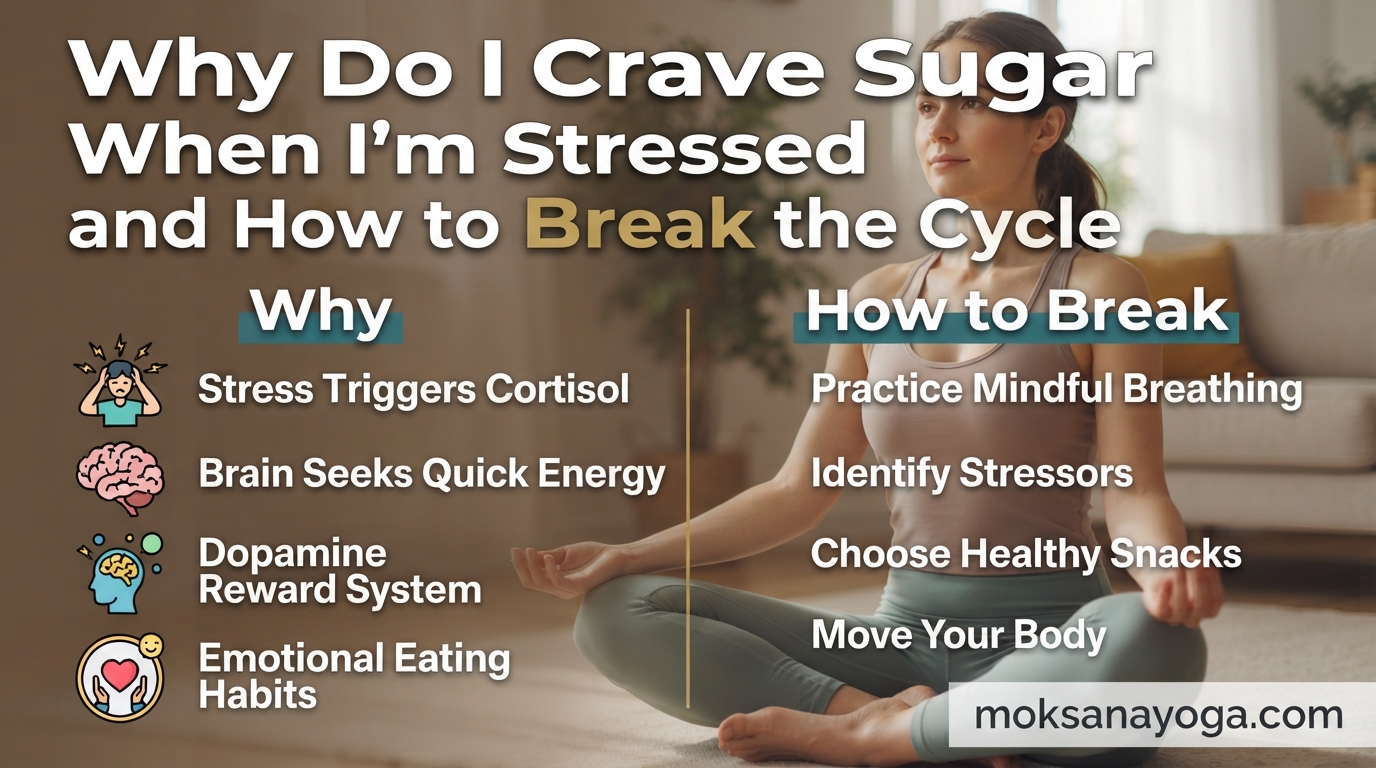
You finish a long, tense day and suddenly the kitchen calls. Not for a salad or a handful of almonds, but for something sweet, soft, and immediate. If that sounds familiar, you are not weak, broken, or lacking willpower. You are experiencing one of the most well-documented biological responses in the human body.
The question of why do I crave sugar when I’m stressed and how to break the cycle is something our team hears constantly at Moksana Yoga. Students describe “panicky moments” where sugar feels like the only thing that will take the edge off. Others notice the pattern most at night, when exhaustion meets unprocessed stress from the day. Some tell us they feel out of control during particularly intense work weeks, only to find the cravings fade the moment life settles.
What most people do not realize is that this pattern has almost nothing to do with discipline and everything to do with brain chemistry, hormones, and a nervous system that is doing exactly what it evolved to do. The craving is not a character flaw. It is a signal.
In this guide, we will walk through the real science behind stress-induced sugar cravings, why sugar backfires and deepens the cycle, the hidden triggers that make cravings worse, and practical, evidence-based strategies to break free. We will also share breathing and mindfulness techniques you can use the very next time a craving hits, because those in-the-moment tools are what most resources leave out.
Table of Contents
The Science of Stress and Sugar Cravings
Stress-induced sugar cravings begin in a part of your brain called the hypothalamic pituitary adrenal axis, or HPA axis. This is the command center that controls your body’s response to stress, and it has a direct line to your appetite and your food preferences. When this system activates, it does not just make you feel anxious. It literally changes what your body wants to eat.
Cortisol and the HPA Axis
When you encounter stress, whether a looming deadline or a tense conversation, your adrenal glands release cortisol. Cortisol is the primary stress hormone, and one of its jobs is to make sure your body has enough quick energy to deal with the perceived threat. From an evolutionary standpoint, this makes perfect sense. If a predator were chasing you, you would need fast fuel to fight or flee.
The problem is that modern stress rarely involves physical action. You sit at a desk, you scroll through difficult news, you hold tension in your shoulders and jaw. The cortisol floods your system but the energy never gets used. Instead, it drives you toward the kitchen.
Cortisol increases hunger and steers your preferences toward energy-dense foods. Sugar, with its rapid conversion to glucose, is the fastest fuel source available. So your body is not being random when it screams for chocolate at 4 PM. It is following a hormonal instruction that made sense for most of human history and works against you now.
Research published through the NIH shows that stress causes many people to increase their consumption of sweet, high-sugar foods precisely because these foods provide measurable stress relief. Sugar actually suppresses the HPA axis temporarily, dialing down the stress response. Your brain learns this quickly and starts reaching for sweets as a form of self-medication. In a very real sense, sugar works, at least for a few minutes.
Your Brain Needs More Energy Under Stress
There is another layer to this. Under acute stress, the brain requires roughly 12 percent more energy than usual, according to research highlighted by Scientific American. Neurons fire faster, decision-making circuits work harder, and your body burns through glucose at an accelerated rate. The brain, unlike muscle, runs almost entirely on glucose, so when demand spikes, the request for sugar becomes urgent.
This is why a stressful workday can leave you feeling genuinely, physically depleted. You are not being lazy or dramatic. Your brain is asking for fuel, and it wants the fastest version possible. The problem is that the fastest version, refined sugar, is also the one most likely to set you up for a crash that makes everything worse.
Research from Scientific American also points to a structure in the brain called the nucleus arcuatus, which acts as a gatekeeper for hunger signals. Under chronic stress, this region becomes more sensitive to cues that push you toward sweet, calorie-dense foods. The longer stress persists, the more your brain’s wiring tilts in favor of sugar.
How Sugar Hijacks Your Brain Chemistry
Sugar does not just calm the HPA axis. It also triggers powerful changes in your neurotransmitters, the chemical messengers that shape how you feel. Two of these, dopamine and serotonin, are central to the sugar-stress loop. Understanding them helps explain why sugar can feel so irresistible and why the relief it provides is so short-lived.
The Dopamine Reward Cycle
When you eat sugar, your brain releases a surge of dopamine in its reward center. Dopamine is the same neurotransmitter involved in addiction pathways, and it creates a sensation of pleasure and satisfaction. This is the “ahh” moment after the first bite of a cookie, the feeling that everything is going to be okay.
The catch is that dopamine spikes are short-lived. Once the sugar is metabolized, dopamine levels drop, sometimes below baseline. This dip creates a subtle sense of deprivation that nudges you toward another hit. Over time, repeated sugar consumption can dull dopamine receptor sensitivity, meaning you need more sugar to get the same relief. This is the same mechanism that drives tolerance in other addictive substances, just in a milder form.
This dopamine loop is why willpower alone rarely works. You are not fighting a simple preference. You are up against a reward system that your brain has learned to rely on for stress relief. The way out is not to fight harder but to give your brain healthier sources of relief.
The Serotonin Mood Connection
Serotonin is often called the feel-good neurotransmitter, and low levels are linked to low mood and anxiety. Sugar temporarily boosts serotonin production because insulin helps shuttle tryptophan, serotonin’s building block, into the brain. This is why a sweet treat can feel emotionally soothing when you are stressed, especially if you are already running low on serotonin due to poor sleep or chronic anxiety.
But like the dopamine effect, this serotonin lift is fleeting. Once blood sugar drops again, mood follows it downward. You are left feeling more drained, more stressed, and often more ashamed than before, which only fuels the next craving. The Cleveland Clinic notes that low serotonin levels can directly trigger cravings for sugar, which is why feeling down or anxious makes sweets especially appealing.
Why Sugar Backfires and Worsens the Cycle
Here is where the sugar-stress loop becomes truly self-reinforcing. That cookie or candy bar gives you a rapid blood sugar spike, followed by an equally rapid crash. The crash triggers irritability, brain fog, fatigue, and, ironically, more hunger. Within an hour or two, you feel worse than you did before the treat.
Your body interprets that crash as another stressor. Cortisol rises again. The HPA axis reactivates. And your brain, now low on glucose and high on stress signaling, sends an even louder request for quick energy. This is how one treat becomes three, and how a stressful Tuesday turns into a week-long pattern of stress eating.
Forum discussions on Reddit’s sugar-free and keto communities capture this perfectly. People describe feeling “less energetic, less mentally sharp, and more stressed and depressed” after periods of heavy sugar consumption. The very thing they reached for to feel better ended up making the stress worse. Many users describe the cycle as something that crept up on them slowly until it felt normal.
There is also an emotional layer that is rarely discussed. Many people feel guilt or shame after stress eating, and those emotions are themselves stressors. Guilt raises cortisol. Cortisol drives cravings. The cycle tightens, and what started as a biological response becomes wrapped in a story about personal failure. Breaking that story is just as important as changing what you eat.
Over weeks and months, chronic stress eating can also affect how your body processes glucose. Repeated blood sugar spikes can contribute to insulin resistance, which makes cravings more intense and energy levels more unstable. This is why addressing the root cause, the stress response itself, matters far more than trying to simply cut out sugar.
Hidden Triggers That Amplify Sugar Cravings
Stress alone is powerful enough, but several other factors stack onto it and make sugar cravings even harder to resist. Understanding these triggers helps you address the full picture, not just one piece. When you recognize what is amplifying your cravings, you can target the real cause instead of blaming yourself.
Sleep Deprivation
Poor sleep is one of the strongest predictors of sugar cravings. When you are sleep-deprived, your body produces more ghrelin, the hunger hormone, and less leptin, the satiety hormone. At the same time, the reward centers in your brain become more reactive to junk food, making sweets look even more appealing than they normally would.
This is why so many people report that being tired directly leads to poor food choices. You are not imagining it. Your chemistry is literally rigged against you after a bad night. Forum users frequently cite sleep as the single biggest factor in whether they can resist cravings, often describing themselves as feeling “dysregulated” after poor sleep.
Nighttime Sugar Cravings
A specific pattern we hear about often is the nighttime craving spiral. By evening, willpower reserves are depleted, the day’s stress has accumulated, and fatigue lowers your resistance. This combination makes the hours after dinner the most vulnerable window for stress-driven sugar consumption. Many people describe it as a switch that flips once the day finally slows down.
The key to addressing nighttime cravings is recognizing that they are rarely about hunger. They are about decompression. Your nervous system has been holding tension all day, and sugar is the fastest way it knows to release it. Building a wind-down routine that does not involve food, like gentle stretching or a few minutes of breathwork, can fill that need without the sugar crash.
Nutrient Deficiencies
Sometimes the body is genuinely asking for something specific. Deficiencies in magnesium, chromium, zinc, and B vitamins can all manifest as sugar cravings. Chronic stress depletes these nutrients faster, creating a feedback loop where stress increases your need for nutrients while simultaneously driving you toward foods that lack them entirely.
If your cravings are persistent, intense, and do not respond to stress management or sleep improvements, it may be worth asking your healthcare provider about a basic nutrient panel. Sometimes the missing piece is not behavioral at all.
Seven Strategies to Break the Sugar-Stress Cycle
Breaking the cycle does not require white-knuckling through every craving. It requires giving your body and brain what they actually need so the sugar impulse loses its grip. Here are seven evidence-based strategies that address the root causes rather than just the symptoms.
1. Stabilize your blood sugar with balanced meals. The single most effective thing you can do is eat meals that combine protein, healthy fats, and complex carbohydrates. This slows glucose absorption and prevents the spikes and crashes that trigger cravings. Aim for protein and fiber at every meal. When your blood sugar is steady throughout the day, the emergency sugar requests from your brain become far less frequent.
2. Prioritize sleep like it is medicine. Getting 7 to 9 hours of quality sleep normalizes ghrelin and leptin, reduces cortisol, and restores the prefrontal cortex’s ability to override impulses. One good night can noticeably reduce cravings the next day. Treat your bedtime as a non-negotiable part of your stress management routine, not a luxury you earn after everything else is done.
3. Move your body to process stress hormones. Physical activity burns off excess cortisol and releases endorphins, your brain’s natural mood stabilizers. Even a brisk 15-minute walk can take the edge off a craving. This is something we emphasize constantly at Moksana Yoga because it works. Movement completes the stress cycle that cortisol started, giving your body the signal that the threat has passed.
4. Practice yoga to regulate your nervous system. Yoga is uniquely effective for breaking the sugar-stress cycle because it directly calms the HPA axis. Slow, deliberate movement combined with breathwork shifts your body out of fight-or-flight mode and into a parasympathetic state where cravings naturally quiet down. Even one short daily session can rewire your stress response over time, making you less reactive to the daily pressures that used to send you to the pantry.
5. Address nutrient gaps. Consider whether your diet provides enough magnesium, chromium, and B vitamins. Leafy greens, nuts, seeds, legumes, and whole grains support the very systems that stress depletes. If cravings persist despite good habits, talk to a healthcare provider about testing for deficiencies. Sometimes the body is asking for minerals, not sweets, and giving it what it actually needs changes everything.
6. Reframe cravings as information, not failure. When a craving hits, treat it as a signal rather than a verdict on your character. Ask yourself what you actually need. Is it rest? A break? A conversation? Water? Often the answer is not sugar but something your stress has been masking. This single shift in perspective, from guilt to curiosity, can transform your relationship with cravings entirely.
7. Build a non-food stress toolkit. Create a short list of things that genuinely calm you and keep it visible. A few rounds of breathwork, a cup of herbal tea, a walk outside, calling a friend, or rolling out your yoga mat. Having alternatives ready means you do not have to think when the craving strikes. Decision-making is hardest in the middle of stress, so do the thinking in advance.
In-the-Moment Techniques When a Craving Hits
Strategies are great for the long game, but what do you do in the 90 seconds when a craving has you by the throat? These techniques are designed for exactly those moments. None of them require willpower, and all of them work by changing your physiology faster than your brain can talk you into the pantry.
The 4-7-8 Breath. Inhale through your nose for 4 counts, hold for 7, and exhale slowly through your mouth for 8. Do this four times. This breathing pattern activates the vagus nerve and rapidly shifts your nervous system out of stress mode. Many people find the craving weakens or disappears entirely after just a few rounds, because the underlying stress signal has been addressed rather than fed.
The 10-minute pause. Tell yourself you can have the sugar, just not right now. Wait 10 minutes. Drink a glass of water. Step outside or move to a different room. Cravings are waves, they rise, peak, and fall. Most people find that the intensity fades significantly within that window, and once it does, making a different choice becomes much easier.
Move for 5 minutes. Do a few sun salutations, stretch, walk up and down your stairs, or dance to one song. Movement redirects blood flow, changes your body chemistry in real time, and interrupts the craving loop before it turns into action. This is why yoga is such a powerful tool for stress eating. It gives your nervous system a healthier way to discharge the energy that sugar was supposed to absorb.
FAQs
Why do I crave sugar so much when I’m stressed?
You crave sugar when stressed because cortisol, your primary stress hormone, increases hunger and directs your preferences toward quick-energy foods. Sugar provides the fastest source of glucose, and it also temporarily suppresses the HPA axis, calming the stress response. Your brain learns this pattern and reaches for sweets as self-medication.
How do you break a sugar craving cycle?
Break the cycle by stabilizing blood sugar with protein- and fiber-rich meals, prioritizing 7 to 9 hours of sleep, moving your body daily to burn off cortisol, and building a non-food stress toolkit. Practices like yoga and breathwork are especially effective because they directly calm the nervous system that drives the cravings.
How to stop craving sugar when stressed?
To stop craving sugar when stressed, use the 10-minute pause technique, drink water, and practice the 4-7-8 breathing method to calm your nervous system. Long-term, focus on balanced meals, quality sleep, and regular stress-reduction practices like yoga so your body stops relying on sugar for relief.
What is the body lacking when it craves sugar?
The body may be lacking magnesium, chromium, zinc, B vitamins, or simply adequate sleep and protein when it craves sugar. Chronic stress depletes these nutrients rapidly. Sometimes cravings are also a signal of emotional depletion, your body asking for rest or connection rather than food.
How to stop sugar cravings instantly?
To stop sugar cravings instantly, drink a glass of water, do four rounds of 4-7-8 breathing, and wait 10 minutes before deciding whether to eat. Movement like a short walk or a few yoga poses also disrupts the craving wave. Most cravings lose intensity within that window.
You Are Not Broken, You Are Wired This Way
If there is one thing to take away from this guide, it is this: why do I crave sugar when I’m stressed and how to break the cycle is not a question about willpower. It is a question about biology. Cortisol, dopamine, serotonin, and the HPA axis are running a program that evolved to keep you alive under threat. The fact that the program misfires in modern life does not mean you are failing. It means you are human.
The way out is not punishment. It is support. Feed your body balanced meals, give it real rest, move it with intention, and teach your nervous system that it does not need sugar to feel safe. Yoga, breathwork, and mindful movement are some of the most powerful tools we have for that rewiring, and they are available to you right now, no equipment required.
Start small. Pick one strategy from this list and try it for a week. The cycle took time to build, and it will take a little time to unwind. But every time you meet a craving with awareness instead of autopilot, you weaken the loop. That is how real change begins, one breath, one meal, one choice at a time.