
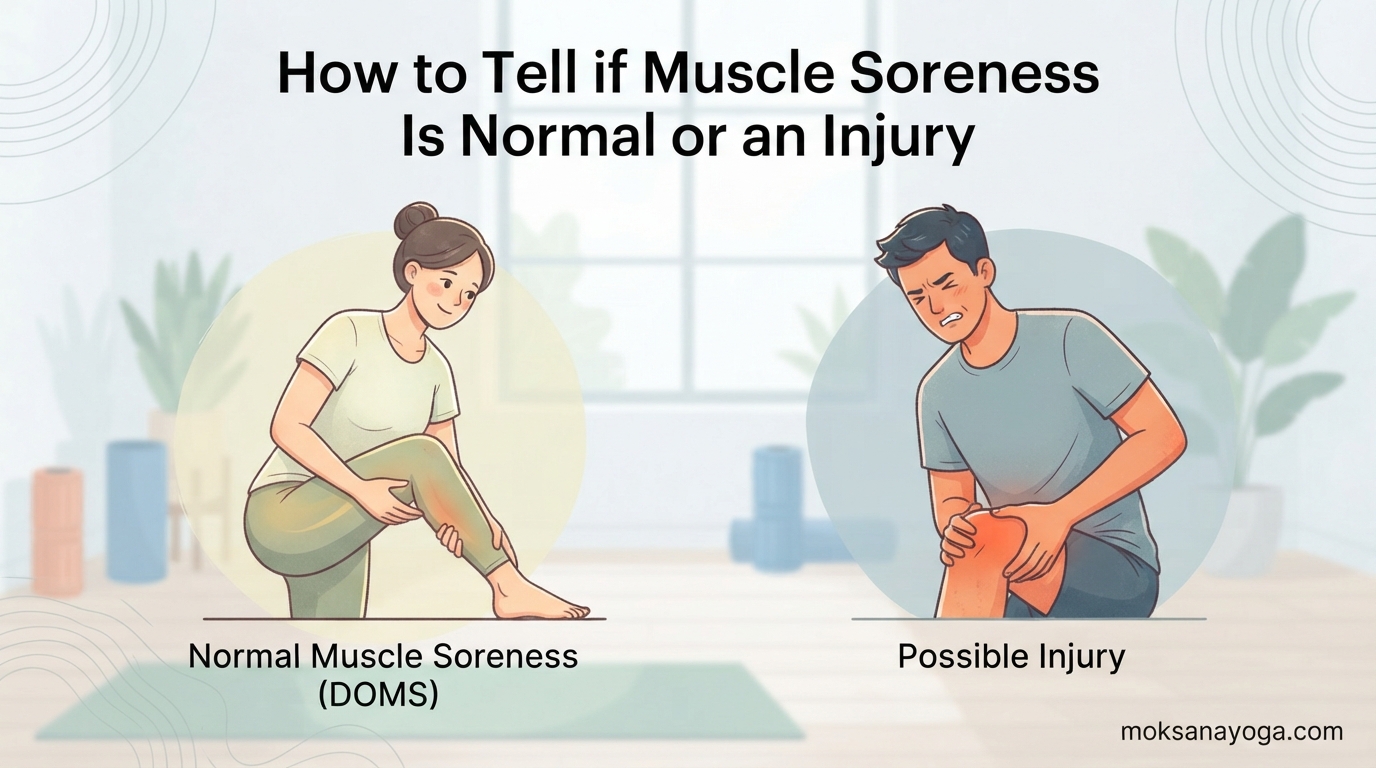
That deep ache after your first vinyasa class in weeks. The twinge in your hamstring during a forward fold. The stiffness that greets you when you roll out of bed the morning after a challenging flow. If you have ever wondered how to tell if muscle soreness is normal or an injury, you are in good company. It is one of the most common questions yoga students ask, and it matters. Pushing through genuine damage can turn a minor strain into a months-long setback, while babying ordinary soreness can stall your progress and your confidence on the mat.
As a yoga community, we hear this confusion constantly. Beginners especially struggle to distinguish between the satisfying ache of muscles rebuilding themselves and the warning signal of tissue that has been pushed too far. The good news is that your body gives you fairly clear clues once you know what to look for. In this guide, we will walk through what normal soreness feels like, the red flags that point to injury, a self-assessment checklist you can use before each practice, and yoga-specific guidance on whether to flow or rest.
Table of Contents
What Normal Muscle Soreness Feels Like
Normal muscle soreness has a scientific name: Delayed Onset Muscle Soreness, or DOMS. It is the dull, achy stiffness that appears 12 to 24 hours after unfamiliar physical activity and typically peaks between 24 and 72 hours. Most practitioners notice it most intensely a day or two after a class that introduced new poses, deeper stretches, or higher intensity than usual.
DOMS happens because exercise creates microscopic tears in muscle fibers. Your body responds with inflammation as it repairs those tears, and that repair process is what makes the muscle stronger over time. The soreness is bilateral, meaning it shows up evenly in both sides of the body when you have worked both sides equally. It feels tender to the touch but improves as you move and warm up.
Describing the sensation helps: normal soreness feels like a dull ache, tightness, or heaviness in the muscle belly, not at the joint. It eases with gentle movement, a warm shower, or light stretching. When you walk, the first few steps may feel stiff, but by minute five you usually feel close to normal. That improvement with activity is one of the strongest signals that you are dealing with healthy soreness rather than damage.
How to Tell if Muscle Soreness Is Normal or an Injury: Key Differences
The fastest way to tell whether you are sore or injured is to compare four factors: how the pain feels, when it started, where it is located, and how it responds to movement. Normal soreness and injury differ distinctly on every one of these dimensions.
Sensation: Soreness is dull, achy, and broad. Injury pain is sharp, stabbing, or burning, often described as a piercing or pinching feeling that grabs your attention suddenly.
Onset: DOMS builds gradually over 12 to 24 hours. Injury pain usually arrives immediately during the activity, often with a specific moment you can point to, or it lingers and worsens rather than fading over days.
Location: Soreness is generalized across the muscle belly and often affects several muscle groups at once. Injury pain is localized to one specific spot, frequently near a tendon, ligament, or joint rather than the middle of the muscle.
Movement response: Soreness feels better as you warm up and move. Injury pain gets worse with movement, may force you to compensate by limping or changing your gait, and does not ease with a few minutes of activity.
Here is a quick-reference comparison you can scan anytime the question comes up.
- Pain type: Soreness = dull, aching, stiff. Injury = sharp, stabbing, burning.
- Timing: Soreness = 12 to 72 hours after activity, then fades. Injury = immediate or persistent, often worsening.
- Location: Soreness = spread across muscle groups, bilateral. Injury = one specific point, often near a joint or tendon.
- Duration: Soreness = resolves within 3 to 5 days. Injury = lasts beyond a week or worsens over time.
- With movement: Soreness = improves with gentle activity. Injury = worsens with movement, causes compensation.
- Visual signs: Soreness = no swelling or bruising. Injury = may include swelling, bruising, redness, or visible deformity.
The Self-Assessment Checklist: Did I Injure Myself or Am I Just Sore?
When you wake up questioning whether that tight feeling is cause for concern, run through this simple self-assessment. It takes about two minutes and gives you a clear picture of whether to ease into your practice or back off entirely.
Step 1: Rate the pain quality. Is it dull and achy, or sharp and stabbing? Dull aching points toward normal soreness. Sharp, piercing, or electric pain is a strong indicator of injury.
Step 2: Check the location. Press gently into the area. If the discomfort spreads across the muscle and feels evenly tender, that suggests DOMS. If you can point to one specific spot with your fingertip, especially near a tendon or joint, treat it as a potential injury.
Step 3: Test movement. Slowly move through a gentle range of motion. If the discomfort eases after a minute of easy movement, you are likely just sore. If the pain increases, stops you mid-motion, or forces you to change how you move, stop and rest.
Step 4: Look for visual signs. Check for swelling, bruising, redness, warmth, or any visible change in shape. None of these accompany normal soreness. Their presence means you should seek evaluation.
Step 5: Consider the timeline. If the discomfort started 12 to 48 hours after your last practice and is gradually improving, it fits the DOMS pattern. If it began during a specific moment in class, or if it has not improved after five to seven days, that falls outside normal soreness.
If your answers lean toward sharp, localized, worsening, or visually abnormal, treat it as an injury and give it proper rest. When in doubt, choosing rest for one or two days rarely causes harm, while pushing through a real strain can cost you weeks.
Warning Signs That Signal an Injury
Certain symptoms almost always indicate something beyond ordinary soreness. If you experience any of the following, treat them as red flags rather than normal post-practice fatigue.
Sharp or stabbing pain that occurs during a specific movement or pose is the clearest injury signal. This is especially true if you can recall the exact moment it started, such as a pop, pull, or sudden grab during a deep stretch.
Swelling, bruising, or redness around the area means tissue damage and inflammation beyond what DOMS produces. A muscle that is visibly enlarged or warm to the touch needs attention.
Limited range of motion that does not improve with gentle warm-up is different from the temporary stiffness of soreness. If you cannot straighten your arm, bear weight, or move through a normal range after a few minutes of easy movement, suspect an injury.
Pain that forces compensation is another warning. If you start limping, avoiding one side in poses, or changing how you sit and walk to spare the area, your body is protecting damaged tissue. Listen to it.
Weakness or instability in the affected area, where the muscle cannot produce its normal force, suggests a strain or tear rather than simple fatigue. A sore muscle still works, just uncomfortably. An injured muscle may give out entirely.
When Soreness May Be Something More Serious
Most post-yoga soreness is harmless DOMS that resolves on its own. But two conditions are worth knowing about because they sit at the boundary between normal soreness and medical concern.
Rhabdomyolysis is a rare but serious condition where extreme muscle breakdown releases proteins into the bloodstream, which can damage the kidneys. It is most associated with extremely intense workouts, especially after long breaks from training. Warning signs include severely dark or cola-colored urine, extreme muscle swelling, weakness, and soreness that is far disproportionate to the workout. If you notice dark urine alongside severe soreness, seek medical care immediately. This is not something to wait out.
Tendonitis is inflammation of a tendon, the tissue connecting muscle to bone. It often develops from repetitive overuse rather than a single moment. Unlike DOMS, tendonitis pain is localized right at the joint, lingers beyond a week, and worsens with continued activity rather than improving. Yoga practitioners sometimes feel it at the front of the shoulder from repeated chaturangas, or at the Achilles from jump-throughs. If pain sticks to one tendon and does not fade in a week, have it evaluated.
Should I Practice Yoga Today? A Gentle Movement Guide
This is the question we hear most. The short answer: if your soreness is mild, dull, and improves with movement, a gentle practice can actually help by increasing blood flow and speeding recovery. If your pain is sharp, localized, or worsens with movement, rest is the right call.
Here is how we suggest deciding. If you rated your soreness at a three or four out of ten and it feels evenly distributed, try a restorative or slow yin sequence. Avoid the poses that target the sorest muscle group heavily. If your hamstrings are screaming from yesterday’s deep forward folds, skip the deep forward folds today. Substitute a supported bridge or a gentle supine hand-to-big-toe pose with a strap instead.
If your soreness is closer to a one or two, a full gentle vinyasa flow is usually fine. Warm up slowly, breathe deeply, and back off any pose that sharpens the sensation. Mild soreness that eases as you move is your body’s way of saying it is ready for activity.
If the discomfort is sharp, focused on one spot, near a joint, or accompanied by swelling, skip your practice entirely. One or two rest days will not undo your progress, but aggravating a strain could sideline you for a month. Use the time for breathwork, meditation, or a long walk instead.
A useful principle: soreness should not change the way you move through your day. If you are limping, wincing when you sit down, or unable to lift your arms overhead comfortably, that is beyond what you should bring to the mat. Wait until normal movement is painless before resuming practice, then ease back in with a gentle class rather than your usual intensity.
Recovering From Normal Soreness: What Actually Helps
Normal DOMS does not need medical treatment, but a few simple practices help it pass faster and feel less uncomfortable along the way.
Gentle movement is the most evidence-backed recovery tool. A short walk, easy stretching, or a slow yoga flow increases blood flow to the muscles, which speeds the delivery of nutrients needed for repair. Complete stillness actually prolongs soreness by leaving stagnant blood and inflammation in the tissue.
Hydration and nutrition support the repair process. Drink plenty of water, eat adequate protein to give your body building blocks for muscle repair, and include anti-inflammatory foods like leafy greens, berries, and omega-3 rich sources if they are part of your diet.
Heat and warmth ease stiffness by relaxing tight tissue and boosting circulation. A warm bath, a heating pad, or simply a hot shower before gentle stretching can take the edge off. Some practitioners add Epsom salts for the magnesium, though the research on absorption through skin is mixed.
Foam rolling and self-massage can release tight fascia and improve comfort. Roll slowly over the sore muscle, pausing on tender spots for 20 to 30 seconds, and avoid rolling directly over joints or bones.
The R.I.C.E. method (Rest, Ice, Compression, Elevation) is best reserved for suspected injuries rather than ordinary soreness. For normal DOMS, gentle movement beats total rest. If you are unsure which you are dealing with, rest for the first 24 hours, then introduce light movement if the discomfort feels dull and improving.
When to See a Doctor for Muscle Pain
Most soreness resolves on its own within three to five days. Seek medical attention if you experience any of the following.
Pain that lasts beyond seven days without improvement, or soreness that is getting worse rather than better after the first 72 hours, warrants an evaluation. A muscle strain or other soft tissue injury will not heal the way DOMS does, and continued use can worsen the damage.
Severe pain that limits your ability to perform daily activities, bear weight, or move a limb through its normal range is a clear signal. So is any visible deformity, significant swelling, or a popping sound accompanied by immediate weakness.
Dark or cola-colored urine, especially alongside severe muscle soreness and swelling, may indicate rhabdomyolysis and requires urgent care. Numbness, tingling, or loss of sensation near the painful area suggests nerve involvement rather than simple muscle strain.
Finally, if something simply does not feel right and your instinct tells you this is more than soreness, trust that instinct. A quick visit to a sports medicine doctor, physical therapist, or orthopedic specialist can either give you peace of mind or catch a problem early, when it is easiest to treat.
FAQs
What does normal muscle soreness feel like?
Normal muscle soreness, or DOMS, feels like a dull, achy stiffness that appears 12 to 24 hours after exercise and peaks between 24 and 72 hours. It is tender to the touch, spreads across the muscle belly rather than one specific point, and improves with gentle movement and warmth.
How do I tell the difference between a torn muscle and a sore muscle?
A torn muscle produces sharp, stabbing pain that often occurs at a specific moment during activity, is localized to one spot usually near a tendon or joint, may cause swelling or bruising, and worsens with movement. Soreness is dull, aching, generalized across the muscle, and improves as you warm up.
How long should muscle soreness last before I worry?
Normal DOMS lasts three to five days and gradually improves. If soreness persists beyond seven days, is getting worse after the first 72 hours, or is accompanied by sharp pain, swelling, or dark urine, seek medical evaluation.
Can I practice yoga with muscle soreness?
Yes, if the soreness is mild, dull, and improves with movement, a gentle yoga practice can actually speed recovery by increasing blood flow. Avoid poses that heavily target the sorest muscles, and skip your practice entirely if pain is sharp, localized, near a joint, or worsening.
How do I know if I have DOMS or rhabdomyolysis?
Rhabdomyolysis causes severe, disproportionate soreness alongside dark or cola-colored urine, extreme muscle swelling, and significant weakness. It usually follows extremely intense workouts. If you notice dark urine with severe soreness, seek medical care immediately rather than waiting it out.
Trusting Your Body on the Mat
Learning how to tell if muscle soreness is normal or an injury is a skill that develops with practice. The more you observe your body, the faster you will recognize the difference between the productive ache of growth and the warning signal of damage. Dull, bilateral, improving soreness is your body rebuilding. Sharp, localized, worsening pain is your body asking for help.
When the answer is unclear, choose rest over ambition for a day or two. A gentle practice, breathwork, or simply a walk can keep you connected to your routine while giving tissue time to recover. The mat will be there when you return, and returning healthy always beats returning early.
Listen for the signals we have covered here, run the self-assessment when doubt shows up, and trust that your body is communicating clearly once you know the language. Your practice will be stronger, safer, and more sustainable for it.