
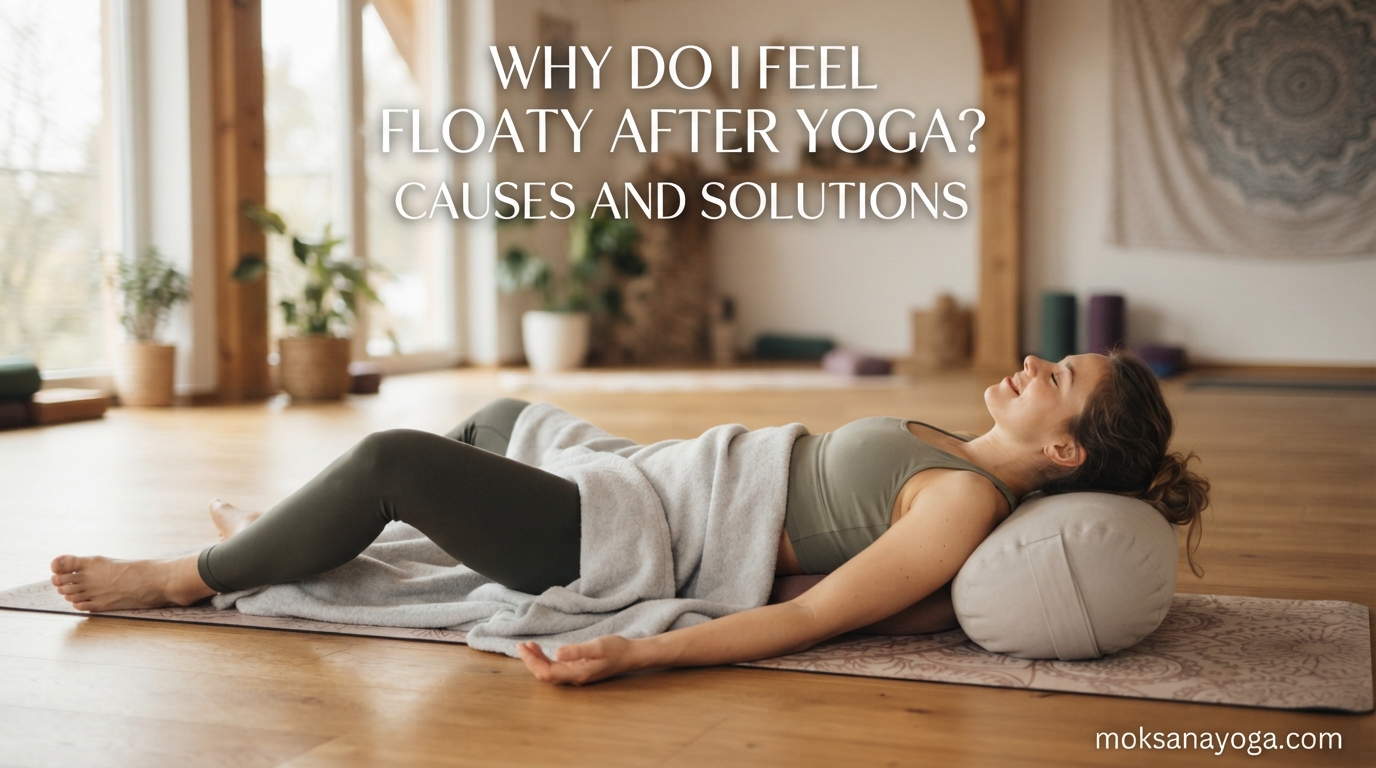
You just rolled up your mat, and instead of feeling energized, your head feels like it is floating somewhere above your shoulders. The room seems slightly unreal. You wonder whether something is wrong with you, or whether this is just part of the practice.
Feeling floaty or spaced out after yoga is extremely common. In most cases it comes from a combination of blood pressure shifts, your parasympathetic nervous system activating the rest-and-digest response, changes in your inner ear during certain poses, dehydration, and even natural endorphin release. None of these are inherently dangerous, though some deserve more attention than others.
Our team has practiced and taught yoga for years, and we have heard this question from students in nearly every class. This guide breaks down exactly why you feel floaty or spaced out after yoga, when it is a sign of healthy relaxation, and when you should pay closer attention.
Table of Contents
Why Do I Feel Floaty or Spaced Out After Yoga? The Short Answer
Feeling floaty, woozy, or spaced out after yoga is typically caused by shifts in blood pressure, inner ear changes from inversions and forward bends, dehydration, low blood sugar, or the natural activation of your parasympathetic nervous system. In some cases, the feeling is actually the result of endorphins and endocannabinoids flooding your brain, producing what many practitioners call a yoga high.
Here is a quick breakdown of the most common reasons:
- Your parasympathetic nervous system shifts into rest-and-digest mode
- Blood pressure drops when you stand up quickly from seated or inverted poses
- Inner ear crystals shift during inversions, triggering mild vertigo (BPPV)
- Dehydration from sweating, especially in hot yoga
- Low blood sugar from practicing on an empty stomach
- Overheating in heated classes
- Deep breathing exercises that alter oxygen and carbon dioxide levels
- Endorphin and endocannabinoid release producing a natural high
- Emotional release or stored stress surfacing during practice
- Caffeine sensitivity or hormonal fluctuations amplified by movement
Most people experience a combination of two or three of these at once. Let us look at each one in more detail.
10 Common Causes of That Floaty, Spaced-Out Feeling
1. Your Parasympathetic Nervous System Is Doing Its Job
Yoga is one of the most effective ways to switch your autonomic nervous system from sympathetic (fight-or-flight) into parasympathetic (rest-and-digest) mode. Slow breathing, gentle movement, and sustained holds signal to your vagus nerve that you are safe.
When this shift happens, your heart rate slows, your blood pressure drops, and your muscles relax. For someone used to running on stress and adrenaline, this sudden relaxation can feel disorienting. Your brain is not used to operating without that background buzz of cortisol, and the contrast can produce a floaty, foggy, almost dreamlike state.
This is the same mechanism behind the deep calm you feel after Yoga Nidra or a long savasana. It is generally a healthy response, even if it feels strange at first.
2. Blood Pressure Drops From Postural Changes
Yoga moves you through constant position changes. You go from standing, to folding forward, to stepping back, to inverting, to lying down, sometimes within the span of a single breath cycle. Each of these transitions affects how blood pools in your body.
When you stand up quickly from a forward bend or rise out of a deep squat, gravity pulls blood into your legs. If your blood vessels do not constrict fast enough to push it back up to your brain, you experience orthostatic hypotension. The result is lightheadedness, brief visual dimming, or that floating sensation.
People with naturally low blood pressure are especially prone to this. So are beginners whose bodies have not yet adapted to the rapid postural shifts yoga demands.
3. Inner Ear Changes and BPPV From Inversions
Your inner ear contains tiny calcium carbonate crystals called otoconia that help detect gravity and movement. Certain yoga poses, particularly headstands, shoulderstands, and deep backward extensions, can shift these crystals into the wrong canal.
When that happens, you experience benign paroxysmal positional vertigo, or BPPV. The hallmark symptom is a spinning or rocking sensation that feels like you are on a boat even when you are standing still. Some people describe it as floating rather than spinning.
Medical studies have documented BPPV triggered specifically by yoga practice, particularly after poses that involve prolonged head inversion. If you consistently feel vertigo after specific poses like shoulderstand or plow pose, BPPV is a likely culprit and worth discussing with an ENT specialist.
4. Dehydration From Sweating and Breath
You lose more water during yoga than most people realize. Even a gentle vinyasa class can produce significant sweat, and you also lose moisture through your breath during extended pranayama exercises. Mild dehydration reduces blood volume, which lowers blood pressure and reduces oxygen delivery to your brain.
The symptoms read like a checklist for feeling spaced out: lightheadedness, brain fog, fatigue, and mild disorientation. If you walk into class already slightly dehydrated, the effect compounds quickly.
5. Low Blood Sugar From Practicing Fasted
Many people prefer to practice yoga on an empty stomach to avoid discomfort during twists and forward folds. But practicing first thing in the morning with nothing in your system means your blood sugar is already at its lowest point of the day.
An hour of flowing movement burns through whatever glucose was circulating, and your brain starts to feel the gap. The result is shakiness, mental fog, and that floaty, disconnected feeling that makes it hard to focus on the drive home.
6. Overheating in Hot Yoga Classes
Hot yoga, Bikram, and heated vinyasa classes raise your core body temperature significantly. Your body redirects blood to the skin to release heat, which means less blood reaches your brain. Add heavy sweating into the mix and you have a recipe for dizziness.
Reddit users frequently describe near-fainting experiences during their first hot yoga classes. One user reported spending at least half their first class in child’s pose because the heat overwhelmed their system. This is common, and it improves with acclimatization, but it should never be pushed through.
7. Pranayama and Deep Breathing Effects
Breathing exercises like kapalabhati (skull-shining breath), bhastrika (bellows breath), and extended breath retention alter the balance of oxygen and carbon dioxide in your blood. Hyperventilation, even the controlled kind, can make you feel tingling in your hands, lightheadedness, and a sense of dissociation from your body.
If you have ever felt lightheaded after pranayama, this is why. The effect is usually temporary and harmless, but it can be alarming if you do not understand what is happening.
8. Endorphins, Endocannabinoids, and the Yoga High
One popular theory among yoga practitioners is that the spaced-out feeling comes from endogenous opiates, your body’s natural endorphins, or possibly endocannabinoids being released in the brain during practice. This would explain the euphoric, almost intoxicated sensation some people describe after an intense class.
Research on the runner’s high has shown that endocannabinoids play a significant role in exercise-induced euphoria, and yoga produces similar effects through sustained physical effort combined with breath control. The floaty, blissful sensation after a strong practice may literally be a mild natural high.
However, some experienced practitioners caution against glorifying this state. They argue that what feels like a yoga high can sometimes just be a state of exhaustion or disconnection rather than genuine presence and awareness.
9. Stress, Anxiety, and Emotional Release
Yoga has a well-documented ability to release stored tension and emotion. As you open tight areas like the hips, chest, and shoulders, physical and emotional holding patterns can surface. Many practitioners report unexpected crying, shaking, or waves of emotion during or after practice.
This emotional processing can leave you feeling raw, foggy, or dissociated. Your nervous system is recalibrating after releasing deeply held stress, and that recalibration does not always feel calm. Sometimes it feels like being momentarily unmoored.
Yoga Nidra practitioners in particular report that subconscious material surfacing during deep relaxation can cause strange, foggy states that take time to integrate.
10. Caffeine and Hormonal Factors
If you drink coffee before class, the combination of caffeine and intense movement can amplify jitters, anxiety, and that wired-but-spaced-out feeling. Caffeine also raises heart rate and can interact unpredictably with breath-holding exercises.
Hormonal fluctuations across the menstrual cycle, pregnancy, or perimenopause also affect blood volume, blood pressure, and sensitivity to positional changes. Some practitioners find they are far more prone to dizziness during certain phases of their cycle.
Is the Yoga High a Good Thing? When Floaty Means Relaxed
Here is something most articles skip: feeling floaty after yoga is often a sign that the practice worked. If you walked into class wound tight with stress and walked out feeling like you are gliding six inches off the ground, your nervous system just got the reset it needed.
The key is learning to tell the difference between a healthy relaxation response and a warning sign. A pleasant, calm floatiness that fades within an hour or two and leaves you feeling restored is your body processing the practice. Dizziness accompanied by nausea, confusion, vision changes, or a spinning sensation that lingers is something else entirely.
The yogic tradition distinguishes between sattvic clarity, a state of balanced, peaceful awareness, and tamasic dullness, a state of heaviness and disconnection. The goal is the former. If your floaty feeling leaves you clear and centered once you ground yourself, you are in good shape. If it leaves you foggy and unable to function, something in your practice needs adjusting.
How to Prevent Dizziness and That Spaced-Out Feeling
The good news is that most of these causes are preventable with a few simple adjustments to your routine. Here is what works.
Hydrate Before, During, and After Class
Drink water throughout the day before your practice, not just right before you step on the mat. For hot yoga or sessions longer than 60 minutes, add electrolytes to replace what you lose through sweat. Coconut water, electrolyte tablets, or a pinch of sea salt and lemon in your water all work well.
Time Your Meals Thoughtfully
Aim to eat a light snack containing carbohydrates and a small amount of protein 60 to 90 minutes before practice. A banana with almond butter, a small bowl of oatmeal, or toast with avocado gives your blood sugar a stable foundation without weighing you down during twists and folds.
Transition Slowly Between Poses
The number one cause of orthostatic dizziness in yoga is standing up too fast. When you rise from a forward fold, come up slowly with a long spine and a soft bend in your knees. When you come out of an inversion, pause in a neutral position for a full breath before moving on. Give your blood vessels time to adjust.
Modify or Skip Inversions If You Are Prone to Vertigo
If you have a history of vertigo, BPPV, or inner ear issues, talk to your teacher about alternatives to headstand, shoulderstand, and plow pose. Legs-up-the-wall pose delivers many of the same benefits of inversion without putting your head below your heart for extended periods.
Pace Yourself in Hot Yoga
Heat acclimatization takes time. If you are new to hot yoga, start with shorter classes, take child’s pose liberally, and sit out any poses that make you feel lightheaded. Never push through dizziness in a heated room, it will only get worse.
Breathe Gently During Pranayama
If deep breathing exercises make you feel lightheaded, scale back the intensity. You should never feel like you are gasping or straining. Return to natural breathing until the sensation passes, then ease back in with less force.
When to Seek Medical Help After Yoga
Most post-yoga floatiness resolves within 30 to 60 minutes with water, food, and rest. But certain symptoms warrant professional attention.
Seek medical help if you experience any of the following: vertigo that lasts more than a few hours, repeated episodes of BPPV triggered by the same poses, fainting or loss of consciousness, severe headache, chest pain, irregular heartbeat, confusion that does not clear, numbness or tingling that persists, or vision changes.
If you suspect BPPV, an ENT specialist can perform a simple repositioning maneuver called the Epley technique that often resolves the issue in a single session. There is no reason to suffer through recurring vertigo when treatment is straightforward.
People with conditions like multiple sclerosis, Parkinson’s, or chronic low blood pressure can absolutely practice yoga, but they should work with an experienced teacher or yoga therapist who understands how to modify for their needs.
FAQs
Why do I feel woozy after yoga?
Feeling woozy after yoga is usually caused by a combination of dehydration, low blood sugar, blood pressure changes from standing up quickly, or the activation of your parasympathetic nervous system. Drink water, eat a light snack, and transition slowly between poses to reduce the sensation.
Why do I feel weird after yoga?
Feeling weird after yoga is common and usually stems from your nervous system shifting into a deep state of relaxation, emotional release, endorphin release, or physical factors like dehydration and low blood sugar. If the weird feeling is a calm floatiness that fades within an hour, it is likely a healthy response.
Why do I feel weird and floaty?
That weird, floaty feeling is typically caused by blood pressure drops during pose transitions, inner ear changes from inversions, your parasympathetic nervous system activating rest-and-digest mode, or natural endorphin and endocannabinoid release. In most cases it is harmless and fades within an hour.
Where is trauma stored in the body in yoga?
In yoga philosophy and modern somatic theory, trauma is thought to be stored in the nervous system and in patterns of chronic muscle tension, particularly in the hips, psoas, jaw, shoulders, and chest. Yoga helps release this stored tension through sustained stretching, breathwork, and mindful awareness, which is why emotional release can occur during or after practice.
Can people with MS do yoga?
Yes, many people with multiple sclerosis benefit from yoga. Gentle, modified yoga can help with flexibility, balance, stress reduction, and fatigue management. People with MS should work with an experienced teacher or yoga therapist, avoid overheating, modify inversions, and listen closely to their body’s signals.
Wrapping Up
Feeling floaty or spaced out after yoga is one of the most common experiences practitioners report, and in most cases it is a sign that your nervous system got the reset it needed. Blood pressure shifts, inner ear changes, dehydration, low blood sugar, deep breathing, and natural endorphin release can all contribute to that floating, dreamy sensation.
The key is learning your own patterns. Hydrate well, eat a light snack before class, transition slowly between poses, and pay attention to which practices trigger which sensations. If something feels off in a way that does not resolve quickly, check in with a healthcare provider. Otherwise, enjoy the float, it usually means your practice is doing exactly what it should.