
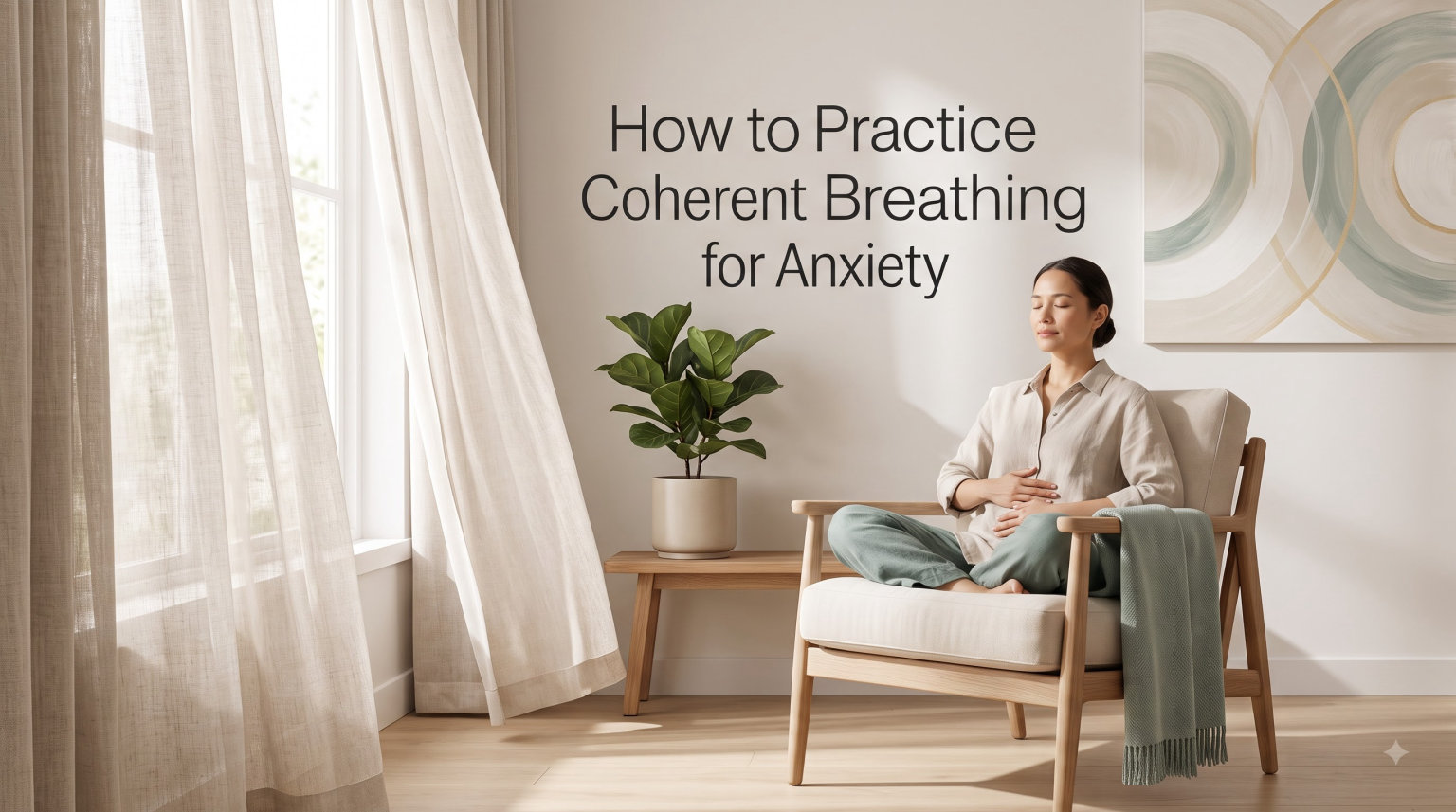
If you have ever felt your chest tighten, your thoughts race, and your breathing turn shallow during a stressful moment, you already know how deeply anxiety connects to your breath. The good news is that connection works in both directions. By changing how you breathe, you can change how you feel.
Coherent breathing for anxiety is one of the simplest and most research-backed techniques for doing exactly that. You breathe at a slow, steady pace of about five breaths per minute, and your nervous system begins to shift from fight-or-flight into a calm, regulated state.
In this guide, I will walk you through everything you need to know to start practicing coherent breathing today. You will learn what it is, the science behind why it works, step-by-step instructions, how long to practice, and the common mistakes that can slow your progress. Whether you deal with daily anxiety, occasional panic, or just want a reliable tool for stressful moments, this technique is worth adding to your toolkit.
Table of Contents
What Is Coherent Breathing?
Coherent breathing is a breathing technique that involves inhaling and exhaling at a steady, equal rate of approximately five breaths per minute. Most commonly, this means breathing in for five seconds and out for five seconds, with no pauses between the inhale and exhale. The goal is to create a smooth, continuous flow of breath.
The technique is also known as resonance breathing, and it shares roots with ancient pranayama practices from the yoga tradition. Dr. Stephen Elliott, a researcher who popularized coherent breathing in the West, formalized the specific protocol of breathing at roughly 5.5 breaths per minute based on decades of research into cardiovascular and nervous system function.
What makes coherent breathing different from other breathing exercises is the emphasis on equal timing and continuous flow. There are no breath holds, no counting pauses, and no forced exhales. You simply match your inhale length to your exhale length and keep the breath moving in a gentle, unhurried rhythm.
Most practitioners breathe through the nose during coherent breathing. Nasal breathing naturally slows the breath, filters the air, and stimulates the production of nitric oxide, which supports healthy blood vessel function. If nasal breathing feels uncomfortable at first, you can start with mouth breathing and transition as you become more comfortable.
The Science: How Coherent Breathing Calms Your Nervous System?
To understand why coherent breathing for anxiety works so well, it helps to look at what happens inside your body when you slow your breath. The key player here is your autonomic nervous system, which has two main branches: the sympathetic nervous system (responsible for the fight-or-flight response) and the parasympathetic nervous system (responsible for rest, digest, and recovery).
When anxiety kicks in, your sympathetic nervous system takes over. Your heart rate increases, your breathing becomes fast and shallow, your muscles tense, and stress hormones like cortisol and adrenaline flood your bloodstream. This response is helpful if you are running from danger, but when it fires during everyday situations, it creates the physical symptoms of anxiety.
Coherent breathing activates the parasympathetic nervous system, which acts as a brake on the stress response. When you breathe at approximately five breaths per minute, you hit what researchers call your resonance frequency. This is the breathing rate that maximizes heart rate variability, or HRV, which is a measure of how flexibly your heart responds to changing demands.
High HRV is associated with better emotional regulation, lower anxiety, and greater resilience to stress. A study published in the journal Frontiers in Psychology found that participants who practiced slow breathing at around five to six breaths per minute showed significant increases in HRV and parasympathetic activity. The baroreflex, a mechanism that regulates blood pressure, also becomes more sensitive at this breathing rate, which is why coherent breathing can help lower blood pressure over time.
Vagal tone is another important piece of the puzzle. The vagus nerve is the main highway of the parasympathetic nervous system, and slow, rhythmic breathing stimulates it directly. Think of coherent breathing as a way to send a clear signal to your brain that you are safe, allowing the nervous system to downshift from high alert into a calmer baseline.
How to Practice Coherent Breathing for Anxiety: Step-by-Step
Learning how to practice coherent breathing for anxiety is straightforward, but mastering it takes consistent practice. Here is a step-by-step guide you can follow right now, whether you are sitting at your desk, lying in bed, or taking a break outside.
Step 1: Find a comfortable position. Sit in a chair with your feet flat on the floor, or lie on your back with your arms at your sides. Keep your spine straight but not rigid. Relax your shoulders and let your hands rest loosely in your lap or by your sides.
Step 2: Close your eyes or soften your gaze. Closing your eyes helps reduce visual stimulation and turns your attention inward. If closing your eyes feels uncomfortable or increases anxiety, simply lower your gaze to a fixed point on the floor a few feet ahead of you.
Step 3: Place one hand on your belly. This helps you feel the movement of your diaphragm. As you inhale, your belly should gently expand outward. As you exhale, it should fall back toward your spine. This diaphragmatic breathing pattern is essential for getting the full benefit of the technique.
Step 4: Inhale slowly through your nose for five seconds. Breathe gently and smoothly. You are not trying to fill your lungs completely. Think of taking in about 70 to 80 percent of your full lung capacity. The breath should feel easy, not forced.
Step 5: Exhale slowly through your nose for five seconds. Let the air out at the same steady pace as your inhale. Do not push or rush the exhale. Simply allow the breath to flow out naturally while maintaining the five-count rhythm.
Step 6: Continue without pausing. The moment your exhale ends, begin your next inhale. There should be no gap, no breath hold, and no hesitation. The breath moves in a continuous loop, like a wave rolling in and out.
Step 7: Maintain this rhythm for 5 to 20 minutes. Start with five minutes if you are new to the practice. Over time, work your way up to 20 minutes per session. You can use a guided audio track, a breathing app, or simply count silently to yourself.
If counting seconds feels distracting, you can use a visual pacer instead. Many free apps and YouTube videos show an expanding and contracting circle that guides your inhale and exhale without any need for counting. This can be especially helpful in the first few weeks as you build muscle memory for the rhythm.
Benefits of Coherent Breathing for Anxiety
The research on coherent breathing for anxiety is encouraging, and many practitioners report noticeable improvements within a few weeks of consistent practice. Here are the key benefits supported by both scientific studies and real-world experience.
1. Reduces anxiety symptoms. A clinical trial conducted by researchers at the University of Pennsylvania found that participants who practiced coherent breathing for 20 minutes daily over eight weeks experienced a significant reduction in anxiety symptoms. The technique helps interrupt the cycle of rapid breathing and racing thoughts that fuels anxiety.
2. Improves heart rate variability. Regular practice at your resonance frequency increases HRV, which is one of the strongest physiological markers of stress resilience. Higher HRV means your nervous system can shift between alertness and relaxation more efficiently.
3. Lowers stress hormones. By activating the parasympathetic nervous system, coherent breathing helps reduce circulating levels of cortisol and adrenaline. This creates a cascade of calming effects throughout the body, from slower heart rate to relaxed muscles.
4. Improves sleep quality. Many people find that practicing coherent breathing before bed helps them fall asleep faster and sleep more deeply. The technique quiets the mental chatter that often keeps anxious minds awake at night.
5. Supports emotional regulation. When you practice coherent breathing regularly, you train your nervous system to recover from stress more quickly. Over time, this translates to fewer emotional spikes, better impulse control, and a greater sense of overall stability.
6. May help lower blood pressure. The baroreflex stimulation that occurs during coherent breathing has been shown to support healthy blood pressure levels. While it is not a replacement for medical treatment, it can be a valuable complementary practice.
How Long and How Often Should You Practice?
One of the most common questions people ask about coherent breathing is how long it takes to see results. Based on both research studies and user experiences from communities like Reddit’s breathwork and anxiety forums, here is what you can realistically expect.
For immediate relief during an acute anxiety episode, even two to three minutes of coherent breathing can help take the edge off. The slow rhythm signals to your nervous system that the threat has passed, which begins to lower your heart rate and calm your thoughts. Think of this as your emergency tool.
For long-term anxiety reduction, the research points to consistent daily practice over several weeks. The University of Pennsylvania study used 20-minute daily sessions for eight weeks. Many Reddit users in breathwork communities report that it took six to eight weeks of daily practice before they noticed a meaningful shift in their baseline anxiety levels.
A good starting point is 10 minutes per day. If that feels like too much, begin with five minutes and add one minute each week until you reach 20. Consistency matters more than duration. Ten minutes every single day will produce better results than 40 minutes once a week.
The best approach is to treat coherent breathing like any other wellness habit. Pick a specific time of day, link it to an existing routine like your morning coffee or evening wind-down, and track your sessions to stay motivated. Morning practice can help set a calm tone for the day, while evening practice can help you decompress and prepare for restful sleep.
Coherent Breathing vs Other Anxiety Breathing Techniques
Coherent breathing is not the only breathing technique for anxiety, and you may be wondering how it compares to other popular methods. Here is a breakdown of the three most common approaches.
Coherent breathing uses an equal ratio of about five seconds in and five seconds out, with no pauses. It is continuous, gentle, and designed to maximize heart rate variability. It is best for daily maintenance, long-term anxiety management, and building nervous system resilience.
Box breathing uses a four-count pattern: inhale for four seconds, hold for four seconds, exhale for four seconds, hold for four seconds. The breath holds create a square pattern. Box breathing is popular among military personnel and athletes for staying calm under pressure. The pauses can feel grounding for some people, but others find that breath holds increase anxiety, especially when they are already feeling panicked.
4-7-8 breathing involves inhaling for four seconds, holding for seven seconds, and exhaling for eight seconds. The long exhale strongly activates the parasympathetic nervous system, making this technique particularly effective for acute anxiety relief and falling asleep. However, the seven-second breath hold can be challenging for beginners and may feel uncomfortable if you are already short of breath.
So which one is best? It depends on your needs. For a daily practice that builds resilience over time, coherent breathing is the strongest choice. For instant relief during a panic attack, 4-7-8 breathing may work faster. For maintaining focus under pressure, box breathing is a solid option. Many people use a combination of techniques depending on the situation, and that is perfectly fine.
Common Mistakes to Avoid
Coherent breathing is simple, but that does not mean it is always easy. Here are the most common mistakes I see people make, along with how to avoid them.
Mistake 1: Breathing too deeply. One of the biggest misconceptions is that you need to take huge, filling breaths. In fact, over-breathing can make anxiety worse by upsetting the balance of oxygen and carbon dioxide in your blood. Aim for relaxed, moderate breaths that feel easy and natural.
Mistake 2: Forcing the pace. If five seconds in and five seconds out feels strained, you are going too slow for your current capacity. Start at a pace that feels comfortable, even if it is three or four seconds per breath. You can gradually slow down as your body adapts.
Mistake 3: Skipping the nose. Mouth breathing bypasses the natural filtration and nitric oxide benefits of nasal breathing. If your nose is congested, work with what you have, but otherwise make nasal breathing your default.
Mistake 4: Practicing only when anxious. Waiting until you are in the middle of an anxiety episode to try coherent breathing is like trying to learn to swim in a storm. Practice when you are calm so the technique becomes second nature. Then, when anxiety hits, your body already knows the rhythm.
Mistake 5: Getting frustrated by wandering thoughts. Your mind will wander during practice. That is completely normal. When it happens, gently bring your attention back to the count or the sensation of breath. The act of noticing and returning is where the real benefit happens.
Mistake 6: Giving up too soon. Based on forum discussions, many people quit after a week because they do not feel different. Coherent breathing is a skill that builds over weeks, not minutes. Commit to at least four weeks of daily practice before evaluating the results.
Tips for Beginners: Building a Sustainable Practice
Starting a new habit is always the hardest part. Here are some practical tips to help you build a coherent breathing practice that sticks.
Use a guided audio or app. Free apps like the Breathing App, HRV training apps, and YouTube videos provide visual or audio cues that take the counting off your plate. This is especially helpful in the first two to three weeks.
Start small and be consistent. Five minutes every day beats 30 minutes once a week. Pick a time that works for your schedule and protect it like any other important appointment.
Track your practice. Use a simple habit tracker or a notebook to mark each session. Seeing a streak build up is surprisingly motivating and helps you push through the days when motivation is low.
Combine with your existing routine. Stack coherent breathing onto something you already do daily. Practice before meditation, after yoga, during your lunch break, or as part of your bedtime wind-down. The existing habit serves as a cue for the new one.
Be patient with yourself. Some days the breathing will feel effortless and calming. Other days it will feel like work. Both are part of the process. The goal is not perfection but consistency.
What to Do If Breathing Exercises Increase Your Anxiety
Here is something most articles on breathing techniques do not mention: for some people, focusing on the breath actually increases anxiety. If you find that paying attention to your breathing makes you feel more panicked, lightheaded, or uncomfortable, you are not alone. This is a known phenomenon, especially among people with panic disorder or trauma histories.
If this happens, there are several adjustments you can make. First, try practicing with your eyes open while focusing on a visual anchor, like a candle flame or a spot on the wall. This gives your brain something external to focus on rather than turning all attention inward.
Second, try a slightly faster pace. If five seconds per breath feels triggering, start at three seconds in and three seconds out. The goal is to find a rhythm that feels soothing, not one that fits a textbook definition.
Third, combine the breathing with gentle movement. Walking slowly while maintaining a rhythmic breath can feel more grounding than sitting still. Some people find that practicing coherent breathing during restorative yoga poses is more tolerable than practicing it on its own.
Finally, if breathing exercises consistently trigger anxiety or panic, consider working with a therapist who specializes in somatic approaches or breathwork. A trained professional can help you build tolerance gradually and identify whether there are underlying factors that need to be addressed.
FAQs
Is coherent breathing good for anxiety?
Yes, coherent breathing is one of the most research-supported breathing techniques for anxiety. Studies show that practicing at approximately five breaths per minute activates the parasympathetic nervous system, increases heart rate variability, and reduces anxiety symptoms over several weeks of daily practice. Many people report noticeable improvements within four to eight weeks.
What is the breathing trick for anxiety?
The most effective breathing approach for anxiety is to slow your breath to about five breaths per minute. Inhale through your nose for five seconds, then exhale through your nose for five seconds, with no pause between breaths. Continue this smooth, equal rhythm for at least five minutes. This is coherent breathing, and it works by signaling to your nervous system that you are safe.
What is the 4-7-8 breathing technique for anxiety?
The 4-7-8 technique involves inhaling for four seconds, holding the breath for seven seconds, and exhaling for eight seconds. The long exhale strongly activates the parasympathetic nervous system, making it effective for acute anxiety relief and sleep onset. It differs from coherent breathing, which uses an equal inhale-exhale ratio with no breath holds.
Which breathing style is best for anxiety?
There is no single best style for everyone. Coherent breathing is ideal for daily maintenance and long-term anxiety management. Box breathing works well for staying calm under pressure. The 4-7-8 technique is best for quick relief and sleep. For most people, a combination of techniques used in different situations produces the best results.
How long does it take for coherent breathing to work?
For immediate, short-term relief, you may notice calming effects within two to five minutes of practice. For lasting anxiety reduction, research and user experiences suggest that four to eight weeks of daily practice for 10 to 20 minutes per session is needed to see significant improvements in baseline anxiety levels.
Can breathing exercises make anxiety worse?
Yes, for some people, focusing on the breath can temporarily increase anxiety, especially those with panic disorder or trauma histories. If this happens, try practicing with eyes open, using a faster pace, combining breathing with gentle movement, or working with a therapist who specializes in somatic or breathwork approaches.
Conclusion
Coherent breathing for anxiety is one of the most accessible and well-researched tools available for managing stress and calming an overactive nervous system. By breathing at a steady rate of about five breaths per minute, you directly influence your heart rate variability, activate your parasympathetic nervous system, and give your body a clear signal that it is safe to relax.
The technique is simple to learn but requires consistency to master. Start with five minutes a day, use a guided app or timer if counting feels distracting, and commit to at least four weeks before evaluating your progress. Remember that some days will feel easier than others, and that is completely normal.
Pair coherent breathing with other anxiety management strategies like regular yoga, mindfulness meditation, therapy, and healthy sleep habits for the best results. Breathing is a powerful tool, but it works best as part of a holistic approach to wellbeing. Your breath is always with you, ready to use whenever you need it. All you have to do is slow down and find your rhythm.