
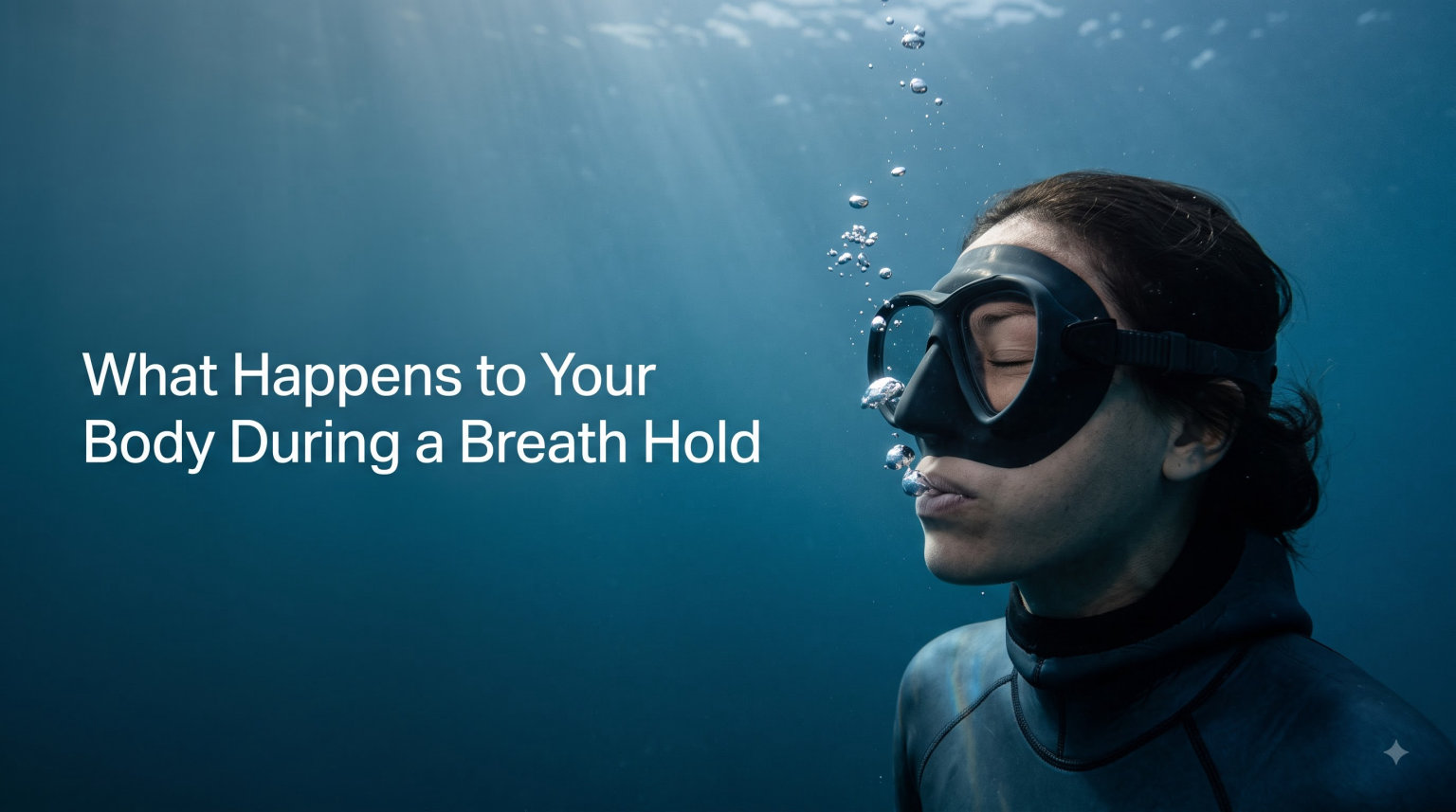
Have you ever wondered what happens to your body during a breath hold? Breath holding, known in medical terms as apnea, sets off a cascade of physiological changes that affect your oxygen levels, carbon dioxide levels, brain function, heart rate, and even your blood chemistry. Most untrained adults can hold their breath for 30 to 90 seconds, and the changes that occur during that short window are remarkable.
When you stop breathing, your body does not simply pause. It keeps consuming oxygen while producing carbon dioxide as a waste product, and the buildup of that gas triggers the powerful urge to breathe. Your body also activates ancient survival reflexes, shifts blood flow, and begins conserving energy in ways most people never experience consciously.
In this guide, we will walk through exactly what happens to your body during a breath hold, second by second. We will cover the timeline of oxygen and carbon dioxide changes, the mammalian dive reflex, how your brain and heart respond, the connection to yoga and pranayama, and the warning signs that tell you when to stop.
Table of Contents
The First 30 Seconds: Oxygen Drops, CO2 Rises
The moment you stop breathing, two things begin happening simultaneously. Your body continues using oxygen at roughly the same rate, and carbon dioxide starts accumulating in your blood because there is no exhalation to clear it.
Most people assume the urge to breathe comes from low oxygen. In reality, the primary trigger is rising carbon dioxide. Your carotid arteries and brainstem contain specialized chemoreceptors that monitor CO2 levels in your blood. When those levels climb past a certain threshold, these sensors send urgent signals to your respiratory muscles.
Within the first 20 to 30 seconds of a breath hold, you will typically feel a gentle warming sensation and a slight urge to breathe. This urge is your body detecting the initial CO2 increase. Your diaphragm may twitch or contract involuntarily as your nervous system pushes you to exhale.
At this stage, oxygen saturation in your blood is still relatively high, usually above 95 percent for a healthy person. Your body has reserves of oxygen stored in your lungs, blood, and muscles, so you are in no immediate danger. The discomfort you feel is almost entirely driven by carbon dioxide, not by a lack of oxygen.
This distinction matters because it explains why CO2 tolerance, not lung capacity, is the main factor that determines how long you can comfortably hold your breath. We will cover that in more detail later.
What Happens to Your Body During a Breath Hold: The Timeline
Understanding what happens to your body during a breath hold is easier when you break it into stages. Here is a timeline of what most untrained adults experience.
0 to 30 Seconds: The Calm Phase
Your oxygen saturation stays above 95 percent. Carbon dioxide begins rising but has not yet crossed the threshold that triggers strong discomfort. Most people feel relaxed during this phase, especially if they took a calm, full breath before starting. Your heart rate may dip slightly.
30 to 60 Seconds: The Urge Builds
Carbon dioxide levels cross the point where your chemoreceptors send strong signals to breathe. You will likely feel diaphragm contractions, throat tightness, and a growing sense of air hunger. Some people describe it as a pressure building in the chest. Oxygen saturation may begin dropping into the low 90s.
This is the phase where most untrained people stop. The sensation is uncomfortable but not dangerous, and it is entirely driven by CO2 rather than actual oxygen deprivation.
60 to 90 Seconds: The Struggle Phase
The urge to breathe becomes intense. Your diaphragm contracts forcefully and rhythmically. You may feel lightheaded as oxygen saturation drops into the high 80s. Your body begins prioritizing blood flow to the brain and heart over the extremities.
If you are relaxed and trained, you can push through this phase. If you are a beginner, this is the point to stop. Continuing past your comfort level without supervision carries real risks.
90 Seconds and Beyond: The Danger Zone
For most untrained individuals, oxygen saturation drops below 85 percent. The brain begins to feel the effects of hypoxia, which is low oxygen in the tissues. You may experience visual changes, tingling in the fingers and lips, confusion, and a reduced sense of urgency.
This reduced sense of urgency is dangerous because it feels like the urge to breathe has passed. In reality, your brain is becoming oxygen-deprived. If the hold continues, you risk a shallow water blackout, which is a sudden loss of consciousness caused by critically low oxygen.
Never push into this zone alone or in water without trained supervision.
The Mammalian Dive Reflex: Your Body’s Hidden Survival Mode
One of the most fascinating things that happens to your body during a breath hold is the activation of the mammalian dive reflex. This is an ancient physiological response shared by all mammals, including humans, and it evolved to help us survive underwater.
The dive reflex is triggered most strongly when cold water touches your face, particularly the area around your eyes, nose, and upper cheeks. When activated, three major changes occur.
First, your heart rate drops significantly. In some people, it can fall by 10 to 25 percent or more within seconds. This bradycardia response reduces the rate at which your body consumes oxygen, effectively extending your breath hold capacity.
Second, blood vessels in your extremities constrict, pushing blood toward your core. This peripheral vasoconstriction prioritizes oxygen delivery to your brain, heart, and other vital organs while reducing flow to your arms and legs.
Third, the spleen releases stored red blood cells into circulation. This gives your blood an increased oxygen-carrying capacity, providing a small but meaningful boost during extended holds. Research published in the European Journal of Applied Physiology has confirmed that splenic contraction occurs during breath holding in humans, similar to what marine mammals experience.
The mammalian dive reflex explains why freedivers can achieve extraordinary breath hold times. It also explains why splashing cold water on your face can calm you down during stress. The same reflex that helps you hold your breath longer also slows your heart and soothes your nervous system.
How Your Brain Responds to Breath Holding?
Your brain is the most oxygen-hungry organ in your body. Despite making up only about 2 percent of your body weight, it consumes roughly 20 percent of the oxygen you breathe. This makes it the first organ to feel the effects of a breath hold.
During the early stages of a breath hold, your brain functions normally because oxygen saturation is still high. As the hold extends and oxygen levels drop, your brain enters what some researchers describe as a conservation mode. Non-essential neural activity slows down.
If oxygen drops too low, your brain begins reducing signals to muscles, which is why you may feel weak or sluggish during extended holds. Your thinking becomes slower, and your judgment becomes impaired. This is why people in low-oxygen states often do not realize they are in danger.
The most serious brain-related risk during a breath hold is syncope, which is the medical term for fainting. When oxygen to the brain drops below a critical level, consciousness shuts down to conserve energy. This is a protective mechanism, but it becomes dangerous if you are underwater or standing where a fall could cause injury.
The good news is that brief, controlled breath holds do not damage brain cells. Research does not support the claim that holding your breath for 30 to 90 seconds kills brain cells. The risk arises only with prolonged, unsupervised holds that cause sustained hypoxia.
How Your Heart Responds?
Your heart also reacts strongly during a breath hold. The most immediate change is a reduction in heart rate, driven partly by the dive reflex and partly by the parasympathetic nervous system, which activates during periods of stillness and breath retention.
Blood pressure typically rises during a breath hold, especially if you are tensing your muscles. The combination of a slower heart rate and higher blood pressure means your heart is working differently, not necessarily less. It is pumping blood against more resistance while beating fewer times per minute.
For healthy individuals, these changes are well-tolerated. For people with cardiovascular conditions, extended breath holds can pose risks. If you have high blood pressure, heart disease, or any cardiac condition, you should consult a doctor before attempting breath hold training.
One notable adaptation from regular breath hold practice is increased production of erythropoietin, or EPO. This hormone signals your body to produce more red blood cells, which improves oxygen transport throughout your system. A study published in the journal PLOS One found that repeated breath holding led to transient increases in EPO and hemoglobin, which is why some athletes incorporate apnea training into their routines.
CO2 Tolerance: The Real Reason Some People Hold Longer
Here is a surprising fact that most people get wrong. Breath hold time is not primarily determined by lung capacity or even how much oxygen you can store. The biggest factor is your tolerance to carbon dioxide.
Remember that the urge to breathe is triggered by rising CO2, not falling oxygen. A person with high CO2 tolerance can withstand higher levels of carbon dioxide before feeling the overwhelming need to breathe. This means they can hold their breath longer without feeling distress.
Freedivers and athletes train specifically to increase CO2 tolerance through structured apnea exercises. These include CO2 tables, where you hold your breath for fixed durations while gradually shortening the recovery periods between holds. Over time, the body adapts to tolerate higher CO2 levels.
This also explains why a beginner might struggle to hold for 30 seconds while a trained freediver can hold for several minutes. The trained diver is not necessarily storing more oxygen. They are simply more comfortable with the discomfort of elevated CO2.
For yoga practitioners, this is relevant because pranayama practices like kumbhaka, which is breath retention, naturally build CO2 tolerance over time. Regular practice trains your nervous system to stay calm in the presence of air hunger.
It is also worth noting that chronic stress and anxiety are linked to overbreathing, which keeps CO2 levels abnormally low. People with low CO2 tolerance due to habitual overbreathing often feel air hunger faster than those with balanced breathing patterns.
Breath Holding in Yoga and Pranayama
Breath retention has been a core practice in yoga for thousands of years. In the yogic tradition, holding the breath is called kumbhaka, and it is one of the central techniques in pranayama, which is the practice of breath control.
There are two main types of kumbhaka. Antara kumbhaka is holding the breath after a full inhalation, and bahya kumbhaka is holding after a full exhalation. Each creates different physiological effects and serves different purposes in practice.
Holding after inhalation, known as antara kumbhaka, keeps the lungs full of oxygen-rich air. This is energizing and tends to activate the sympathetic nervous system slightly. It is the type of hold most people instinctively do.
Holding after exhalation, known as bahya kumbhaka, empties the lungs first. This creates a stronger CO2 buildup more quickly and tends to activate the parasympathetic nervous system, which promotes deep relaxation. It is more challenging but can be profoundly calming.
From a physiological standpoint, kumbhaka produces the same effects described throughout this article: oxygen reduction, CO2 accumulation, diaphragm engagement, and activation of the dive reflex. The yogic tradition simply frames these effects in terms of prana, which is life force energy, and the movement of energy through the body’s subtle channels.
Modern breathwork methods like the Wim Hof technique and the Buteyko method draw on similar principles. They use controlled breath retention to influence the autonomic nervous system, improve CO2 tolerance, and build resilience to stress.
If you are new to breath retention, start small. Hold for 5 to 10 seconds after inhalation during your regular yoga practice and gradually increase as your comfort grows. Never force a hold past the point of comfort, and always practice in a safe, seated position.
Unconscious Breath Holding During Stress
Not all breath holding is intentional. Many people hold their breath without realizing it, especially during periods of stress, anxiety, or intense concentration.
This phenomenon is sometimes called screen apnea, named after the tendency to stop breathing while staring at phones and computers. Researchers studying this pattern have found that a significant percentage of people briefly suspend their breathing when reading emails, scrolling social media, or dealing with stressful digital tasks.
Unconscious breath holding is also common during physical tension, emotional distress, and even while focusing on a difficult task. You might catch yourself holding your breath while parallel parking, bracing for bad news, or trying to remember something.
Becoming aware of this pattern is the first step toward changing it. The simple act of noticing your breath throughout the day can reduce stress-related apnea and help you develop a more relaxed, continuous breathing rhythm.
Safe Breath Hold Times: What Is Normal?
One of the most common questions people ask is whether their breath hold time is normal. The answer depends on training, health, and experience.
For an untrained, healthy adult, a breath hold of 30 to 60 seconds is completely normal. Many people in online forums worry that holding for only 30 seconds means something is wrong with their lungs. It does not. Thirty seconds is a perfectly healthy baseline.
With a few weeks of simple practice, most people can extend their breath hold to 1 to 2 minutes. This improvement comes primarily from increased CO2 tolerance rather than any dramatic change in lung capacity.
Trained freedivers and athletes routinely achieve 3 to 5 minute holds. Elite competitive freedivers can exceed 10 minutes for static apnea, which is breath holding while floating motionless in a pool. The world records, which are achieved through years of specialized training and intense physiological adaptation, exceed 11 minutes for men and over 9 minutes for women.
These extreme times are possible because elite freedivers combine high CO2 tolerance, maximized oxygen stores, strong dive reflex activation, and mental techniques for managing intense discomfort. They also train under strict supervision, which is essential for safety at those levels.
For the average person interested in breath work, aiming for 1 to 2 minutes is a reasonable and healthy goal. Anything beyond that requires structured training and safety protocols.
Warning Signs: When to Stop
Knowing when to stop is the most important skill in breath holding. Your body gives clear warning signs before things become dangerous.
Stop immediately if you experience any of the following:
Strong dizziness or vertigo that makes you feel unsteady.
Tingling or numbness in your lips, fingers, or toes.
Visual changes such as tunnel vision, blurring, or graying at the edges.
Confusion, difficulty thinking clearly, or a sudden sense of euphoria.
Sudden loss of the urge to breathe, which can signal approaching hypoxia.
Muscle twitching or involuntary jerking movements.
Never hold your breath underwater without a trained spotter. Shallow water blackout can occur without warning, and it is one of the leading causes of drowning among swimmers. It happens when oxygen drops too low and the brain loses consciousness, often without the struggle or gasping that bystanders expect to see.
Also avoid breath holding if you are pregnant, have cardiovascular conditions, suffer from epilepsy, or have any condition affected by changes in blood pressure or oxygen levels. Always consult a healthcare provider before beginning any breath training program.
FAQs
Is a 2 minute breath-hold impressive?
For an untrained adult, holding your breath for 2 minutes is impressive and above average. Most people can reach this with a few weeks of simple practice focused on relaxation and CO2 tolerance. Trained freedivers consider 2 minutes a beginner-level hold, but for the general population, it shows solid breath control and calm nervous system function.
Is it bad that I can only hold my breath for 30 seconds?
No, holding your breath for 30 seconds is perfectly normal and healthy. The average untrained adult holds for 30 to 60 seconds. Your breath hold time reflects your CO2 tolerance more than your lung health, so a shorter hold does not mean your lungs are weak. With light practice, you can usually double your time within a few weeks.
Does holding breath longer mean healthy lungs?
Not necessarily. Breath hold duration is primarily determined by your tolerance to carbon dioxide, not your lung capacity or lung health. A person with excellent lungs might hold for only 30 seconds if they have low CO2 tolerance. Lung function is better measured by tests like spirometry, not breath hold time. That said, breath training can improve breathing efficiency and diaphragm strength.
Is a 7 minute breath-hold good?
A 7 minute breath-hold is extraordinary and only achievable by highly trained freedivers after years of specialized practice. The average person should never attempt holds anywhere near this length. Elite freedivers who reach these times train under strict supervision with extensive physiological adaptation, including maximized oxygen storage and strong activation of the mammalian dive reflex.
What does holding breath feel like?
Holding your breath typically starts with a calm, relaxed feeling for the first 20 to 30 seconds. After that, you feel a growing urge to breathe, often described as pressure in the chest, throat tightness, and involuntary diaphragm contractions. If you continue, you may experience lightheadedness, tingling in your lips or fingers, and sometimes a warm, floating sensation as oxygen drops.
Conclusion
Understanding what happens to your body during a breath hold reveals just how much is going on beneath the surface when you stop breathing. Your oxygen levels drop, carbon dioxide builds up, your diaphragm contracts, your heart rate slows, and ancient survival reflexes activate to protect your most vital organs.
The most important takeaway is that breath hold time is driven by CO2 tolerance, not lung size. A 30-second hold is normal and healthy, and with gentle, consistent practice, you can extend it safely. Whether you are a swimmer, a freediver, or a yoga student exploring pranayama, the key is to train gradually, listen to your body’s warning signs, and never push past the point of comfort without supervision.
If you want to explore breath work further, start by simply observing your natural breathing throughout the day. Notice when you unconsciously hold your breath during stress, and practice gentle breath retention as part of your yoga or meditation routine. Your breath is one of the most powerful tools you have for regulating your nervous system, and the more you understand it, the more effectively you can use it.