
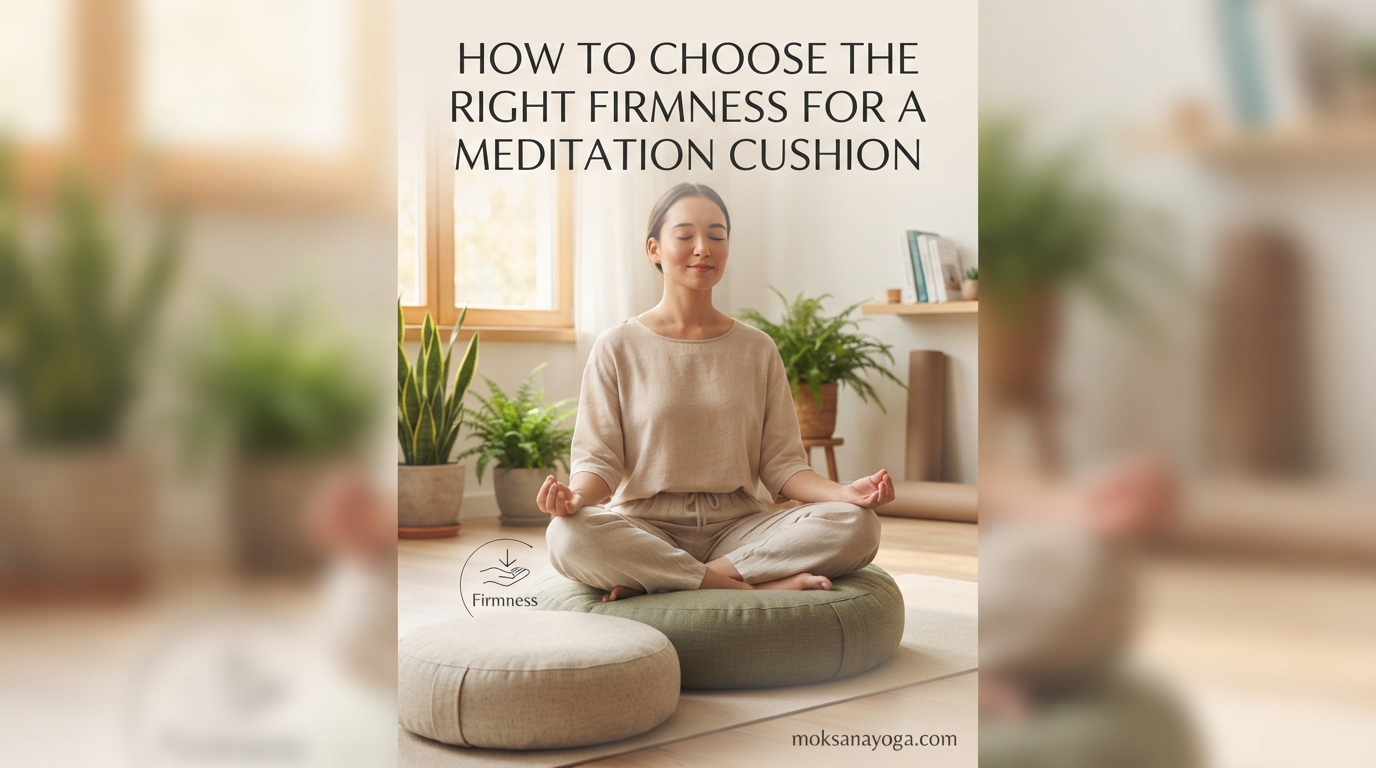
When I first started meditating, I grabbed a random throw pillow from my couch and figured that would do the trick. Twenty minutes later, my legs were numb, my lower back ached, and I spent the entire session thinking about anything except my breath. It took me months of trial and error to realize the problem was not my posture or my discipline. The problem was firmness.
Learning how to choose the right firmness for a meditation cushion changed everything about my practice. The right support keeps your spine stacked, your hips elevated above your knees, and your attention where it belongs. The wrong firmness turns a peaceful sit into a painful endurance test.
In this guide, we will walk through exactly what meditation cushion firmness means, how fill materials affect it, and how to match firmness to your body weight, flexibility, and meditation style. By the end, you will know whether you need a firm buckwheat zafu, a softer kapok cushion, or something in between.
Table of Contents
What Meditation Cushion Firmness Actually Means
Meditation cushion firmness refers to how much resistance a cushion provides when your body weight presses into it. It is determined primarily by the fill material, the density of that fill, and the construction of the cushion cover. A firm cushion holds its shape under pressure, while a soft cushion compresses and conforms to your body.
Firmness is not the same as height, though the two are related. A cushion can be tall and soft, or short and firm. What matters for your practice is how the cushion responds when you sit on it for 30, 45, or 60 minutes at a stretch. A cushion that feels fine for two minutes may collapse under sustained weight, dropping your hips below your knees and throwing your spine out of alignment.
The right meditation cushion firmness keeps your sit bones supported without bottoming out. It allows a slight forward pelvic tilt that creates the natural S-curve of your spine. Too soft, and your hips sink, collapsing that curve. Too firm, and the pressure concentrates on your sit bones and ankle joints, creating hotspots of discomfort that pull you out of your practice.
The Golden Rule: Hips Above Knees
Before we dive into materials and measurements, you need to understand the single most important principle of meditation seating. Your hips should always sit slightly higher than your knees when you are in a cross-legged position. This is what experienced meditators and teachers call the golden rule of meditation posture.
When your hips are higher than your knees, your pelvis naturally tilts forward. This tilt allows your lower back to find its natural curve, which stacks the rest of your spine effortlessly on top. Your weight drops down through your sit bones into the cushion, and your legs relax without strain. In this position, you can sit for extended periods without your legs falling asleep or your back screaming at you.
Firmness plays a direct role here. If your cushion is too soft, it compresses under your weight and your hips drop to the level of your knees, or below. The moment your knees rise above your hips, your lower back rounds backward, your hip flexors strain, and your legs lose circulation. A cushion with proper meditation cushion firmness holds your hips in place so the golden rule stays intact throughout your entire sit.
If you take only one thing from this article, let it be this. Test any cushion by sitting on it for at least 10 minutes, then check whether your knees still rest below your hips. If they do not, you need a firmer cushion, a taller cushion, or both.
Fill Materials and Their Firmness Profiles
The fill material inside a meditation cushion is the single biggest factor in how firm or soft it feels. Different materials compress differently, hold their shape differently over time, and suit different bodies and practices. Here is a breakdown of the four most common fills you will encounter.
Buckwheat Hulls: The Firm, Adjustable Standard
Buckwheat hulls are the most popular fill for meditation cushions today, and for good reason. These small, triangular husks pack together tightly and behave almost like sand. They mold to your body shape when you settle in, then lock into place to provide stable, firm support that does not shift as you sit.
From my experience and the consensus across meditation communities on Reddit and dhammawheel, buckwheat is the go-to choice for meditators who want consistent firmness over long sessions. A buckwheat zafu feels firm but not rigid. It gives slightly under your sit bones while maintaining its overall height and structure.
One major advantage of buckwheat is adjustability. Most buckwheat cushions have a zipper that lets you add or remove hulls to change both firmness and height. If your cushion feels too firm, remove a handful of hulls. If it is too soft or too low, add more. This makes buckwheat the most versatile option for dialing in your ideal meditation cushion firmness.
The downside is weight. Buckwheat cushions are heavier than kapok or cotton alternatives, which matters if you travel to a sangha or meditation center. They can also feel too firm for some people, particularly those who are lighter in body weight or newer to sitting practice.
Kapok Fiber: Soft and Lightweight
Kapok is a natural fiber harvested from the seed pods of the kapok tree. It feels something like a denser version of cotton candy, soft and fluffy but with enough structure to hold a shape. Kapok-filled cushions provide a softer sit than buckwheat, with a gentle give that some meditators find more comfortable, especially for shorter sessions.
The trade-off is that kapok compresses over time. A brand-new kapok cushion may feel perfect, but after months of regular use, the fibers pack down and the cushion loses both height and firmness. Some meditators fluff their kapok cushions regularly to slow this process, but eventually, the fill settles permanently.
Kapok is ideal for practitioners who find buckwheat uncomfortably firm or who meditate for shorter durations. It is also extremely lightweight, making it a favorite for travel. Just be prepared to either refill or replace a kapok cushion every couple of years as the firmness fades.
Organic Cotton Batting: The Middle Ground
Cotton batting offers a middle ground between the firmness of buckwheat and the softness of kapok. It compresses more than buckwheat but holds its shape better than kapok over time. Cotton-filled cushions have a familiar, cushiony feel that works well for beginners who are not yet sure what firmness they prefer.
The main limitation of cotton is that it is not easily adjustable. Unlike buckwheat, you cannot simply add or remove fill to change the firmness. Once a cotton cushion loses its loft, your options are to replace it or accept the softer feel.
Memory Foam: Skip It for Meditation
Memory foam has become popular in pillows and seat cushions, but experienced meditators almost universally recommend against it for meditation. The problem is that memory foam is designed to compress and conform, which is the opposite of what you want in a meditation cushion. It sinks under sustained weight, dropping your hips and breaking the hips-above-knees rule within minutes.
As one Reddit user on r/Meditation put it, squish is bad, you want support as firm as you can get for stability while giving your joints in contact some leeway. Memory foam is just horrible. If you see a memory foam meditation cushion, look elsewhere.
How Body Weight Affects Firmness Choice
This is the section no competitor writes, and it is arguably the most useful one. Your body weight directly determines how a cushion will feel under you. A cushion that a 130-pound meditator finds perfectly firm might collapse completely under a 220-pound meditator. Firmness is relative to the load pressing down on it.
Here is a practical guideline for matching meditation cushion firmness to body weight, based on community feedback and our own testing across different body types.
For meditators under 150 pounds, a medium-firm cushion usually works well. Your lighter weight means even a kapok cushion may provide enough support for sessions under 45 minutes. If you sit for longer durations or in full lotus, lean toward buckwheat for its stability. Avoid overly dense buckwheat fills, which can feel like sitting on concrete for lighter bodies.
For meditators between 150 and 200 pounds, a firm buckwheat cushion is your best starting point. At this weight range, kapok and cotton cushions will compress significantly under sustained sitting. You need the locking structure of buckwheat hulls to maintain hip elevation over time. Look for cushions described as firmly stuffed rather than softly filled.
For meditators over 200 pounds, firmness becomes critical. A standard buckwheat zafu may compress too much under your weight, especially after the hulls settle. Look for oversized or extra-firm zafus specifically marketed for larger bodies. You may also benefit from a higher cushion, since a taller starting height gives you more room before compression drops your hips below your knees. Pair your zafu with a zabuton mat to protect your ankles and knees from hard floor pressure.
The key takeaway is that no single firmness works for every body. Heavier meditators need firmer, taller cushions. Lighter meditators have more flexibility and can choose based on personal comfort preferences.
Flexibility Self-Test: Do You Need Firm or Soft?
Your hip flexibility is the second major factor in choosing meditation cushion firmness. Flexible hips allow you to sit with less elevation, while tight hips need more lift and firmer support to prevent strain. Here is a simple self-test you can do at home in under two minutes.
Step 1: Sit on the floor with your legs crossed in whatever position feels most natural. Do not use a cushion yet.
Step 2: Notice where your knees are relative to your hips. If your knees rest easily on the floor and your hips feel open, you have good flexibility. If your knees float several inches above the floor and your hips feel tight, you have limited flexibility.
Step 3: Place a firmly folded blanket under your sit bones, about 3 inches thick. Sit on it and check your alignment again. If your knees now drop closer to the floor and your spine feels effortlessly upright, you need a medium-height cushion with firm support.
Step 4: If your knees are still high even on the blanket, add more height. Keep adding until your knees drop below your hips. The thickness you need tells you how tall your cushion should be. Tighter hips need taller, firmer cushions to achieve proper alignment.
Step 5: Once you find the right height, test firmness. Press your hand down hard on the cushion. If it barely gives, it is firm. If it sinks significantly, it is soft. Less flexible meditators should choose firm cushions that will not compress and drop their hips. More flexible meditators can tolerate softer fills because their hips naturally sit lower.
This test gives you a baseline. When you shop for a cushion, you will know roughly what height and firmness range to target instead of guessing.
Cushion Types and Their Firmness Profiles
Different cushion shapes serve different postures, and each shape interacts with firmness in its own way. Understanding the main types will help you narrow your choices quickly.
The Zafu: Round or Crescent-Shaped Seat Cushion
The zafu is the classic round meditation cushion, traditionally about 14 inches in diameter and 5 to 6 inches tall. It is designed to lift your hips off the floor while you sit cross-legged, creating the elevation needed for proper spinal alignment. Crescent-shaped zafus curve at the front to accommodate the thighs more comfortably.
Zafus come in all firmness levels depending on fill, but their design inherently favors firm support. Because your entire body weight concentrates on a relatively small surface area, the fill needs to resist compression. This is why buckwheat is the most popular zafu fill. A firm zafu gives you a stable, predictable seat that holds its shape for the duration of your sit.
The Zabuton: Flat Floor Mat
The zabuton is a large, flat rectangular mat that goes underneath your zafu and cushions your knees, ankles, and shins against the hard floor. While the zafu handles the firmness equation for your hips, the zabuton handles comfort for your joints.
Zabutons are typically softer than zafus because their job is to provide a cushioned surface, not structural support. A zabuton filled with cotton batting or kapok gives just enough padding to prevent ankle and knee pain during long sits. You want it soft enough to relieve pressure points but firm enough that it does not bottom out completely.
The Meditation Bench (Seiza Bench)
A meditation bench is a small wooden bench you kneel behind, with the bench seat supporting your weight as you sit back between your heels. This posture, called seiza, takes pressure off the hips entirely and works well for meditators with limited hip flexibility.
The firmness of a meditation bench comes from the wood itself, but the cushion on top of the bench seat matters. A thin layer of foam or cotton batting on the seat prevents pressure on your sit bones. Because the bench provides rigid support, the cushion padding can be soft without compromising alignment. This makes seiza benches a great option for meditators who find cushion firmness a persistent challenge.
Meditation Style and Firmness Needs
Different meditation traditions ask different things of your body. A 10-minute mindfulness session places very different demands on your cushion than a 10-day Vipassana retreat. Here is how meditation style should factor into your firmness choice.
Vipassana and Long Retreats
Vipassana meditation, especially in the Goenka tradition, involves sits that last 60 minutes or longer, sometimes multiple times a day for days on end. For this kind of practice, firmness is non-negotiable. A soft cushion that feels fine for a 20-minute sit will become agonizing over hour three of a retreat day.
Choose the firmest buckwheat zafu you can find, and make sure it has a zipper so you can adjust the fill as needed. Many Vipassana meditators bring extra buckwheat hulls to retreats so they can add height and firmness as their bodies change over the course of the schedule. Pair your zafu with a quality zabuton to protect your joints over the long hours.
Zen Practice (Zazen)
Zen meditation emphasizes stillness and a very specific posture called the full or half lotus, with the pelvis tilted forward and the spine stacked tall. Traditional Zen practice uses firm, round zafus, often filled with kapok in the Japanese tradition. Modern Zen practitioners frequently switch to buckwheat for its superior stability.
For Zen, prioritize firmness and height. The posture demands a stable base that does not shift or compress. A cushion that wobbles or sinks undermines the precise alignment Zen requires.
Daily Mindfulness Meditation
If your practice consists of 15 to 30 minutes of daily mindfulness, you have more flexibility in firmness. A medium-firm kapok or cotton cushion may serve you well, especially if you alternate between sitting on a cushion and sitting in a chair. The key is comfort over shorter durations, since you are less likely to experience the compression-related problems that emerge during long sits.
That said, even for short sessions, the hips-above-knees rule still applies. A cushion that is too soft will still drop your hips and round your back, regardless of how brief your sit is.
How to Adjust Meditation Cushion Firmness Over Time
One of the best features of buckwheat meditation cushions is that their firmness is not fixed. You can adjust them as your body changes, your flexibility improves, or the fill settles. Here is how to manage firmness adjustments throughout the life of your cushion.
When you first get a buckwheat cushion, it will likely be stuffed firmly, almost to the point of feeling hard. This is intentional. Manufacturers overstuff because it is easier to remove fill than to add it. On day one, sit on the cushion for 10 minutes and assess. If it feels too tall or too firm, open the zipper and remove a small handful of hulls. Repeat until the cushion feels right.
Over the first few weeks of use, the buckwheat hulls will settle and compress slightly as they conform to each other. You may notice your cushion losing a small amount of height. This is normal. Add a handful of hulls back in if needed, or accept the slightly lower profile if your alignment still checks out.
After several months, you may find your meditation cushion firmness has changed as your body has adapted. Meditators who develop better hip flexibility over time often prefer a slightly lower, softer cushion than they did when they started. Conversely, meditators who increase their sit times may need more firmness to handle the longer duration. Keep your extra hulls in a sealed bag so you can make these adjustments.
For kapok and cotton cushions, adjustability is limited. You can try fluffing kapok by kneading the cushion like dough to redistribute the fibers. Some kapok cushions have zippers that allow you to add fresh fiber. Cotton batting cushions generally cannot be adjusted, and when they lose their firmness, replacement is the only option.
Common Firmness Mistakes to Avoid
After researching forum discussions, talking with experienced meditators, and making plenty of mistakes myself, here are the most common firmness errors people make when choosing a meditation cushion.
Mistake 1: Choosing soft because it sounds comfortable. Soft sounds appealing, but in meditation, soft means your hips sink, your spine rounds, and your legs go numb. What feels comfortable for 30 seconds becomes painful by minute 15. Always lean firmer than you think you need.
Mistake 2: Ignoring body weight. A cushion recommendation from a 140-pound YouTuber may not work for your 210-pound frame. Always factor your own weight into the firmness equation. Heavier bodies need firmer, denser fills.
Mistake 3: Buying a cushion with no zipper. Without zipper access, you cannot adjust firmness or height. You are stuck with whatever the manufacturer decided, and your body may need something different. Always choose a cushion with a zippered opening for fill adjustment.
Mistake 4: Skipping the zabuton. Many beginners buy just a zafu and sit directly on the hard floor. Without a zabuton mat underneath, your ankles and knees take the full force of the floor, and the perceived firmness of your zafu feels worse because your joints are already irritated. A zabuton softens the foundation and makes even a firm zafu more tolerable.
Mistake 5: Never retesting your firmness. Your body changes. Your flexibility changes. Your sit length changes. A cushion that was perfect six months ago may no longer serve you. Check your alignment every few months by sitting in front of a mirror and verifying that your hips stay above your knees throughout your session.
Mistake 6: Assuming all buckwheat cushions are the same firmness. The firmness of a buckwheat cushion depends on how densely it is stuffed. Two buckwheat zafus from different makers can feel very different. Read reviews mentioning firmness, and check whether the seller allows you to adjust the fill on arrival.
FAQs
How to choose the right meditation cushion?
Start by determining your sitting posture, then match fill material and firmness to your body weight and hip flexibility. Heavier meditators and those with tight hips need firmer, taller cushions like a buckwheat zafu. Lighter or more flexible meditators can choose softer fills like kapok. Always verify your hips sit above your knees.
How big should a meditation cushion be?
A standard round zafu is about 14 inches in diameter and 5 to 6 inches tall. Taller meditators or those with tight hips may need a cushion 6 to 8 inches tall. A zabuton mat should be at least 30 by 30 inches to cushion your knees and ankles fully.
How to sit properly on a meditation cushion?
Position yourself on the front third of the cushion so your sit bones are supported but your thighs drop off the edge. This creates a forward pelvic tilt that stacks your spine naturally. Cross your legs comfortably, rest your hands on your thighs, and verify your knees stay below your hips throughout the sit.
What is the difference between crescent and round meditation cushions?
A round zafu provides symmetrical support for cross-legged postures and works for most meditators. A crescent cushion has a curved front edge that accommodates your thighs, which some find more comfortable in burmese or seiza-style positions. Both can use the same fill, so firmness depends on material rather than shape.
How do I make my meditation cushion firmer?
For buckwheat cushions, open the zipper and add more hulls until you reach the desired firmness. For kapok or cotton cushions, you can try adding fresh fiber if the cushion has a zipper opening, otherwise replacement is the only option. Fluffing kapok regularly helps slow compression but cannot fully restore lost firmness.
Conclusion
Choosing the right firmness for a meditation cushion comes down to three things: your body weight, your hip flexibility, and your meditation style. Heavier bodies and tight hips demand firmer, taller support from materials like buckwheat hulls. Lighter bodies and open hips can work with softer fills like kapok or cotton.
Remember the golden rule. Your hips must stay above your knees throughout your entire sit, which means leaning firmer than feels comfortable in the first 30 seconds. Buy a cushion with a zipper so you can adjust the fill as your practice and your body evolve over time.
Take the flexibility self-test, consider your weight range, and invest in a quality buckwheat zafu paired with a zabuton mat. Your spine, your knees, and your practice will thank you for it.