
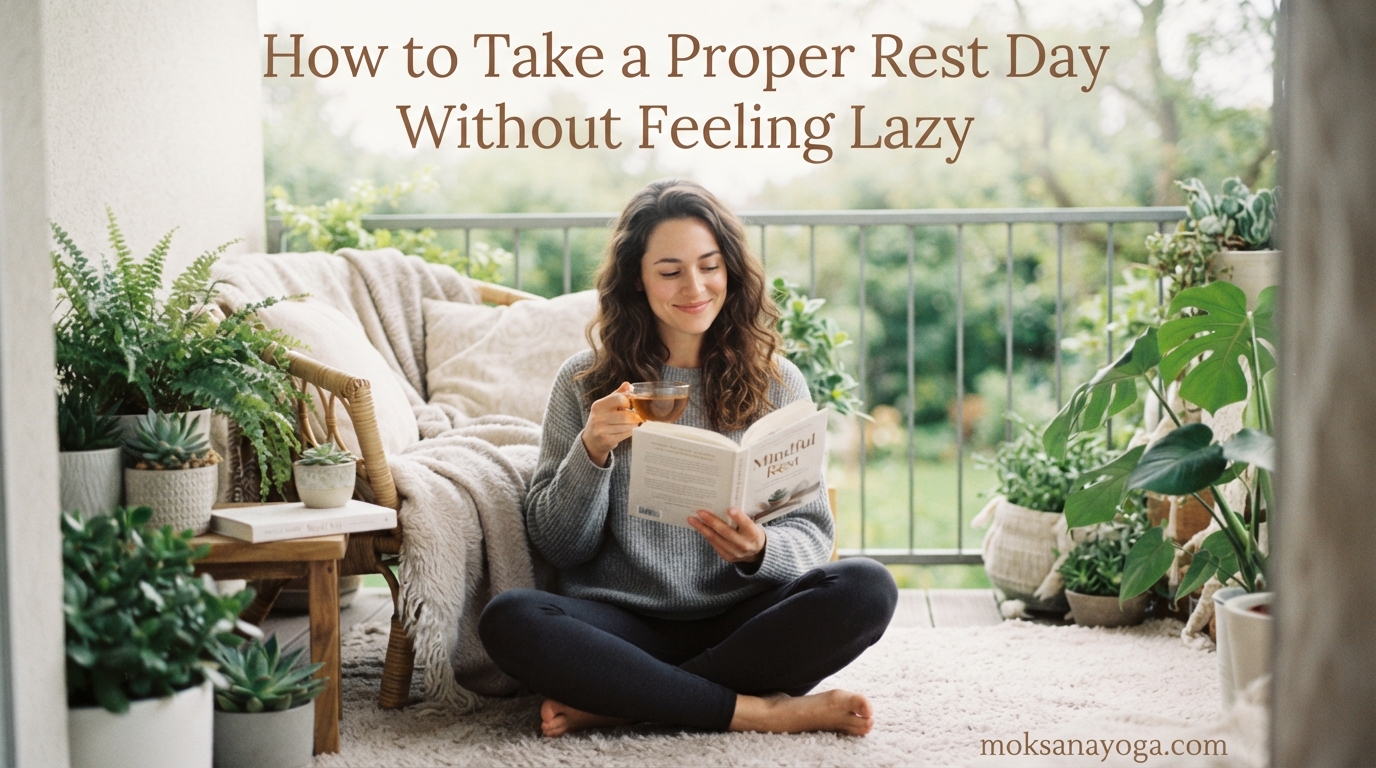
You planned to take today off. But by 10 a.m., you are already googling whether a “quick” 20-minute flow counts as rest. Sound familiar? If you have ever wondered how to take a proper rest day without feeling lazy, you are in good company. Nearly every dedicated practitioner I have taught at Moksana Yoga has wrestled with this exact guilt.
Here is the truth I keep coming back to after years on the mat: rest is not the absence of practice. It is part of it. Without intentional recovery, the body cannot integrate the work you have done. The strength, flexibility, and mental clarity you chase on your mat are actually built during rest, not during effort.
In this guide, we will walk through what a proper rest day looks like, why the guilt shows up, and how yoga philosophy offers a refreshingly different lens on the whole question. You will also find a yoga-specific rest day sequence, a simple routine you can follow, and clear answers to the questions most people ask about rest.
Table of Contents
What Is a Rest Day, Really?
A rest day is a deliberate pause from your usual training or practice intensity that gives your body and mind time to recover, repair, and reset. It is not about doing nothing. It is about doing the right kind of nothing.
Yoga philosophy describes two qualities that live in every practice and every pose: sthira (steadiness, effort, discipline) and sukha (ease, comfort, spaciousness). A healthy practice needs both. When we only value sthira, the relentless effort, we burn out. When we honor sukha, we create the conditions for sustainable growth.
A rest day is a sukha day. It is the intentional ease that balances your effort. Framed this way, rest stops being a weakness or a failure of willpower. It becomes a deliberate act of balance, just as valid as your hardest vinyasa class.
There are two main flavors of rest, and understanding the difference helps remove the guilt:
- Active recovery involves low-intensity movement that increases blood flow without stressing your system. Think gentle walking, restorative yoga, or easy mobility work. You are moving, but gently enough that you could hold a full conversation.
- Passive recovery is true stillness. Sleep, naps, savasana, lying on the couch with a book. Your body does its deepest repair work here, and nothing can substitute for it.
Both count. Both are rest. And most people need a mix of the two across a week.
The Science of Why Rest Matters
When you practice hard, whether that is power yoga, weight training, or running, you create tiny micro-tears in your muscle fibers. This sounds alarming, but it is exactly how strength is built. The repair happens during recovery, not during the workout itself. Skip the recovery and you skip the gains.
Your body is always working toward homeostasis, a state of internal balance. Intense exercise is a controlled stressor that temporarily disrupts that balance. Rest is when your body returns to baseline and rebuilds stronger than before. Without enough rest, you stay in a depleted state and progress stalls.
Rest also directly affects your hormones. Chronically under-recovering keeps cortisol, your primary stress hormone, elevated. High cortisol interferes with sleep quality, encourages inflammation, breaks down muscle tissue, and makes it harder to recover from the next session. This is why people who never rest often feel worse, not better, over time.
The mental benefits are just as significant. Your nervous system needs downtime to regulate mood, consolidate learning, and restore motivation. Studies on overtraining show that insufficient recovery leads to irritability, brain fog, and loss of drive long before physical symptoms appear. Your mind often signals the need for rest before your body does.
Here is what consistent, proper rest supports:
- Muscle repair and growth through protein synthesis and tissue rebuilding
- Reduced inflammation as your immune system catches up on repair work
- Better sleep quality because your nervous system is not stuck in overdrive
- Injury prevention since fatigued tissues are far more prone to strains and tears
- Mental clarity and motivation through dopamine and serotonin regulation
- Performance gains because adaptation happens during recovery, not effort
None of this is lazy. This is your body doing deep, invisible work. The fact that you cannot see it on a fitness tracker does not make it less real.
Signs You Need a Rest Day
Your body sends clear signals when it needs rest. The problem is that most of us were taught to push through them. Here are the signs to watch for, grouped by category.
Physical signs:
- Persistent soreness that lasts more than 72 hours
- Heavy, sluggish feeling in your muscles during warm-up
- Declining performance despite consistent effort
- Trouble sleeping or waking unrefreshed
- Frequent minor illnesses, like colds that linger
- Nagging aches in joints or connective tissue that do not resolve
Mental and emotional signs:
- Loss of motivation or dread toward practice you usually enjoy
- Irritability, mood swings, or short fuse
- Brain fog, poor concentration, or forgetfulness
- Feeling emotionally flat or disconnected
- Increased anxiety, especially around training or food
If you notice two or three of these stacking up at once, that is your body asking for a rest day, not a harder workout. Learning to read these signals is a skill, and it gets easier with practice.
How to Take a Proper Rest Day Without Feeling Lazy
This is the heart of the matter. Knowing rest is important does not automatically make the guilt disappear. Here is a step-by-step approach to actually taking a rest day without spending it mentally beating yourself up.
Step 1: Reframe Rest as Part of Your Practice
Stop treating rest as the opposite of training. It is a phase of training. Every athlete, every long-term practitioner, every teacher who has sustained a decades-long practice treats recovery as non-negotiable. When you rest, you are not quitting. You are completing the cycle.
Try this reframe: a rest day is not a day off from your goals. It is a day working toward them through a different channel.
Step 2: Plan Your Rest Day in Advance
Guilt thrives in ambiguity. When rest is unplanned, it feels like avoidance. When it is scheduled, it feels like strategy. Decide at the start of each week which day is your rest day and protect it the same way you would protect a class or training session.
Planning ahead also shuts down the internal negotiation. You are not deciding in the moment whether to practice. You already decided. Today is rest. That is the plan.
Step 3: Fill the Day With Intentional Recovery
An empty rest day leaves space for guilt to fill the void. Instead, choose two or three restorative activities and do them on purpose. A morning walk, a 15-minute restorative yoga sequence, an afternoon nap, an evening bath. Structure the day around recovery rather than drifting through it feeling like you should be doing more.
Step 4: Step Away From Tracking
One of the most common rest day mistakes is obsessively checking your fitness tracker, your step count, or your practice streak. Recovery means recovering from the pressure to perform, not just from physical effort. Put the watch in a drawer. Let go of the numbers for one day.
Step 5: Address the Psychology of Guilt
Rest day guilt is usually not really about rest. It is about identity. If you have built your sense of self around being disciplined, active, and productive, then stillness feels like a threat to who you are. The fix is not to push harder. It is to widen your identity so that rest is part of being a healthy practitioner, not a departure from it.
Notice the voice that says you are being lazy. Get curious about it. Where did it come from? Whose voice is it? Often it is an old story, not a current truth.
Step 6: Use Yoga Philosophy as Your Anchor
Yoga offers a framework that makes rest feel natural rather than indulgent. The concept of sukha, ease, is not a consolation prize for the weak. It is a core principle. The Yoga Sutras describe practice as steady and comfortable. A practice with no ease is not yoga. It is just exertion.
When guilt shows up, remind yourself that you are not abandoning your practice by resting. You are practicing sukha. You are practicing the art of balance.
What to Do on a Rest Day: 7 Restorative Activities
Not sure how to fill a rest day? Here are seven science-backed, guilt-free activities that support recovery without adding stress to your system.
- Take a long walk in nature. Walking at a conversational pace increases blood flow, supports lymphatic drainage, and lowers cortisol. Time in green space has been shown to reduce rumination and improve mood. Aim for 30 to 60 minutes, ideally somewhere quiet.
- Practice 15 to 20 minutes of restorative yoga. Long holds in supported poses activate your parasympathetic nervous system, the rest-and-digest state where deep repair happens. We will cover specific poses in the next section.
- Do a guided yoga nidra session. Yoga nidra, or yogic sleep, is a structured relaxation practice that takes you into a state between waking and sleeping. Twenty minutes can feel like hours of rest for an exhausted nervous system.
- Take a real nap. A 20 to 30 minute nap supports memory consolidation, reduces stress hormones, and improves afternoon focus. Keep it short enough that you do not enter deep sleep and wake groggy.
- Do something creative with your hands. Cooking, drawing, gardening, playing music. Creative activities engage different neural pathways than training and give your analytical, goal-oriented brain a genuine break.
- Get bodywork or self-massage. A massage, foam rolling session, or even 10 minutes with a tennis ball on tight spots improves circulation and tissue quality without taxing your system.
- Protect a full hour of stillness. This is the hardest one for most people. Sit with a book, meditate, or simply lie down and do nothing for an hour. True rest requires moments of complete non-productivity.
Pick two or three from this list rather than all seven. The goal is rest, not another to-do list to perform.
Yoga-Specific Rest Day Practices
This is where yoga offers something genuinely unique. No other training modality has built-in tools for rest the way yoga does. Here is how to use yoga specifically for recovery rather than effort.
Restorative Yoga for Deep Nervous System Reset
Restorative yoga uses props, bolsters, blankets, blocks, straps, to fully support your body in passive poses. You do not stretch. You do not work. You simply rest in shapes that signal safety to your nervous system. A 20-minute sequence of supported child’s pose, supported bridge, legs-up-the-wall, and savasana can drop you into a parasympathetic state that few other practices reach.
Hold each pose for 5 to 10 minutes. Breathe naturally. The only goal is to let gravity and the props do the work.
Yin Yoga for Connective Tissue Recovery
Yin yoga targets the connective tissues, fascia, ligaments, and joints, through long, passive holds. On a rest day, a gentle yin sequence can release stored tension without demanding muscular effort. Focus on poses that open the hips, spine, and shoulders, the areas that hold the most stress from daily life and intense practice.
Keep the intensity moderate. Yin should feel like a gentle, satisfying stretch, never sharp or straining.
Yoga Nidra for Mental Recovery
Yoga nidra is perhaps the most undervalued rest tool in the entire yoga tradition. It is a guided lying-down practice that systematically moves your awareness through your body, breath, and mind. Studies suggest that 30 to 45 minutes of yoga nidra can match the restorative effects of several hours of sleep for the nervous system.
This is the practice I recommend most for people who feel terrible on rest days. If lying still feels unbearable, yoga nidra gives your mind something to do while your body rests. It bridges the gap for restless recoverers.
Gentle Breathwork to Down-Regulate
Simple breathwork can shift your nervous system into recovery mode in minutes. Try this: lie down, place one hand on your belly, and breathe so that your belly rises on each inhale and falls on each exhale. Make the exhale slightly longer than the inhale. Five minutes of this practice is enough to lower heart rate and reduce stress chemistry.
Avoid intense breathwork like kapalabhati or long breath retentions on rest days. Those are stimulating practices. On a rest day, you want the opposite.
A Simple Rest Day Yoga Sequence
If you want one short sequence you can return to, try this 15-minute flow. Move slowly and let your breath lead.
- Child’s pose, 2 minutes
- Cat-cow, 1 minute
- Thread-the-needle, 1 minute each side
- Supported bridge (block under sacrum), 3 minutes
- Supine twist, 2 minutes each side
- Legs-up-the-wall, 5 minutes
- Savasana, 5 minutes or longer
This is not a workout. It is a nervous system ritual. Treat it as such and notice how different you feel afterward.
What NOT to Do on a Rest Day
Certain habits quietly sabotage your recovery and keep the guilt alive. Here is what to avoid.
- Do not turn rest into a workout. If your “easy” recovery run leaves you sweaty and breathless, it is not recovery. The line is simple: if you cannot hold a conversation, you are training, not resting.
- Do not restrict food. Your body needs nutrients to repair tissue and replenish energy. Undereating on rest days slows recovery and often triggers cravings and binges later. Eat normally, with plenty of protein, healthy fats, and complex carbs.
- Do not obsessively check your tracker. Step counts, sleep scores, and readiness metrics can turn rest into a performance. Put the data away for a day.
- Do not fill the day with chores. If your rest day becomes a marathon of cleaning, errands, and life admin, your body is still working. Recovery requires actual stillness somewhere in the day.
- Do not spiral into guilt. Notice the guilt when it arrives, name it, and let it pass. You do not have to obey it. Rest is not something to earn.
A Simple Rest Day Routine You Can Follow
If structure helps you feel less adrift on a rest day, here is a simple template. Adapt it to your own rhythms.
- Morning: Wake without an alarm if possible. Drink water. Take a 20 to 30 minute easy walk. Eat a nourishing breakfast. Do 10 minutes of gentle stretching or breathwork.
- Midday: Eat a full, satisfying meal. Do something unrelated to fitness, read, cook, see a friend, garden. Optional 20-minute nap.
- Afternoon: 15 to 30 minutes of restorative yoga or yoga nidra. Bodywork, foam rolling, or a bath if you have time.
- Evening: A relaxed dinner. Light movement if you feel called, but nothing structured. Early bedtime to maximize sleep.
Notice what is missing: no intense workout, no tracker check, no productivity goals. The only goal is recovery.
FAQs
How to not feel lazy on a rest day?
Reframe rest as part of your practice rather than a break from it. Plan your rest day in advance, fill it with intentional recovery activities like walking or restorative yoga, and step away from fitness trackers. Rest day guilt usually comes from tying your identity to constant productivity, not from actual laziness.
Do rest days lower cortisol?
Yes. Proper rest days help bring elevated cortisol levels back to a healthy baseline. Chronic under-recovery keeps your stress hormones high, which interferes with sleep, muscle repair, and immune function. Activities like restorative yoga, yoga nidra, and gentle walking actively activate your parasympathetic nervous system, which lowers cortisol.
Why do I feel terrible on rest days?
Feeling terrible on rest days is common and usually temporary. When you stop pushing, your body finally registers how fatigued it actually is. This can surface as sluggishness, low mood, or body aches. It typically passes within a day or two. Staying gently active with walks or restorative yoga and eating enough nutrients helps ease the transition.
How many rest days per week do I need?
Most people need at least one full rest day per week, and many benefit from two. If you practice intensely four or more days a week, schedule one passive rest day and one active recovery day. Listen to your body and watch for signs of overtraining like poor sleep, declining performance, or persistent soreness.
What is active recovery?
Active recovery is low-intensity movement that increases blood flow without stressing your system. Examples include gentle walking, restorative yoga, easy cycling, and mobility work. The key test is whether you can hold a full conversation while doing it. If you cannot, you are training, not recovering.
Conclusion
Learning how to take a proper rest day without feeling lazy is not a one-time fix. It is a practice, the same way your time on the mat is a practice. The guilt will not disappear overnight, but it loses its grip each time you choose rest on purpose and notice that you come back stronger, clearer, and more yourself.
Rest is not laziness. It is the sukha that balances your sthira, the ease that makes your effort sustainable. When you rest well, you are not stepping away from your practice. You are completing it.
So plan your next rest day. Choose two or three restorative activities. Put the tracker away. And when the guilt shows up, as it probably will, let it sit beside you for a moment and then move on. Your body is doing important work, even when you cannot see it.