
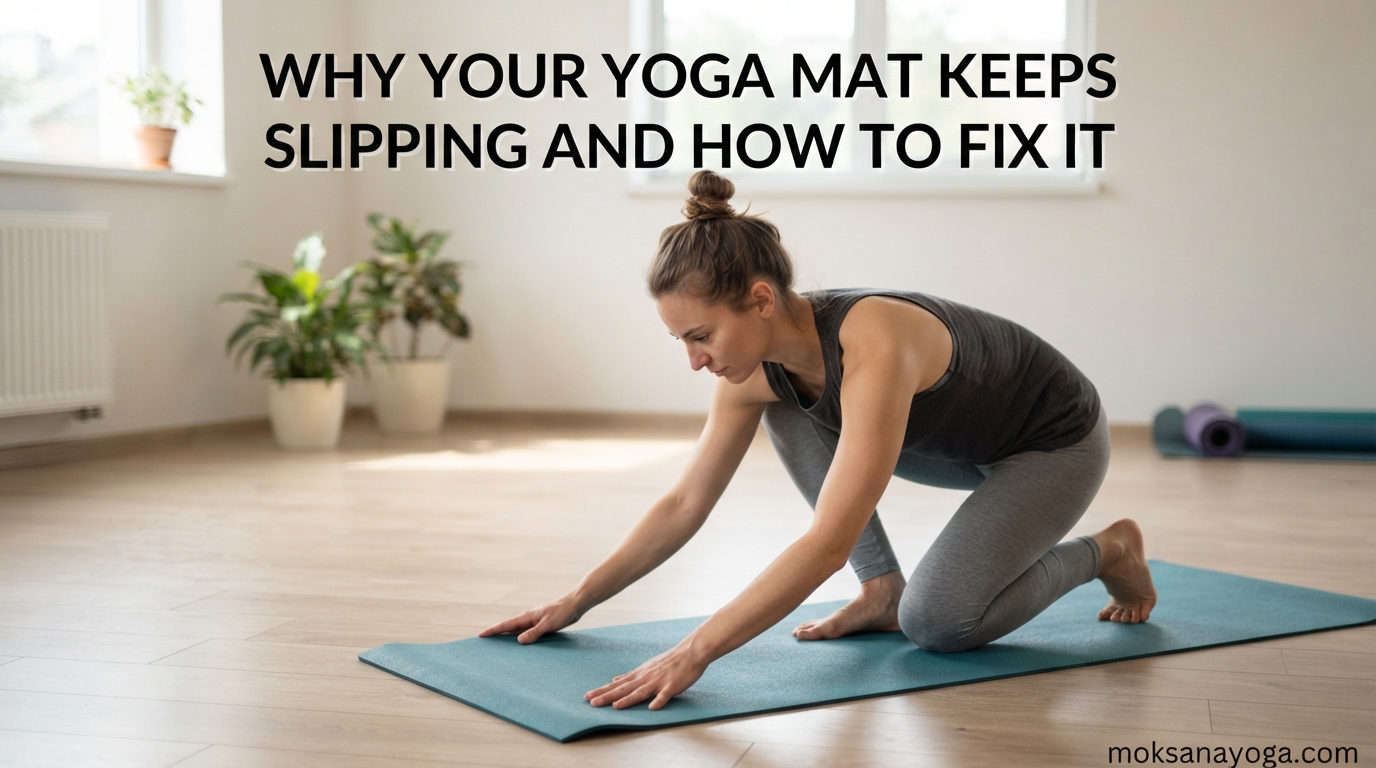
You are five minutes into your practice. You settle into Downward-Facing Dog, press your palms into the mat, and feel your hands slowly slide forward. Sound familiar? If you are wondering why your yoga mat keeps slipping and how to fix it, you are in good company. This is one of the most common frustrations yoga practitioners face, and it has nothing to do with your skill level.
Our team has spent years testing mats across every material, from budget PVC to premium cork and natural rubber. We have scoured forums, talked to instructors, and tested every break-in hack the community swears by. The result is this comprehensive guide that covers every root cause and every proven fix.
Whether your hands slip when dry, your mat slides across the floor, or you lose grip the moment sweat appears, there is a specific reason and a specific solution. Let us walk through exactly how to stop a yoga mat from slipping so you can focus on your breath instead of your grip.
Table of Contents
Quick Answer: Why Your Yoga Mat Keeps Slipping and How to Fix It
The number one reason your yoga mat keeps slipping is an invisible factory coating applied during manufacturing. This thin film, made from release agents used to pop mats out of molds, acts like a lubricant on the surface. Most new mats need a break-in period of one to two weeks before the coating wears off and the true grip emerges.
Here are the five most effective fixes you can try today:
- Do a sea salt scrub – Mix sea salt with warm water and scrub the mat surface to remove the factory film faster.
- Clean with vinegar solution – Equal parts water and white vinegar cuts through residue without leaving soap film.
- Use a yoga towel – Place a microfiber towel over your mat for instant grip, especially in hot yoga.
- Break it in with daily use – Simply practicing every day speeds up the natural wear that removes the coating.
- Check your alignment – Spread your fingers wide and engage Hasta Bandha to distribute weight evenly.
If none of these work, your mat material may simply not suit your practice style. We will cover that in depth below.
Why Your Yoga Mat Keeps Slipping: 6 Root Causes
Before jumping to solutions, it helps to understand which specific cause applies to your situation. Slipping on a yoga mat is not a single problem with a single fix. It is a symptom with several possible sources, and identifying the right one saves you time and frustration.
1. Factory Film and Release Agents
If you just unrolled a brand new mat and it feels like ice, you are dealing with factory film. This is the most common cause of slipping for new mat owners, and it is completely normal.
During manufacturing, mats are formed in molds. To prevent the material from sticking to the mold, factories apply release agents that leave a thin, invisible coating on the surface. This coating does not wipe off with a quick pass of a damp cloth. It takes time and friction to wear away.
Even expensive mats from premium brands like Manduka and Lululemon ship with this coating. In fact, higher-quality natural rubber mats often have a longer break-in period because the material is denser and the coating adheres more strongly. Reddit users frequently express surprise that their expensive mat performs worse than a cheap one right out of the box, but this is expected behavior.
The good news is that once you break through the factory film, the mat surface underneath provides excellent grip. Most mats need one to two weeks of regular practice to fully break in, though you can speed this up with a salt scrub.
2. Sweat and Moisture on Closed-Cell Mats
If your mat feels great for the first ten minutes but turns slippery the moment you start sweating, moisture is the culprit. How your mat handles moisture depends entirely on whether it has a closed-cell or open-cell surface.
Closed-cell mats have a smooth, sealed surface where moisture sits on top rather than being absorbed. PVC and TPE mats are typically closed-cell. When sweat pools on the surface, it creates a thin liquid layer between your skin and the mat, drastically reducing friction. Think of it like trying to grip a wet countertop.
Open-cell mats absorb moisture into the material itself. Natural rubber mats are often open-cell, which means sweat actually improves grip as it gets absorbed into the surface. This is why many hot yoga practitioners prefer rubber mats for sweaty sessions.
Cork mats take a different approach. They contain suberin, a natural waxy substance that becomes grippier when exposed to moisture. This makes cork one of the best materials for practitioners who sweat heavily. Microfiber mats work similarly, needing a light mist of water to activate their grip.
If you practice hot yoga or sweat a lot during Vinyasa flow, your mat material matters more than any cleaning routine. Switching to a moisture-activated surface can transform your practice instantly.
3. Cleaning Residue and Soap Buildup
Here is a frustrating irony: cleaning your mat the wrong way actually makes it more slippery. Using multipurpose household cleaners, body wash, or dish soap leaves a residue film on the surface that acts as a lubricant. The more you clean with these products, the worse the slipping gets.
This is one of the most overlooked causes of slipping. Many practitioners assume their mat is defective or worn out when in reality, soap buildup is the problem. The solution is simple but requires changing your cleaning routine.
Use a dedicated yoga mat cleaner or a simple mixture of equal parts water and white vinegar. Vinegar cuts through grease and residue without leaving any film behind. Wipe the mat down with a soft cloth, then let it air dry completely before rolling it up.
Never roll up a damp mat. Whether it is wet from cleaning or from a sweaty practice, trapping moisture inside the roll creates a breeding ground for bacteria and can leave the surface feeling slick. Always hang your mat over a door or shower rod to dry fully.
4. Lotions, Oils, and Body Products
Body lotion, sunscreen, massage oil, and even natural skin oils transfer onto your mat during practice. These substances create a slippery barrier between your skin and the mat surface, and they build up over time with each session.
If you notice slipping concentrated on areas where your hands and feet make the most contact, body products may be the cause. The palms of your hands and the soles of your feet pick up oils from the rest of your body and deposit them on the mat.
Wash your hands and feet before practice to remove lotions and oils. If you apply moisturizer, do it after yoga rather than before. For mats that already have oil buildup, a vinegar cleaning solution will help break down the residue.
Be especially careful with essential oil sprays. Some practitioners love the aromatherapy aspect, but certain oils can degrade natural rubber and cork surfaces over time. Tea tree oil in small amounts mixed with water is generally safe, but citrus oils can break down rubber compounds.
5. Your Floor Surface Matters More Than You Think
Sometimes the problem is not your mat sliding under your body, but your mat sliding across the floor. This is a completely separate issue that requires a different solution, and almost no competitor covers it thoroughly.
Hardwood floors with even a thin layer of dust create a low-friction surface that lets your mat slide with every movement. Tile and laminate floors can be similarly slick, especially if they have been recently polished or waxed. Even carpet can cause issues if the pile is thick enough that the mat cannot grip a solid surface underneath.
To fix mat-on-floor sliding, first clean the floor thoroughly. A damp mop removes the dust layer that acts like tiny ball bearings under your mat. If the floor is still too slick, try placing a non-slip rug pad underneath your mat for a few dollars.
Carpet practitioners should look for a firm surface underneath. A thick, plush carpet prevents the mat from making solid contact with anything stable. In this case, a plywood board or a dedicated yoga platform under the mat can provide the grip you need.
6. Body Alignment and Weight Distribution
Not all slipping is the mat’s fault. How you distribute your body weight on the mat plays a massive role in whether you stay put or slide around. This is especially true for poses like Downward-Facing Dog, Chaturanga, and Plank.
When you dump all your weight into the heel of your palm, you create a pressure point that acts like a sled. The force pushes your hand forward, and any moisture or residue on the surface amplifies the slide. The fix is to spread your fingers wide and distribute weight evenly across the entire hand.
This technique has a name in yoga: Hasta Bandha, or the hand seal. By pressing down through the knuckles and finger pads while slightly lifting the center of the palm, you create a suction-like grip that anchors you to the mat. It takes practice, but it transforms your stability in weight-bearing poses.
Core engagement matters too. When your core is disengaged, more weight shifts into your hands and wrists, increasing the downward force that causes sliding. By drawing your navel toward your spine and engaging your abdominal muscles, you redistribute weight more evenly and reduce the load on your extremities.
Wrist and forearm strength is another factor that many practitioners overlook. As one Reddit user pointed out, front arm strength is a bigger contributor to slipping than most people realize. Building upper body strength over time reduces how much you rely on surface friction to hold poses.
7 Fixes You Can Try Today to Stop Your Yoga Mat from Slipping
Now that you understand the causes, let us walk through each fix in detail. These solutions range from quick five-minute fixes to longer-term habit changes. Try them in order, starting with the easiest.
Fix 1: The Sea Salt Scrub Method
This is the community favorite for a reason. The sea salt scrub has been shared hundreds of times on Reddit with dozens of confirmations. It works by using mild abrasion to physically remove the factory film from the surface of a new mat.
Here is how to do it step by step:
- Step 1: Lay your mat flat on a clean floor.
- Step 2: Sprinkle a generous handful of coarse sea salt across the entire surface, paying extra attention to the areas where your hands and feet go.
- Step 3: Dampen a clean cloth with warm water and scrub the salt into the mat using circular motions.
- Step 4: Keep scrubbing for five to ten minutes, covering every inch of the surface.
- Step 5: Wipe away all the salt with a clean, damp cloth.
- Step 6: Let the mat air dry completely before rolling it up.
Some practitioners add a splash of white vinegar to the scrubbing water for extra cleaning power. This combination of physical abrasion and chemical cutting power removes even stubborn factory coatings.
You may notice the mat feels slightly rougher after a salt scrub. This is a good sign. It means the slick coating is gone and the grippy material underneath is now exposed. Most mats need one or two salt scrubs to fully break in.
Fix 2: Vinegar and Water Solution
If salt scrubbing sounds like too much work, a simple vinegar solution can remove cleaning residue, body oils, and light factory film. Mix equal parts white vinegar and warm water in a spray bottle.
Spray the solution lightly across the mat surface. Do not soak it. Wipe down with a soft cloth using long strokes from one end to the other. Flip the cloth to a dry section and wipe again to remove excess moisture.
Vinegar is ideal because it evaporates completely without leaving residue. Unlike soap, which sticks around and creates new slipperiness, vinegar cleans and disappears. Use this method weekly to keep your mat in top condition.
The vinegar smell fades within minutes as the solution dries. If you find it unpleasant, add two or three drops of tea tree oil or lavender oil to the bottle. These oils are safe for most mat materials and provide a pleasant scent.
Fix 3: Break It In With Daily Use
Sometimes the best fix is the simplest one. Every time you practice, your body weight, body heat, and the friction of your hands and feet gradually wear away the factory film. Mats that feel impossibly slippery on day one often feel perfectly grippy by day ten.
To speed up the break-in process, try leaving your mat unrolled on the floor between sessions. Some practitioners recommend leaving it out for a full day or two when it is brand new. The continuous exposure to air and the natural settling of the material help the surface mature faster.
Different materials have different break-in timelines. PVC and TPE mats typically break in within a few days. Natural rubber mats can take one to two weeks of regular practice. Cork mats may need less break-in time since they rely on moisture activation rather than surface friction alone.
Be patient. If you just bought an expensive mat and it feels slippery, resist the urge to return it immediately. Give it at least two weeks of daily practice plus one salt scrub session before making a judgment.
Fix 4: Use a Yoga Towel
A yoga towel is the most reliable instant fix for slipping, and it works on any mat. These thin microfiber towels lay on top of your mat and provide a grippy surface that actually improves with moisture. For hot yoga and Bikram practitioners, a yoga towel is practically mandatory equipment.
Look for towels with silicone nubs or dots on the bottom side. These grip the mat underneath and prevent the towel itself from sliding. The top surface uses microfiber material that wicks sweat and provides traction when slightly damp.
The trick to getting the most grip from a yoga towel is to lightly mist it with water before practice. A dry microfiber towel can feel slippery at first, but once it absorbs a small amount of moisture, the fibers soften and grip your skin. This is the same moisture-activated principle behind microfiber mats.
Yoga towels are also great for protecting your mat from sweat and oil buildup, extending its lifespan. You can throw the towel in the washing machine after each use, which is much easier than deep-cleaning a mat regularly.
Fix 5: Switch to a Moisture-Activated Mat
If you have tried everything and still struggle with slipping during sweaty practices, your mat material may be the problem. Closed-cell PVC and TPE mats simply are not designed for heavy sweaters. Switching to a moisture-activated material can eliminate slipping overnight.
Natural rubber mats are the gold standard for sweaty practitioners. The open-cell surface absorbs sweat, and the rubber provides excellent wet grip. Brands like Manduka (PRO series) and Lululemon (The Reversible Mat) are popular choices in the community.
Cork mats are another excellent option. The suberin in cork creates a surface that gets grippier as it gets wetter. Cork is also naturally antimicrobial, which helps control odor from sweat. Many practitioners find cork ideal for hot yoga.
Microfiber mats and combo mats that combine a towel layer with a mat base are designed specifically for sweat. These are essentially a built-in yoga towel system. They work best when lightly sprayed with water before practice to activate the grip fibers.
Fix 6: Practice Hasta Bandha for Better Grip
Hasta Bandha, the yoga hand seal, is a technique that can dramatically reduce slipping regardless of your mat quality. It changes how your hand interacts with the mat surface, spreading force across a wider area and creating a natural suction effect.
To practice Hasta Bandha, place your hands flat on the mat with fingers spread wide. Press down firmly through the knuckles at the base of each finger and through your finger pads. Then, slightly lift the center of your palm, creating a gentle arch.
This arch creates a vacuum effect that anchors your hand to the mat. Think of it like a suction cup. The wider your fingers are spread, the more surface area you have for grip and the more evenly your weight is distributed.
This technique takes time to develop. If you are used to dumping weight into the heel of your palm, spreading it across the whole hand will feel awkward at first. Start by practicing it in tabletop position before applying it to Downward Dog and Plank.
Pair Hasta Bandha with core engagement for maximum stability. When your core is active, less weight transfers to your hands, reducing the force that causes sliding. Draw your lower belly in and up, and feel how your hands suddenly feel lighter on the mat.
Fix 7: Try Yoga Socks or Gloves
If you have exhausted other options and still need more grip, yoga socks and gloves provide a direct solution. These accessories have grippy silicone dots or rubber pads on the contact surfaces that dramatically increase friction.
Yoga socks are particularly popular with Yin and restorative practitioners who prefer not to use a mat towel. Toe socks with individual toe separators allow full toe articulation while providing grip. Brands like Toe Sox are widely recommended in the yoga community.
Yoga gloves work similarly for hand grip. They are less common than socks but can be a lifesaver for practitioners with naturally dry hands who struggle with grip even on broken-in mats. Some practitioners also use climbing chalk on their hands for a similar effect.
These accessories are especially useful for travel. If you are using a studio mat or a borrowed mat and cannot control the surface quality, bringing your own grip socks ensures consistent traction regardless of the mat condition.
Yoga Mat Materials Comparison: Which Ones Grip Best?
Choosing the right mat material is the single biggest factor in long-term slip prevention. Here is how the most common materials compare for grip and slip resistance.
PVC Mats: Budget-friendly and widely available. Closed-cell surface means sweat sits on top, causing slipping. Good grip when dry but poor grip when wet. Long lifespan but not eco-friendly.
TPE Mats: Lighter and more eco-friendly than PVC. Similar closed-cell surface behavior. Decent dry grip, moderate break-in time. A good budget option for light practice.
Natural Rubber Mats: The gold standard for sweaty practitioners. Open-cell surface absorbs moisture and provides excellent wet grip. Requires a longer break-in period (one to two weeks). Can be heavy and has a rubber smell initially.
Cork Mats: Moisture-activated grip that improves with sweat. Naturally antimicrobial and eco-friendly. Excellent for hot yoga. Can be more expensive and slightly less cushioned than rubber.
Microfiber / Combo Mats: Towel-and-mat hybrid designed for sweaty practice. Needs to be lightly misted with water to activate grip. Excellent for hot yoga and Bikram. Machine washable for easy cleaning.
Jute Mats: Natural fiber surface with a textured, rough grip. Good for dry practice but less effective when sweaty. Eco-friendly with a unique feel that some practitioners love.
How to Diagnose Your Specific Slipping Problem
Before trying every fix on this list, take a moment to diagnose exactly what is happening. The right diagnosis points you to the right solution and saves hours of frustration.
Is your mat sliding on the floor? If the entire mat moves when you shift positions, the problem is between the mat and the floor, not between you and the mat. Clean the floor, try a non-slip rug pad, or practice on a surface with more texture.
Are your hands slipping when dry? If you slip before sweating at all, you are dealing with factory film, cleaning residue, or body oils. Try a salt scrub and a vinegar clean. If the mat is new, give it more break-in time.
Are your hands slipping only when sweaty? This is a material issue. Your closed-cell mat cannot handle moisture. Either switch to a moisture-activated mat or add a yoga towel for sweaty sessions.
Do you slip in specific poses? If slipping happens mainly in Downward Dog, Plank, or Chaturanga, your alignment may be the issue. Practice Hasta Bandha, engage your core, and check that your wrist creases align with the front of the mat.
Did slipping start after cleaning? If your mat was fine before you cleaned it and slippery after, you used the wrong cleaner. Switch to a vinegar solution and wipe the mat down to remove soap residue.
Do’s and Don’ts of Yoga Mat Care
Do:
- Clean your mat weekly with a vinegar and water solution.
- Let your mat air dry completely before rolling it up.
- Store your mat unrolled when possible to speed up break-in.
- Wash your hands and feet before practice to remove oils and lotions.
- Use a dedicated yoga mat cleaner instead of household products.
- Invest in a yoga towel for hot yoga sessions.
Don’t:
- Don’t use dish soap, body wash, or multipurpose cleaners on your mat.
- Don’t roll up a damp or sweaty mat.
- Don’t apply body lotion or oil immediately before practice.
- Don’t use citrus essential oils on natural rubber mats.
- Don’t submerge your mat in water unless the manufacturer specifically allows it.
- Don’t expect a new mat to have perfect grip on day one.
Seasonal Factors: How Humidity and Temperature Affect Grip
No competitor talks about this, but seasonal changes have a real impact on mat performance. In humid summer months, moisture in the air can settle on your mat surface and make even a clean, well-maintained mat feel slippery. This is especially noticeable in coastal or tropical climates.
In dry winter months, the opposite problem occurs. Low humidity dries out your skin, which can reduce the natural friction between your palms and the mat. Dry, flaky skin slides more easily than slightly moisturized skin.
If you practice in a humid climate, consider a cork or rubber mat that handles ambient moisture well. In dry climates, a light hand moisturizer applied well before practice (giving it time to fully absorb) can improve grip without leaving residue on the mat.
Temperature also plays a role. Cold mats feel stiffer and less grippy, while warm mats soften and conform to your hands. If you practice in a cold room, give the mat a few minutes to warm up under your hands and feet before attempting challenging poses.
FAQs
How to get a yoga mat to stop slipping?
To stop a yoga mat from slipping, first identify the cause. For new mats, do a sea salt scrub to remove the factory coating. For sweat-related slipping, use a yoga towel or switch to a moisture-activated mat like cork or natural rubber. For cleaning residue, wipe with a vinegar and water solution. For alignment issues, practice spreading your fingers wide and engaging Hasta Bandha.
Why is my new yoga mat so slippery?
New yoga mats are slippery because of a thin factory film called a release agent applied during manufacturing. This invisible coating prevents the mat from sticking to the mold and acts like a lubricant on the surface. It wears off naturally over one to two weeks of regular practice, or you can remove it faster with a sea salt scrub.
How to fix a slippery mat?
Fix a slippery mat by doing a sea salt scrub to remove factory film, cleaning with a vinegar and water solution to eliminate residue, using a yoga towel for instant grip, practicing daily to speed up break-in, switching to a moisture-activated mat for sweaty sessions, or using yoga socks and gloves for additional traction.
How long does it take to break in a yoga mat?
Most yoga mats take one to two weeks of daily practice to fully break in. PVC and TPE mats may break in within a few days, while natural rubber mats can take up to two weeks. You can speed up the process by doing a sea salt scrub, leaving the mat unrolled between sessions, and practicing daily.
Can I wash my yoga mat to make it less slippery?
Yes, but only with the right method. Use a mixture of equal parts water and white vinegar to clean the mat. Avoid soap, dish detergent, and multipurpose cleaners, which leave a residue film that makes slipping worse. Some mats are machine washable on a cold gentle cycle with mild detergent, but always check the manufacturer instructions first.
Do yoga towels really help with slipping?
Yes, yoga towels are one of the most effective solutions for slipping, especially during hot yoga. Microfiber yoga towels provide a grippy surface that improves when slightly damp. Look for towels with silicone nubs on the bottom to prevent the towel from sliding on the mat. Lightly mist the towel with water before practice to activate the grip fibers.
When to Replace Your Yoga Mat
Sometimes a mat has simply reached the end of its life. If you have tried every fix on this list and your mat still slips, it may be time for a replacement. Most mats last one to three years depending on frequency of use and material quality.
Signs that your mat needs replacing include visible wear in the areas where your hands and feet go, a smooth and shiny surface that no longer responds to cleaning, compression marks that do not bounce back, or a persistent odor even after cleaning.
When shopping for a replacement, consider your practice style. If you sweat heavily or practice hot yoga, prioritize cork or natural rubber. If you travel frequently, look for a lightweight combo mat. If you are a beginner, a mid-range TPE mat offers good grip without a long break-in period.
Conclusion: Take Control of Your Grip
Understanding why your yoga mat keeps slipping and how to fix it transforms your practice from frustrating to focused. The cause is almost always one of six things: factory film, sweat on a closed-cell surface, cleaning residue, body oils, a slick floor, or alignment issues. Once you identify which one applies to you, the fix becomes obvious.
Start with the quick wins. Do a salt scrub on a new mat. Switch to a vinegar-based cleaner. Try a yoga towel for sweaty sessions. Practice Hasta Bandha in your next Downward Dog. Most practitioners see immediate improvement from just one or two of these changes.
Remember that every mat has a break-in period. Be patient with a new mat, and give it two weeks of daily practice before judging its grip. If you have done everything right and the mat still does not work for your practice style, consider switching to a material better suited to your needs. Your mat should support your practice, not fight against it.