
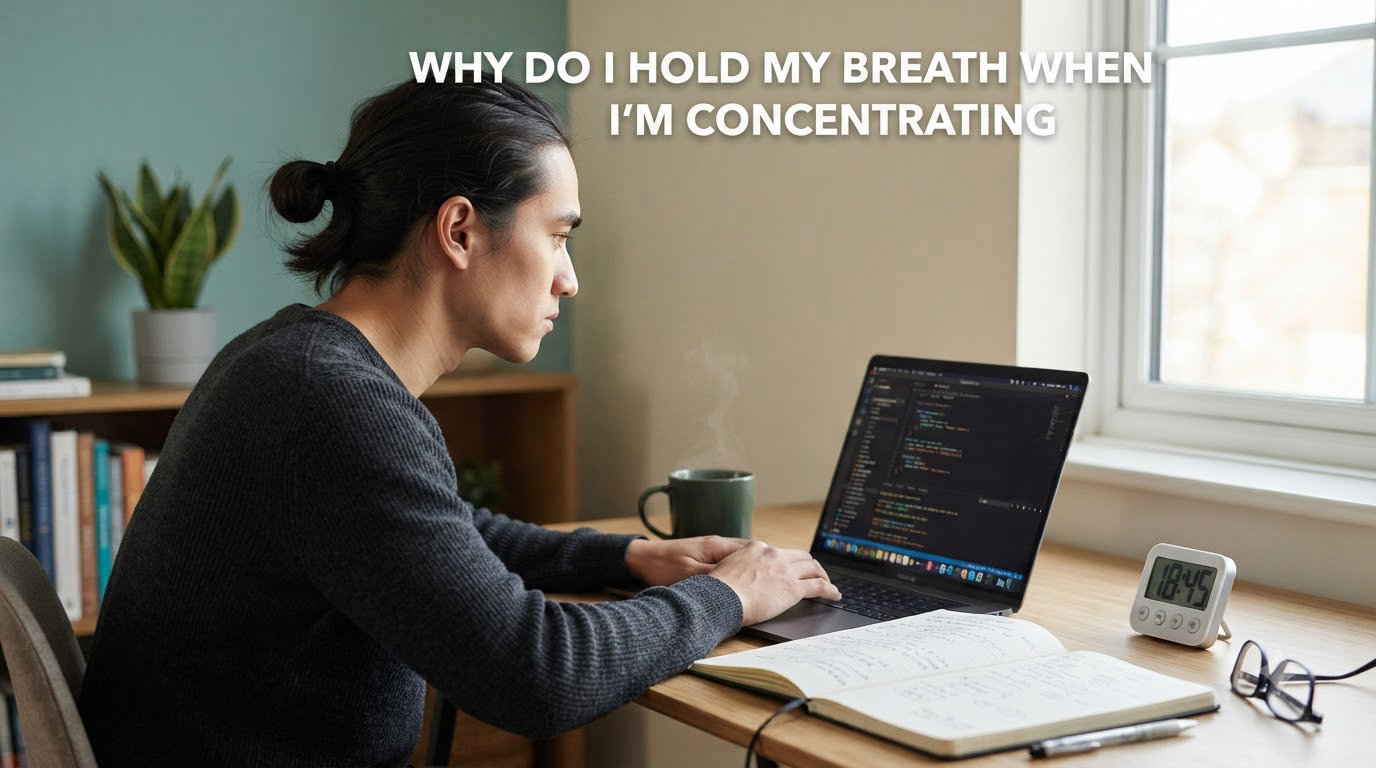
You are deep into a task. Maybe typing an email, reading a contract, or threading a needle. Then suddenly you realize: you have not taken a breath in what feels like a very long time. Your chest feels tight, your shoulders are tense, and you gasp slightly as awareness returns.
If this sounds familiar, you are far from alone. Researchers have a name for this phenomenon, and understanding why do I hold my breath when concentrating can help you break the pattern and feel more relaxed, focused, and energized throughout your day.
In this article, we will explore the science behind concentration apnea, the yoga perspective on breath and focus, and five practical techniques you can use today to retrain your breathing during focused tasks.
Table of Contents
What Is Concentration Apnea (Email Apnea)?
Holding your breath when concentrating, sometimes called concentration apnea, email apnea, or screen apnea, is an unconscious physical reaction where your brain redirects energy away from automatic functions like breathing to focus on the task at hand.
The term “email apnea” was coined by former Apple executive Linda Stone, who noticed she and many colleagues held their breath while reading emails. She later surveyed friends and colleagues and estimated that roughly 80 percent of people experience some form of breath-holding while working at screens.
Whether you call it email apnea, screen apnea, or simply “forgetting to breathe,” this habit is incredibly common. The good news is that it is also completely normal and, with awareness, entirely manageable.
Why Do I Hold My Breath When Concentrating? The Science Explained
Several overlapping mechanisms explain why your body suspends breathing during intense focus. It is not a conscious choice but rather a layered physiological response involving your nervous system, muscles, and evolutionary wiring.
Postural Stabilization: The Body’s Natural Brace
One leading explanation is postural stabilization. When you concentrate hard on a task, your body instinctively braces itself to stay still. Think of a photographer holding their breath to take a steady shot or a surgeon pausing their breath during a precise incision.
Your diaphragm is both a breathing muscle and a core stabilizer. When you need stillness, the body temporarily halts breathing so the diaphragm can brace your spine. This is helpful in short bursts but becomes problematic when sustained for hours at a desk.
The Fight-or-Flight Connection
Breath-holding during focus also taps into your autonomic nervous system. When you concentrate intensely, your brain can interpret the situation as mildly stressful, triggering a subtle fight-or-flight response through the sympathetic nervous system.
This response causes muscles to tense, heart rate to shift, and breathing to become shallow or pause entirely. The vagus nerve, which regulates your parasympathetic (rest and digest) response, gets suppressed. Your body enters a low-grade alert state that keeps you braced and ready.
This mechanism was useful for our ancestors who needed freeze-like stillness to avoid predators. In modern life, though, it is triggered by a deadline or a difficult email, which means the response fires far more often than necessary.
Resource Rerouting and Cognitive Load
Your brain also deprioritizes what it considers non-essential functions when cognitive load spikes. Breathing is automatic, so the brain reduces it to the back burner while attentional resources concentrate on the task. You essentially shift into a narrower band of awareness, and breathing falls outside that band.
This is why people often describe breath-holding as a “brace” response. Their body tenses up, shoulders creep toward the ears, and the chest locks in place. It feels like the whole system is holding itself together to maintain focus.
How Breath-Holding Affects Your Body and Mind
Here is the counterintuitive part: holding your breath while focusing actually reduces your ability to focus over time. It works against the very thing your body is trying to achieve.
When you hold your breath, carbon dioxide levels in your blood rise while oxygen delivery to the brain becomes less efficient. This can lead to brain fog, mild dizziness, and that “out of it” feeling many people describe after long focus sessions.
Over hours and days, chronic shallow breathing or breath-holding keeps your nervous system locked in a low-grade stress state. You may notice tension headaches, tight shoulders, dry eyes, fatigue, and a shorter temper. Your body never fully returns to the parasympathetic rest state it needs to recover.
People on forums like Reddit’s ADHD and meditation communities frequently report that the oxygen dip from breath-holding makes concentration worse, not better. They describe feeling dissociated, foggy, or disconnected after long hyperfocus episodes. The body’s attempt to sharpen focus ends up sabotaging it.
The Yoga Perspective: Prana, Breath, and Focus
Yogic traditions have understood the connection between breath and mental state for thousands of years. In yoga philosophy, prana is the vital life force carried through the breath, and pranayama is the practice of consciously directing that energy.
Ancient yogis observed that when the breath is agitated, the mind is agitated. When the breath is still, the mind becomes still. This is not just philosophy; it maps directly onto what modern neuroscience tells us about the vagus nerve and autonomic regulation.
In practices like Ujjayi (victorious breath) and Nadi Shodhana (alternate nostril breathing), the breath is used deliberately to steady attention. The breath becomes both an anchor for focus and a regulator for the nervous system, rather than something the body suspends.
This is why yoga teachers constantly remind students to return to the breath. The breath is the bridge between body and mind. When you let it flow during challenging tasks, you stay grounded, present, and mentally clear.
Are You Holding Your Breath? A Self-Assessment
Most people are surprised to learn how often they hold their breath during the day. Try this simple awareness exercise right now.
Step 1: Sit at your computer or pick up your phone as if starting a focused task.
Step 2: Without changing anything, simply notice your breathing for 30 seconds.
Step 3: Ask yourself: Is my breath shallow? Is my jaw clenched? Are my shoulders raised? Am I breathing at all?
Common signs you may be a habitual breath-holder include frequent sighing, tight shoulders, tension headaches, a clenched jaw, dry mouth, brain fog after screen time, and that gasping sensation when you suddenly notice your breath. If any of these feel familiar, the next section is for you.
How to Stop Holding Your Breath When Focusing
Breaking the breath-holding habit takes awareness and a few simple practices. Here are five techniques you can start using immediately.
1. Set Breath Check Reminders
Place a small sticky note on your monitor that says “Breathe.” Or set a gentle phone chime every 15 minutes during work sessions. Each time the reminder fires, take one conscious breath and check in with your shoulders, jaw, and chest.
This sounds almost too simple, but the research on habit formation is clear: awareness is the first and most powerful step. You cannot change what you do not notice.
2. Practice Diaphragmatic Breathing
Diaphragmatic breathing, or belly breathing, is the foundation of both modern stress management and classical pranayama. Place one hand on your chest and one on your belly. As you inhale, the belly hand should rise while the chest hand stays mostly still.
This type of breathing activates the parasympathetic nervous system through the vagus nerve. It signals safety to your body, which counteracts the low-grade fight-or-flight response that drives breath-holding. Practice it for two minutes before starting any focused task.
3. Try Box Breathing During Focus Tasks
Box breathing is a structured pattern used by Navy SEALs and yogis alike. Inhale for four counts, hold for four counts, exhale for four counts, hold for four counts. Repeat this cycle for several rounds.
This technique keeps your attention gently tethered to your breath, which makes it much harder to unconsciously suspend it. It also regulates your nervous system, keeping you alert but calm during mentally demanding work.
4. Adjust Your Posture
Slouching compresses the diaphragm and makes shallow breathing more likely. Sit tall with your feet flat on the floor, shoulders relaxed away from your ears, and the crown of your head lifting gently upward.
When your spine is long and open, your diaphragm has room to move fully. This alone can dramatically reduce unconscious breath-holding, because the body no longer needs to brace against a collapsed posture.
5. Use Pranayama Techniques Between Tasks
Borrow from the yoga tradition and take short pranayama breaks between focused work blocks. Try three rounds of alternate nostril breathing (Nadi Shodhana) or one minute of ocean-sounding Ujjayi breath before diving back into a demanding task.
These practices do more than just remind you to breathe. They actively reset your nervous system, clear residual tension, and bring fresh prana, or vital energy, into the next phase of your work.
Breath-Holding, Focus, and Neurodiversity
If you have ADHD, autism, or another form of neurodivergence, you may notice breath-holding more frequently. Forum discussions on Reddit’s ADHD and autism communities reveal that many people experience breath-holding during hyperfocus states.
For some neurodivergent individuals, breath-holding serves as a subtle form of self-regulation or masking. The body braces and holds still as part of the effort to maintain focus or navigate social demands. This is not a flaw; it is your nervous system doing its best to manage high cognitive and sensory load.
If this resonates with you, the techniques in this article still apply. Gentle breath awareness, posture checks, and regular micro-breaks can make a meaningful difference without requiring you to fundamentally change how your brain works.
FAQs
How to stop holding breath when focusing?
To stop holding your breath while focusing, set regular breath check reminders, practice diaphragmatic (belly) breathing before and during tasks, try box breathing to keep attention anchored to your breath, adjust your posture so your diaphragm can move freely, and take short pranayama or stretching breaks between work blocks.
Do people with ADHD hold their breath?
Yes, many people with ADHD report holding their breath during hyperfocus or demanding cognitive tasks. ADHD communities on Reddit frequently discuss this pattern, which appears linked to the body bracing itself during intense concentration. Gentle breath awareness and structured breathing exercises can help manage this habit.
Why do I hold my breath when I think?
You hold your breath when you think intensely because the body instinctively braces for stillness (postural stabilization), the nervous system enters a mild fight-or-flight state, and the brain deprioritizes automatic functions like breathing to redirect cognitive resources toward the task at hand.
Is it normal to hold your breath when concentrating?
Yes, it is completely normal. Research suggests around 80 percent of people hold their breath or breathe shallowly during focused screen tasks. This phenomenon, called email apnea or concentration apnea, is a natural physiological response, though becoming aware of it and retraining your breath can improve focus and reduce stress.
What is email apnea?
Email apnea, also called screen apnea or concentration apnea, is the unconscious habit of holding your breath or breathing shallowly while focused on digital tasks like reading emails, scrolling, or working at a computer. The term was coined by Linda Stone, who found that roughly 80 percent of people experience this pattern.
Bringing It All Together
Understanding why do I hold my breath when concentrating gives you a powerful tool for better focus, less stress, and more energy. It is a natural response involving postural stabilization, your autonomic nervous system, and the brain’s tendency to deprioritize breathing during cognitive load.
The fix is not to force yourself to breathe perfectly. It is to notice, gently, when the habit arises and guide your body back to ease. Start with one technique from this article, perhaps a simple breath check reminder or two minutes of belly breathing before your next focused task.
Your breath is always available as an anchor. With a little practice, it can transform not just how you concentrate, but how you feel throughout your entire day.