
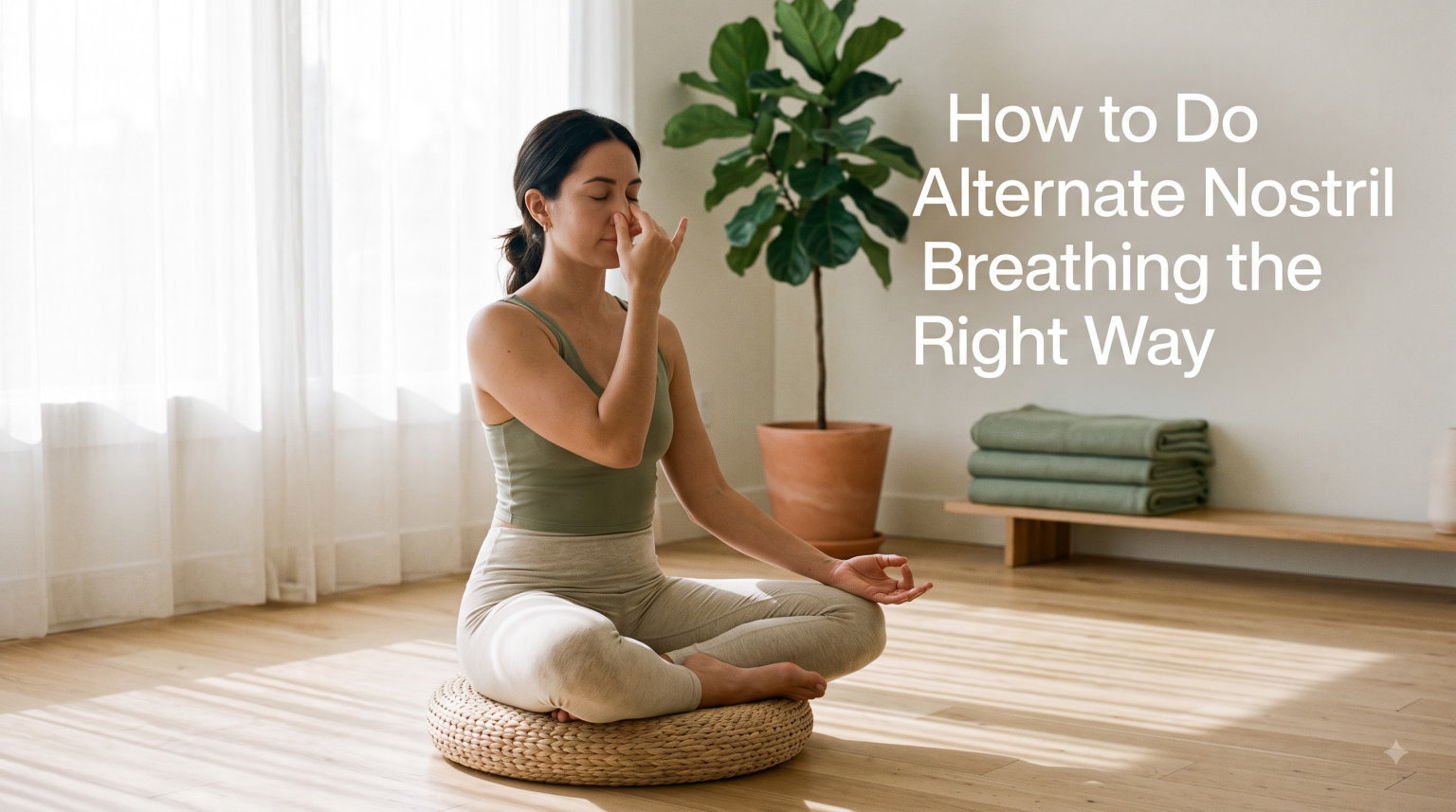
Alternate nostril breathing is one of the first pranayama techniques I teach my yoga students, and for good reason. In just five minutes, this simple practice can shift your entire nervous system from fight-or-flight into a calm, grounded state. I have watched anxious students walk into my studio with racing thoughts and leave ten minutes later visibly softer, their shoulders dropped, their breath steady.
Whether you are dealing with daily stress, trouble sleeping, or a scattered mind that refuses to settle for meditation, learning how to do alternate nostril breathing the right way gives you a portable tool you can use anywhere. No mat required, no special equipment, no prior yoga experience needed.
In this guide, I will walk you through everything I have learned over years of practicing and teaching this technique. We will cover the Sanskrit roots, the exact hand position, step-by-step instructions for both beginners and advanced practitioners, the science-backed benefits, common mistakes I see students make, and how to adapt the practice when things feel off.
Alternate nostril breathing, known in Sanskrit as Nadi Shodhana Pranayama, is a yogic breath control technique that involves gently alternating inhalation and exhalation between the left and right nostrils to balance the nervous system and clear subtle energy channels. By the end of this article, you will have everything you need to build a safe, consistent, and effective practice.
Table of Contents
What Is Nadi Shodhana? (Sanskrit Meaning and Origins)
Nadi Shodhana comes from three Sanskrit words that tell you exactly what the practice does. Nadi means “channel” or “flow,” referring to the subtle energy channels that carry prana (life force) throughout the body. Shodhana means “purification” or “cleansing.” And Pranayama is the yogic science of breath control. Put it all together and you get “the purification of the energy channels through breath control.”
The practice is rooted in classical yoga texts that date back centuries. The Hatha Yoga Pradipika, written in the 15th century by Swami Swatmarama, describes Nadi Shodhana as one of the eight classical pranayamas. The Gheranda Samhita, another foundational text, calls it the technique that cleanses all 72,000 nadis in the body. These texts did not view breathing as merely a physical act. They understood it as the bridge between body and mind, between the physical and the energetic.
To understand why this matters, it helps to know a bit about the yogic map of the body. According to yoga tradition, prana flows through a vast network of subtle energy channels called nadis. Three of these are considered primary: the ida nadi, the pingala nadi, and the sushumna nadi.
The ida nadi runs along the left side of the spine and is associated with cooling, lunar, feminine, and calming energy. The pingala nadi runs along the right side and is linked to heating, solar, masculine, and activating energy. The sushumna nadi runs through the center and represents balance, neutrality, and spiritual awakening.
Most of us spend our lives swinging between these two energies. We are either overstimulated (too much pingala) or sluggish and withdrawn (too much ida). Alternate nostril breathing is designed to bring these forces into equilibrium, clearing the path for prana to flow freely through the sushumna nadi. When that channel opens, yogic texts say the mind becomes still and meditation becomes effortless.
You do not need to believe in the energetic anatomy to benefit from the practice. The beauty of Nadi Shodhana is that it works on every level at once. Your nervous system calms, your breathing slows, and if you happen to be someone who is tuned into subtle energy, you feel that clearing too.
How to Do Alternate Nostril Breathing: Step-by-Step Instructions
This is the heart of the practice. I am going to break it down into three phases: preparation, the beginner version (without breath retention), and the advanced version (with kumbhaka). If you are new to pranayama, start with the beginner version and stay there for at least a few weeks before adding retention.
Phase 1: Preparation
Before you begin, find a quiet space where you will not be disturbed for 10 to 15 minutes. Sit on the floor with your legs crossed, or on a chair with your feet flat on the ground. Your spine should be tall but not rigid, your shoulders relaxed and rolled back, and your chin slightly tucked to lengthen the back of your neck.
Rest your left hand on your left knee with the palm facing up. You can keep it in Chin mudra (thumb and index finger touching) or simply leave the hand open and relaxed. This hand stays still throughout the entire practice.
Bring your right hand up to your face. You will be using a specific hand position called Vishnu mudra (also called Vishnu mudra or Mrigi mudra). Here is how to form it:
Fold your index and middle fingers down toward the palm of your right hand. Your thumb, ring finger, and pinky finger stay extended. You will use your thumb to gently close your right nostril and your ring finger to gently close your left nostril. The pinky rests alongside the ring finger for support.
Some people find this hand position awkward at first. That is completely normal. If your fingers will not fold comfortably, you can use an alternative: just use your thumb and ring finger normally, letting the other fingers rest however feels natural. The exact shape matters less than the function of opening and closing the nostrils.
Take a moment here to notice your natural breath. Do not try to change anything yet. Just observe the inhale and exhale, the rise and fall of your chest, the temperature of the air. This awareness is the foundation of all pranayama practice.
Phase 2: Beginner Practice (Without Breath Retention)
This version is perfect if you are just starting out. No breath holding, no counting ratios, no pressure. The goal is simply to breathe smoothly and evenly through alternating nostrils.
Step 1: Close your right nostril gently with your right thumb. Exhale completely through your left nostril. This exhale clears the space and sets your starting point.
Step 2: Still closing the right nostril, inhale slowly and smoothly through your left nostril. Count to four at a comfortable pace. The breath should feel effortless, not forced.
Step 3: Release your thumb from the right nostril and close the left nostril with your ring finger. Exhale slowly through your right nostril for a count of four.
Step 4: Keeping the left nostril closed, inhale through your right nostril for a count of four.
Step 5: Release the ring finger, close the right nostril with your thumb, and exhale through the left nostril for a count of four.
You have now completed one full round. The pattern is simple: inhale left, exhale right, inhale right, exhale left. Always start with a left-nostril exhale to set your starting point, and always finish each round with a left-nostril exhale.
Continue this pattern for 5 to 10 rounds. Each round includes two inhales and two exhales, so a single round takes about 30 to 40 seconds at a comfortable pace. Aim for a smooth, continuous breath with no jerking, no sound, and no strain. If your breath becomes ragged, slow down or take a break.
Keep your inhales and exhales equal in length. This 1:1 ratio is the foundation. Once you can maintain it comfortably for 10 rounds, you can begin extending your exhales to be slightly longer than your inhales (a 1:2 ratio), which deepens the calming effect.
Phase 3: Advanced Practice (With Kumbhaka and the 1:4:2 Ratio)
Once you have practiced the beginner version consistently for several weeks and your breath feels steady, you can introduce breath retention (kumbhaka). This is what distinguishes Nadi Shodhana from the simpler Anulom Vilom practice.
The classical ratio described in the Hatha Yoga Pradipika is 1:4:2. For every count of inhalation, you hold for four counts and exhale for two counts. For example, inhale for 4, hold for 16, exhale for 8. That is a challenging ratio, so start small.
Step 1: Close the right nostril with your thumb and exhale fully through the left nostril.
Step 2: Inhale through the left nostril for a count of 4.
Step 3: Close both nostrils (thumb on the right, ring finger on the left) and hold the breath gently for a count of 4 to 8. This is internal retention, called antar kumbhaka. Do not clamp down. Keep your throat, jaw, and belly soft.
Step 4: Release the thumb, keep the left nostril closed, and exhale through the right nostril for a count of 8.
Step 5: Inhale through the right nostril for a count of 4.
Step 6: Close both nostrils and hold for a count of 4 to 8.
Step 7: Release the ring finger, keep the right nostril closed, and exhale through the left nostril for a count of 8.
That is one complete round. The breath should remain smooth and silent throughout. If you feel any strain, dizziness, or urgency to gasp for air, your retention is too long. Shorten it immediately or drop back to the beginner practice.
Build up to the 1:4:2 ratio gradually over months, not days. Start with a 1:1:1 ratio (inhale 4, hold 4, exhale 4), then move to 1:2:1, then 1:2:2, and so on. Patience here is not optional. Rushing breath retention can trigger anxiety, lightheadedness, and even panic.
How Many Rounds and How Long Should You Practice?
This is one of the most common questions I hear, and the research gives us clear guidance. For beginners, 5 to 10 rounds (about 5 minutes) daily is plenty. For intermediate practitioners, 10 to 15 minutes per session is ideal. Advanced practitioners may work up to 20 to 30 minutes, but I rarely recommend going beyond that in a single sitting.
A 2017 study published in the Journal of Yoga and Physiotherapy found that practicing alternate nostril breathing for 30 minutes daily over four weeks produced significant improvements in cardiovascular function and stress markers. Another study from 2020 showed that even five minutes of the practice measurably reduced anxiety levels. More is not always better. Consistency beats intensity every time.
The best time to practice is early morning on an empty stomach, ideally before sunrise if your schedule allows. The second-best time is early evening, before dinner. Avoid practicing within two hours of eating a full meal. You can also use it as a midday reset when stress builds up at work.
If you are using alternate nostril breathing for sleep, practice 10 minutes before bed while lying down or sitting on the edge of your bed. The extended exhale activates the parasympathetic nervous system, signaling to your body that it is safe to rest.
Benefits of Alternate Nostril Breathing (Backed by Science)
The benefits of Nadi Shodhana go far beyond a few minutes of calm. Research over the past decade has shown that this practice produces measurable changes in the body and brain. I have grouped the benefits into three categories to make them easy to understand: physical, mental, and energetic.
Physical Benefits
Lower blood pressure: Multiple studies have shown that regular alternate nostril breathing practice reduces both systolic and diastolic blood pressure. A 2020 study found significant reductions after just four weeks of daily practice. The slow, rhythmic breathing stimulates the vagus nerve, which in turn activates the parasympathetic nervous system and allows blood vessels to relax.
Improved lung function: Pranayama practices like Nadi Shodhana train your respiratory muscles and increase your lung capacity. Research shows improvements in forced vital capacity (FVC), peak expiratory flow rate, and breath-holding time after consistent practice. This is particularly beneficial for people with mild respiratory conditions or those recovering from illness.
Cardiovascular health: Alternate nostril breathing improves heart rate variability (HRV), which is one of the best indicators of overall cardiovascular fitness. Higher HRV means your heart can adapt to stress and recover quickly. Regular practitioners often see resting heart rate drop over time as their nervous system becomes more resilient.
Better oxygenation: While the practice does not increase your oxygen saturation beyond normal levels, it does improve the efficiency of gas exchange in the lungs. Slow, diaphragmatic breathing allows more complete emptying and filling, which means each breath delivers more oxygen with less effort.
Mental and Emotional Benefits
Anxiety reduction: This is perhaps the best-documented benefit. Studies consistently show that alternate nostril breathing reduces symptoms of anxiety by activating the parasympathetic nervous system and lowering cortisol levels. I have seen this in my own students repeatedly. The structured, rhythmic pattern gives the mind something to focus on, which interrupts the spiral of anxious thoughts.
Enhanced focus and concentration: The practice requires enough attention to coordinate breath and hand position that your mind cannot simultaneously run through your to-do list. Regular practice strengthens sustained attention and working memory. Some users in the ADHD community report significant improvements in focus, with one Reddit user noting that a physician prescribed the technique to help manage ADHD symptoms.
Improved sleep: If you struggle with falling asleep, alternate nostril breathing can help. The extended exhale pattern triggers the relaxation response, slowing your heart rate and quieting mental chatter. Practicing for 10 minutes before bed can significantly reduce the time it takes to fall asleep and improve sleep quality.
Migraine relief: A notable study showed that practicing alternate nostril breathing three times daily for three months reduced migraine frequency and disability scores. Forum users echo this, with several reporting fewer and less severe migraines after establishing a daily practice. The mechanism likely involves the vagus nerve stimulation and stress reduction.
Energetic and Spiritual Benefits
Balancing the nadis: From a yogic perspective, the primary benefit of Nadi Shodhana is the purification and balancing of the ida and pingala nadis. When these two channels are in equilibrium, prana flows freely through the sushumna nadi. This creates a state of mental clarity and emotional stability that traditional texts describe as the gateway to deeper meditation.
Meditation preparation: I almost always begin my meditation sessions with five minutes of alternate nostril breathing. It works as a bridge between the active, external focus of daily life and the internal stillness of meditation. The practice settles the nervous system, balances the hemispheres of the brain, and gives the mind a single point of focus.
Vagus nerve stimulation: The vagus nerve is the longest cranial nerve in the body and is the main pathway of the parasympathetic nervous system. Slow, rhythmic nasal breathing stimulates the vagus nerve directly. This increases vagal tone, which is associated with better emotional regulation, reduced inflammation, and improved digestion. Modern science is essentially confirming what yogis have known for centuries.
Common Mistakes and How to Avoid Them
After years of teaching this practice, I see the same mistakes over and over. None of them are dangerous on their own, but they can make the practice uncomfortable or ineffective. Here are the most common ones and how to correct them.
1. Forcing the breath. This is the number one mistake I see. Students hear “slow your breath” and they clamp down, trying to stretch each inhale and exhale as long as possible. The result is tension, strain, and sometimes lightheadedness. Your breath should feel like silk, smooth and effortless. If you feel any strain, shorten your count. The depth will come naturally over time as your lung capacity improves.
2. Holding the breath too aggressively. In the advanced practice, kumbhaka should be gentle. You are not trying to see how long you can survive without air. You are creating a brief pause that allows the body to absorb the prana. If you feel urgency, panic, or the need to gasp when you release, you held too long. The retention should feel calm and comfortable, never desperate.
3. Using the wrong fingers or pressing too hard. The thumb and ring finger should rest lightly on the nostrils. You do not need to pinch hard or push the nose sideways. A gentle touch that creates a seal is all you need. If your arm gets tired, you can support your right elbow with your left hand.
4. Practicing on a full stomach. Pranayama should always be done on an empty stomach. Practicing after a meal can cause discomfort, nausea, and make diaphragmatic breathing difficult. Wait at least two hours after a light snack and three to four hours after a full meal.
5. Tensing the shoulders, jaw, and face. It is easy to unconsciously scrunch up your shoulders and tighten your jaw when concentrating on the breath. Check in periodically. Drop your shoulders away from your ears. Unclench your teeth. Soften the muscles around your eyes. The more relaxed your body, the more effective the practice.
6. Overdoing the duration. I see this especially with enthusiastic beginners. They read about the benefits and decide to do 30 or 45 minutes on day one. This is a recipe for frustration and even increased anxiety. As one Reddit user wisely warned, “30 to 60 minutes of alternate nostril breathing with breath holds sounds way over recommended dosages.” Start with 5 minutes and build gradually.
7. Pushing through a blocked nostril. If one nostril is completely blocked due to congestion, do not force it. See the section on precautions below for modifications. Forcing air through a blocked nostril creates pressure and can worsen congestion.
8. Expecting instant results. Some practitioners report feeling calmer after the very first session. Others feel nothing for the first week or two. A few even experience temporary increased anxiety as they become more aware of their breath. Give the practice at least two weeks of daily use before judging its effects.
Nadi Shodhana vs. Anulom Vilom: What Is the Difference?
These two terms are often used interchangeably, and for good reason. They are closely related practices that share the same basic technique of alternating breath between nostrils. But in traditional yoga texts, there is a meaningful distinction.
Anulom Vilom is the simpler version. It involves alternating inhalation and exhalation between the left and right nostrils without any breath retention. The ratio is typically 1:1 (equal inhale and exhale). This is what I described above as the beginner practice.
Nadi Shodhana is the more advanced version that includes breath retention (kumbhaka). The classical ratio is 1:4:2 (inhale for 1 count, hold for 4, exhale for 2). The retention is what makes it a “purification” practice rather than just a balancing one.
In everyday conversation and in most yoga classes in the West, people use the terms interchangeably. Most teachers teach Anulom Vilom but call it Nadi Shodhana. This is not wrong, exactly, but if you are studying classical yoga or pursuing yoga teacher training, it helps to know the distinction.
Here is a quick comparison to make the differences clear:
- Technique: Anulom Vilom is alternate nostril breathing without retention. Nadi Shodhana adds internal breath retention (antar kumbhaka).
- Ratio: Anulom Vilom uses a 1:1 or 1:2 inhale-to-exhale ratio. Nadi Shodhana uses the classical 1:4:2 ratio.
- Difficulty: Anulom Vilom is suitable for all levels, including complete beginners. Nadi Shodhana is for intermediate to advanced practitioners.
- Primary purpose: Anulom Vilom balances the nervous system and calms the mind. Nadi Shodhana purifies the nadis and prepares the body for deeper spiritual practices.
- Duration: Anulom Vilom can be practiced for longer periods (15 to 30 minutes). Nadi Shodhana with full retention is typically shorter (10 to 15 minutes) because the breath holds are demanding.
If you are new to pranayama, start with Anulom Vilom. Once that feels natural and your breath is steady, gradually introduce the retention of Nadi Shodhana. There is no rush. The practices build on each other.
As for whether there is any truth behind the nostril breathing claims, modern research is increasingly validating what yogic texts have taught for centuries. Studies on the nasal cycle (the natural alternating congestion and decongestion of the nostrils throughout the day) confirm that breathing through each nostril affects different sides of the brain. The practice is not mysticism. It is applied respiratory science.
Precautions and Contraindications
Alternate nostril breathing is generally safe for most people, but there are situations where you should modify the practice or avoid it entirely. Here is what you need to know.
High blood pressure: The beginner version (without breath retention) is generally safe and can actually help lower blood pressure over time. However, if you have uncontrolled or severe hypertension, avoid breath retention entirely. The holding phase can temporarily spike blood pressure. Consult your doctor before starting any new breathing practice.
Heart conditions: If you have a heart condition, especially arrhythmia or recent cardiac events, avoid kumbhaka. Stick to the simple alternate nostril pattern without any holding. As with any new practice, get clearance from your cardiologist first.
Respiratory conditions: People with asthma, COPD, or other respiratory conditions should approach the practice gently. Start with shorter sessions and never force the breath. If you feel any respiratory distress, stop immediately. The practice can be beneficial for lung function, but only when done with respect for your current capacity.
Pregnancy: The beginner version is safe and often helpful during pregnancy for managing stress and improving sleep. Avoid breath retention during pregnancy. Always check with your healthcare provider before starting pranayama while pregnant.
Nasal congestion and sinus issues: If one or both nostrils are blocked, do not force the practice. You can try practicing after a warm shower or using a neti pot to clear congestion. If the blockage persists, do a simplified version: visualize alternating the breath between nostrils without physically closing them. The mental focus alone can produce some of the calming benefits.
Anxiety and panic disorders: This is a nuanced one. While alternate nostril breathing helps many people with anxiety, a subset of practitioners (as reported in online forums) experience increased anxiety, especially when they add breath retention. If you have a history of panic attacks, start with the beginner version and keep your exhales longer than your inhales. If the practice ever makes you feel worse, stop. There is no one-size-fits-all approach to breathwork.
General safety rule: If you feel dizzy, lightheaded, nauseous, or panicky at any point during the practice, stop immediately. Return to your natural breath and rest. These symptoms mean you are pushing beyond your current capacity. There is no shame in stepping back. Safety always comes first.
A note on practicing with fevers, acute illness, or after recent surgery: wait until you have fully recovered. Pranayama requires energy, and your body needs that energy to heal.
Frequently Asked Questions
Does alternate nostril breathing work?
Yes, alternate nostril breathing has been shown in multiple studies to reduce stress, lower blood pressure, improve lung function, and decrease anxiety. Research from 2017 to 2026 confirms measurable changes in cardiovascular function and nervous system activity after consistent practice. Most people notice a calming effect within the first few sessions.
How long should you do alternate nostril breathing?
For beginners, 5 to 10 minutes (roughly 5 to 10 rounds) daily is ideal. Intermediate practitioners can aim for 10 to 15 minutes per session. Advanced practitioners may extend to 20 minutes. Consistency matters more than duration. Five minutes every day will produce better results than 30 minutes once a week.
Who should not do Nadi Shodhana?
People with uncontrolled high blood pressure, severe heart conditions, recent abdominal surgery, or active respiratory infections should avoid Nadi Shodhana or consult a doctor first. Pregnant women should skip breath retention. Anyone experiencing dizziness, anxiety, or discomfort should stop immediately.
Is alternate nostril breathing good for sinuses?
Alternate nostril breathing can improve nasal airflow over time and may help with mild congestion. However, if one nostril is fully blocked, do not force the practice. Try it after a warm shower or saline rinse. The practice does not cure sinus infections but can support overall respiratory health when done regularly.
Is alternate nostril breathing good for anxiety?
Yes, alternate nostril breathing is one of the most effective pranayama techniques for anxiety relief. Studies show it activates the parasympathetic nervous system and lowers cortisol. However, a small number of people experience increased anxiety, especially with breath retention. Start with the beginner version and longer exhales if you are anxiety-prone.
How long can one do alternate nostril breathing safely?
Most people can safely practice 5 to 15 minutes daily on a long-term basis. Advanced practitioners may do up to 20 to 30 minutes, but going beyond that regularly is unnecessary and can cause fatigue. Always practice on an empty stomach and stop if you feel any discomfort or dizziness.
Is there any truth behind the nostril breathing claim?
Yes. Modern research confirms that the nasal cycle naturally alternates airflow between nostrils throughout the day, and breathing through each nostril affects different hemispheres of the brain. Studies show alternate nostril breathing improves heart rate variability, reduces blood pressure, and changes brain wave patterns. The traditional claims about balancing energy channels align with measurable physiological effects.
Bringing It All Together
Learning how to do alternate nostril breathing the right way is not about achieving a perfect ratio or holding your breath for some impressive number of counts. It is about building a simple, daily relationship with your breath that steadies your mind and calms your body.
Start with five minutes a day. Use the beginner version without retention. Keep your breath smooth, your shoulders relaxed, and your expectations realistic. Over time, the practice will meet you wherever you are, whether that is a stressful morning at work, a sleepless night, or a moment when you just need to come back to yourself.
The ancient yogis who developed Nadi Shodhana understood something that modern science is only now catching up to. Your breath is the most powerful tool you have for regulating your nervous system. It is always with you, always free, and always available. All you have to do is breathe.